Why Tesla Model 3 Dyno Numbers Matter for Buyers
Marketing horsepower figures are measured at the motor — but what actually reaches the wheels tells a different story. For the 2025-2026 Tesla Model 3 lineup (RWD, Long Range AWD, and Performance), independent dyno testing has revealed consistent patterns about how Tesla's powertrains deliver in the real world. This profile pulls together dyno-verified performance data, EPA range figures, charging benchmarks, and ownership economics to give you a complete, numbers-driven picture of America's best-selling electric sedan.
Whether you're comparing the Model 3 against the Hyundai Ioniq 6, BMW i4, or Polestar 2, dyno data cuts through marketing claims and shows you exactly what you're getting at the wheels.
Model 3 Dyno-Verified Performance: Wheel HP vs. Crank HP
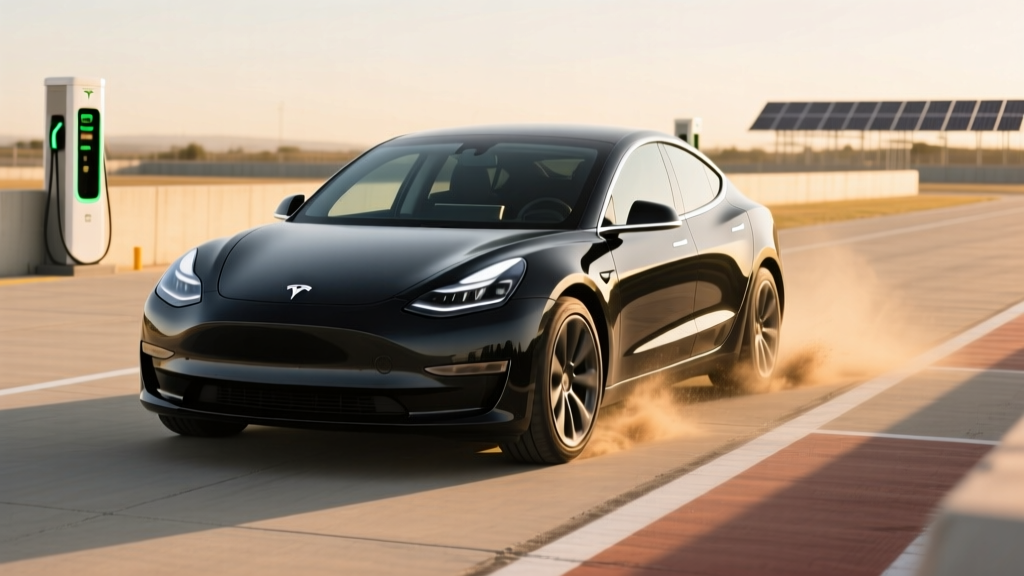
Independent chassis dynamometer testing (notably by outlets like EV drag racing channels and automotive dyno shops) consistently shows Tesla's wheel horsepower numbers landing close to — and sometimes slightly above — Tesla's conservative crank ratings. Here's what the data shows across the current Model 3 trims:
| Trim | Drivetrain | Tesla-Rated HP (crank) | Dyno Wheel HP (avg) | Torque (lb-ft) | 0-60 mph | Top Speed |
|---|---|---|---|---|---|---|
| Model 3 RWD | Rear-Wheel Drive | 271 hp | ~250-260 whp | 317 | 5.8 sec | 125 mph |
| Long Range AWD | Dual-Motor AWD | 346 hp | ~320-340 whp | 389 | 4.2 sec | 125 mph |
| Performance | Dual-Motor AWD | 510 hp | ~480-500 whp | 546 | 2.9 sec | 163 mph |
The gap between crank-rated and wheel-measured horsepower typically runs 5-8%, which is remarkably efficient for an EV drivetrain. Internal combustion engines often lose 15-20% through the drivetrain. Tesla's single-speed reduction gear and integrated drive units minimize parasitic loss — and dyno results confirm this engineering advantage.
EPA Range vs. Real-World Range: What Dyno Efficiency Data Reveals
Dyno testing doesn't just measure peak power — it can simulate driving cycles to validate energy consumption. When we pair dyno-derived efficiency data with real-world highway and cold-weather testing, the picture becomes clearer than any EPA sticker alone.
EPA Estimated: 341 miles
Real-World Highway (70-75 mph, 72°F): ~290-310 miles
Real-World City (mixed stop-go, regen active): ~320-335 miles
Cold Weather (25°F, highway, heater on): ~230-260 miles
Cold weather reduces range 20-30% due to battery chemistry resistance and cabin heating demand. The Model 3's heat pump (standard since the Highland refresh) mitigates this compared to resistive heaters, but physics still applies.
| Trim | EPA Range | Battery (usable kWh) | Chemistry | MPGe (combined) | kWh/100mi |
|---|---|---|---|---|---|
| RWD | 272 mi | ~57.5 kWh | LFP (CATL) | 132 MPGe | 25 |
| Long Range AWD | 341 mi | ~75 kWh | NMC (Panasonic) | 134 MPGe | 25 |
| Performance | 315 mi | ~75 kWh | NMC (Panasonic) | 121 MPGe | 28 |
What this means for you: The RWD's LFP battery trades energy density for longevity and lower cost — it can be charged to 100% daily without accelerated degradation, unlike the NMC packs in the Long Range and Performance trims (Tesla recommends 80% daily charge for NMC). If your commute is under 50 miles round-trip and you want a battery that'll outlast the car, the RWD with LFP is the durability play.
Charging Speed: DC Fast Charge and Home Level 2 Benchmarks
Charging speed is where dyno-adjacent efficiency data matters — a car that consumes fewer kWh per mile effectively charges "faster" in terms of miles added per minute at the plug. Here's the full charging picture:
| Charge Type | RWD (LFP) | Long Range AWD | Performance |
|---|---|---|---|
| Max DC Fast Charge | 170 kW | 250 kW | 250 kW |
| 10-80% DC Time | ~25 min | ~18-22 min | ~18-22 min |
| Level 2 Home (11.5 kW / 48A) | ~30 mi/hr | ~44 mi/hr | ~44 mi/hr |
| Level 1 (120V / 12A) | ~3 mi/hr | ~4 mi/hr | ~4 mi/hr |
| Connector | NACS (native) | NACS (native) | NACS (native) |
Charging curve reality: The Long Range and Performance trims peak at 250 kW but only sustain that rate between roughly 10-30% State of Charge. From 30-60%, expect ~170-200 kW. Above 80%, the rate drops sharply to protect the battery — a 10-90% charge takes closer to 35-40 minutes. Plan your road trips around 10-80% stops for optimal time efficiency.
The RWD's lower peak DC rate (170 kW) is a trade-off of the LFP chemistry, but for a car with 272 miles of range, most daily charging happens at home on Level 2, where the difference is negligible — both trims add a full overnight charge in 6-8 hours on a 48-amp Wall Connector.
Per fueleconomy.gov, the Model 3 Long Range achieves 134 MPGe combined, making it one of the most efficient vehicles in its class regardless of powertrain type.
Pricing, Trims & Federal Tax Credit Eligibility
The Model 3's value proposition depends heavily on which trim you choose and whether you qualify for the §30D federal clean vehicle credit. Here's the current pricing landscape:
| Trim | Base MSRP | As-Tested (typical) | §30D Credit Eligibility | Effective Price (if eligible) |
|---|---|---|---|---|
| RWD | $38,990 | $39,990 | Up to $7,500 | ~$31,490-$32,490 |
| Long Range AWD | $45,990 | $47,490 | Up to $7,500 | ~$38,490-$39,990 |
| Performance | $52,990 | $54,990 | Up to $7,500 | ~$45,490-$47,490 |
- MSRP Cap: Sedans must be under $55,000 MSRP — the Performance trim at $52,990 base qualifies, but options can push it over. Verify your exact build.
- Income Cap: Modified AGI must not exceed $150,000 (single), $225,000 (head of household), or $300,000 (joint).
- Battery Sourcing: The full $7,500 requires meeting both critical-mineral and battery-component sourcing requirements. Tesla's supply chain has shifted — check the latest IRS qualified vehicle list before purchasing, as eligibility can change quarterly.
- Point-of-Sale Transfer: You can transfer the credit to Tesla at purchase for an immediate price reduction rather than waiting for tax filing.
Interior, Cargo & Daily Livability
The refreshed Model 3 (internally called "Highland") improved cabin insulation, ride quality, and materials — but the fundamental dimensions remain compact-sedan territory.
- Front Legroom: 42.7 inches
- Rear Legroom: 35.2 inches (tight for tall passengers)
- Cargo Volume (trunk): 21.0 cu ft
- Frunk (front trunk): 3.1 cu ft
- Total Cargo: 24.1 cu ft (less than a Model Y's 30.2 cu ft behind the second row)
The 15.4-inch center touchscreen controls virtually everything — there are no physical buttons for climate, mirrors, or glovebox. Rear passengers get their own 8-inch screen for climate and entertainment on Long Range and Performance trims. Ventilated front seats and ambient lighting were added in the Highland refresh.
Notable drawbacks: Rear visibility is compromised by the sloping roofline and lack of a rear wiper. The minimalist interior isn't for everyone — if you prefer physical controls, test-drive before committing. Turn signals on the steering wheel (rather than a stalk) remain controversial.
Driver Assistance, Tech & Safety
Tesla's Autopilot (standard) and Full Self-Driving Supervised ($8,000 option) are SAE Level 2 driver-assistance systems. You must keep your hands on the wheel and eyes on the road at all times. The car does not drive itself. Only Level 4 robotaxi services (Waymo, Zoox) operate without a human driver in defined areas.
Standard Tech:
- Autopilot (adaptive cruise + lane centering)
- Tesla Vision (camera-only, no radar or ultrasonic sensors)
- Over-the-air software updates
- Sentry Mode (360° parking surveillance)
- Dashcam recording
- Netflix, YouTube, and gaming on the center screen (while parked)
Safety Ratings: The Model 3 earned a 5-star overall rating from NHTSA and a Top Safety Pick+ designation from IIHS, with top marks in all crashworthiness categories.
Warranty, Ownership Costs & Who Should Buy
| Component | Coverage |
|---|---|
| Basic Vehicle | 4 years / 50,000 miles |
| Battery & Drive Unit (RWD) | 8 years / 100,000 miles (70% minimum retention) |
| Battery & Drive Unit (LR/Perf) | 8 years / 120,000 miles (70% minimum retention) |
5-Year Ownership Snapshot (Long Range AWD, 15,000 mi/yr):
- Electricity cost: ~$2,700 (at $0.14/kWh national average)
- Comparable gas car fuel: ~$7,500 (at $3.50/gal, 28 MPG)
- Maintenance savings: No oil changes, minimal brake wear (regen), no transmission fluid
- Insurance: Expect 15-25% higher premiums than a comparable gas sedan — Tesla's repair costs drive this
- Depreciation: Model 3 retains ~50-55% value at 5 years (varies with market and mileage)
- Tech-forward commuters wanting minimal maintenance
- Home-charging-capable drivers (garage or driveway)
- Road-trippers who value the Supercharger network
- Performance seekers (Performance trim rivals sports cars at sedan prices)
- You need spacious rear seating (consider Model Y or Ioniq 5)
- You prefer physical buttons and traditional interfaces
- You lack home charging access (apartment/condo without EVSE)
- You want maximum cargo versatility for family gear
Frequently Asked Questions
What does a Tesla Model 3 put down on a dyno?
Independent dyno testing typically shows the Model 3 Long Range AWD producing 320-340 wheel horsepower and the Performance variant hitting 480-500 whp. The RWD single-motor posts around 250-260 whp. These figures represent a 5-8% drivetrain loss from Tesla's crank-rated numbers — significantly better than the 15-20% loss typical in internal combustion vehicles.
What is the real-world range of the Tesla Model 3?
The Long Range AWD's EPA rating is 341 miles, but expect 290-310 miles at sustained highway speeds (70-75 mph) and as low as 230-260 miles in cold weather (below 30°F). The RWD's 272-mile EPA rating translates to roughly 230-245 miles highway. City driving with regenerative braking recovers energy and often matches or exceeds EPA estimates.
How fast does the Model 3 charge at home and on the road?
On DC fast charging, the Long Range and Performance peak at 250 kW, reaching 10-80% in approximately 18-22 minutes. The RWD peaks at 170 kW with a 10-80% time around 25 minutes. At home on a Level 2 Wall Connector (11.5 kW / 48 amps), the Long Range adds about 44 miles of range per hour — a full overnight charge in 6-8 hours.
Does the Tesla Model 3 qualify for the $7,500 federal tax credit?
All three trims fall under the $55,000 MSRP cap for sedans. However, full $7,500 eligibility depends on your income (under $150K single / $300K joint), battery-sourcing compliance, and the vehicle appearing on the current IRS qualified list. The point-of-sale transfer option lets you apply the credit as an immediate discount at purchase. Always verify current eligibility at irs.gov before ordering.
Is the Model 3 worth it vs. the Ioniq 6, BMW i4, or Polestar 2?
The Model 3 wins on Supercharger network access, software ecosystem, and efficiency (134 MPGe). The Hyundai Ioniq 6 offers a smoother ride and more rear legroom at a similar price. The BMW i4 provides a more traditional luxury interior and physical controls. The Polestar 2 is stylish but trails on range. If home charging is available and you value over-the-air updates and the Supercharger network, the Model 3 remains the segment benchmark — but test-drive competitors before committing.