Why the Tesla Model 3 Door Handle Gets So Much Attention
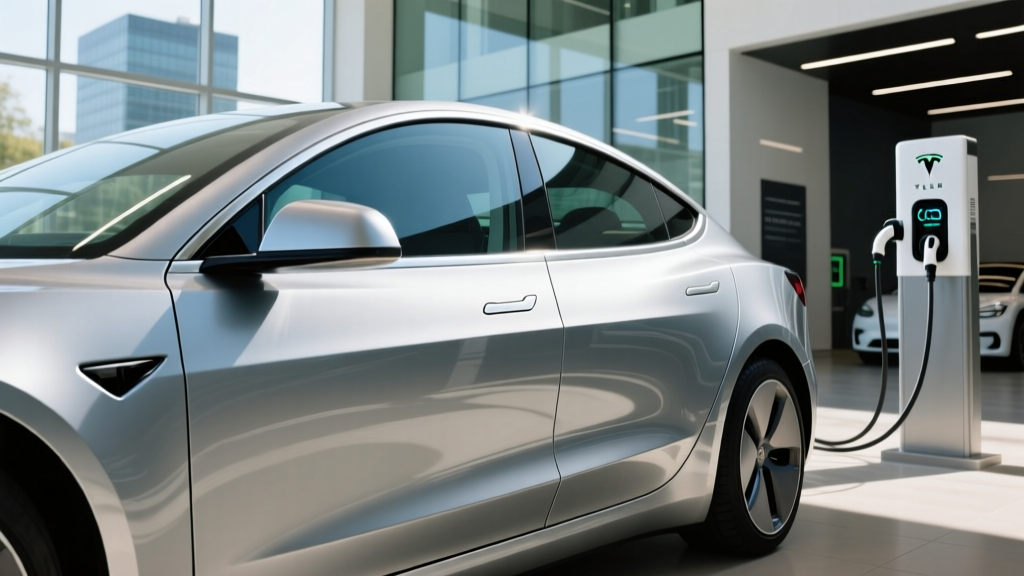
If you have ever searched for a Tesla door handle tutorial on YouTube, you are not alone. The flush, electronic door handles on the Tesla Model 3 (and Model Y) are among the most searched exterior features in the EV space. They sit completely flat against the body panel, reducing aerodynamic drag and giving the car its seamless silhouette — but they also require a brief learning curve for first-time passengers, valets, and rideshare riders.
This review covers the full 2026 Tesla Model 3 lineup — including how the door handle system works in practice — alongside the data that actually matters for buyers: EPA range, real-world efficiency, DC fast-charging curves, battery chemistry, pricing after federal tax credits, and how it stacks up against the Hyundai Ioniq 6 and BMW i4.
How Tesla's Flush Door Handles Actually Work
The Tesla Model 3 uses an electronic push-button door handle system. From the outside, you press the wide end of the handle with your thumb, and the narrow end pivots out toward you — pull it to open. With the key fob or phone-as-key nearby, the car auto-presents the handle on approach (if enabled in settings). From the inside, a button on the door panel electronically releases the latch.
Tesla also includes a mechanical emergency release inside each door — a small pull tab located near the window switch cluster — in case the 12V auxiliary system loses power. This is critical to know, especially for child safety and emergency responder training.
The aerodynamic benefit is real: flush handles contribute to the Model 3's class-leading 0.219 Cd drag coefficient, directly improving highway efficiency and range.
2026 Tesla Model 3: Full Spec Breakdown
| Spec | RWD (Base) | Long Range AWD | Performance |
|---|---|---|---|
| EPA Range | 272 mi | 341 mi | 315 mi |
| Battery (usable) | ~57.5 kWh (LFP) | ~75 kWh (NMC) | ~75 kWh (NMC) |
| Drivetrain | Rear-Wheel Drive | Dual-Motor AWD | Dual-Motor AWD |
| Horsepower | 271 hp | 346 hp | 510 hp |
| 0–60 mph | 5.8 sec | 4.2 sec | 2.9 sec |
| MPGe (combined) | 132 MPGe | 124 MPGe | 116 MPGe |
| Efficiency | 25 kWh/100 mi | 27 kWh/100 mi | 29 kWh/100 mi |
| Peak DC Charge Rate | 170 kW | 250 kW | 250 kW |
| 10–80% DC Time | ~28 min | ~25 min | ~25 min |
| Level 2 Home Rate | 11.5 kW (~44 mi/hr) | 11.5 kW (~44 mi/hr) | 11.5 kW (~44 mi/hr) |
| Cargo Volume | 23 cu ft (trunk + frunk combined) | ||
| Rear Legroom | 35.3 in | ||
| Battery Warranty | 8 yr / 100,000 mi | 8 yr / 120,000 mi | |
| Base MSRP | $38,990 | $45,990 | $53,990 |
Source: fueleconomy.gov and Tesla's official 2026 specs. Prices exclude destination fee.
Real-World Range: What the EPA Sticker Doesn't Tell You
EPA Sticker: 341 miles (Long Range AWD)
Real-World Expectation: ~280–310 miles on mixed highway driving at 70–75 mph. In winter conditions (below 30°F), expect a 15–30% reduction, bringing usable range to roughly 240–270 miles. City driving with regenerative braking can match or slightly exceed the EPA figure in mild weather.
The Model 3 Long Range AWD remains one of the most efficient sedans in the EV market at 27 kWh per 100 miles. The LFP-equipped RWD model is slightly more efficient per mile but carries a smaller battery, trading range for a lower entry price. LFP chemistry also allows routine charging to 100% without degradation concerns — a meaningful daily-use advantage over NMC, which Tesla recommends charging to 80% for daily use.
Charging Speed: DC Fast, Level 2, and Home Setup
| Charging Level | Power | Speed | Best For |
|---|---|---|---|
| Level 1 (120V) | ~1.4 kW | ~3–5 mi/hr | Emergency / overnight trickle |
| Level 2 (240V home) | 11.5 kW max | ~44 mi/hr | Daily home charging |
| DC Fast (Supercharger) | 170–250 kW peak | 10–80% in ~25 min | Road trips |
Tesla's Supercharger network remains the most reliable public charging infrastructure in North America. The Model 3 Long Range and Performance peak at 250 kW at V3 and V4 Superchargers, though sustained rates taper significantly above 60% state of charge — a typical lithium-ion charge curve reality. Expect roughly 150 kW average from 10–80%, not the full 250 kW for the entire session.
With the Model 3's native NACS connector, you access Superchargers directly. Third-party networks (Electrify America, EVgo) require no adapter on newer NACS-equipped public chargers, and Tesla includes a CCS adapter in the glovebox for legacy CCS stations.
Home charging note: A full Level 2 installation on a 60-amp circuit (48-amp continuous) delivers the car's maximum 11.5 kW acceptance rate. Budget $800–$2,000 for a licensed electrician to install a NEMA 14-50 outlet or hardwired Tesla Wall Connector, plus $200–$500 if your panel needs upgrading to 200A service. Always consult a licensed electrician for final specs.
Pricing, Trims, and Federal Tax Credit Eligibility
| Trim | Base MSRP | Est. After §30D Credit* | Dest. Fee |
|---|---|---|---|
| RWD | $38,990 | ~$31,490 | $1,390 |
| Long Range AWD | $45,990 | ~$38,490 | $1,390 |
| Performance | $53,990 | ~$46,490 | $1,390 |
*Estimates assume full $7,500 federal tax credit eligibility under IRS §30D. Actual eligibility depends on buyer income, battery sourcing, and MSRP caps. As of 2026, the point-of-sale transfer option allows dealers to apply the credit directly at purchase.
Federal Tax Credit Checklist (IRS §30D, 2026 Rules)
- MSRP cap: Sedans must be ≤ $55,000 — the RWD and Long Range qualify; the Performance trim at $53,990 also qualifies before options push it over.
- Buyer income cap: AGI must not exceed $150,000 (single), $225,000 (head of household), or $300,000 (joint filers).
- Battery sourcing: A percentage of critical minerals and battery components must be sourced from the U.S. or FTA partners. Tesla's domestic battery production (including 4680 cells from Giga Texas) positions the Model 3 well, but verify current-year compliance on IRS.gov before purchasing.
- Point-of-sale transfer: You can transfer the credit to the dealer at purchase, reducing your out-of-pocket cost immediately — no need to wait for tax filing.
Consult a tax professional to confirm your personal eligibility. State and local incentives vary by jurisdiction and may stack on top of the federal credit.
Tech, Interior, and Driver Assistance
The 2026 Model 3 "Highland" refresh interior carries over its minimalist 15.4-inch center touchscreen with no physical instrument cluster — all driving data lives on the left edge of the display. Rear passengers get an 8-inch screen for climate and media controls.
Autopilot and FSD (Supervised): Tesla's Autopilot (standard) includes adaptive cruise and lane centering. Full Self-Driving (Supervised), available as a $8,000 option or $99/month subscription, adds automated lane changes, traffic light recognition, and city-street navigation.
SAE Automation Level: Level 2. Both Autopilot and FSD (Supervised) require continuous driver attention and hands-on-wheel supervision. They are not self-driving systems. Only Level 4 robotaxi services (e.g., Waymo) operate without a human driver.
Notable features: Cabin overheat protection, sentry mode, dog mode, HEPA air filtration, and over-the-air software updates that periodically add features. The ventilated front seats and ambient lighting added in the Highland refresh address prior comfort complaints.
Drawbacks: No physical buttons for climate or mirrors (all screen-controlled), no Apple CarPlay or Android Auto, turn signals are on the steering wheel (not a stalk) in the refreshed model, and the all-glass roof can increase cabin heat in summer despite UV tinting.
Tesla Model 3 vs. Key Competitors
| Spec | Tesla Model 3 LR | Hyundai Ioniq 6 SE LR | BMW i4 eDrive40 |
|---|---|---|---|
| EPA Range | 341 mi | 361 mi | 307 mi |
| Starting MSRP | $45,990 | $42,750 | $57,900 |
| Peak DC Charge | 250 kW | 233 kW | 205 kW |
| 10–80% Time | ~25 min | ~18 min (800V) | ~31 min |
| 0–60 mph | 4.2 sec | 5.1 sec | 5.5 sec |
| Connector | NACS (native) | CCS1 | CCS1 |
| §30D Credit | Likely eligible | Eligibility varies | Not eligible (MSRP cap / sourcing) |
The Ioniq 6 beats the Model 3 on EPA range and DC charging speed (thanks to its 800V architecture), but the Tesla's Supercharger network access, software ecosystem, and stronger resale value remain significant ownership advantages. The BMW i4 offers a more traditional luxury interior but at a steep premium and without federal credit eligibility.
Who Should Buy the 2026 Tesla Model 3?
Choose the Model 3 if:
- You want access to the Tesla Supercharger network without adapters
- Software features (OTA updates, Sentry Mode, app integration) matter to you
- You value efficiency and range per dollar in the mid-$30K–$45K price bracket
- You are comfortable with a screen-centric, minimalist interior
Look elsewhere if:
- You need maximum rear-seat space for car seats or tall passengers (consider Model Y or Ioniq 5)
- You prefer physical buttons and Apple CarPlay (consider Hyundai/Kia EVs)
- You want the fastest possible DC charging (Ioniq 6's 800V system is quicker)
- You need a hatchback cargo layout (Model 3 is a traditional trunk)
Pros and Cons at a Glance
Pros
- Class-leading efficiency (27 kWh/100 mi) and real-world range
- Supercharger network access — most reliable DC charging in North America
- Strong software, OTA updates, and mobile app integration
- Flush door handles and 0.219 Cd for sleek aerodynamics
- LFP battery on RWD allows 100% daily charging without degradation worry
- Federal §30D tax credit eligibility on most trims
Cons
- Screen-only controls for climate, mirrors, and glovebox frustrate some drivers
- No Apple CarPlay or Android Auto
- Door handles require explanation for passengers and valets
- Highway and cold-weather range loss still significant (15–30%)
- Rear seat is tighter than crossover competitors
- Insurance costs above segment average
Frequently Asked Questions
What is the real-world range of the 2026 Tesla Model 3?
The Long Range AWD carries a 341-mile EPA estimate. In real-world mixed highway driving at 70–75 mph, expect 280–310 miles in mild weather and 240–270 miles in freezing temperatures. The RWD model's 272-mile EPA figure translates to roughly 225–250 miles on the highway.
How fast does the Model 3 charge at home and on road trips?
At home on a 240V Level 2 charger (48 amps), the Model 3 accepts up to 11.5 kW, adding roughly 44 miles of range per hour — a full overnight session easily replenishes a depleted battery. On DC fast chargers, the Long Range and Performance models peak at 250 kW, reaching 10–80% in approximately 25 minutes at a V3 or V4 Supercharger. The RWD model peaks at 170 kW.
How much does the Tesla Model 3 cost after federal tax credits?
The RWD starts at $38,990 and can drop to approximately $31,490 after the full $7,500 §30D credit, assuming you meet income limits and the vehicle meets battery-sourcing requirements. The Long Range AWD falls to roughly $38,490. Verify current eligibility at IRS.gov before purchasing.
Does the 2026 Model 3 qualify for the federal EV tax credit?
The Model 3 RWD and Long Range AWD have historically qualified for the full $7,500 credit under IRS §30D, given their MSRP falls below the $55,000 sedan cap and Tesla's North American battery sourcing. The Performance trim at $53,990 also qualifies before destination and options. However, eligibility depends on your income (AGI caps apply) and current-year critical mineral and battery component rules, which can shift. Always check the latest IRS guidance or consult a tax professional.
Is the Tesla Model 3 worth buying vs. the Hyundai Ioniq 6 or BMW i4?
The Model 3 wins on Supercharger network access, software features, and price-to-range value. The Ioniq 6 offers more EPA range (361 mi) and faster 800V DC charging (10–80% in ~18 min) at a similar price, but relies on third-party charging networks. The BMW i4 delivers a more premium cabin but costs significantly more and may not qualify for the federal credit. If charging convenience and software ecosystem are priorities, the Model 3 remains the benchmark.
Are Tesla's electronic door handles reliable?
Tesla's flush door handles on the Model 3 are electronically actuated and generally reliable in daily use. They include a mechanical emergency release inside the cabin. In extreme cold (below 0°F), ice can occasionally prevent the handle from presenting — Tesla recommends using the Tesla app to precondition the cabin, which thaws the mechanisms. Replacement cost out of warranty is approximately $250–$400 per handle including labor.
What is the battery warranty on the 2026 Model 3?
The RWD model carries an 8-year/100,000-mile battery and drive unit warranty. The Long Range and Performance trims extend that to 8 years/120,000 miles. Tesla warrants that the battery will retain at least 70% of its original capacity during the warranty period. Real-world degradation data from Tesla's fleet shows most Model 3 batteries retain approximately 85–90% capacity after 100,000 miles, per Tesla's 2025 Impact Report.