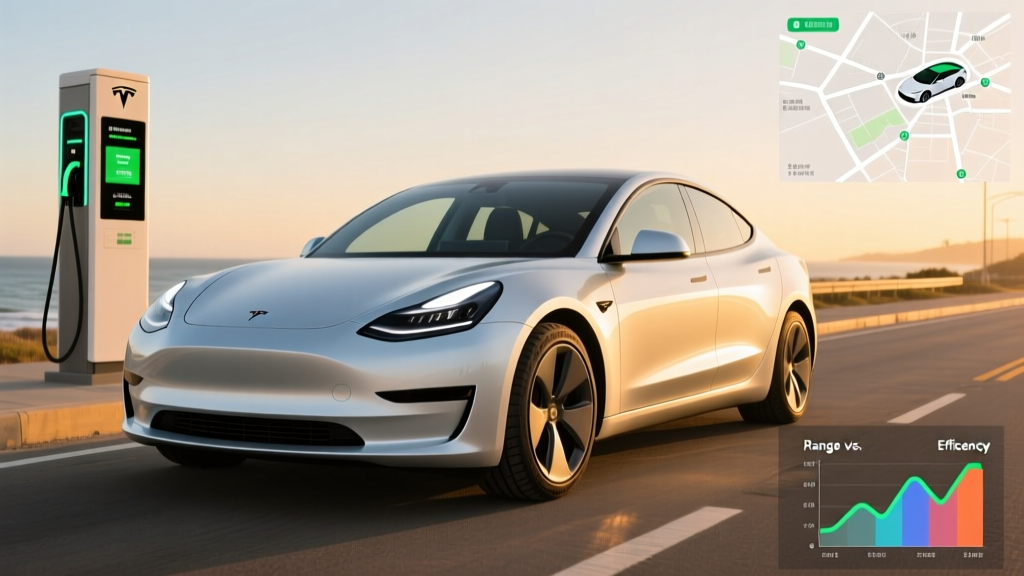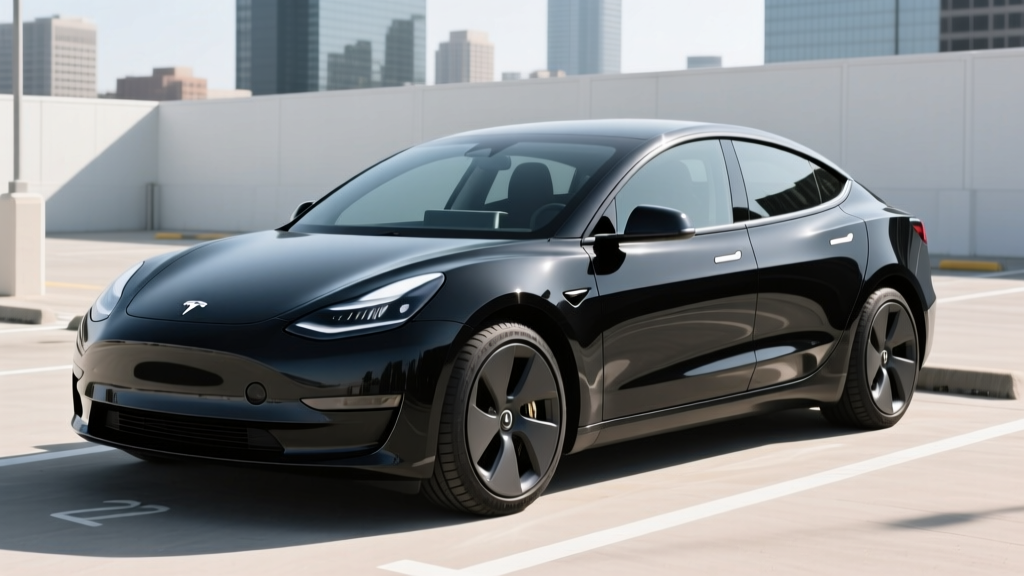
Quick Verdict: The Benchmark Sedan Still Sets the Bar
The Tesla Model 3 Highland refresh brought meaningful improvements to ride quality, cabin noise, and interior materials — and the 2026 model year carries those gains forward with minor software and packaging tweaks. For buyers researching every aspect of the Model 3 dimension profile, efficiency, and daily usability, this remains the compact electric sedan to beat on range-per-dollar and charging infrastructure access. It is not perfect: the minimalist interior frustrates some, rear headroom is tight for taller passengers, and the all-screen interface demands a learning curve. But measured against rivals like the Hyundai Ioniq 6, BMW i4, and Polestar 2, the Model 3's combination of EPA range, Supercharger network access, and software polish keeps it at the top of the segment.
| Spec | Standard Range (RWD) | Long Range (AWD) | Performance (AWD) |
|---|---|---|---|
| EPA Range | 272 mi | 363 mi | 315 mi |
| Battery (usable) | ~60 kWh (LFP) | ~82 kWh (NMC) | ~82 kWh (NMC) |
| Peak DC Fast Charge | 170 kW | 250 kW | 250 kW |
| 10–80% DC Time | ~25 min | ~22 min | ~22 min |
| Level 2 (11.5 kW) | ~44 mi/hr | ~44 mi/hr | ~44 mi/hr |
| 0–60 mph | 5.8 sec | 4.2 sec | 2.9 sec |
| Horsepower | 283 hp | 384 hp | 510 hp |
| Drivetrain | RWD | Dual-Motor AWD | Dual-Motor AWD |
| MPGe (combined) | 132 MPGe | 134 MPGe | 115 MPGe |
| kWh/100 mi | 25 | 25 | 29 |
| Base MSRP | $38,990 | $47,740 | $54,990 |
Source: EPA fueleconomy.gov and Tesla spec sheets. Prices reflect 2026 MSRP before destination or incentives.
Real-World Range: What the EPA Number Doesn't Tell You
EPA Sticker: 363 miles (Long Range AWD)
Real-World Highway (65–75 mph, 70°F): ~290–320 miles
Cold Weather (30°F, highway): ~230–260 miles
City / Suburban Mixed: ~340–360 miles (regen-friendly)
The Long Range AWD's 363-mile EPA figure is legitimate under mixed driving conditions, and Tesla's powertrain efficiency (25 kWh/100 mi) is among the best in any EV on sale. However, sustained highway speeds above 70 mph cut range by roughly 15–20% compared to the sticker. Cold weather compounds this: in temperatures below freezing, expect a 25–35% reduction if you're not preconditioning the battery.
The Standard Range RWD model, with its ~60 kWh LFP battery, delivers 272 EPA miles. Real-world highway driving yields approximately 215–240 miles. For commuters with predictable routes and home charging, this is ample. For road-trippers, the Long Range is the clear upgrade.
The LFP chemistry in the Standard Range model has an important ownership implication: Tesla recommends charging to 100% regularly to maintain cell balancing, whereas the NMC packs in Long Range and Performance trims are best kept at 80% daily for longevity. This means the Standard Range's effective daily range (272 mi) is actually closer to its sticker, while the Long Range's effective daily range at 80% SoC is approximately 290 miles.
Charging Speed: Home, Destination, and DC Fast Charging
Charging speed is measured in kW (power — how fast energy flows) while battery capacity is measured in kWh (energy — how much the battery holds). The Model 3's onboard charger accepts up to 11.5 kW on Level 2 AC, and up to 250 kW on DC fast charging (Long Range/Performance).
| Level | Power | Connector | Speed (mi/hr) | Notes |
|---|---|---|---|---|
| Level 1 (120V) | ~1.4 kW | NACS (native) / J1772 adapter | ~3–5 mi/hr | Emergency/trickle only |
| Level 2 (240V, 48A) | 11.5 kW | NACS / Wall Connector | ~44 mi/hr | Full overnight charge in 7–9 hr |
| DC Fast (V3 Supercharger) | Up to 250 kW | NACS (native) | ~1,000+ mi/hr peak | 10–80% in ~22 min (LR) |
| DC Fast (V4 Supercharger) | Up to 250 kW | NACS | Same as V3 for Model 3 | Model 3 cannot exceed 250 kW peak |
Charging curve reality: The Model 3 Long Range peaks near 250 kW only between roughly 10–30% state of charge. Above 50%, the rate tapers significantly — often dropping below 100 kW past 70%. This is why Tesla (and most EV makers) quote 10–80% times rather than 0–100%. Charging from 80–100% on DC fast charging can add another 20–30 minutes and is rarely worth the time at a road-trip stop.
For home charging, a Tesla Wall Connector on a 60-amp circuit delivers the full 11.5 kW (48A continuous). Expect a full charge from 10% in about 7 hours for the Long Range. Installation costs vary widely — budget $500–$2,000 depending on panel proximity and whether a panel upgrade is needed. Always hire a licensed electrician for the final install and permitting.
Performance and Driving Dynamics
Even the base Standard Range RWD Model 3 hits 60 mph in 5.8 seconds — quick by any sedan standard. The Long Range drops that to 4.2 seconds with dual-motor AWD, and the Performance variant reaches 2.9 seconds with 510 hp. All trims feature regenerative braking with adjustable intensity, though Tesla removed the user-selectable "low" regen option in recent software updates, defaulting to a strong one-pedal driving feel.
The Highland redesign significantly improved ride compliance. The previous generation's firm, crashy suspension over sharp bumps has been replaced with better damping and thicker acoustic glass. Road noise is noticeably lower at highway speeds. The steering remains quick and precise, though some drivers find it overly light in Comfort mode.
Handling is confident but not sports-sedan sharp — the Model 3 prioritizes efficiency and comfort over corner-carving. The Performance trim adds adaptive dampers, track mode, and stickier tires that transform the character, but at the cost of some ride comfort and efficiency (115 MPGe vs. 134 for Long Range).
Model 3 Dimensions, Cargo, and Interior Space
For shoppers specifically researching the Model 3 dimension profile, here are the exact exterior and interior measurements for the 2026 sedan:
| Measurement | Value |
|---|---|
| Overall Length | 189.8 in |
| Overall Width (mirrors folded) | 77.8 in |
| Overall Height | 56.8 in |
| Wheelbase | 113.2 in |
| Front Headroom | 40.3 in |
| Rear Headroom | 37.8 in |
| Front Legroom | 42.7 in |
| Rear Legroom | 35.2 in |
| Trunk (rear) | 21.0 cu ft |
| Frunk (front trunk) | 3.1 cu ft |
| Total Cargo | 24.1 cu ft |
| Curb Weight (Long Range) | 4,034 lb |
The rear seat is the Model 3's most common spatial complaint. At 37.8 inches of headroom and 35.2 inches of legroom, adults over 6 feet will find the sloping roofline limiting on longer trips. The seat cushion is also relatively low, creating a knees-up posture. Compare this to the Hyundai Ioniq 6 (38.0 in rear headroom, 35.7 in legroom) and the gap is narrow but noticeable in practice.
Cargo capacity at 21.0 cu ft (trunk) plus 3.1 cu ft (frunk) is competitive for the class. The trunk opening is a conventional sedan lid rather than a hatchback, which limits loading of bulky items. The frunk is useful for charging cables and small bags but not large luggage.
Pricing, Trims, and Federal Tax Credit Eligibility
| Trim | Base MSRP | Destination | Est. §30D Credit | Effective Price |
|---|---|---|---|---|
| Standard Range RWD | $38,990 | $1,390 | Up to $7,500* | ~$32,880 |
| Long Range AWD | $47,740 | $1,390 | Up to $7,500* | ~$41,630 |
| Performance AWD | $54,990 | $1,390 | Up to $7,500* | ~$48,880 |
*Federal tax credit caveats (IRS §30D, 2026 rules):
- MSRP cap: Sedans must be priced at or below $55,000. The Performance trim at $54,990 barely qualifies; adding certain options or packages could push it above the cap.
- Income cap: Modified adjusted gross income must not exceed $150,000 (single), $225,000 (head of household), or $300,000 (joint filers).
- Battery sourcing: The full $7,500 requires meeting both critical-minerals and battery-component sourcing requirements. Tesla's North American battery supply chain has largely complied, but the exact credit amount can vary by production batch. Always verify current eligibility on fueleconomy.gov and consult a tax professional.
- Point-of-sale transfer: As of 2024, buyers can transfer the credit to the dealer at purchase, reducing the upfront cost rather than waiting for a tax refund. Tesla supports this at checkout.
Warranty, Battery Longevity, and Ownership Costs
Tesla provides the following coverage for the 2026 Model 3:
- Vehicle Limited Warranty: 4 years / 50,000 miles
- Battery & Drive Unit Warranty: 8 years / 100,000 miles (Standard Range); 8 years / 120,000 miles (Long Range & Performance)
- Capacity retention threshold: Tesla warrants that the battery will retain at least 70% of its original capacity during the warranty period.
Long-term degradation data from Tesla's fleet shows NMC packs losing approximately 10–12% capacity over 150,000 miles, with most of that loss occurring in the first 30,000 miles before stabilizing. LFP packs in the Standard Range model show similar or slightly better retention, with the added benefit of being less sensitive to regular 100% charging.
Insurance costs for the Model 3 tend to run 15–30% higher than comparable gas sedans, reflecting repair costs and Tesla's direct repair network limitations. Budget $1,800–$2,800 annually depending on your state, age, and driving record. Tesla offers its own insurance product in many states, priced based on real-time driving behavior via the Safety Score — safe drivers can see meaningful discounts.
Charging cost vs. gasoline: At the U.S. average electricity rate of $0.17/kWh, the Long Range Model 3 costs roughly $4.25 to "fill" 25 kWh/100 mi. A comparable 30 MPG gas sedan at $3.40/gallon costs $11.33 per 100 miles. Annual savings for a 12,000-mile driver: approximately $850 in fuel alone. Public DC fast charging is more expensive ($0.35–$0.50/kWh typical), narrowing the gap for drivers who can't charge at home.
Tech, Driver Assistance, and Standout Features
SAE Automation Level: Tesla Autopilot and FSD (Supervised) are Level 2 driver-assistance systems. The driver must remain fully attentive, keep hands on the wheel (or demonstrate engagement via the cabin camera), and be prepared to take over at any moment. This is not self-driving. Only Level 4 robotaxi services (Waymo, Zoox in designated areas) operate without a human driver.
The Model 3's 15.4-inch center touchscreen handles every vehicle function — climate, mirrors, glovebox, navigation, media, and vehicle settings. There is no instrument cluster; speed and navigation instructions appear in the upper-left corner of the main display. This minimalism is polarizing: some owners love the clean aesthetic, while others find it distracting to glance right for speed information.
Key tech features:
- Autopilot (standard): Adaptive cruise control + lane centering on highways. Competent and smooth in routine scenarios.
- FSD Supervised ($8,000 option or $99/month): Adds automatic lane changes, navigation-guided on/off-ramp handling, traffic light and stop sign recognition, and city-street autosteer. Capabilities continue to expand via over-the-air updates, but driver supervision remains mandatory.
- Sentry Mode: Cameras record surroundings when parked, with phone alerts for incidents.
- Dashcam: Built-in recording via the vehicle's cameras.
- Over-the-air updates: Regular software improvements, feature additions, and UI refinements.
- Ventilated front seats, ambient lighting, power-folding mirrors, and acoustic glass (all added with the Highland refresh).
Notable Drawbacks:
- No Apple CarPlay or Android Auto — Tesla's native system is the only option.
- Rear-seat space is tight for taller adults (see dimensions above).
- Turn signal stalks were removed in the Highland refresh; signals are now on the steering wheel, which some drivers find unintuitive during roundabouts or lane changes.
- No traditional instrument cluster or heads-up display.
- Service center wait times can be lengthy in some metro areas.
Who the Model 3 Suits Best
Choose the Model 3 Standard Range if: You commute under 60 miles round-trip, charge at home, want the lowest entry price, and don't regularly carry rear passengers.
Choose the Model 3 Long Range if: You take regular road trips (200+ miles), live in a cold climate where range loss matters, want AWD traction, and value the flexibility of 363 EPA miles.
Choose the Model 3 Performance if: You want sports-sedan acceleration (2.9 sec 0–60), track capability, and don't mind the efficiency trade-off or higher price near the §30D MSRP cap.
Look elsewhere if: You need a spacious rear seat for adults (consider Model Y or Ioniq 5), prefer CarPlay/Android Auto (Hyundai Ioniq 6, BMW i4), or want a hatchback cargo opening (Polestar 2, Ioniq 5).
Pros and Cons
Pros
- Class-leading EPA range and efficiency (134 MPGe Long Range)
- Access to Tesla Supercharger network — the most reliable DC fast-charging network in North America
- Strong 250 kW peak DC charging (Long Range/Performance)
- Over-the-air updates continuously improve the vehicle
- High resale value relative to other EVs
- LFP battery option allows daily 100% charging without degradation concern
Cons
- Rear seat headroom and legroom are tight for adults over 6 ft
- No Apple CarPlay or Android Auto
- Steering-wheel turn signals take adjustment
- Insurance premiums above segment average
- Performance trim barely under the $55K §30D MSRP cap
- Trunk is a conventional sedan lid, not a hatchback
Frequently Asked Questions
What is the real-world range of the 2026 Tesla Model 3?
The Long Range AWD achieves approximately 290–320 miles on the highway in mild weather, dropping to 230–260 miles in freezing temperatures. City and suburban driving with regenerative braking can approach the 363-mile EPA sticker. The Standard Range RWD delivers roughly 215–240 highway miles in practice.
How fast does the Model 3 charge at home and on DC fast chargers?
On a Level 2 home charger (11.5 kW / 48A), the Model 3 adds about 44 miles of range per hour, with a full charge taking 7–9 hours depending on trim. On a V3 or V4 Supercharger, the Long Range and Performance trims peak at 250 kW and charge from 10–80% in approximately 22 minutes. The Standard Range peaks at 170 kW with a 10–80% time of about 25 minutes. Expect significant tapering above 80% SoC.
How much does the Model 3 cost after the federal EV tax credit?
With the full $7,500 §30D credit applied at point of sale, the Standard Range RWD drops to approximately $32,880, the Long Range to $41,630, and the Performance to $48,880. Eligibility depends on buyer income (under $150K single / $300K joint), MSRP (under $55K for sedans), and battery-component sourcing compliance. Verify current status on fueleconomy.gov.
Is the Model 3 worth buying vs. the Hyundai Ioniq 6 or BMW i4?
The Model 3 wins on range-per-dollar (363 mi at ~$41,630 after credit for Long Range), Supercharger access, and software features. The Ioniq 6 offers comparable range (361 mi), CarPlay/Android Auto, and an 800V architecture for faster charging peaks, but its public charging network (Electrify America) has lower reliability scores. The BMW i4 provides a more traditional luxury interior and CarPlay but at a higher price point and lower EPA range (up to 307 mi for eDrive40). If Supercharger reliability and range are your top priorities, the Model 3 leads.
Does the 2026 Model 3 qualify for the $7,500 federal EV tax credit?
All three trims currently qualify, provided the buyer meets income caps ($150K single / $300K joint) and the vehicle meets battery-sourcing requirements. Tesla's U.S.-built battery packs have largely satisfied critical-mineral and component rules, but eligibility can shift with supply-chain changes. The Performance trim's $54,990 MSRP is just under the $55,000 sedan cap — avoid adding options that could push the total above the threshold if the credit matters to you. Consult a tax professional and check IRS.gov §30D guidance before purchasing.
What are the Model 3's exact exterior dimensions?
The 2026 Model 3 measures 189.8 inches long, 77.8 inches wide (mirrors folded), and 56.8 inches tall, with a 113.2-inch wheelbase. Curb weight ranges from approximately 3,862 lb (Standard Range) to 4,034 lb (Long Range). Total cargo volume is 24.1 cu ft (21.0 trunk + 3.1 frunk).