The Tesla Model 3 remains one of the best-selling electric vehicles in the United States, and for good reason: competitive pricing, access to the Supercharger network, and a technology stack that few rivals can match. But for safety-conscious buyers — especially families and high-mileage commuters — the question often starts with crashworthiness. In this review, we examine the latest Tesla Model 3 crash test data from federal and independent labs, then layer in the range, charging, performance, and ownership economics you need to make a confident purchase decision in 2026.
Tesla Model 3 Crash Test Results: NHTSA and IIHS Scores
The current-generation Model 3 (refreshed for the 2024 model year and carried forward into 2026) has been thoroughly evaluated by both U.S. crash-testing authorities. Here is how it performs:
NHTSA Ratings
The National Highway Traffic Safety Administration (NHTSA) awards the 2026 Tesla Model 3 an overall 5-Star Safety Rating. The breakdown:
- Frontal Crash: 5 Stars (driver and passenger)
- Side Crash: 5 Stars
- Rollover: 5 Stars (risk of rollover approximately 6.6%)
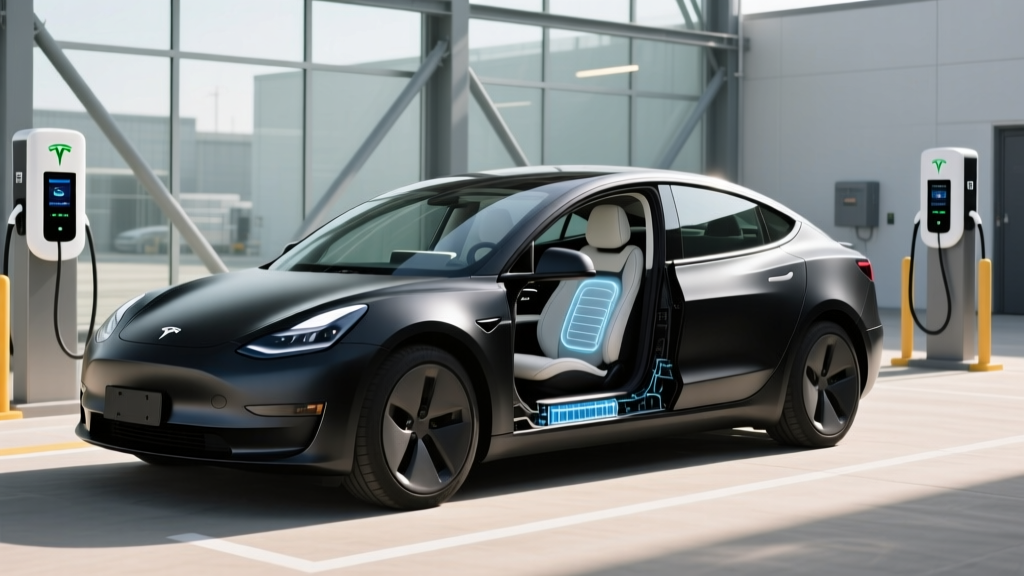
The low rollover risk reflects the Model 3's skateboard architecture, which places the heavy battery pack along the floor, giving it one of the lowest centers of gravity in the compact sedan segment.
IIHS Ratings
The Insurance Institute for Highway Safety (IIHS) has historically rated the refreshed Model 3 as a Top Safety Pick+ when equipped with acceptable headlights. Key test results include:
- Moderate Overlap Front (updated test): Good
- Side Impact (updated test): Good
- Roof Strength: Good
- Head Restraints & Seats: Good
- Front Crash Prevention (vehicle-to-vehicle): Superior
- Headlights: Acceptable (varies by trim)
The updated IIHS side-impact test uses a heavier barrier at higher speed to simulate a modern SUV or truck strike. The Model 3's reinforced B-pillars and side-sill structure performed well, showing minimal intrusion into the occupant compartment.
Range, Battery, and Real-World Efficiency
Safety gets buyers to the showroom, but range and efficiency close the deal. The 2026 Model 3 is offered in three trims, each with a distinct battery and drivetrain configuration.
| Spec | RWD (Base) | Long Range AWD | Performance AWD |
|---|---|---|---|
| EPA Range | 272 mi | 363 mi | 315 mi |
| Battery (usable) | ~57.5 kWh (LFP) | ~75 kWh (NMC) | ~75 kWh (NMC) |
| Drivetrain | RWD, single motor | AWD, dual motor | AWD, dual motor |
| Horsepower | 271 hp | 346 hp | ~510 hp |
| 0-60 mph | 5.8 sec | 4.2 sec | 2.9 sec |
| MPGe (combined) | 132 MPGe | 130 MPGe | 115 MPGe |
| Efficiency (kWh/100 mi) | 25 | 26 | 29 |
| Base MSRP | $38,990 | $44,990 | $52,990 |
Charging Speed: DC Fast Charge and Home Level 2
The Model 3 uses the NACS (North American Charging Standard) connector natively — no adapter needed at Tesla Superchargers. This remains a significant advantage in 2026, as the Supercharger network continues to offer the highest uptime and reliability of any public charging network in North America.
| Charging Level | RWD (LFP) | Long Range / Performance (NMC) |
|---|---|---|
| Level 1 (120V household) | ~3–4 mi/hr (1.4 kW) | ~3–4 mi/hr (1.4 kW) |
| Level 2 (240V home, 48A) | ~30 mi/hr (11.5 kW) | ~44 mi/hr (11.5 kW) |
| DC Fast Charge (peak) | 170 kW peak | 250 kW peak |
| 10–80% DCFC time | ~25 min | ~18–22 min |
A critical nuance: peak kW is not sustained kW. The Long Range Model 3 may hit 250 kW briefly at a low state of charge on a V3 Supercharger, but the charge curve tapers significantly above 60% SoC. Expect the 50–80% portion to average closer to 80–100 kW. Preconditioning the battery (which the car does automatically when you navigate to a Supercharger) is essential to achieving peak rates — arriving at a Supercharger without preconditioning can add 5–10 minutes to your session.
For home charging, a Tesla Wall Connector on a 60A circuit delivers up to 11.5 kW (48A continuous). Most owners with a daily commute of 40–60 miles will recover a full day's driving in roughly 1.5–2 hours of Level 2 charging overnight.
Pricing, Trims, and Federal Tax Credit Eligibility
The 2026 Model 3 lineup spans from a value-oriented RWD base model to the track-focused Performance variant. All trims include Tesla's basic Autopilot (lane centering + adaptive cruise) as standard; Enhanced Autopilot and Full Self-Driving (Supervised) remain optional add-ons.
| Trim | Base MSRP | Est. Federal Credit (§30D) | Effective Price* |
|---|---|---|---|
| RWD | $38,990 | Up to $7,500 | ~$31,490 |
| Long Range AWD | $44,990 | Up to $7,500 | ~$37,490 |
| Performance AWD | $52,990 | Up to $7,500 | ~$45,490 |
*Effective price assumes full §30D credit eligibility. Destination fees, options, and state/local incentives not included. Verify eligibility at purchase.
- MSRP Cap: Sedars must be ≤ $55,000. The RWD and Long Range qualify; the Performance at $52,990 also clears the cap (before options).
- Buyer Income Cap: Modified AGI must not exceed $150,000 (single), $225,000 (head of household), or $300,000 (joint).
- Battery Sourcing: The credit is split into two halves — $3,750 for critical-minerals sourcing and $3,750 for battery-component manufacturing. Full $7,500 requires both halves to be satisfied. Tesla's U.S.-built battery packs have generally met both requirements, but sourcing rules tighten annually. Always verify current eligibility on IRS.gov or with your tax professional before purchase.
- Point-of-Sale Transfer: Eligible buyers can transfer the credit to the dealer at purchase, reducing the out-of-pocket price immediately rather than waiting for tax-season filing.
Interior, Cargo, and Daily Practicality
The refreshed Model 3 interior is a marked improvement over the pre-2024 cabin. Materials are softer, road noise is reduced thanks to acoustic glass, and the rear now features an 8-inch touchscreen for rear passengers.
- Front headroom: 40.3 inches
- Rear legroom: 35.3 inches
- Cargo (trunk + frunk): ~23 cu ft total (trunk: 19.8 cu ft; frunk: ~3.1 cu ft)
- Seating: 5 passengers (tight for three-across in the rear on long trips)
The cargo volume is competitive for the compact sedan class, though it falls short of hatchback rivals like the Hyundai Ioniq 5 or the Tesla Model Y. If you regularly haul bulky items or need a flat load floor, the Model Y's liftback design is more practical. For daily commuting, groceries, and carry-on luggage for road trips, the Model 3's trunk is sufficient.
The minimalist interior remains polarizing. There is no traditional instrument cluster — all information (speed, navigation, media) is displayed on the central 15.4-inch touchscreen. Steering-wheel-integrated controls handle turn signals, wipers, and drive-mode selection. Some buyers adapt quickly; others find the lack of physical buttons frustrating, especially for climate and mirror adjustments.
Driver-Assistance Technology: Autopilot and FSD (Supervised)
Tesla's Autopilot and Full Self-Driving (Supervised) are Level 2 driver-assistance systems under the SAE J3016 taxonomy. This means the system can manage steering and acceleration/braking simultaneously, but the driver must remain fully engaged, hands on the wheel (or providing torque input), and eyes on the road at all times. The Model 3 is not a self-driving car. Only Level 4 services like Waymo operate without a human driver in geofenced areas.
Standard Autopilot includes Traffic-Aware Cruise Control and Autosteer (lane centering). Enhanced Autopilot ($6,000 option) adds automatic lane changes, Navigate on Autopilot, Autopark, and Summon. FSD (Supervised) ($8,000 or $99/month subscription) adds traffic-light and stop-sign recognition, city-street autosteer, and more assertive navigation.
In real-world use, Autopilot excels on well-marked highways. FSD (Supervised) has improved substantially on surface streets but still requires frequent interventions — plan to stay alert and ready to take over at any moment. The camera-only Tesla Vision approach (no lidar or radar) occasionally struggles with low-sun glare, construction zones, and faded lane markings.
Warranty Coverage and Long-Term Ownership
| Coverage | Term |
|---|---|
| Basic Vehicle Limited Warranty | 4 years / 50,000 miles |
| Battery & Drive Unit (RWD — LFP) | 8 years / 100,000 miles (min 70% retention) |
| Battery & Drive Unit (Long Range / Perf — NMC) | 8 years / 120,000 miles (min 70% retention) |
Tesla's battery warranty guarantees that the pack will retain at least 70% of its original capacity during the warranty period. If degradation falls below that threshold, Tesla will repair or replace the battery at no cost. Real-world data from fleet analytics sources suggests that NMC Model 3 packs lose approximately 8–12% capacity over the first 100,000 miles, with the curve flattening significantly after the initial break-in period. LFP packs tend to show even slower degradation, though they have lower energy density (hence the shorter range in the RWD trim).
Insurance costs for the Model 3 tend to run higher than comparable gas sedans. Average annual premiums range from $1,800 to $2,800 depending on your state, age, and driving record. Tesla Insurance is available in some states and may offer competitive rates, particularly for drivers who use Autopilot frequently (via the Safety Score program).
Pros, Cons, and Who Should Buy the Model 3
Pros
- Top-tier crash test scores (5-star NHTSA, IIHS Top Safety Pick+)
- Class-leading Supercharger network access (native NACS)
- Excellent efficiency — among the lowest kWh/100mi in its class
- Strong resale value relative to most EVs
- Over-the-air updates continuously add features
- Competitive pricing after federal tax credit
Cons
- Minimalist interior not for everyone (no physical buttons, no instrument cluster)
- Rear seat is snug for tall adults on long trips
- Cargo space trails hatchback and SUV competitors
- Repair costs and insurance premiums above segment average
- FSD (Supervised) remains Level 2 — requires constant driver attention
- LFP RWD range may feel limiting for road-trip-heavy owners
Best for: Tech-forward commuters and couples who prioritize efficiency, safety, and charging convenience. The Long Range AWD is the sweet spot for most buyers — offering 363 miles of EPA range, dual-motor traction for inclement weather, and fast DC charging for road trips.
Look elsewhere if: You need maximum cargo space (consider the Model Y or Ioniq 5), prefer physical controls, or regularly carry three adults in the rear seat.
Frequently Asked Questions
What is the real-world range of the Tesla Model 3?
The EPA rates the Long Range AWD at 363 miles. In real-world mixed driving at moderate temperatures, expect 320–340 miles. Sustained highway driving at 75+ mph reduces this to roughly 280–300 miles. In freezing weather, plan for a 15–25% reduction from the EPA figure. The RWD (LFP) model's 272-mile EPA rating translates to roughly 230–250 real-world miles in mixed conditions.
How fast does the Model 3 charge at home and on the road?
On a 240V Level 2 home charger (48A), the Long Range adds approximately 44 miles of range per hour — enough to fully replenish overnight. On a V3 Supercharger (250 kW DC), the Long Range charges from 10–80% in approximately 18–22 minutes, with the charge rate tapering significantly above 60% SoC.
Does the 2026 Tesla Model 3 qualify for the $7,500 federal EV tax credit?
All three trims fall under the $55,000 MSRP cap for sedans. Full $7,500 eligibility depends on the buyer's income (under $150K single / $300K joint), the battery's critical-mineral and component sourcing (which Tesla's U.S.-assembled packs have generally satisfied), and annual rule tightening. The credit can be transferred at point of sale to reduce your purchase price immediately. Always verify current eligibility on IRS.gov.
Is the Tesla Model 3 worth buying vs. competitors?
Against the Hyundai Ioniq 6, the Model 3 offers better Supercharger access and stronger crash test data but less rear-seat room and a more polarizing interior. The BMW i4 is more refined but costs significantly more. The Polestar 2 offers a more traditional cabin layout but trails on range and efficiency. For buyers who value charging infrastructure, safety ratings, and OTA updates, the Model 3 remains a top pick in the segment.
How does the Model 3 perform in crash tests compared to other EVs?
The Model 3's 5-star NHTSA rating and IIHS Top Safety Pick+ designation place it among the safest vehicles in any powertrain category. Its low center of gravity (from the floor-mounted battery pack) contributes to a 6.6% rollover risk — among the lowest in the compact sedan class. These scores are competitive with or exceed those of the Volvo S60, Mercedes C-Class, and BMW 3 Series.
What are the biggest pros and cons of owning a Model 3?
Top advantages: exceptional safety scores, Supercharger access, low running costs, strong efficiency, and continuous software improvements. Top drawbacks: minimalist controls require a learning curve, rear-seat space is limited, insurance costs run high, and the FSD package — despite its name — does not make the car self-driving.