Tesla Model 3 Colors and Configurations for 2026
If you're researching tesla colors model 3 options alongside the hard specs that actually matter—range, charging speed, pricing, and tax credit eligibility—you've landed in the right place. The 2026 Tesla Model 3 continues the refresh that debuted for the 2024 model year (internally called "Highland"), bringing updated styling, a quieter cabin, improved suspension tuning, and the same industry-leading efficiency that has kept the Model 3 atop the EV sedan segment for nearly a decade.
But color selection is only the starting point. The real decision involves choosing between the Rear-Wheel Drive (RWD), Long Range AWD, and Performance trims—each with different battery chemistries, range figures, and tax credit implications. Let's break down everything you need to know before configuring your order.
Exterior Color Options: What's Available and What It Costs
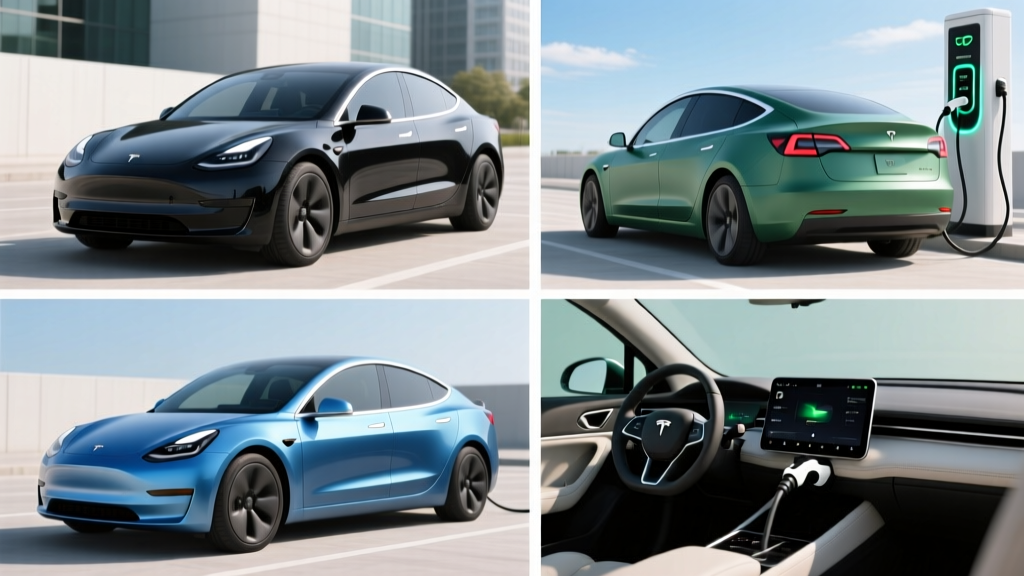
Tesla periodically adjusts its color palette, and for the 2026 model year the Model 3 lineup includes the following exterior paint options:
- Pearl White Multi-Coat — The default no-cost option. A tri-coat pearlescent white that holds resale value well and hides minor dirt better than flat whites.
- Solid Black — A deep, non-metallic black. Striking when clean but shows swirl marks and dust readily. Typically a $1,000 upcharge.
- Deep Blue Metallic — A rich metallic blue with noticeable flake under direct sunlight. $1,000 upcharge.
- Midnight Silver Metallic — A dark gunmetal silver that reads as charcoal-gray in overcast light. $1,000 upcharge.
- Red Multi-Coat — A premium tri-coat red with exceptional depth. Historically a $2,000 upcharge and the most expensive color in the lineup.
- Ultra Red — Tesla introduced this as a replacement/supplement to Red Multi-Coat in certain markets, using a more saturated pigment. Availability and pricing vary by region and order date.
- Quicksilver — A limited or regional option that has appeared on Model 3 and Model Y in select markets. Check Tesla's configurator for current U.S. availability.
Interior options remain streamlined: All Black (standard) and Black & White (premium, typically $1,000 extra). The black-and-white cabin uses Tesla's vegan leather, which has proven durable in long-term ownership reports, though the white seats do show denim dye transfer if you're not careful.
Trim Levels, Pricing, and Federal Tax Credit Eligibility
The 2026 Model 3 is offered in three primary trims. Pricing below reflects the base MSRP before any options, destination fees, or incentives:
| Trim | Base MSRP | Drivetrain | Battery Chemistry | Est. Price After §30D Credit* |
|---|---|---|---|---|
| Model 3 RWD | ~$38,990 | Rear-Wheel Drive | LFP (CATL) | ~$31,490 (if eligible) |
| Model 3 Long Range AWD | ~$45,990 | Dual-Motor AWD | NMC | ~$38,490 (if eligible) |
| Model 3 Performance | ~$52,990 | Dual-Motor AWD | NMC | ~$45,490 (if eligible) |
*Pricing is approximate and subject to change. Federal tax credit eligibility under IRS §30D depends on multiple factors. See checklist below.
Federal EV Tax Credit (§30D) Eligibility Checklist
Not every Model 3 buyer qualifies for the full $7,500 federal tax credit. Here's what the IRS requires as of 2026:
- MSRP Cap: The vehicle's manufacturer's suggested retail price must not exceed $55,000 for sedans (all Model 3 trims currently fall under this cap at base MSRP, but loaded configurations may exceed it).
- Buyer Income Cap: Modified adjusted gross income must not exceed $150,000 (single), $225,000 (head of household), or $300,000 (joint filers).
- Battery Sourcing Requirements: A percentage of critical minerals and battery components must be sourced from the U.S. or free-trade-agreement countries. These thresholds increase annually. The RWD model's CATL-sourced LFP battery has faced scrutiny under these rules—verify current-year eligibility on fueleconomy.gov before ordering.
- Point-of-Sale Transfer: As of 2024, buyers can transfer the credit to the dealer at purchase, reducing the upfront cost rather than waiting for a tax refund. Tesla participates in this program.
- Final Assembly: The Model 3 built for the U.S. market is assembled in Fremont, California, satisfying the North American final assembly requirement.
Key caveat: Battery component and critical mineral sourcing rules tighten each year. The RWD trim's LFP battery, historically sourced from CATL in China, may not satisfy the critical-minerals threshold in 2026. Always confirm the specific vehicle's eligibility via the VIN on the IRS portal or fueleconomy.gov before finalizing your purchase. A tax professional can advise on your individual situation.
Range, Efficiency, and Real-World Expectations
| Specification | Model 3 RWD | Model 3 Long Range AWD | Model 3 Performance |
|---|---|---|---|
| EPA Estimated Range | 272 miles | 341 miles | 315 miles |
| Usable Battery Capacity | ~57.5 kWh (LFP) | ~75 kWh (NMC) | ~75 kWh (NMC) |
| EPA Efficiency (MPGe) | 132 MPGe combined | 130 MPGe combined | 124 MPGe combined |
| Energy Consumption | ~25 kWh/100mi | ~26 kWh/100mi | ~28 kWh/100mi |
| 0-60 mph | 5.8 seconds | 4.2 seconds | 2.9 seconds |
| Horsepower | ~271 hp | ~346 hp | ~510 hp |
| Drivetrain | Single Motor RWD | Dual Motor AWD | Dual Motor AWD |
| Top Speed | 125 mph | 125 mph | 163 mph |
The EPA numbers above represent mixed driving under controlled conditions. In real-world use, expect the following:
- Highway driving at 70-80 mph: Reduce EPA range by 10-15%. A Long Range AWD rated at 341 miles will typically deliver 290-310 miles on a flat interstate run in mild weather.
- Cold weather (below 32°F / 0°C): Expect 20-30% range reduction due to battery resistance and cabin heating demands. The RWD's smaller 57.5 kWh LFP pack may deliver as little as 190-210 miles in freezing highway conditions.
- City / stop-and-go driving: Regenerative braking recovers energy, often allowing you to meet or slightly exceed EPA estimates in urban commuting.
- Preconditioning matters: Using the Tesla app to precondition the battery and cabin while plugged in preserves range and enables faster DC charging. Always precondition before a road trip fast-charge stop.
LFP vs. NMC: What the Chemistry Means for You
The RWD trim uses a lithium iron phosphate (LFP) battery, while the Long Range and Performance trims use nickel manganese cobalt (NMC) chemistry. Here's why that matters:
| Factor | LFP (RWD) | NMC (Long Range / Performance) |
|---|---|---|
| Energy Density | Lower — smaller usable capacity in a similar physical pack | Higher — more kWh in the same footprint, enabling longer range |
| Cycle Life | Superior — 3,000+ cycles with minimal degradation | Good — 1,500-2,000 cycles before notable capacity loss |
| Charging to 100% | Tesla recommends regular 100% charges (LFP needs this for BMS calibration) | Tesla recommends daily limit of 80-90%; 100% only for trips |
| Cold-Weather Performance | More range loss in extreme cold vs. NMC | Better cold-weather retention, aided by heat pump (standard on all trims) |
| Cost | Lower — enables the RWD's lower MSRP | Higher — contributes to Long Range/Performance price premium |
Charging Speeds: DC Fast Charging and Home Level 2
Charging speed is where the Model 3's Highland refresh delivered meaningful gains. The updated architecture supports faster DC charge acceptance, particularly on the Long Range and Performance trims.
| Charging Method | Model 3 RWD (LFP) | Model 3 Long Range / Performance (NMC) |
|---|---|---|
| Max DC Fast-Charge Rate | ~170 kW peak | ~250 kW peak |
| 10-80% DC Fast Charge Time | ~25 minutes | ~18 minutes |
| Miles Added in 15 Min (DC) | ~130 miles | ~175 miles |
| Level 2 Home Charging (kW) | 11 kW (48A) | 11 kW (48A) |
| Level 2 Miles per Hour | ~33 mi/hr | ~44 mi/hr |
| Level 1 (120V) Miles per Hour | ~3-4 mi/hr | ~3-4 mi/hr |
| Connector | NACS (native Tesla) | NACS (native Tesla) |
Understanding the charge curve: The peak kW number (170 or 250) is the maximum rate the car accepts at a low state of charge—typically around 10-20% SoC. As the battery fills, the rate tapers significantly. Above 80% SoC, charging slows dramatically to protect battery health, often dropping below 50 kW. This is why 10-80% times are the industry-standard metric; the final 20% can take as long as the first 70%.
Supercharger network access: All Model 3 vehicles charge natively on Tesla's Supercharger network using the NACS connector—no adapter needed. Tesla Superchargers remain the most reliable public DC fast-charging network in the U.S., with V3 stalls delivering up to 250 kW and V4 stalls rolling out at select locations.
Home charging setup: The onboard 11 kW (48-amp) AC charger requires a 60-amp dedicated circuit with a Tesla Wall Connector or equivalent NACS-equipped Level 2 EVSE. Expect a full charge from 10% to 100% in approximately 5-7 hours on Level 2, depending on trim. A licensed electrician will typically charge $500-$2,000 for installation depending on panel proximity and local permitting; a panel upgrade (to 200A service) can add $1,500-$3,000 if your home's electrical service is older.
Interior, Cargo Space, and Technology
Passenger and Cargo Dimensions
- Front legroom: 42.7 inches
- Rear legroom: 35.2 inches
- Front headroom: 40.3 inches
- Rear headroom: 37.8 inches
- Trunk cargo volume: 23 cu ft (rear seats up)
- Frunk (front trunk): ~3.1 cu ft — fits a backpack or charging cables
- Total cargo with seats folded: ~56 cu ft
The Highland refresh slightly improved rear-seat comfort with revised cushioning and a marginally more upright seatback angle. Rear visibility remains a known compromise due to the sloping roofline—most owners rely on the backup camera.
Infotainment and Standout Tech
The 2026 Model 3 retains Tesla's minimalist, screen-centric approach:
- 15.4-inch center touchscreen — Controls all vehicle functions including climate, mirrors, and glovebox. No physical instrument cluster; speed and navigation are displayed on the center screen (a rear 8-inch touchscreen for rear passengers is included on Long Range and Performance trims).
- Tesla app integration — Remote preconditioning, Sentry Mode camera access, location sharing, and software update management.
- Over-the-air (OTA) updates — Tesla regularly pushes feature additions, UI improvements, and efficiency optimizations. The Model 3 has received meaningful updates years after purchase.
- Ambient lighting and ventilated seats — The Highland refresh added customizable ambient light strips across the dashboard and doors, plus ventilated front seats on Long Range and Performance trims.
- Sound system — The Long Range and Performance trims feature a 17-speaker premium audio system with immersive sound. The RWD has a 9-speaker setup that still outperforms most competitors at this price point.
Driver Assistance: Autopilot and FSD (Supervised)
Tesla's Autopilot and Full Self-Driving (Supervised) are Level 2 driver-assistance systems. They require continuous driver supervision, hands on or near the wheel, and full attention to the road at all times. They are not self-driving systems. Only Level 4 services like Waymo operate without a human driver in geofenced areas.
- Basic Autopilot (standard): Traffic-aware cruise control and lane-centering assist. Competent for highway cruising but requires active steering-wheel torque input for supervision confirmation.
- Enhanced Autopilot ($6,000 option): Adds automatic lane change, Navigate on Autopilot (highway on/off-ramp guidance), Autopark, and Summon.
- Full Self-Driving Supervised ($8,000 option): Adds traffic light and stop sign recognition, city street autosteer, and the most advanced neural-net-based driving policy. Still requires full driver supervision and intervention readiness.
- Drive the car without a licensed, attentive driver in the seat
- Handle all construction zones, unmapped roads, or severe weather reliably
- Replace your responsibility as the driver — you are liable for all vehicle actions
- Guarantee collision avoidance in all scenarios
Warranty, Safety, and Long-Term Ownership
Warranty Coverage
- Basic Vehicle Limited Warranty: 4 years / 50,000 miles
- Battery & Drive Unit Warranty (RWD): 8 years / 100,000 miles, with minimum 70% capacity retention
- Battery & Drive Unit Warranty (Long Range / Performance): 8 years / 120,000 miles, with minimum 70% capacity retention
Tesla's battery warranty guarantees that if your battery degrades below 70% of its original capacity within the warranty period, it will be repaired or replaced. In practice, Tesla battery degradation has proven modest—most owners report 5-10% loss over the first 100,000 miles based on long-term fleet data. LFP batteries in the RWD model are expected to show even less degradation over time due to their superior cycle life, though long-term real-world data on the specific CATL packs in U.S.-market Model 3s is still accumulating.
Safety Ratings
The Model 3 has consistently earned top marks. Refer to NHTSA and IIHS for the most current ratings on the 2026 model year. The previous-generation Model 3 earned a 5-star overall NHTSA rating and IIHS Top Safety Pick+ designation; the Highland refresh carries forward the same fundamental structure with additional passive safety refinements.
How It Compares: Model 3 vs. Key Competitors
The Model 3 competes in the premium electric sedan segment. Here's how it stacks up against the most relevant alternatives:
| Attribute | Tesla Model 3 LR AWD | Hyundai Ioniq 6 SEL AWD | BMW i4 xDrive40 |
|---|---|---|---|
| EPA Range | 341 miles | 316 miles | 285 miles |
| Base MSRP | ~$45,990 | ~$47,000 | ~$57,000 |
| Max DC Charge Rate | 250 kW | 240 kW | 205 kW |
| 10-80% DC Time | ~18 min | ~18 min | ~31 min |
| Federal Tax Credit | Up to $7,500* | Up to $7,500* | Likely ineligible (MSRP/sourcing) |
| Charging Network | Native Supercharger | NACS adapter needed for Superchargers | NACS adapter needed for Superchargers |
| 0-60 mph | 4.2 sec | 5.1 sec | 4.6 sec |
Verdict: The Model 3 Long Range AWD remains the efficiency-and-range benchmark in its price class. The Ioniq 6 is a strong alternative with comparable charging speed and a more conventional interior layout (physical buttons, traditional gauge display). The BMW i4 offers premium build quality and driving dynamics but at a significant price premium and with slower DC charging. If Supercharger network access is a priority for road trips, the Model 3's native NACS connector provides a frictionless experience that competitors still require adapters to match.
Who Should Buy the Tesla Model 3?
- You're a daily commuter with reliable home Level 2 charging
- Your typical daily driving is under 100 miles round-trip
- You want the lowest entry price and plan to keep the car 8+ years (LFP longevity)
- You live in a mild climate where cold-weather range loss is less severe
- You take regular road trips of 200+ miles
- You live in a cold-weather state and need range buffer
- You want AWD traction for snow and rain
- You value the fastest DC charging speeds and maximum Supercharger utility
- Acceleration and track capability are top priorities
- You want the highest-output dual-motor setup with adaptive damping
- You accept slightly lower range and efficiency for the performance trade-off
- You need SUV-level cargo space or seating for more than 5
- You prefer physical buttons and a traditional instrument cluster
- You cannot install home charging and your area lacks reliable public DC infrastructure
- You need towing capability (the Model 3 is not rated for towing in the U.S. market)
Pros and Cons at a Glance
- Class-leading efficiency (kWh/100mi) translates to lower charging costs
- Native Tesla Supercharger access — the most reliable U.S. DC network
- Long Range AWD delivers 341 EPA miles with 250 kW fast charging
- OTA updates continuously add features years after purchase
- Strong resale value relative to non-Tesla EVs
- Spacious trunk (23 cu ft) plus frunk for a sedan
- Minimalist interior with premium audio on LR/Performance trims
- Everything controlled via touchscreen — no physical climate or volume knobs
- Rear visibility is poor due to sloping roofline
- RWD (LFP) has notably less range and slower DC charging than Long Range
- FSD (Supervised) costs $8,000 and remains Level 2 — not autonomous
- Panel gaps and minor build-quality inconsistencies still reported by some owners
- No towing capacity
- Tax credit eligibility for RWD uncertain due to battery sourcing rules
Frequently Asked Questions
What is the real-world range of the Tesla Model 3?
The EPA rates the Long Range AWD at 341 miles, the Performance at 315 miles, and the RWD at 272 miles. In real-world highway driving at 70-80 mph in mild weather, expect roughly 290-310 miles from the Long Range, 270-290 from the Performance, and 230-250 from the RWD. In freezing temperatures, subtract another 20-30% from these figures, particularly on the RWD's LFP battery.
How fast does the Model 3 charge at home and on the road?
On a Level 2 home charger (11 kW / 48A), the Model 3 adds roughly 33-44 miles of range per hour depending on trim, achieving a full charge overnight. On DC fast chargers, the Long Range and Performance peak at 250 kW, reaching 10-80% in approximately 18 minutes. The RWD peaks at around 170 kW with a 10-80% time of roughly 25 minutes.
How much does the Tesla Model 3 cost after tax credits?
If you qualify for the full $7,500 federal §30D credit and apply it at point of sale, the RWD drops to approximately $31,490, the Long Range AWD to roughly $38,490, and the Performance to about $45,490. However, eligibility depends on your income, the vehicle's MSRP, and battery sourcing compliance—which changes annually. Confirm eligibility on fueleconomy.gov and consult a tax professional.
Does the Tesla Model 3 qualify for the federal EV tax credit?
It depends on the trim and the current year's sourcing requirements. The Model 3 is assembled in Fremont, CA (meeting the final assembly requirement), and base MSRPs fall under the $55,000 sedan cap. However, the critical minerals and battery component thresholds tighten each year, and the RWD's CATL LFP battery may not meet 2026 sourcing requirements. The Long Range and Performance trims, with NMC batteries from different supply chains, have historically maintained better eligibility. Always verify by VIN before purchasing.
Is the Tesla Model 3 worth buying vs. competitors in 2026?
For buyers prioritizing range, charging speed, Supercharger network access, and software capability, the Model 3 Long Range AWD remains the strongest value proposition in the electric sedan segment. The Hyundai Ioniq 6 is a credible alternative with a more conventional cabin. The BMW i4 offers superior build quality but at a premium price with slower charging and likely no federal tax credit. If you road-trip frequently, the native Supercharger advantage is significant.
What Tesla Model 3 color holds resale value best?
Historically, Pearl White Multi-Coat and Midnight Silver Metallic have shown the strongest resale performance in the used-EV market, partly because they're popular with fleet and corporate buyers. Red Multi-Coat and Ultra Red command a premium at purchase but don't always recoup the upcharge at resale. Solid Black shows wear most readily and can be harder to sell in warmer climates.
What's the difference between kW and kWh?
This is the most common EV confusion. kW (kilowatts) measures power—the rate at which energy flows, like the speed of water from a hose. It determines how fast your car charges. kWh (kilowatt-hours) measures energy—the total amount stored, like the size of a water tank. It determines how far you can drive. A 75 kWh battery charged at 250 kW fills quickly; a 57.5 kWh battery holds less total energy.