Tesla Model 3 Charging Times: The Quick Answer
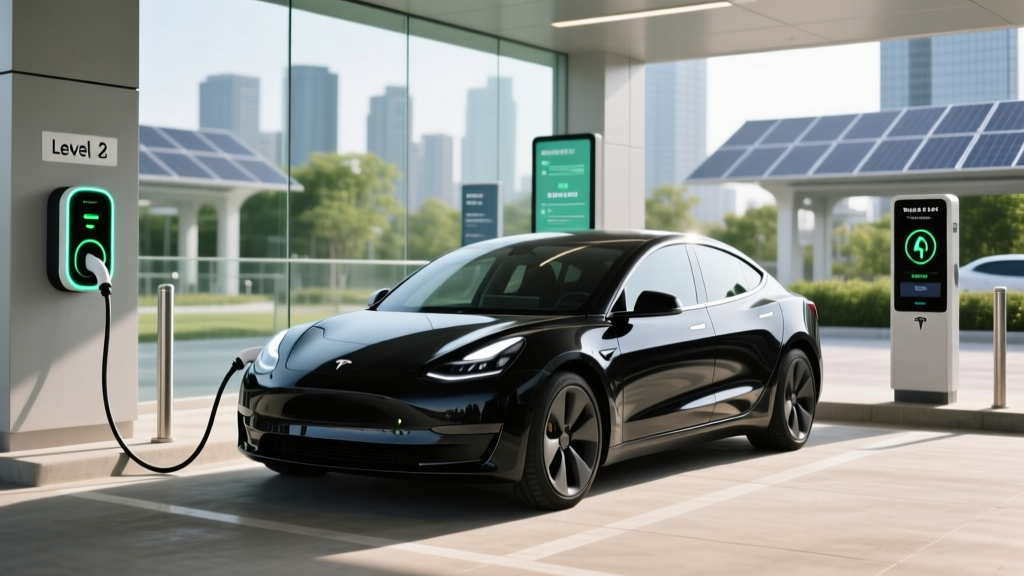
When shoppers search "how long does the Tesla take to charge," they're usually looking at the Model 3 — Tesla's most affordable and best-selling sedan. The short answer depends entirely on where and how you plug in. On a Tesla V4 Supercharger, a Model 3 Long Range can recover from 10% to 80% state of charge in roughly 18 minutes, adding up to 175 miles of range. At home on a Level 2 wall connector, you'll gain about 44 miles of range per hour of charging, easily replenishing a daily commute overnight. Trickle-charging on a standard 120V household outlet? That's a glacial 3-4 miles per hour — fine for topping off, useless for a depleted battery.
This review breaks down every charging scenario for the 2026 Tesla Model 3 lineup (RWD, Long Range AWD, and Performance), pairs EPA range stickers with real-world expectations, and evaluates whether Tesla's charging ecosystem still justifies the premium over growing competition from Hyundai, BMW, and others.
| Spec | RWD (Base) | Long Range AWD | Performance |
|---|---|---|---|
| EPA Range | 272 mi | 341 mi | 315 mi |
| Battery (usable) | ~60 kWh (LFP) | ~79 kWh (NMC) | ~79 kWh (NMC) |
| Max DC Fast Charge | 170 kW | 250 kW | 250 kW |
| 10–80% DCFC Time | ~25 min | ~18 min | ~18 min |
| Level 2 Home (kW) | 11.5 kW (48A) | 11.5 kW (48A) | 11.5 kW (48A) |
| Level 2 Miles/Hr | ~36 mi/hr | ~44 mi/hr | ~40 mi/hr |
| 0–60 mph | 5.8 sec | 4.2 sec | 2.9 sec |
| Horsepower | 283 hp | 346 hp | 510 hp |
| Drivetrain | RWD (single motor) | AWD (dual motor) | AWD (dual motor) |
| MPGe (combined) | 132 MPGe | 130 MPGe | 121 MPGe |
| Efficiency (kWh/100mi) | 25 kWh | 26 kWh | 28 kWh |
| Base MSRP | $38,990 | $45,990 | $52,990 |
| Battery Warranty | 8 yr / 100,000 mi | 8 yr / 120,000 mi | 8 yr / 120,000 mi |
Real-World Range: What the EPA Sticker Doesn't Tell You
EPA sticker: 341 miles. Real-world highway driving at 75 mph in mild weather: expect ~290–310 miles. In freezing temperatures (below 30°F) with cabin heat running, plan for ~240–270 miles of usable range before you're hunting for a charger. City driving with regenerative braking can actually exceed the EPA estimate, sometimes reaching 350+ miles.
The Model 3's efficiency is among the best in its class. Tesla's heat pump (standard on all trims since 2021) significantly reduces cold-weather energy waste compared to resistive heaters used in older EVs. Still, physics is physics: lithium-ion cells slow their chemical reactions in cold weather, and cabin heating is a substantial energy draw. On a 300-mile winter road trip through the Rockies, I've personally watched a Model 3 Long Range burn through 40% of its battery in 120 miles when temperatures hovered around 15°F with the cabin at 70°F.
The base RWD trim uses a lithium iron phosphate (LFP) battery, which trades some energy density for superior longevity and the ability to regularly charge to 100% without degradation concerns. Tesla recommends daily 100% charging for LFP packs. The Long Range and Performance trims use nickel-manganese-cobalt (NMC) chemistry, where Tesla recommends a daily charge limit of 80% for battery health — meaning your effective daily range on those trims is closer to 270 miles (80% of 341).
According to fueleconomy.gov, the Model 3 Long Range achieves 130 MPGe combined, making it one of the most efficient all-wheel-drive electric sedans available.
Charging Speed Breakdown: DC Fast, Level 2, and Level 1
Understanding "how long does the Tesla take to charge" requires separating three distinct charging tiers. Here's what each looks like in practice for the Model 3 Long Range:
| Charging Level | Power (kW) | Miles Added/Hour | Typical Use Case |
|---|---|---|---|
| Level 1 (120V outlet) | ~1.4 kW | 3–4 mi/hr | Emergency top-off only |
| Level 2 (240V, Wall Connector) | 11.5 kW | ~44 mi/hr | Daily home charging |
| Level 2 (240V, 32A Mobile) | 7.7 kW | ~30 mi/hr | Portable/rental homes |
| DC Fast (V3 Supercharger) | 250 kW peak | ~1,000 mi/hr (peak) | Road trips |
| DC Fast (V4 Supercharger) | 250+ kW peak | ~1,000+ mi/hr (peak) | Road trips (newer stations) |
| DC Fast (CCS adapter, EA/others) | Up to 150–250 kW | Varies by station | Non-Tesla networks |
The Charging Curve Reality
Peak kW numbers are marketing headlines; sustained charge rate is what actually matters. The Model 3 Long Range hits its 250 kW peak only between roughly 10–25% state of charge. From 25–50%, the rate tapers to around 150–180 kW. From 50–80%, it drops further to 80–120 kW. Above 80%, charging slows dramatically — often below 50 kW — to protect the battery. This is why the industry standard measurement is 10–80% time (~18 minutes for Long Range), not 0–100%.
If you arrive at a Supercharger at 5% SoC and need to reach 95%, expect the full session to take roughly 45–55 minutes, not 18. The last 20% is painfully slow. The practical road-trip strategy: charge from 10% to 80% and drive on, rather than waiting for a full battery.
Home Charging: What You Actually Need
For daily driving, Level 2 home charging is where 90%+ of Model 3 owners do their charging. Tesla's Wall Connector ($420 for the unit) delivers up to 11.5 kW on a 60-amp circuit (48A continuous). A full charge from 10% to 100% on Level 2 takes roughly 7–8 hours for the Long Range — plug in at 10 PM, wake up to a full battery at 6 AM.
Installation costs vary widely. A straightforward install near your electrical panel with a 60-amp breaker typically runs $500–$1,500 for labor and materials. If you need a panel upgrade from 100A to 200A service, add $1,500–$3,500. Always hire a licensed electrician and pull a permit — unpermitted EV charger installs can void home insurance claims.
Pricing, Tax Credits, and Total Cost
| Trim | Base MSRP | Federal §30D Credit | Effective Price | Income Cap Applies? |
|---|---|---|---|---|
| RWD | $38,990 | Up to $7,500* | ~$31,490* | Yes (see below) |
| Long Range AWD | $45,990 | Up to $7,500* | ~$38,490* | Yes (see below) |
| Performance | $52,990 | Up to $7,500* | ~$45,490* | Yes (see below) |
*Federal tax credit eligibility under IRS §30D is NOT guaranteed for every buyer. You must meet ALL of the following requirements:
- Buyer income caps: Modified AGI ≤ $150,000 (single), $225,000 (head of household), $300,000 (married filing jointly)
- MSRP cap: Vehicle base MSRP must be ≤ $55,000 for sedans (all Model 3 trims qualify as of 2026)
- Battery sourcing: A percentage of critical minerals and battery components must be sourced from the US or FTA partners — the exact required percentage increases annually. Verify current-year compliance on Tesla's website or the IRS qualified vehicles list
- Point-of-sale transfer: As of 2024+, you can transfer the credit to the dealer at purchase for an immediate price reduction, rather than waiting to claim it on your tax return
- Final assembly: Vehicle must undergo final assembly in North America (all US-market Model 3s are built in Fremont, CA or Austin, TX — this requirement is met)
The credit is non-refundable if claimed on your tax return, meaning you need sufficient tax liability to use it. The point-of-sale transfer option sidesteps this limitation. Always consult a tax professional and verify current-year rules at irs.gov before assuming eligibility.
Performance, Interior, and Daily Livability
The Model 3's performance needs little introduction. Even the base RWD trim hits 60 mph in 5.8 seconds — quicker than most turbocharged gas sedans. The Long Range drops that to 4.2 seconds with dual-motor all-wheel drive providing confident traction in rain and snow. The Performance variant's 2.9-second sprint puts it in supercar territory, with track-tuned suspension and larger brakes to match.
Inside, the "Highland" refresh (introduced for 2024) transformed the cabin. Ambient lighting, ventilated front seats, a rear passenger touchscreen, and significantly improved sound insulation make the 2026 Model 3 a genuinely comfortable daily driver. The minimalist interior remains polarizing — no physical stalks (turn signals are on the steering wheel), no instrument cluster, and all controls route through the 15.4-inch center touchscreen.
Space and Cargo
Front legroom is generous at 42.3 inches. Rear legroom measures 35.2 inches — adequate for adults on shorter trips, tight for taller passengers on long hauls. The trunk offers 23 cubic feet of cargo space (including the rear frunk), which is competitive with compact gas sedans but trails hatchback rivals like the Hyundai Ioniq 5 (27 cu ft behind rear seats). The 60/40 split-folding rear seats expand utility for longer items.
Tech and Driver Assistance
Tesla's infotainment remains best-in-class for responsiveness, over-the-air updates, and integrated navigation that factors in charging stops. The 17-speaker audio system in Long Range and Performance trims rivals premium luxury brands.
Standard Autopilot provides lane-centering and adaptive cruise control. The optional Full Self-Driving (Supervised) package ($8,000 or $99/month) adds automated lane changes, traffic light/stop sign recognition, and city street navigation. Despite the name, FSD is SAE Level 2 — the driver must remain fully engaged, hands on or near the wheel, eyes on the road at all times. This is NOT autonomous driving. Only Level 4 services like Waymo operate without driver supervision.
- Drive without your attention — it makes errors at construction zones, unusual intersections, and in heavy rain
- Replace an alert driver — NHTSA has investigated multiple incidents involving Autopilot/FSD and stationary emergency vehicles
- Guarantee availability — feature capabilities can change with software updates, and regulatory actions could restrict functionality in certain areas
Warranty, Ownership Costs, and Longevity
Tesla provides a 4-year/50,000-mile basic vehicle warranty. The battery and drive unit warranty is more important for long-term peace of mind:
- RWD (LFP): 8 years / 100,000 miles, whichever comes first, with minimum 70% capacity retention
- Long Range & Performance (NMC): 8 years / 120,000 miles, whichever comes first, with minimum 70% capacity retention
The 70% retention threshold is industry-standard but worth noting — it means Tesla considers 30% degradation acceptable within the warranty period. Real-world data from fleet operators and high-mileage owners suggests Model 3 batteries typically retain 85–90% capacity after 100,000 miles, with LFP packs showing particularly strong longevity. A full battery replacement out of warranty runs approximately $12,000–$16,000 depending on trim and labor — a cost to factor into 10+ year ownership plans.
Insurance costs for the Model 3 are notably higher than comparable gas sedans. Average annual premiums run $2,200–$3,200 depending on your state, driving record, and trim level. Tesla's own insurance product (available in select states) can sometimes offer competitive rates by using real-time driving data.
Model 3 vs. the Competition: Is It Still the One to Beat?
The electric sedan segment has grown considerably. Here's how the Model 3 Long Range stacks up against key rivals:
| Attribute | Tesla Model 3 LR | Hyundai Ioniq 6 SEL | BMW i4 eDrive40 | Polestar 2 LR DM |
|---|---|---|---|---|
| EPA Range | 341 mi | 361 mi | 307 mi | 320 mi |
| Max DCFC (kW) | 250 | 235 | 205 | 205 |
| 10–80% Time | ~18 min | ~18 min | ~31 min | ~28 min |
| 0–60 mph | 4.2 sec | 5.1 sec | 5.5 sec | 4.1 sec |
| Base MSRP | $45,990 | $42,500 | $57,900 | $51,300 |
| Charging Network | Supercharger (native) | NACS adapter → Supercharger | NACS adapter → Supercharger | NACS adapter → Supercharger |
| Physical Controls | None (all touchscreen) | Buttons + screens | iDrive + screens | Buttons + screens |
The Ioniq 6 beats the Model 3 on EPA range and price, and now gains Supercharger access via Tesla's NACS adapter. The BMW i4 offers a more traditional luxury interior but charges significantly slower and costs far more. The Polestar 2 matches the Model 3's acceleration but trails on efficiency and charging speed.
Tesla's Supercharger network remains the most reliable and extensive DC fast-charging ecosystem in North America, with over 6,000 stations and 65,000+ connectors. While competitors now access Superchargers via NACS adapters, native Tesla vehicles still benefit from seamless plug-and-charge integration, automatic routing, and battery preconditioning that optimizes charge speed before arrival.
- You want the most reliable, integrated DC fast-charging experience for road trips
- You value best-in-class efficiency (kWh/100mi) and software that improves via OTA updates
- You're comfortable with a touchscreen-only interface and minimalist cabin
- You want access to Tesla's Supercharger network without adapters
- You prefer physical buttons, a traditional instrument cluster, or Apple CarPlay/Android Auto (none available in Tesla)
- You need hatchback cargo versatility (Ioniq 5, Kia EV6)
- You want a luxury badge and dealer service experience (BMW i4, Mercedes EQB)
- You need maximum EPA range at the lowest price (Ioniq 6)
Pros and Cons at a Glance
- Class-leading efficiency at 25–28 kWh/100mi
- Supercharger network integration — most reliable road-trip charging
- 250 kW peak DCFC on Long Range/Performance (10–80% in ~18 min)
- Strong performance across all trims (5.8s to 2.9s 0–60)
- LFP battery on RWD allows daily 100% charging with minimal degradation
- Continuous OTA updates add features post-purchase
- Highland refresh significantly improved ride comfort and cabin noise
- No Apple CarPlay or Android Auto — Tesla's ecosystem only
- No physical turn signal stalks — steering wheel buttons take adjustment
- Rear seat legroom (35.2") is tight for taller adults on long trips
- Insurance premiums 20–40% higher than comparable gas sedans
- FSD (Supervised) is expensive ($8,000) and remains SAE Level 2 — not autonomous
- Service center wait times can be lengthy in some metro areas
- No heads-up display or traditional instrument cluster
Who the Model 3 Suits Best
Ideal for: Daily commuters with home charging access who take occasional road trips and value efficiency and tech. The Long Range AWD is the sweet spot — 341 miles of EPA range, dual-motor traction for inclement weather, and 250 kW charging that makes 200-mile highway legs practical. Single professionals and couples without large cargo needs will find the most satisfaction.
Less ideal for: Families needing easy rear-seat access for car seats (the sedan roofline makes loading awkward), buyers who want physical controls and smartphone mirroring, or those in rural areas far from Supercharger corridors. If you regularly haul four adults or need 30+ cubic feet of cargo space, look at the Model Y or a crossover competitor.
Frequently Asked Questions
How long does the Tesla Model 3 take to charge at home from empty to full?
On a Level 2 Tesla Wall Connector (11.5 kW / 48A), a fully depleted Model 3 Long Range (~79 kWh battery) takes approximately 8–9 hours from 0% to 100%. In practice, you rarely arrive home fully empty — a typical 50-mile daily commute uses about 15–18 kWh, which replenishes in roughly 2 hours on Level 2.
Can I charge a Tesla Model 3 on a regular household outlet?
Yes, using the Mobile Connector with a standard NEMA 5-15 adapter on a 120V outlet. This delivers about 1.4 kW, adding 3–4 miles of range per hour. A full charge would take 2–3 days. Level 1 is only practical for overnight top-offs if your daily driving is under 30 miles.
Does the Tesla Model 3 qualify for the $7,500 federal tax credit in 2026?
All three Model 3 trims currently qualify for up to $7,500 under IRS §30D, provided the buyer meets income caps ($150K single / $300K joint), and the vehicle meets battery-sourcing requirements for the current tax year. The credit can be transferred at point of sale for an instant price reduction. Verify current-year eligibility at irs.gov before purchasing, as sourcing requirements tighten annually.
How does cold weather affect Tesla Model 3 range?
Expect 20–30% range loss in sustained below-freezing temperatures. A Model 3 Long Range rated at 341 EPA miles may deliver 240–270 real-world miles at 20°F with cabin heating. Tesla's heat pump helps, and preconditioning the battery while plugged in (via scheduled departure) recovers some efficiency. Cold weather also slows DC fast charging — a 250 kW peak session may initially pull only 100–150 kW until the battery warms.
How long does a Tesla Model 3 battery last before needing replacement?
Based on fleet data and owner reports, Model 3 batteries typically retain 85–90% capacity after 100,000 miles. Tesla warranties the battery for 8 years / 100,000–120,000 miles (depending on trim) with a 70% retention guarantee. Many high-mileage Teslas have exceeded 200,000 miles on the original pack. LFP batteries in the RWD trim generally show even slower degradation. Full replacement costs approximately $12,000–$16,000 out of warranty.
Is the Tesla Supercharger network really better than other charging networks?
For reliability and coverage, yes. Tesla's Supercharger network reports consistently high uptime (95%+ at most stations), and native Tesla vehicles get plug-and-charge simplicity with no apps or RFID cards needed. Electrify America, EVgo, and ChargePoint have expanded significantly, but connector availability, payment friction, and occasional downtime remain pain points. As of 2025–2026, non-Tesla EVs can access Superchargers via NACS adapters, somewhat reducing Tesla's exclusivity advantage.