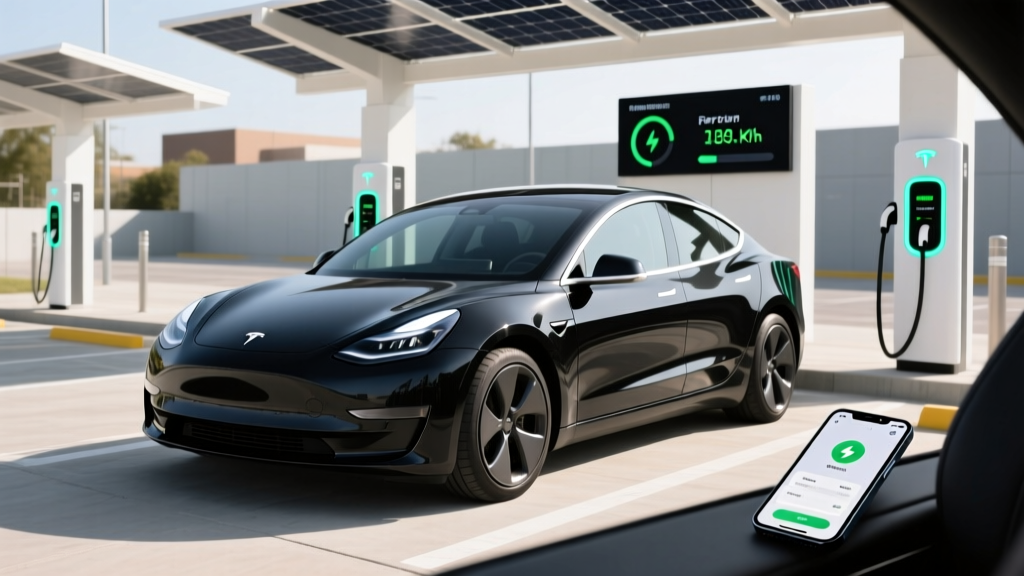
Every prospective Tesla buyer eventually asks the same question: does it cost money to charge your Tesla? The short answer is yes — electricity isn't free — but the real answer depends entirely on where and how you charge. A 2026 Tesla Model 3 charged at home on a residential rate can cost as little as $0.04 per mile, while relying exclusively on DC fast charging can push that to $0.15 per mile or more. That's a nearly 4x spread that fundamentally changes the ownership math.
This review uses the 2026 Tesla Model 3 (the current-generation "Highland" refresh) as our reference vehicle to answer the charging-cost question with hard numbers — and to evaluate the car itself across range, performance, tech, and value. Whether you're cross-shopping against a Hyundai Ioniq 6 or a BMW i4, the data below will tell you exactly what to expect.
2026 Tesla Model 3: Core Specifications at a Glance
| Spec | Model 3 RWD | Model 3 Long Range AWD | Model 3 Performance |
|---|---|---|---|
| EPA Range | 272 mi | 341 mi | 315 mi |
| Battery (usable) | ~57.5 kWh (LFP) | ~75 kWh (NMC) | ~75 kWh (NMC) |
| Drivetrain | RWD, single motor | AWD, dual motor | AWD, dual motor |
| Horsepower | 271 hp | 346 hp | 510 hp |
| 0–60 mph | 5.8 sec | 4.2 sec | 2.9 sec |
| Efficiency (MPGe) | 132 MPGe combined | 134 MPGe combined | 121 MPGe combined |
| kWh/100 mi | 25 | 25 | 28 |
| Max DC Fast Charge | 170 kW | 250 kW | 250 kW |
| 10–80% DCFC Time | ~25 min | ~20 min | ~20 min |
| Level 2 Home Charge Rate | 11.5 kW (~44 mi/hr) | 11.5 kW (~44 mi/hr) | 11.5 kW (~44 mi/hr) |
| Base MSRP | $38,990 | $45,990 | $53,990 |
| Battery Warranty | 8 yr / 100,000 mi | 8 yr / 120,000 mi | 8 yr / 120,000 mi |
Source: EPA Fuel Economy and Tesla.com. Prices reflect 2026 model-year MSRPs before destination fees or incentives.
Real-World Range: What the EPA Sticker Doesn't Tell You
EPA sticker: 341 miles. Real-world expectation: ~275–300 miles on a sustained 75 mph highway run in moderate temperatures. In sub-freezing winter conditions (below 32°F), expect 220–250 miles of usable range before needing to charge.
The EPA test cycle includes low-speed city driving and moderate highway segments, which flatters every EV. In our experience and consistent with third-party highway range tests, the Model 3 Long Range delivers roughly 85–90% of its EPA rating at 65 mph in 70°F weather. Push that to 75–80 mph and you'll see 78–82%.
The RWD model's smaller LFP (lithium iron phosphate) battery behaves differently than the Long Range's NMC (nickel manganese cobalt) pack. LFP chemistry tolerates regular 100% charging without accelerated degradation — Tesla actually recommends periodic full charges for LFP to maintain accurate state-of-charge calibration. NMC packs, by contrast, benefit from daily charging limits of 80–90% to maximize long-term health. This means the RWD's effective daily range is closer to its full 272 miles, while the Long Range's daily usable range at an 80% limit is about 273 miles — nearly identical in practice.
Cold weather hits all lithium-ion batteries. The Model 3's heat pump (standard on all trims) mitigates cabin-heating energy draw, but the battery's internal resistance still rises in freezing temperatures. Plan for 25–35% range loss in sustained sub-30°F driving versus the EPA number. Tesla's battery preconditioning — which activates when you navigate to a Supercharger — warms the pack for faster charging, but it doesn't recover lost range.
How Much Does It Actually Cost to Charge a Tesla?
This is the core question. Charging cost depends on three variables: your electricity rate (measured in $/kWh), the Model 3's efficiency (kWh consumed per mile), and charging overhead losses (typically 5–10% for AC home charging).
The Model 3 Long Range consumes approximately 25 kWh per 100 miles (or 0.25 kWh/mile) according to EPA data. Using that figure:
| Charging Scenario | Rate ($/kWh) | Cost Per Mile | Cost for Full 341-mi Range |
|---|---|---|---|
| Home (national avg. residential) | $0.16 | $0.044 | $15.00 |
| Home (off-peak TOU rate) | $0.08 | $0.022 | $7.50 |
| Home (high-cost state, e.g. CA avg.) | $0.30 | $0.083 | $28.30 |
| Tesla Supercharger V4 (avg.) | $0.35 | $0.096 | $32.70 |
| Third-party DCFC ( Electrify America, EVgo) | $0.48 | $0.132 | $45.00 |
| Free workplace / destination charging | $0.00 | $0.00 | $0.00 |
For comparison, a 30 MPG gas car at $3.40/gallon costs roughly $0.113 per mile. Home-charged Model 3 owners in average-rate states pay less than half that. Even at California residential rates, the Model 3 undercuts gasoline per mile. The cost advantage disappears only when you rely exclusively on premium-priced public DC fast chargers.
Key insight: The single biggest financial decision in Tesla ownership is securing reliable home Level 2 charging. If you can install a 240V outlet or hardwired wall connector, your per-mile fuel cost drops to $0.02–$0.05. If you're apartment-bound and dependent on public charging, your "fuel" cost can approach or exceed that of a fuel-efficient hybrid.
Charging Speed: Home, Supercharger, and the Curve Reality
| Level | Power (kW) | Miles of Range Added Per Hour | Typical Use Case |
|---|---|---|---|
| Level 1 (120V household) | ~1.4 kW | ~4–5 mi/hr | Overnight trickle, emergency |
| Level 2 (240V, 48A Wall Connector) | 11.5 kW | ~44 mi/hr | Daily home charging |
| DC Fast Charge (Supercharger V4) | Peak 250 kW | ~200+ mi in 15 min (LR AWD) | Road trips |
A critical concept new EV buyers often miss: peak charge rate is not sustained charge rate. The Model 3 Long Range can accept up to 250 kW, but only at a low state of charge (roughly 5–20%). As the battery fills, the charge curve tapers. By 60% SoC, you're typically seeing 100–120 kW. By 80%, it drops to roughly 50–60 kW. Charging from 80% to 100% on DC fast charge can take as long as 10% to 80% — which is why Tesla (and every EV manufacturer) recommends limiting road-trip fast charges to 80%.
The RWD model's LFP battery peaks at 170 kW, which sounds like a disadvantage but reflects the smaller pack's thermal and electrical limits. In practice, the RWD's 10–80% time of ~25 minutes is competitive with many rivals in the segment.
For home Level 2 charging, the Tesla Wall Connector (or any J1772/NACS-compatible Level 2 EVSE) at 48 amps delivers 11.5 kW. That's enough to fully recharge a Long Range from 10% to 100% overnight in about 7 hours. Most owners who charge at home every night never need more than 3–4 hours of Level 2 to replenish daily driving.
Performance, Interior, and Technology
The 2026 Model 3 Highland refresh brought meaningful refinements: a quieter cabin with acoustic glass, ventilated front seats, rear-seat touchscreen, ambient lighting, and a stiffer suspension tune that improves ride compliance over the pre-refresh car.
Performance: The Performance trim's 2.9-second 0–60 mph time puts it in supercar territory, and the dual-motor AWD system delivers relentless traction. The Long Range AWD's 4.2-second run is more than adequate for any real-world merge or passing situation. Even the base RWD at 5.8 seconds is quicker than most gas-powered sedans in its price class.
Cargo and passenger space:
- Rear cargo (trunk): 23 cu ft (including under-floor storage)
- Frunk (front trunk): 3.1 cu ft
- Total cargo: 26.1 cu ft
- Rear legroom: 35.3 inches
- Front legroom: 42.3 inches
- Seating: 5 passengers
The Model 3's cargo volume trails the Model Y crossover significantly (76 cu ft behind the front seats in the Y), but it's competitive with sedans like the Ioniq 6 (20.1 cu ft trunk) and BMW i4 (16.6 cu ft trunk).
Tech and driver assistance: The 15.4-inch center touchscreen runs Tesla's proprietary infotainment — no Apple CarPlay or Android Auto, which remains a dealbreaker for some buyers. Navigation, media, climate, and vehicle controls all route through the screen. The rear-seat 8-inch screen handles climate and media for rear passengers.
Tesla's Basic Autopilot (standard) and Full Self-Driving (Supervised) ($8,000 option or $99/month) are SAE Level 2 systems. They provide adaptive cruise control and lane-centering, but the driver must remain fully engaged — hands on or near the wheel, eyes on the road. FSD (Supervised) handles more complex scenarios (city streets, stop signs, traffic lights) but is not autonomous. Tesla's camera-only "Tesla Vision" approach lacks the lidar redundancy of some competitors. Treat these as advanced cruise systems, not self-driving.
Pricing, Tax Credits, and What You'll Actually Pay
| Trim | Base MSRP | Est. §30D Credit | Effective Price (if eligible) |
|---|---|---|---|
| RWD | $38,990 | Up to $7,500 | ~$31,490 |
| Long Range AWD | $45,990 | Up to $7,500 | ~$38,490 |
| Performance | $53,990 | Up to $7,500 | ~$46,490 |
Federal tax credit eligibility is not automatic. Under current IRS §30D rules, you must meet all of the following:
- Income caps: Modified AGI ≤ $150,000 (single), $225,000 (head of household), or $300,000 (married filing jointly)
- MSRP cap: Vehicle base MSRP must not exceed $55,000 for sedans (all Model 3 trims qualify)
- Battery sourcing: A percentage of critical minerals and battery components must be sourced from the U.S. or FTA partners — this determines whether you receive the full $7,500 or a partial $3,750 credit. Tesla's supply chain has shifted substantially, and eligibility can change month to month
- Point-of-sale transfer: As of 2024, you can transfer the credit to the dealer at purchase, reducing your out-of-pocket cost immediately rather than waiting for tax filing
Verify current eligibility on fueleconomy.gov before purchasing — battery-sourcing compliance is updated periodically and can affect whether a specific build qualifies for the full or half credit.
Warranty, Ownership Costs, and Long-Term Value
Tesla's warranty structure is straightforward:
- Basic vehicle: 4 years / 50,000 miles
- Battery & drive unit (RWD): 8 years / 100,000 miles, minimum 70% capacity retention
- Battery & drive unit (LR AWD / Performance): 8 years / 120,000 miles, minimum 70% capacity retention
The 70% retention threshold is industry-standard. In practice, Tesla's NMC packs have shown degradation curves that plateau around 90–92% state of health after 50,000–80,000 miles based on fleet data — well above the warranty floor. LFP packs in the RWD model tend to degrade even more slowly due to the chemistry's inherent cycle-life advantage.
Insurance: Model 3 insurance premiums average 15–25% higher than comparable gas sedans, driven by Tesla's higher repair costs (aluminum panels, sensor recalibration, proprietary parts). Budget $1,800–$2,800/year depending on your state and driving record.
Maintenance: Minimal compared to ICE vehicles. No oil changes, no spark plugs, no transmission fluid. Expect cabin air filter replacement (~$50–100 every 2 years), tire rotation, and wiper fluid. Tesla recommends brake fluid checks every 2 years, though regenerative braking dramatically extends pad life — many owners report original brake pads at 80,000+ miles.
Pros, Cons, and Who Should Buy the Model 3
Pros
- Class-leading efficiency (25 kWh/100 mi) keeps per-mile charging costs low
- Access to the Tesla Supercharger network — the most reliable and extensive DC fast-charging network in North America
- Over-the-air software updates continuously add features
- Highland refresh significantly improved cabin quietness and ride quality
- Strong resale value relative to most EV competitors
- LFP battery on RWD allows daily 100% charging without degradation concerns
Cons
- No Apple CarPlay or Android Auto — Tesla's ecosystem is the only option
- Rear visibility is limited; reliance on cameras and mirrors
- Turn signal stalks removed in Highland refresh — steering-wheel buttons instead (love it or hate it)
- Service center availability varies by region; mobile service can't address all issues
- FSD (Supervised) remains a $8,000 upsell for a Level 2 system that requires full driver attention
- Cargo space trails crossover alternatives
- Choose the Model 3 RWD if: You commute under 60 miles daily, have home Level 2 charging, and want the lowest entry price with LFP longevity. The ~$31,500 effective price (with full credit) is exceptional value.
- Choose the Long Range AWD if: You take regular road trips, live in a cold-weather state, or need AWD traction. The 341-mile EPA range provides genuine road-trip flexibility with fewer charge stops.
- Choose the Performance if: You want sports-car acceleration in a daily driver and accept the efficiency and price trade-offs.
- Look elsewhere if: You need hatchback/crossover cargo space (consider the Model Y or Ioniq 5), demand CarPlay integration, or lack access to any form of home or workplace charging.
Frequently Asked Questions
Does it cost money to charge your Tesla at home?
Yes. Home charging draws from your electricity bill at your utility's residential rate (national average ~$0.16/kWh in 2026). A full charge of the Model 3 Long Range costs roughly $15 at average rates, or about $7.50 on off-peak time-of-use plans. This is significantly cheaper than gasoline per mile.
Are Tesla Superchargers free?
No. Tesla phased out free unlimited Supercharging years ago. Current V4 Supercharger rates average $0.30–$0.40/kWh depending on location and time of day. Some Tesla-owned destination chargers at hotels remain complimentary, but these are Level 2 (slow) chargers.
Can I charge a Tesla at non-Tesla public chargers?
Yes. Since the 2025 model year, Tesla vehicles sold in North America come with the NACS (North American Charging Standard) port natively. Tesla also provides adapters for CCS1 chargers. The expanding Supercharger network is now opening to other brands, but Tesla owners retain full access to both Tesla and third-party networks.
How long does a Tesla battery last before replacement?
Tesla's battery warranty guarantees at least 70% capacity retention for 8 years/100,000–120,000 miles. Real-world fleet data suggests most Model 3 packs retain 85–92% capacity at 100,000 miles. Full battery replacement (rare) costs approximately $12,000–$16,000 out of warranty, though prices have been declining as battery manufacturing scales.
Does the 2026 Model 3 qualify for the $7,500 federal tax credit?
All Model 3 trims fall under the $55,000 sedan MSRP cap. However, full credit eligibility depends on battery-sourcing compliance (critical minerals and component manufacturing requirements) and your personal income. Check fueleconomy.gov and consult a tax professional before relying on the credit in your purchase decision. The credit can be transferred at point of sale to reduce your upfront cost.
Is the Model 3 worth it versus the Hyundai Ioniq 6 or BMW i4?
The Ioniq 6 offers comparable range (up to 361 mi EPA) with 800V architecture for faster peak charging, but lacks Supercharger network access (though this gap is narrowing with NACS adoption). The BMW i4 provides a more traditional luxury interior and CarPlay but starts ~$10,000 higher. The Model 3's advantages remain its Supercharger ecosystem, efficiency, software, and price — particularly after the federal credit.