Tesla How Long to Charge: The 2026 Model 3 Breakdown
If you've ever typed "tesla how long to charge" into a search bar, you're not alone. It's one of the most common questions from EV shoppers — and the answer depends heavily on which Tesla model you're looking at, what charging equipment you have access to, and the battery chemistry inside the pack. For this guide, we're putting the 2026 Tesla Model 3 under the microscope, because it remains the brand's volume seller and the entry point for most first-time Tesla buyers.
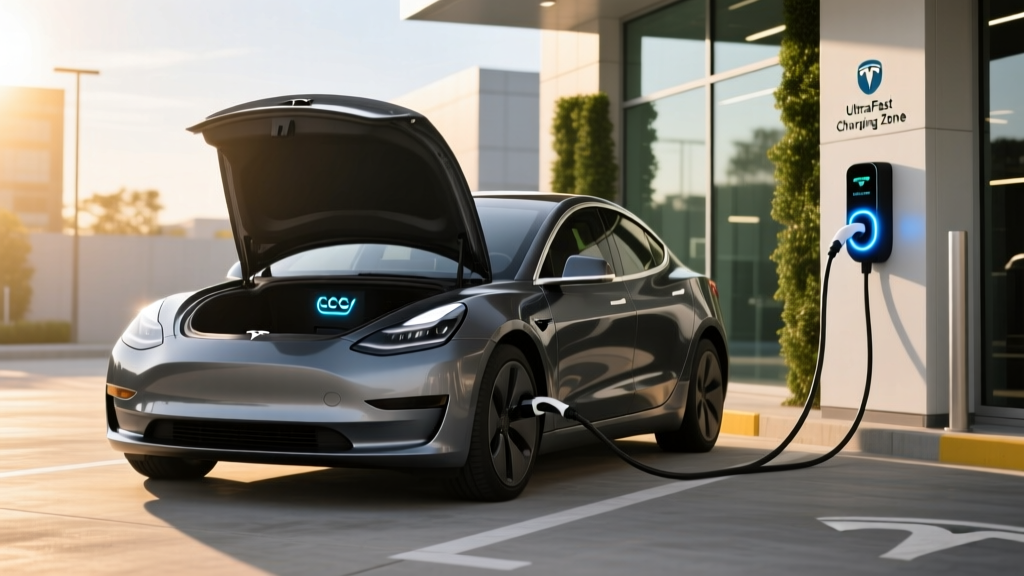
The short answer: at a V4 Supercharger, a Model 3 Long Range can recover from 10% to 80% state of charge (SoC) in roughly 25 minutes. At home on a Level 2 wall connector, you'll add about 44 miles of range per hour. But the full picture — which is what actually matters for ownership — requires digging into the charge curve, battery chemistry, and real-world conditions. Let's get into it.
2026 Tesla Model 3: Quick Spec Reference
| Spec | RWD (Standard Range) | Long Range AWD | Performance AWD |
|---|---|---|---|
| EPA Range | 272 mi | 363 mi | 315 mi |
| Battery (usable) | ~57 kWh (LFP) | ~75 kWh (NMC) | ~75 kWh (NMC) |
| Max DC Fast Charge | 170 kW | 250 kW | 250 kW |
| 10–80% DC Time | ~30 min | ~25 min | ~25 min |
| Level 2 Home Rate | ~30 mi/hr (7.6 kW) | ~44 mi/hr (11.5 kW) | ~44 mi/hr (11.5 kW) |
| 0–60 mph | 5.8 sec | 4.2 sec | 2.9 sec |
| Horsepower | 271 hp | 346 hp | 510 hp |
| Drivetrain | RWD | Dual-Motor AWD | Dual-Motor AWD |
| Base MSRP | $38,990 | $47,740 | $54,990 |
| MPGe (combined) | 132 MPGe | 134 MPGe | 125 MPGe |
| Battery Warranty | 8 yr / 100,000 mi | 8 yr / 120,000 mi | 8 yr / 120,000 mi |
Sources: fueleconomy.gov, Tesla Model 3 specs.
Charging Speed: DC Fast, Level 2, and Level 1 Explained
Understanding kW (kilowatts — the rate of power delivery) versus kWh (kilowatt-hours — the battery's energy capacity) is essential. Think of kW as the width of the pipe and kWh as the size of the tank. A wider pipe fills the tank faster, but the flow tapers as the tank nears full.
| Charging Level | Power (kW) | Approx. Miles Added per Hour | Typical Use Case |
|---|---|---|---|
| Level 1 (120V outlet) | ~1.4 kW | ~5 mi/hr | Emergency / overnight trickle |
| Level 2 (240V Wall Connector) | 11.5 kW | ~44 mi/hr | Daily home charging |
| DC Fast (V3 Supercharger) | Up to 250 kW peak | ~1,000+ mi/hr (peak) | Road trips |
| DC Fast (V4 Supercharger) | Up to 250 kW (current vehicles) | ~1,000+ mi/hr (peak) | Road trips, newer stations |
The Charge Curve Reality
Tesla's advertised "250 kW" is a peak, not a sustained rate. In real-world testing, the Model 3 Long Range ramps quickly to around 240–250 kW between roughly 10% and 30% SoC, then gradually tapers. By 60% SoC, you're seeing closer to 100–120 kW. By 80%, it drops to around 50 kW or less. This is why manufacturers quote 10–80% times rather than 0–100%: the last 20% can take as long as the first 60%.
If you're planning a road trip, the practical takeaway is this: plan to charge from 10–20% up to 70–80% at each stop. That sweet spot takes about 18–22 minutes and gives you roughly 200–250 miles of highway range. Charging past 80% at a Supercharger is rarely worth the time unless you're at your final destination.
Home Charging Setup
The Tesla Wall Connector on a 60-amp circuit (48-amp continuous) delivers up to 11.5 kW to the Long Range and Performance models. That means a full charge from near-empty takes about 7–8 hours overnight — more than enough for any daily commute. The RWD model, with its smaller LFP battery, charges at a lower 7.6 kW on Level 2, filling in roughly 6 hours.
Installation costs for a 240V / 60A circuit typically range from $500 to $2,500 depending on the distance from your electrical panel and whether a panel upgrade (to 200A service) is needed. Tesla's Wall Connector itself retails for around $475.
Real-World Range vs. EPA Estimates
EPA Estimate: 363 miles
Real-World Highway (70 mph, mild weather): ~300–320 miles
Real-World Cold Weather (below 30°F): ~250–280 miles
Real-World City (moderate regen, mild): ~340–360 miles
The EPA range figure is generated under a controlled test cycle that includes city, highway, and idle segments. It's a useful baseline, but no one drives under lab conditions. Highway driving at sustained speeds above 70 mph increases aerodynamic drag significantly — EVs are especially sensitive to this because they have no multi-speed transmission to optimize efficiency.
Cold weather compounds the issue. Lithium-ion batteries operate less efficiently at low temperatures, and the cabin heater draws substantial energy. Tesla's heat pump (standard on all current Model 3 variants) helps — it's roughly 2–3× more efficient than resistive heating — but you should still budget a 20–30% range reduction in sub-freezing conditions. Fueleconomy.gov lists the combined MPGe at 134 for the Long Range, but expect real-world efficiency closer to 27–29 kWh/100 mi on the highway versus the EPA-rated 25 kWh/100 mi.
One advantage of the RWD model's LFP (lithium iron phosphate) battery: Tesla recommends charging LFP packs to 100% regularly, which means you get access to the full 272 EPA miles daily. NMC packs in the Long Range and Performance trims are best kept between 20–80% for longevity, giving you a practical daily range of roughly 290 miles — still excellent.
Pricing, Trims, and Federal Tax Credit Eligibility
| Trim | Base MSRP | As-Tested (typical) | §30D Credit Eligible? | Effective Price (if eligible) |
|---|---|---|---|---|
| RWD | $38,990 | $40,490 (w/ delivery) | Yes (subject to rules) | ~$31,490–$32,990 |
| Long Range AWD | $47,740 | $49,240 (w/ delivery) | Yes (subject to rules) | ~$39,740–$41,740 |
| Performance AWD | $54,990 | $56,490 (w/ delivery) | Yes (subject to rules) | ~$46,990–$48,990 |
Federal Tax Credit (§30D) Rules You Must Know
All three Model 3 trims are manufactured in the U.S. (Fremont, CA) and have historically qualified for the $7,500 federal EV tax credit under IRS §30D — but eligibility is not automatic. Here's what you need to verify:
- Income caps: Modified adjusted gross income (MAGI) must not exceed $150,000 (single), $225,000 (head of household), or $300,000 (joint filers).
- MSRP cap: The vehicle's MSRP (including delivery but excluding destination) must not exceed $55,000 for sedans. All Model 3 trims currently clear this bar, but options can push the Long Range and Performance close to the limit.
- Battery sourcing: A percentage of critical minerals and battery components must be sourced from the U.S. or free-trade-agreement countries. These thresholds tighten annually. Tesla's supply chain has largely complied, but the IRS maintains the official list of eligible vehicles — always verify before purchase.
- Point-of-sale transfer: As of 2024, buyers can transfer the credit to the dealer (Tesla) at purchase, reducing the purchase price directly rather than waiting for a tax refund.
Important: Tax rules change. Consult a tax professional and check IRS.gov for the most current guidance before purchasing.
Performance, Tech, and Daily Ownership
Driving Dynamics
The Model 3 Performance remains one of the quickest sedans under $60,000 with a 2.9-second 0–60 mph time and 510 hp from its dual-motor setup. The Long Range at 4.2 seconds is hardly slow, and even the RWD model's 5.8-second run is competitive with turbocharged gas sedans. All trims benefit from Tesla's low center of gravity (battery pack under the floor) and precise steering, though the ride is firm — especially with the 19-inch sport wheels.
Interior and Cargo
The refreshed "Highland" interior (introduced for the 2024 model year and carried into 2026) improved cabin materials, added ventilated front seats, ambient lighting, and a rear touchscreen for passengers. Cargo space totals 23 cu ft (trunk + frunk), which is competitive with compact sedans but less than a Model Y or crossover rival. Rear legroom measures 35.3 inches — adequate for adults on shorter trips, tight for anyone over 6 feet on long drives.
Driver Assistance: Autopilot and FSD
Tesla Autopilot and Full Self-Driving (Supervised) are Level 2 driver-assist systems, not autonomous driving. The driver must remain fully engaged — hands on the wheel, eyes on the road — at all times. These systems can manage lane centering, adaptive cruise, and stop-and-go traffic, but they do not replace the driver.
Tesla's Autopilot (standard) handles highway lane-keeping and adaptive cruise competently. The optional FSD (Supervised) package, currently priced at $8,000 or $99/month, adds automated lane changes, traffic light/stop sign recognition, and city-street navigation. It's impressive in well-marked environments but still requires constant supervision and can behave unpredictably in construction zones or unusual road configurations.
Efficiency and Operating Costs
At the U.S. average electricity rate of ~$0.17/kWh and the Long Range's real-world efficiency of ~27 kWh/100 mi, you're looking at roughly $0.046 per mile for home charging. Compare that to a 30 MPG gas sedan at $3.50/gallon — about $0.117 per mile. Over 15,000 miles annually, the Model 3 saves roughly $1,065 per year in energy costs alone. Supercharger costs are higher, typically $0.25–$0.40/kWh depending on location and time of day.
Pros and Cons: Honest Assessment
- Best-in-class Supercharger network reliability and coverage
- Class-leading efficiency (kWh/mi) in the sedan segment
- Strong 0–60 performance across all trims
- Over-the-air updates add features post-purchase
- Extensive charging infrastructure reduces road-trip anxiety
- Strong resale value relative to EV peers
- Firm ride quality, especially on 19-inch wheels
- Turn signals via steering-wheel buttons (no stalk) take adjustment
- Rear seat space tight for tall adults on long trips
- No Apple CarPlay / Android Auto integration
- FSD is expensive and still requires full driver supervision
- Insurance premiums 15–25% higher than comparable gas sedans
Who Should Buy the 2026 Tesla Model 3?
Best for: Tech-forward commuters who want low operating costs, have access to home charging (Level 2 recommended), and take occasional road trips. The Long Range AWD is the sweet spot — 363 EPA miles means most people can commute all week on a single charge and hit the Supercharger for weekend trips.
Consider alternatives if: You need maximum rear-seat space (look at the Model Y or Hyundai Ioniq 5), prefer a traditional infotainment interface with phone projection, or live in an apartment without charging access. The Model 3's sedan form factor also limits cargo versatility compared to hatchback and crossover EVs.
Key competitors: The Hyundai Ioniq 6 (361 mi EPA, $42,500) offers comparable range with a more compliant ride and CarPlay. The BMW i4 eDrive40 (307 mi, $57,000) delivers a more premium interior but at a significant price premium. The Polestar 2 (320 mi, $49,900) is well-built but less efficient.
Frequently Asked Questions
How long does it take to charge a Tesla Model 3 at home?
On a Level 2 Tesla Wall Connector (240V, 48A), the Long Range and Performance models add about 44 miles of range per hour, with a full 10–100% charge taking roughly 7–8 hours. The RWD model charges at about 30 miles per hour, completing a full charge in around 6 hours. On a standard 120V outlet (Level 1), expect just 5 miles per hour — suitable only for topping off or emergency use.
How long does it take to charge a Tesla at a Supercharger?
At a V3 or V4 Supercharger, the Model 3 Long Range and Performance achieve a 10–80% charge in approximately 25 minutes. The RWD model takes about 30 minutes due to its lower 170 kW peak charge rate and smaller battery. Actual times vary based on battery temperature, station load, and state of charge when you plug in. Preconditioning the battery (the car does this automatically when you navigate to a Supercharger) is critical for achieving peak charge speeds.
Does the Tesla Model 3 qualify for the $7,500 federal tax credit?
As of 2026, all Model 3 trims are eligible for the full $7,500 federal tax credit under IRS §30D — provided you meet the income caps ($150K single / $300K joint), the vehicle MSRP stays under $55,000, and battery sourcing requirements are met. The credit can be transferred at point of sale to reduce your purchase price directly. Always verify current eligibility on IRS.gov before purchasing.
What is the real-world range of the Tesla Model 3?
The EPA rates the Long Range AWD at 363 miles, but real-world highway driving at 70 mph in mild weather yields roughly 300–320 miles. In cold weather (below 30°F), expect 250–280 miles. The RWD model's 272 EPA miles translates to about 230–250 highway miles in practice. City driving with regenerative braking can match or slightly exceed EPA estimates.
Is the Tesla Model 3 worth buying over competitors?
The Model 3's strongest advantages are the Supercharger network, segment-leading efficiency, and strong resale value. If those priorities align with your needs, it's arguably the best electric sedan under $50,000. If you value ride comfort, rear-seat space, or phone integration more highly, the Hyundai Ioniq 6 or BMW i4 deserve serious consideration. Test-drive both before deciding.
How long will the Tesla Model 3 battery last?
Tesla warranties the Long Range and Performance battery for 8 years / 120,000 miles (whichever comes first) with a minimum 70% capacity retention guarantee. The RWD's LFP battery is warranted for 8 years / 100,000 miles at the same 70% threshold. Real-world data from Tesla's fleet suggests NMC packs retain roughly 85–90% capacity at 100,000 miles, while LFP packs show even slower degradation due to their chemistry. Replacement cost, should it ever be needed out of warranty, currently ranges from $12,000 to $16,000 depending on the pack.