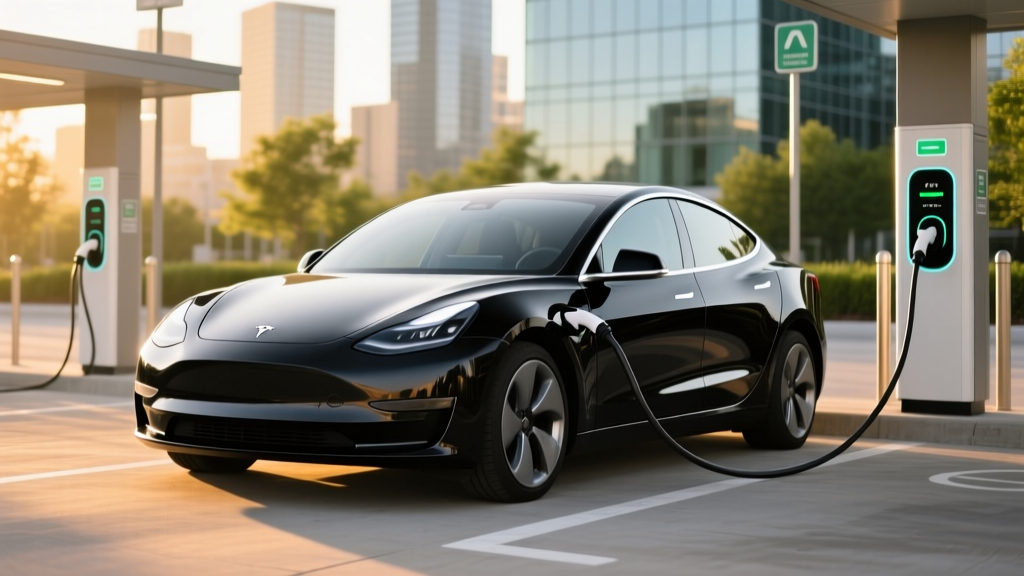
If you're researching the Tesla Model 3, one question inevitably rises to the top: how long does the Tesla Model 3 take to charge? The answer depends on which 2026 trim you choose, what charger you're standing in front of, and whether you understand the difference between peak power (kW) and sustained charging speed. Below, we break down every charging scenario — from a 250 kW Supercharger to a standard wall outlet — alongside the range, efficiency, pricing, and ownership data you need to decide if the refreshed Model 3 still earns its benchmark status.
Tesla Model 3 at a Glance: 2026 Specs
The 2026 Tesla Model 3 carries over the "Highland" refresh architecture introduced in late 2023, with incremental battery and software updates. Three trims remain in the US lineup: the Standard Range RWD, the Long Range AWD, and the Performance AWD. Here's the spec snapshot before we get into charging specifics.
| Spec | Standard Range RWD | Long Range AWD | Performance AWD |
|---|---|---|---|
| EPA Range | 272 mi | 363 mi | 315 mi |
| Battery (usable) | ~60 kWh (LFP) | ~75 kWh (NMC) | ~75 kWh (NMC) |
| Max DC Fast Charge | 170 kW | 250 kW | 250 kW |
| 10–80% DCFC Time | ~25 min | ~22 min | ~22 min |
| Level 2 (11.5 kW) Rate | ~44 mi/hr | ~44 mi/hr | ~44 mi/hr |
| 0–60 mph | 5.8 sec | 4.2 sec | 2.9 sec |
| Horsepower | 271 hp | 384 hp | 510 hp |
| Drivetrain | RWD | Dual-Motor AWD | Dual-Motor AWD |
| Efficiency (MPGe) | 132 MPGe | 125 MPGe | 115 MPGe |
| Base MSRP | $38,990 | $47,740 | $53,990 |
How Long Does the Tesla Model 3 Take to Charge?
This is the core question, and the answer spans a wide range depending on your power source. Here's the full breakdown by charging level for the Long Range AWD (the most popular trim), followed by notes on how the Standard Range differs.
| Charging Level | Power / Voltage | Miles Added per Hour | 10–80% Time | Best Use Case |
|---|---|---|---|---|
| Level 1 (120V outlet) | ~1.4 kW | ~3–4 mi/hr | ~45+ hours | Emergency top-up only |
| Level 2 (240V, 32A Mobile Connector) | ~7.7 kW | ~30 mi/hr | ~9.5 hours | Budget home charging |
| Level 2 (240V, 48A Wall Connector) | 11.5 kW | ~44 mi/hr | ~6.5 hours | Daily home charging (ideal) |
| DC Fast (Tesla Supercharger V3) | Up to 250 kW | Up to ~1,000 mi/hr (peak) | ~22 min | Road trips, quick stops |
| DC Fast (CCS adapter, non-Tesla) | Up to 250 kW* | Similar to Supercharger | ~22–25 min | Non-Tesla network access |
*Actual CCS speeds depend on the station's max output and the adapter's throughput. Tesla's native NACS connector remains the most seamless DC fast-charging experience.
What the Charging Curve Actually Looks Like
A common mistake new EV buyers make is assuming a 250 kW peak charge rate means the car sustains 250 kW from 10% to 80%. It doesn't. The Model 3 Long Range hits ~250 kW only between roughly 10–20% State of Charge (SoC), then tapers progressively. From 50–80%, you're typically seeing 80–120 kW. This is why the 10–80% time (~22 minutes) is the meaningful metric — not the peak kW number plastered on marketing materials.
On the Standard Range RWD, the LFP battery chemistry charges at a lower peak of 170 kW, and LFP cells tolerate being held at 100% SoC far better than NMC. Tesla actually recommends periodic 100% charges for the Standard Range to help the battery management system (BMS) recalibrate — a notable ownership difference from the Long Range and Performance trims, where daily charging to 80% is recommended for longevity.
Cold-Weather Charging Penalty
If you live in a climate where winter temperatures drop below freezing, expect DC fast-charge times to increase by 20–40% unless you precondition the battery. The Model 3's heat pump and navigation-based battery preconditioning help — when you route to a Supercharger, the car warms the pack before you arrive. Without preconditioning, a cold-soaked battery at 20°F might only accept 50–80 kW initially, stretching that 22-minute session to 30+ minutes. Always navigate to your charger; don't just punch in the address from a third-party app.
Real-World Range: What You'll Actually Drive
EPA Estimate: 363 miles (Long Range AWD) / 272 miles (Standard Range RWD) / 315 miles (Performance AWD)
Real-World Expectation: On mixed highway driving at 70–75 mph, expect roughly 300–320 miles from the Long Range, 225–240 miles from the Standard Range, and 265–280 from the Performance. In cold weather (below 32°F), subtract another 15–25% due to cabin heating demand and increased battery resistance. The Model 3's heat pump mitigates this better than most competitors, but physics still applies.
The Model 3 Long Range's efficiency — roughly 26 kWh per 100 miles (or 125 MPGe combined per fueleconomy.gov) — is among the best in its class. This efficiency matters more than raw battery size: a smaller, lighter pack delivering 363 miles beats a heavier competitor with a 90 kWh pack delivering the same range, because you're charging fewer kWh and paying less per mile.
Home Charging Setup: What You Need and What It Costs
Most Model 3 owners charge at home, and the Tesla Wall Connector (Gen 3 or newer) at 48 amps / 11.5 kW is the gold standard. It adds roughly 44 miles of range per hour of charging, meaning an overnight session from 80% to full takes just a few hours.
Installation cost reality: If your electrical panel has capacity and the run from panel to garage is short (under 30 feet), expect $500–$1,200 for professional installation plus the $475 Wall Connector. Longer runs, conduit through finished walls, or a panel upgrade (100A to 200A) can push total costs to $2,000–$4,500. Always get a quote from a licensed electrician — don't estimate panel capacity yourself.
The included Mobile Connector with a NEMA 14-50 adapter delivers ~7.7 kW (30 mi/hr) on a 240V/32A circuit, which is adequate for many owners who drive under 80 miles daily. A standard 120V household outlet (Level 1) is genuinely only practical as a backup or for very low-mileage drivers — at 3–4 miles per hour, it takes over 45 hours to charge a depleted Long Range battery.
2026 Pricing, Trims, and Federal Tax Credit Eligibility
The 2026 Model 3 lineup starts at $38,990 for the Standard Range RWD (including destination), scaling up to $53,990 for the Performance. Options like Ultra Red paint ($2,500), 19" Nova wheels ($1,500), and FSD (Supervised) ($8,000 one-time or $99/month) can push as-tested prices well above $60,000 on higher trims.
| Trim | Base MSRP | Federal §30D Credit | Effective Price |
|---|---|---|---|
| Standard Range RWD | $38,990 | Up to $7,500* | ~$31,490* |
| Long Range AWD | $47,740 | Up to $7,500* | ~$40,240* |
| Performance AWD | $53,990 | Up to $7,500* | ~$46,490* |
*Critical §30D eligibility caveats (per IRS guidelines):
- Income caps: Modified AGI must not exceed $150,000 (single), $225,000 (head of household), or $300,000 (joint filers).
- MSRP cap: Sedans must be under $55,000 MSRP. The Standard Range and Long Range qualify; the Performance at $53,990 base qualifies, but adding options that push MSRP above $55,000 could disqualify it. Verify your exact build.
- Battery sourcing: The full $7,500 requires meeting both critical-mineral and battery-component sourcing thresholds, which shift annually. Tesla's US-built LFP packs (Standard Range) and domestic NMC sourcing have generally qualified, but always confirm at the point of sale — the dealer/Tesla must certify compliance.
- Point-of-sale transfer: As of 2024+, you can transfer the credit to the dealer at purchase for an immediate price reduction rather than waiting to claim it on your tax return.
Interior, Tech, and the Tesla Differentiator
The Highland-refreshed Model 3 interior is genuinely a step up from pre-2024 models: acoustic glass all around, ventilated front seats, ambient lighting, and a rear 8" touchscreen for passengers. Cargo volume is 23 cubic feet (trunk + frunk combined), which is competitive with compact sedans but less than the Model Y's hatchback utility. Rear legroom measures 35.3 inches — adequate for adults on shorter trips, tight for anyone over 6'2" on longer drives.
The 15.4" center touchscreen handles everything — there are no physical stalks for turn signals (they're on the steering wheel) and no traditional instrument cluster. This minimalism is polarizing. If you're coming from a car with physical buttons and a speedometer in your sightline, budget a week of muscle-memory adjustment.
Driver assistance: Basic Autopilot (lane centering + adaptive cruise) is standard and is an SAE Level 2 system — meaning you must keep your hands on the wheel and eyes on the road at all times. Full Self-Driving (Supervised) adds automated lane changes, traffic light recognition, and city-street navigation, but remains Level 2. It is not autonomous driving, despite the name. The $8,000 FSD purchase is a bet on future capability, not a reflection of current hands-free operation.
Pros, Cons, and Who the Model 3 Suits Best
Pros
- Class-leading efficiency (125+ MPGe) means lower charging costs per mile
- Supercharger network remains the most reliable DC fast-charging ecosystem in the US
- 250 kW peak DCFC delivers genuine 20-minute road-trip stops
- Over-the-air updates continuously add features post-purchase
- Strong resale value relative to most EV competitors
- LFP battery on Standard Range tolerates 100% daily charging
Cons
- Turn signals on the steering wheel (not a stalk) frustrate many new owners
- Rear-seat space is tighter than the Hyundai Ioniq 6 or BMW i4
- No Apple CarPlay or Android Auto — Tesla's ecosystem is closed
- FSD (Supervised) costs $8,000 and remains Level 2, not autonomous
- Insurance premiums run 15–30% higher than equivalent gas sedans
- Standard Range LFP battery loses more range in extreme cold than NMC
Who Should Buy the Model 3?
The commuter who values efficiency: If your daily drive is 40–100 miles and you can charge at home, the Standard Range RWD at ~$31,490 (after credit) is one of the cheapest cost-per-mile vehicles on the road — electric or gas.
The road-tripper who needs fast charging: The Long Range AWD with 363 miles EPA and 250 kW Supercharger access makes 300+ mile days comfortable. Plan 20-minute stops every 3 hours and you'll match gas-car travel times on most corridors.
The performance buyer on a budget: The Performance trim's 2.9-second 0–60 time rivals a Porsche Taycan at half the price, though you sacrifice ~50 miles of range for the privilege.
Not ideal for: Families needing easy car-seat access (the Model Y's crossover stance is better), buyers who insist on Apple CarPlay, or those in regions with limited Supercharger density who need CCS-native charging flexibility.
Model 3 vs. Key Competitors: Is It Still Worth It?
The 2026 Model 3 faces stiffer competition than it did even two years ago. The Hyundai Ioniq 6 offers comparable range (361 mi SE Long Range), faster 800V charging (10–80% in ~18 min), and CarPlay — but lacks Supercharger access (though Hyundai's CCS-to-NACS adapter situation continues to improve). The BMW i4 eDrive40 is more refined and spacious but costs ~$10,000 more and charges slower. The Chevrolet Equus (if considering value EVs) doesn't exist; instead, look at the upcoming Chevrolet Bolt EUV successor or the Hyundai Kona Electric for sub-$40K alternatives with less range.
The Model 3's decisive advantage remains the Supercharger network and Tesla's software integration. If charging infrastructure reliability is your top priority — and you don't want to juggle multiple charging apps and adapters — the Tesla ecosystem still wins.
Frequently Asked Questions
How long does the Tesla Model 3 take to charge on a Supercharger?
On a V3 Supercharger (250 kW), the Long Range and Performance trims charge from 10% to 80% in approximately 22 minutes under ideal conditions (warm battery, preconditioned). The Standard Range peaks at 170 kW and takes about 25 minutes for the same session.
Can I charge a Tesla Model 3 at home with a regular outlet?
Yes, but slowly. A standard 120V household outlet delivers roughly 1.4 kW (Level 1), adding about 3–4 miles of range per hour. It's viable only as a backup or for drivers covering under 30 miles daily. A 240V Level 2 setup is strongly recommended for regular ownership.
Does the Tesla Model 3 qualify for the $7,500 federal tax credit?
It can, but eligibility depends on your income (AGI caps apply), the vehicle's MSRP (must stay under $55,000 for sedans), and battery-sourcing compliance. The Standard Range and Long Range trims at base MSRP generally qualify. Always verify with Tesla at purchase and consult a tax professional — rules change and your individual situation matters. See IRS §30D guidelines for current requirements.
What's the real-world range of the Tesla Model 3 Long Range?
The EPA rates it at 363 miles. In real-world highway driving at 70–75 mph, expect 300–320 miles. In winter conditions below freezing, expect 260–290 miles. The Model 3's heat pump helps, but cold weather always reduces EV range.
Is the Tesla Model 3 cheaper to own than a gas car?
Over 5 years, typically yes — especially if you charge at home on off-peak electricity rates (~$0.12–0.16/kWh). At national average electricity prices, the Model 3 costs roughly 4–5 cents per mile to "fuel," versus 12–15 cents per mile for a 30 MPG gas sedan at $3.50/gallon. Factor in lower maintenance (no oil changes, fewer brake replacements thanks to regen) and the total-cost-of-ownership advantage is significant, though higher insurance premiums partially offset the savings.
How long will the Tesla Model 3 battery last?
Tesla warranties the battery for 8 years or 100,000 miles (Long Range/Performance) or 8 years/100,000 miles (Standard Range), whichever comes first, with a minimum 70% capacity retention. Real-world degradation data from Tesla's fleet suggests most Model 3 packs retain ~90% capacity at 100,000 miles. LFP batteries in the Standard Range are rated for more charge cycles than NMC, potentially offering longer calendar life.