If you've searched "how long does it take to charge a Tesla fully," the honest answer depends on which Tesla you own, which charger you're standing in front of, and whether you actually need 100%. Most EV owners quickly learn that charging to full is rarely necessary — and sometimes counterproductive. But understanding the full spectrum of Tesla Model 3 charging times, from a 250 kW Supercharger stop to an overnight Level 2 top-up, is essential for ownership satisfaction and road-trip planning.
This guide dissects the 2026 Tesla Model 3 lineup — Long Range RWD, Long Range AWD, and Performance — with exact charging figures, real-world range expectations, and the ownership math that determines whether this sedan still earns its spot as the default EV benchmark.
2026 Tesla Model 3: Quick Verdict
The Model 3 remains Tesla's most accessible vehicle and arguably the most energy-efficient electric sedan on the market. With EPA range stretching to 363 miles on the Long Range RWD and DC fast charging that can add up to 175 miles in 15 minutes, it's built for both daily commuting and cross-country travel. The 2026 refresh (internally called "Highland") brought a quieter cabin, ventilated seats, ambient lighting, and a rear touchscreen — addressing the most common complaints from the pre-refresh model.
The catch? The minimalist interior still polarizes, the lack of physical stalks takes adjustment, and the base RWD model's LFP battery means slower charging and reduced winter range. But if you want an EV that just works with the most reliable charging network in North America, the Model 3 is still the answer.
Spec Sheet: 2026 Tesla Model 3 Lineup
| Specification | Long Range RWD | Long Range AWD | Performance |
|---|---|---|---|
| EPA Range | 363 mi | 341 mi | 315 mi |
| Battery (usable) | ~75 kWh (NMC) | ~75 kWh (NMC) | ~75 kWh (NMC) |
| Drivetrain | Rear-Wheel Drive | Dual-Motor AWD | Dual-Motor AWD |
| Horsepower | 271 hp | 346 hp | 510 hp |
| 0-60 mph | 5.8 sec | 4.2 sec | 2.9 sec |
| MPGe (combined) | 132 MPGe | 124 MPGe | 118 MPGe |
| Efficiency | 25 kWh/100mi | 27 kWh/100mi | 29 kWh/100mi |
| Max DC Fast Charge | 250 kW | 250 kW | 250 kW |
| Level 2 Home Charge | 11.5 kW (44 mi/hr) | 11.5 kW (44 mi/hr) | 11.5 kW (44 mi/hr) |
| Base MSRP | $42,490 | $47,490 | $54,990 |
| Cargo Volume | 23 cu ft (trunk + frunk combined) | ||
| Rear Legroom | 35.3 inches | ||
| Battery Warranty | 8 years / 120,000 miles (Long Range & Performance) | ||
Note: The base Model 3 RWD (not shown) uses a ~57.5 kWh LFP battery with 272 miles EPA range and 250 kW max DC charging. LFP batteries have different charging characteristics discussed below.
How Long Does It Take to Charge a Tesla Fully?
The answer changes dramatically depending on your charging method. Here's the breakdown most Tesla buyers actually need:
DC Fast Charging (Supercharger / CCS-compatible stations)
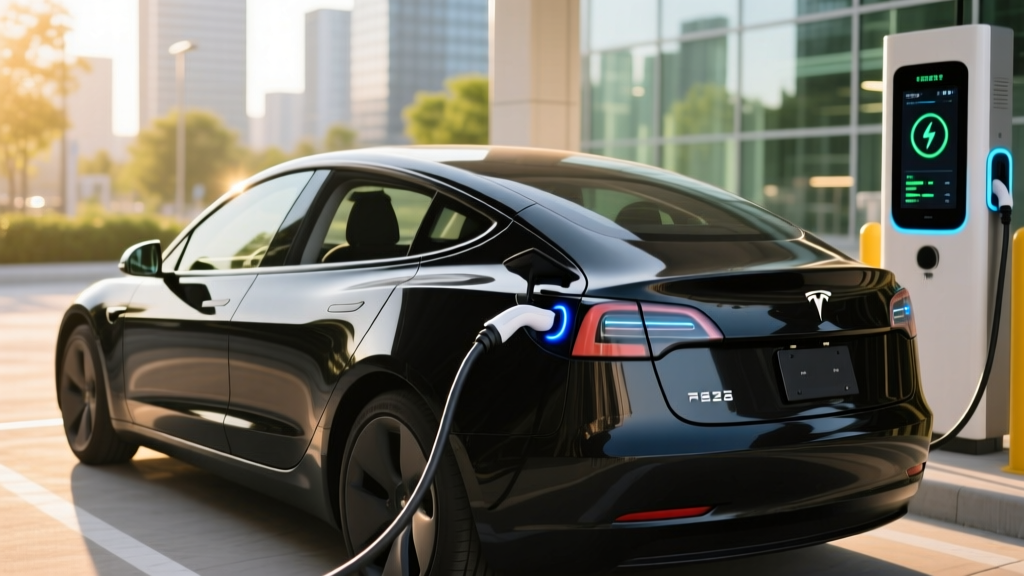
Tesla's V3 and V4 Superchargers deliver up to 250 kW of peak power to the Model 3. But peak power is not sustained power — this is where many new EV owners get confused. The charge curve tapers significantly as the battery fills:
| Charging Scenario | Time | Notes |
|---|---|---|
| 10% → 80% (Long Range, preconditioned) | ~28 minutes | Peak 250 kW sustained through ~50%, then tapering |
| 80% → 100% (Long Range) | ~35-40 additional minutes | Severe taper above 80%; charging slows to <30 kW |
| 0% → 100% (Long Range, full DC charge) | ~65-70 minutes total | Rarely recommended; unnecessary battery stress |
| 15 minutes at V3 Supercharger | Up to 175 miles added | From low SoC with preconditioning active |
Key insight: Charging from 80% to 100% on a DC fast charger takes longer than charging from 10% to 80%. This is why road-trip strategy focuses on short stops between 10-80% rather than full charges. The battery management system (BMS) restricts current flow at high state of charge to protect cell longevity.
Level 2 Home Charging (240V)
This is where most Tesla charging actually happens. The Model 3's onboard charger accepts up to 11.5 kW on Level 2, which translates to roughly 44 miles of range per hour of charging.
| Home Setup | Power Delivered | Miles Added/Hour | 0→100% Time (Long Range) |
|---|---|---|---|
| Tesla Wall Connector (48A circuit) | 11.5 kW | ~44 mi/hr | ~8 hours |
| Generic Level 2 (32A / 7.7 kW) | 7.7 kW | ~30 mi/hr | ~11.5 hours |
| Level 1 (120V outlet) | ~1.2 kW | ~3-4 mi/hr | ~60+ hours |
A full home charge from empty to 100% on a Tesla Wall Connector takes approximately 8 hours for the Long Range model. In practice, most owners plug in each evening and wake up to a full battery — the "full charge" question becomes irrelevant when you charge where you sleep.
LFP vs NMC: Why Your Battery Chemistry Matters
The base Model 3 RWD uses a lithium iron phosphate (LFP) battery, while Long Range and Performance trims use nickel manganese cobalt (NMC). This distinction directly affects your charging experience:
- LFP (Base RWD): Tesla recommends charging to 100% regularly — even daily. LFP chemistry tolerates full charges better and actually benefits from periodic full charges for BMS calibration. However, LFP charges slower at low temperatures and has lower energy density.
- NMC (Long Range / Performance): Tesla recommends setting daily charge limits to 80% and only charging to 100% before long trips. NMC degrades faster when held at high SoC for extended periods.
The Long Range AWD's EPA estimate of 341 miles is achieved under mixed driving conditions. Expect approximately:
- Highway (75 mph, mild weather): ~285-305 miles
- City / suburban mixed: ~320-340 miles (regen braking helps)
- Cold weather (below 32°F): ~240-275 miles (battery heating + cabin HVAC load)
- Cold weather + highway: ~220-250 miles (worst-case scenario)
The Model 3's heat pump (standard on all trims) mitigates cold-weather losses compared to resistive heating, but physics still applies: expect 20-30% range reduction in freezing temperatures. Source: EPA fueleconomy.gov
Pricing, Tax Credits, and Total Cost
The 2026 Model 3 pricing structure positions it competitively against rivals like the Hyundai Ioniq 6, BMW i4, and Polestar 2. But federal tax credit eligibility adds complexity.
| Trim | Base MSRP | Federal Credit (§30D) | Effective Price* |
|---|---|---|---|
| RWD (LFP) | $38,990 | Up to $7,500 | ~$31,490 |
| Long Range RWD | $42,490 | Up to $7,500 | ~$34,990 |
| Long Range AWD | $47,490 | Up to $7,500 | ~$39,990 |
| Performance | $54,990 | Up to $7,500 | ~$47,490 |
*Effective price assumes full §30D credit eligibility. As of 2026, the IRS §30D credit requires:
- MSRP cap: Sedans must be under $55,000 (all Model 3 trims qualify)
- Income cap: Modified AGI ≤ $150,000 (single), $225,000 (head of household), $300,000 (joint)
- Battery sourcing: Critical minerals and battery components must meet escalating domestic/free-trade-partner thresholds — Tesla's US-built battery packs have largely met these requirements, but verify at point of sale
- Point-of-sale transfer: You can transfer the credit to the dealer at purchase, reducing your out-of-pocket cost immediately rather than waiting for tax filing
Always confirm current eligibility with your tax professional and the dealer's point-of-sale documentation, as sourcing requirements tighten annually.
Interior, Cargo, and Daily Livability
The refreshed Model 3 interior is a meaningful step up from the pre-2024 model. Acoustic glass all around, ventilated front seats, ambient lighting, and a rear 8-inch touchscreen for passengers transform the cabin from "spartan" to "intentionally minimal." However, the absence of turn-signal stalks (replaced by steering-wheel buttons) and the lack of a traditional instrument cluster still require a learning curve.
Cargo capacity: 23 cubic feet total (trunk + front trunk). The trunk alone offers roughly 19.8 cu ft with a wide-opening lid — more practical than many sedan competitors. The frunk adds about 3.1 cu ft, useful for charging cables or a small bag.
Passenger space: Front headroom is generous at 40.3 inches; rear legroom at 35.3 inches is adequate for adults but tighter than a Hyundai Ioniq 6 (36.2 in). The panoramic glass roof creates an airy feel, though it offers no shade — aftermarket tint film is a common owner upgrade for hot climates.
Infotainment: The 15.4-inch center touchscreen runs Tesla's proprietary OS, which remains the gold standard for responsiveness and over-the-air updates. Navigation, media, climate, and vehicle controls all live on this single screen. No Apple CarPlay or Android Auto — a deliberate Tesla choice that frustrates some buyers.
Driver Assistance and Safety
Every Model 3 includes Tesla's Basic Autopilot — adaptive cruise control and lane-centering that works well on highways. This is a SAE Level 2 driver-assistance system, meaning you must keep your hands on the wheel and eyes on the road at all times.
Tesla's Autopilot and Full Self-Driving (Supervised) are Level 2 systems per SAE classification. They do not make the vehicle autonomous. The driver is legally and practically responsible for all vehicle operation. Only Level 4 services like Waymo operate without a human driver. FSD (Supervised) costs $8,000 as a one-time purchase or $99/month and adds features like traffic-light recognition and city-street navigation assists — but it still requires constant supervision.
The Model 3 earned the IIHS Top Safety Pick+ designation and a 5-star overall NHTSA rating. Standard active safety features include automatic emergency braking, blind-spot monitoring, lane-departure warning, and rear cross-traffic alert. See NHTSA safety data for full crash-test results.
Pros and Cons: Honest Assessment
Pros
- Class-leading efficiency (132 MPGe combined on LR RWD)
- Access to Tesla Supercharger network — the most reliable DC fast-charging network in North America
- Over-the-air updates continuously add features and improve performance
- Strong resale value compared to most EV competitors
- 250 kW peak DC charging with excellent charge-curve management
- Heat pump standard on all trims (better cold-weather range retention)
- Minimal maintenance costs — no oil changes, fewer brake replacements due to regen
Cons
- No Apple CarPlay or Android Auto
- Turn signals via steering-wheel buttons take significant adaptation
- Rear seat space is tighter than some midsize competitors
- Base RWD LFP battery has reduced cold-weather performance and slower charging in winter
- No physical gauges or HUD — all info on center screen
- FSD (Supervised) remains a Level 2 system despite the name and $8,000 price
- Insurance premiums tend to be higher than comparable non-Tesla sedans
Who Should Buy the 2026 Tesla Model 3?
Best for: Tech-forward commuters and road-trippers who value charging-network reliability above all else. The Long Range RWD at $42,490 (potentially ~$34,990 after tax credit) offers the best value proposition — 363 miles of EPA range, excellent efficiency, and access to over 6,000 Supercharger stalls in North America with NACS native compatibility.
Consider alternatives if: You need maximum rear-seat space (look at the Hyundai Ioniq 6 or BMW i4 Gran Coupe), you refuse to live without Apple CarPlay, or you frequently drive in extreme cold where the LFP base model's range loss would be problematic.
Towing note: The Model 3 is not rated for towing. If you need tow capacity, consider the Model Y (up to 3,500 lbs) or a truck-platform EV.
Frequently Asked Questions
How long does it take to charge a Tesla Model 3 fully at home?
Using a Tesla Wall Connector at 11.5 kW (48 amps), a full 0-100% charge on the Long Range model takes approximately 8 hours. On a standard 32-amp Level 2 charger delivering 7.7 kW, expect about 11.5 hours. Most owners never charge from zero — plugging in nightly from 30-40% remaining to 80% takes just 3-4 hours.
Is it bad to charge a Tesla to 100% every day?
For NMC batteries (Long Range and Performance), Tesla recommends a daily charge limit of 80% and reserving 100% charges for trips. Consistently charging NMC to full accelerates long-term degradation. For LFP batteries (base RWD), Tesla actually recommends regular 100% charges — LFP chemistry handles full charges well and needs them for accurate state-of-charge calibration.
Does the Tesla Model 3 qualify for the $7,500 federal tax credit?
All 2026 Model 3 trims fall under the $55,000 MSRP cap for sedans and are assembled in the US. However, your personal eligibility depends on income limits (≤$150K single / ≤$300K joint) and the vehicle's battery-component and critical-mineral sourcing meeting current-year thresholds. Tesla's US battery production has largely satisfied these requirements, but confirm at purchase. The credit can be transferred at point of sale for an immediate price reduction. Check current rules at IRS.gov.
What's the real-world range of a Tesla Model 3 Long Range?
The EPA rates the Long Range RWD at 363 miles and the Long Range AWD at 341 miles. In real-world highway driving at 75 mph in moderate temperatures, expect 285-305 miles (AWD). In freezing conditions with highway driving, range can drop to 220-250 miles. City driving with regenerative braking yields results closer to the EPA sticker.
How does Tesla Supercharger speed compare to other networks?
Tesla V3 Superchargers deliver up to 250 kW to the Model 3, adding up to 175 miles in 15 minutes from a low state of charge. While some competitors like the Hyundai Ioniq 5 can accept up to 350 kW on compatible chargers, Tesla's advantage is network reliability — Supercharger uptime consistently exceeds 99%, and plug-and-charge authentication eliminates the app-swiping frustrations common on third-party networks. With the NACS connector becoming the North American standard, this gap is narrowing as other vehicles gain Supercharger access.
How much does it cost to charge a Tesla Model 3 at home vs. Supercharging?
At the US average residential electricity rate of ~$0.16/kWh, a full charge of the Long Range's ~75 kWh battery costs roughly $12 — equating to about $0.04 per mile. Supercharger pricing varies by location and time of day but typically ranges from $0.25-$.40/kWh, making a full charge $19-$30 ($0.07-$0.10 per mile). Both figures are significantly cheaper than gasoline at $3.50/gallon for a comparable 30 MPG sedan ($0.12 per mile).
What is the battery warranty on the 2026 Model 3?
Tesla covers the Long Range and Performance battery and drive unit for 8 years or 120,000 miles, whichever comes first, with a minimum 70% capacity retention guarantee. The base RWD (LFP) battery is covered for 8 years or 100,000 miles. If capacity drops below 70% within the warranty period, Tesla will repair or replace the battery to bring it above that threshold.
Bottom Line: Is the Model 3 Still the EV to Beat?
The 2026 Tesla Model 3 doesn't win every category — rear-seat space, CarPlay support, and the stalk-less steering wheel are legitimate friction points. But it remains the most energy-efficient, best-charging-network-supported, and most technologically integrated electric sedan you can buy. If "how long does it take to charge a Tesla fully" was your starting question, the practical answer is this: with home Level 2 charging, you'll wake up to a full battery every morning. On the road, 25-30 minutes at a Supercharger gets you from 10% to 80% — enough time for a rest stop and a coffee. That's the ownership experience that keeps Model 3 buyers coming back.