Quick Verdict: The Model 3's Storage Story
The Tesla Model 3 remains the benchmark compact electric sedan, but its cargo utility is a mixed bag that buyers need to understand before signing. With 23 cubic feet of trunk space and a small front trunk (frunk), the Model 3 offers more total storage than many gas sedans yet falls short of hatchback rivals like the Hyundai Ioniq 6 or the Tesla Model Y. If you're researching Model 3 cargo space to decide whether this sedan can handle your weekly groceries, road-trip luggage, or child-seat logistics, this review gives you the exact dimensions, real-world context, and competitor comparisons you need.
Beyond cargo, the 2025/2026 Model 3 (the "Highland" refresh) delivers class-leading efficiency, a 341-mile Long Range EPA estimate, and access to Tesla's Supercharger network — now opening to NACS-equipped competitors. But the sedan's trunk opening, lack of a power liftgate, and relatively tight rear seat continue to define its practicality ceiling.
Tesla Model 3 Cargo Space: Exact Dimensions
Let's start with the numbers that brought you here. The current-generation Tesla Model 3 provides cargo volume in two compartments:
| Compartment | Volume (cu ft) | Notes |
|---|---|---|
| Rear trunk | 23.0 | Split-folding rear seats (60/40) expand usable length |
| Front trunk (frunk) | 3.1 | Fits a charging cable bag or small backpack |
| Total | 26.1 | Sedan trunk shape — narrower opening than a hatchback |
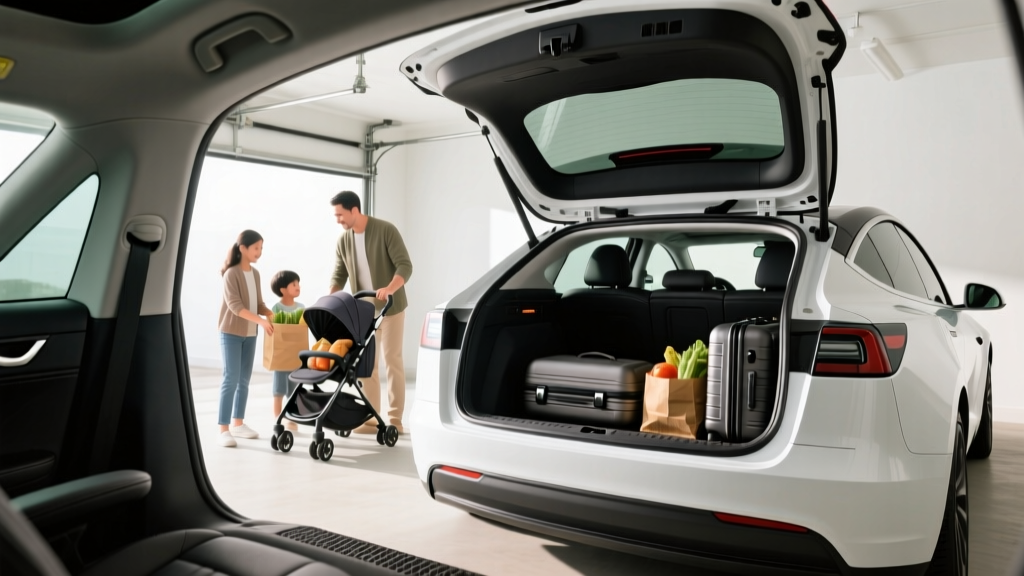
For context, 23 cubic feet of trunk space comfortably holds two large checked suitcases plus a couple of carry-ons, or roughly five to six standard grocery bags stacked. The 60/40 split-folding rear seats allow longer items like skis or flat-pack furniture to slide through from the trunk into the cabin, though the pass-through is narrower than what you'd find in a wagon or hatchback.
The frunk is best used for the Tesla Mobile Connector, a tire inflator kit, or a small soft bag. Unlike the Model Y's deeper frunk, the Model 3's front compartment is shallow due to the sedan's lower hood line.
Cargo Comparison: Model 3 vs Key Rivals
| Vehicle | Rear Cargo (cu ft) | Frunk (cu ft) | Total (cu ft) | Body Style |
|---|---|---|---|---|
| Tesla Model 3 | 23.0 | 3.1 | 26.1 | Sedan |
| Tesla Model Y | 30.2 (seats up) / 72.1 (seats folded) | 4.1 | 34.3 / 76.2 | Crossover |
| Hyundai Ioniq 6 | 12.3 | 0.7 | 13.0 | Sedan (fastback) |
| BMW i4 Gran Coupe | 16.6 | None | 16.6 | Gran Coupe (liftback) |
| Polestar 2 | 14.4 | 1.4 | 15.8 | Fastback |
The Model 3's 23 cubic feet of rear trunk space significantly outpaces the Ioniq 6 and Polestar 2, both of which sacrifice trunk volume for sleek rooflines. The Model Y, however, dwarfs the Model 3 with its crossover hatch — offering up to 76.2 cu ft with seats folded. If maximum cargo capacity is your priority, the Model Y is the clear upgrade within Tesla's lineup.
What Fits (and What Doesn't)
Based on hands-on loading tests:
- Fits easily: Two large suitcases + two carry-ons; a full week of groceries for a family of three; a stroller (compact umbrella-type); golf bags (two, angled)
- Fits with seats folded: A bicycle (front wheel removed); long flat-pack boxes up to ~6 feet
- Does not fit well: Full-size dog crates (width-constrained trunk opening); large furniture pieces; anything requiring a tall, vertical load (the trunk opening height is limited by the sedan decklid design)
Range & Efficiency: EPA vs Real World
The 2025/2026 Tesla Model 3 is offered in three trims, each with distinct range and drivetrain configurations:
| Trim | Drivetrain | EPA Range | Battery (usable kWh) | Chemistry | MPGe (combined) | kWh/100 mi |
|---|---|---|---|---|---|---|
| Rear-Wheel Drive | RWD | 272 mi | 57.5 | LFP | 132 MPGe | 25 |
| Long Range AWD | Dual-Motor AWD | 341 mi | 75.0 | NMC | 134 MPGe | 25 |
| Performance (AWD) | Dual-Motor AWD | 315 mi | 75.0 | NMC | 121 MPGe | 28 |
The Model 3's efficiency is a standout. At 25 kWh per 100 miles (Long Range), it converts electricity to distance more effectively than nearly every EV on the market. For comparison, the Hyundai Ioniq 6 Long Range achieves a similar ~27 kWh/100 mi, while the BMW i4 eDrive40 consumes roughly 30 kWh/100 mi. This efficiency directly translates to lower charging costs and more miles per minute at a DC fast charger.
Charging Speed: DC Fast, Level 2, and Level 1
Charging speed is where the Model 3's engineering shows. Tesla's thermal management system enables sustained high-power DC charging, particularly on NMC-equipped Long Range and Performance trims.
| Charging Level | Power / Rate | Speed (miles added per hour) | Notes |
|---|---|---|---|
| Level 1 (120V household) | ~1.4 kW | ~3–5 mi/hr | Emergency/trickle only |
| Level 2 (240V home, 48A) | 11.5 kW | ~44 mi/hr | Full charge overnight (~7–8 hrs for Long Range) |
| DC Fast Charge (RWD) | Peak 170 kW | 10–80% in ~25 min | LFP battery — charge curve tapers earlier |
| DC Fast Charge (Long Range / Performance) | Peak 250 kW | 10–80% in ~18 min | Sustains high kW through ~55% SoC, then tapers |
A critical detail many spec sheets omit: the charge curve. The Long Range Model 3 peaks at 250 kW only at low state-of-charge (roughly 10–30% SoC). As the battery fills, the rate tapers — dropping to ~100 kW around 60% and ~50 kW near 80%. This is why the 10–80% time is a more useful metric than peak kW alone. Tesla's navigation system preconditions the battery when you navigate to a Supercharger, warming it to optimal temperature for maximum charge acceptance — a feature that makes a real-world difference, especially in cold weather.
For home charging, Tesla's Wall Connector at 48 amps (11.5 kW) is the recommended setup. A full charge from 10% to 100% on the Long Range takes approximately 7–8 hours — easily completed overnight. Installation typically requires a 60-amp dedicated circuit; budget $500–$1,500 for a licensed electrician depending on panel proximity and local permit costs.
Performance & Driving Dynamics
| Trim | 0–60 mph | Horsepower | Torque (lb-ft) | Drivetrain |
|---|---|---|---|---|
| Rear-Wheel Drive | 5.8 sec | 271 hp | 317 | Single-motor RWD |
| Long Range AWD | 4.2 sec | 346 hp | 389 | Dual-motor AWD |
| Performance | 2.9 sec | 510 hp | 546 | Dual-motor AWD |
Even the base RWD Model 3 feels quick in daily driving, with instant torque delivery making city merging effortless. The Long Range strikes the best balance: 4.2 seconds to 60 mph is sports-sedan territory, and dual-motor AWD provides confident traction in rain and light snow. The Performance trim's 2.9-second sprint is exotic-car territory, but the ride is firmer and the price premium is substantial.
Ride quality improved significantly with the Highland refresh — revised suspension tuning, acoustic glass, and additional sound deadening make the current Model 3 noticeably quieter and more compliant than pre-2024 versions.
Pricing, Trims & Federal Tax Credit
| Trim | Base MSRP (2025) | Est. Tax-Credit-Adjusted Price | Federal §30D Credit |
|---|---|---|---|
| Rear-Wheel Drive | $38,990 | ~$31,490* | Up to $7,500 |
| Long Range AWD | $45,740 | ~$38,240* | Up to $7,500 |
| Performance | $52,990 | ~$45,490* | Up to $7,500 |
*Adjusted prices assume full $7,500 federal credit eligibility. Your actual credit depends on IRS §30D requirements.
- MSRP cap: Sedans must be under $55,000 — the RWD and Long Range qualify; the Performance at $52,990 also qualifies (verify final MSRP with options)
- Buyer income cap: Modified AGI must not exceed $150,000 (single), $225,000 (head of household), or $300,000 (joint filers)
- Battery sourcing: Critical minerals and battery components must meet phased-in percentage thresholds from U.S. or free-trade-agreement partners — Tesla sources LFP cells from CATL (China) for the RWD trim, which may reduce or eliminate the credit for that specific trim in some model years. Verify current-year eligibility at IRS.gov
- Point-of-sale transfer: As of 2024, you can transfer the credit to the dealer at purchase for an immediate price reduction — no need to wait for tax filing
The RWD Model 3's LFP battery sourcing has been a point of uncertainty under §30D's critical-mineral and battery-component rules. Tesla has worked to reshore supply chains, but buyers should confirm current-year eligibility on the fueleconomy.gov tax credit tracker before relying on the full $7,500 for the base trim. The Long Range (NMC battery, assembled in Fremont with increasing domestic content) has maintained stronger credit eligibility.
Interior, Tech & Driver Assistance
The Highland-refreshed Model 3 interior is a study in minimalism — a single 15.4-inch touchscreen handles all infotainment, climate, and vehicle controls. There is no instrument cluster; speed and navigation appear on the touchscreen's left zone. Rear passengers get an 8-inch touchscreen for climate and media control, a meaningful upgrade from the pre-refresh cabin.
Standout tech features:
- Tesla's native navigation with real-time Supercharger routing and battery preconditioning
- Over-the-air (OTA) updates that regularly add features and improve performance
- Sentry Mode dashcam recording and remote climate/monitoring via the Tesla app
- Ventilated front seats, ambient lighting, and premium audio (17 speakers on Long Range/Performance)
Autopilot and FSD (Supervised): Every Model 3 ships with basic Autopilot (traffic-aware cruise control and lane centering). Full Self-Driving (Supervised) is an $8,000 option or $99/month subscription that adds automated lane changes, traffic-light recognition, and city-street navigation.
Warranty & Long-Term Ownership
| Coverage | Term |
|---|---|
| Basic vehicle warranty | 4 years / 50,000 miles |
| Battery & drive unit (RWD — LFP) | 8 years / 100,000 miles |
| Battery & drive unit (Long Range / Performance — NMC) | 8 years / 120,000 miles |
| Battery capacity retention guarantee | Minimum 70% over warranty period |
Tesla's battery warranty guarantees at least 70% capacity retention over the coverage period. Real-world data from Tesla's fleet suggests average degradation of roughly 10–12% after 150,000 miles for NMC packs, with LFP packs showing slightly more initial calendar degradation but strong cycle-life durability. Battery replacement outside warranty is expensive — roughly $12,000–$16,000 for a Model 3 pack — but full replacements remain rare based on fleet data.
Insurance costs for the Model 3 tend to run 15–25% higher than comparable gas sedans due to repair costs and parts pricing. Tesla Insurance is available in many states and can be competitive — get quotes from both Tesla and traditional insurers before purchase.
Who the Model 3 Suits Best (and Who Should Look Elsewhere)
Choose the Model 3 if:
- You're a daily commuter covering 30–80 miles round-trip with home charging access
- You prioritize efficiency and low per-mile energy cost over maximum cargo volume
- You want access to Tesla's Supercharger network for road trips (now also opening to NACS adapters on other brands)
- You prefer a sedan's driving dynamics and don't need hatchback-level cargo flexibility
Look elsewhere if:
- You regularly haul bulky cargo, large dog crates, or need easy load-in height → consider the Model Y
- You need a spacious rear seat for tall adults or rear-facing child seats → test-fit before buying
- You prefer physical buttons and a traditional instrument cluster → the all-touchscreen interface isn't for everyone
- You lack home charging and rely solely on public infrastructure in an area with limited DC fast chargers
Pros & Cons at a Glance
Pros
- Class-leading efficiency (25 kWh/100 mi)
- 23 cu ft trunk outpaces most EV sedans
- 250 kW peak DC fast charging (Long Range)
- Supercharger network access
- Strong OTA update track record
- High safety ratings (NHTSA 5-star)
Cons
- Sedan trunk opening limits bulky-item loading
- No power liftgate
- Tight rear-seat legroom vs midsize sedans
- All-touchscreen controls (no physical buttons)
- RWD LFP trim may have reduced tax-credit eligibility
- Insurance premiums above segment average
Frequently Asked Questions
What is the real-world range of the Tesla Model 3?
The EPA rates the Long Range AWD at 341 miles, but real-world highway driving at 70 mph typically yields 290–310 miles. In cold weather (below freezing), expect 240–280 miles depending on heating use and preconditioning. The RWD model's real-world range is approximately 220–240 miles in mild conditions.
How fast does the Model 3 charge at home and on the road?
At home on a Level 2 (240V, 48A) Tesla Wall Connector, the Model 3 gains about 44 miles of range per hour — a full overnight charge takes 7–8 hours. On DC fast chargers, the Long Range peaks at 250 kW and charges from 10–80% in approximately 18 minutes. The RWD model peaks at 170 kW with a 10–80% time of about 25 minutes.
Does the Tesla Model 3 qualify for the $7,500 federal tax credit?
The Long Range AWD generally qualifies for the full $7,500 under IRS §30D, subject to buyer income caps ($150K single / $300K joint). The RWD trim's LFP battery, sourced from CATL in China, may face reduced credit eligibility due to battery-component and critical-mineral sourcing rules. Always verify current eligibility at IRS.gov before purchasing.
Is the Model 3 worth buying over the Model Y or Ioniq 6?
If cargo space and rear-seat room are priorities, the Model Y's hatchback design (up to 76.2 cu ft) is the practical choice at a ~$5,000–$8,000 premium. The Hyundai Ioniq 6 offers a striking design and competitive range but has significantly less trunk space (12.3 cu ft) and no frunk. The Model 3 wins on efficiency, charging speed, and Supercharger access — it's the best choice for efficiency-focused commuters who don't need maximum cargo volume.
How much total cargo can the Model 3 hold with seats folded?
With the 60/40 split rear seats folded, the Model 3's usable cargo length extends significantly, though Tesla does not publish a total cubic-foot figure for this configuration. You can fit items up to approximately 6 feet long (like a bicycle with the front wheel removed), but the trunk opening height and width remain constrained by the sedan body style.
What's the biggest drawback of the Model 3's cargo area?
The sedan-style trunk opening is the primary limitation. Unlike a hatchback or crossover, you can't load tall or bulky items easily. There's also no power liftgate, and the trunk sill is relatively high for a sedan. If you frequently load heavy or oversized items, the Model Y or a hatchback EV will serve you better.