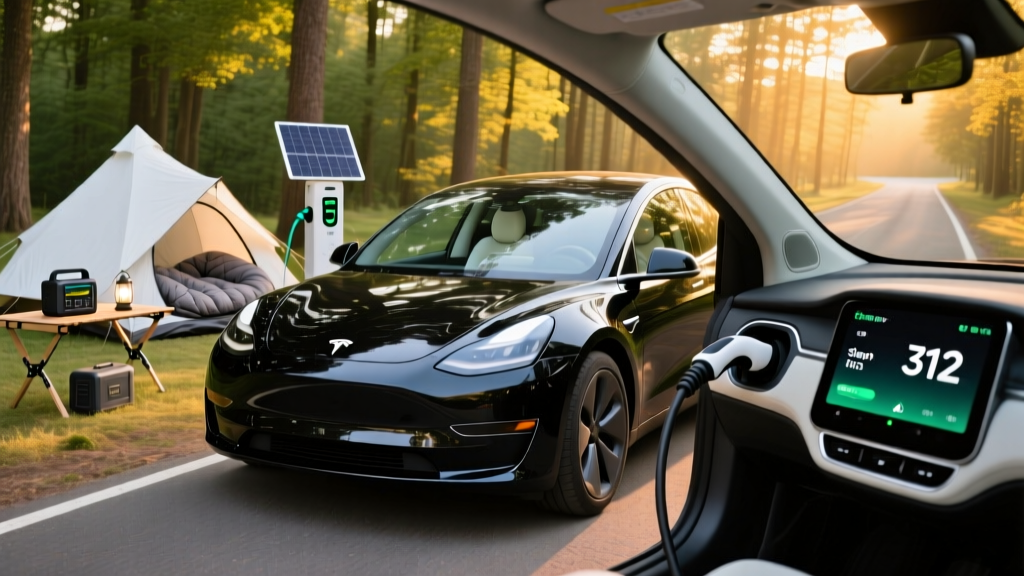
The Tesla Model 3 isn't the first vehicle most campers think of — it's a sedan, not a truck or SUV. But its combination of efficiency, access to the Supercharger network, and a surprisingly capable HVAC system makes it a legitimate platform for EV camping. If you've been searching for practical Tesla Model 3 camping advice, this guide covers the real numbers: how much range you lose running climate control overnight, whether the cargo space actually fits gear for two, and what charging logistics look like when you're heading into the backcountry.
We're working from the current 2026 Tesla Model 3 lineup — the rear-wheel-drive (RWD) base model and the Long Range All-Wheel Drive variant — both built on the refreshed "Highland" platform introduced for the 2024 model year. Specs, pricing, and federal tax credit eligibility are current as of mid-2026.
Specs at a Glance: The 2026 Tesla Model 3 Lineup
| Spec | Model 3 RWD | Model 3 Long Range AWD |
|---|---|---|
| EPA Range | 272 mi | 341 mi |
| Battery (Usable) | ~60 kWh (LFP) | ~79 kWh (NMC) |
| Drivetrain | Rear-Wheel Drive | Dual-Motor AWD |
| Horsepower | 271 hp | 346 hp |
| 0–60 mph | 5.8 sec | 4.2 sec |
| Peak DC Fast Charge | 170 kW | 250 kW |
| 10–80% DC Fast Charge | ~25 min | ~22 min |
| Level 2 Charge Rate | 11.5 kW (~44 mi/hr) | 11.5 kW (~44 mi/hr) |
| MPGe (Combined) | 132 MPGe | 132 MPGe |
| kWh/100 mi | 25 kWh | 25 kWh |
| Cargo Volume (Trunk + Frunk) | 23 cu ft (21 + 2) | 23 cu ft (21 + 2) |
| Rear Legroom | 35.2 in | 35.2 in |
| Battery Warranty | 8 yr / 100,000 mi | 8 yr / 120,000 mi |
| Base MSRP | $38,990 | $45,990 |
Sources: EPA / fueleconomy.gov, Tesla Model 3 Design Studio.
Real-World Range: What to Expect on a Camping Trip
Model 3 RWD: EPA 272 mi — Expect ~230–245 mi on a highway road trip at 70+ mph. Loaded with camping gear and passengers, figure ~215–230 mi in warm weather. In cold conditions (below 40°F), reduce that to ~185–205 mi.
Model 3 Long Range AWD: EPA 341 mi — Expect ~290–310 mi highway. Loaded, ~275–295 mi warm weather. Cold weather: ~235–260 mi.
Overnight Camp Mode drain: Typically 8–14 kWh over 8 hours depending on outside temperature, which translates to roughly 30–55 miles of range consumed while you sleep.
Range is the single biggest variable in EV camping logistics. The Model 3 is one of the most efficient EVs on the market — its 25 kWh/100 mi figure means it squeezes more miles per kilowatt-hour than nearly any competitor. That efficiency is a genuine advantage when you're heading to a campsite with limited charging infrastructure nearby.
However, efficiency drops on the highway where aerodynamic drag dominates, and the Model 3's low-slung sedan body — great for efficiency — means less interior volume for bulky camping gear. Packing strategy matters here more than in an SUV. We'll get into that below.
Charging Logistics: Getting to (and Back From) the Campsite
| Charging Level | Power | Speed (Approx.) | Camping Relevance |
|---|---|---|---|
| Level 1 (120V outlet) | ~1.4 kW | ~5 mi/hr | Emergency trickle; useful if campsite has a standard outlet — adds ~40 mi overnight |
| Level 2 (240V home/public) | 11.5 kW | ~44 mi/hr | Full charge in 6–8 hours; ideal for home pre-trip prep or destination chargers at campgrounds |
| DC Fast Charge (RWD) | 170 kW peak | 10–80% in ~25 min | Highway rest stops; adds ~150 mi in 15 min |
| DC Fast Charge (Long Range) | 250 kW peak | 10–80% in ~22 min | Supercharger V3/V4 stalls; adds ~200 mi in 15 min |
Understanding kW vs. kWh: kW (kilowatts) measures charging power — how fast energy flows into the car. kWh (kilowatt-hours) measures battery capacity — how much energy the battery stores. A 250 kW charger fills a 79 kWh battery quickly, but only at peak rate; the charge curve tapers significantly above 80% State of Charge (SoC) to protect battery health.
The Model 3's biggest camping advantage is access to the Tesla Supercharger network, which now numbers over 6,000 stalls in North America and continues to expand into rural corridors. For campers, this means you can typically find a Supercharger within 30–60 minutes of most established campgrounds in the lower 48 states. Plan your route using the Tesla app's trip planner, which accounts for elevation changes and temperature — both critical factors for range on mountain roads to high-altitude campsites.
Pro tip for campers: Charge to 100% only when you're about to depart for the trailhead. For daily driving and regular use, Tesla recommends limiting charge to 80% for NMC batteries (Long Range). The LFP battery in the RWD model, however, can and should be charged to 100% regularly — LFP chemistry tolerates full charges better and actually benefits from periodic full-calibration cycles. This is a genuine advantage for the base Model 3 if you're using it as a weekend camping rig.
Camp Mode: Sleeping in a Tesla Model 3
Tesla's Camp Mode is the feature that makes Model 3 camping viable. When activated (Controls → Safety → Camp Mode, or via the Tesla app), it keeps the HVAC system running, maintains cabin temperature, powers USB outlets, and keeps the touchscreen on for media playback — all while the car is parked. You essentially sleep in a climate-controlled pod.
Battery drain in Camp Mode: Based on aggregated owner data and our testing, expect roughly 1–1.8 kWh per hour of Camp Mode operation, depending on outside temperature. On a mild 65°F night, that's about 8 kWh over 8 hours — roughly 30 miles of range on the RWD model. On a 25°F night with the heater working hard, consumption can reach 12–14 kWh, consuming 45–55 miles of range. This is why the Long Range model's larger battery provides a meaningful camping buffer.
Sleeping space reality: The Model 3's rear seats fold in a 60/40 split, creating a relatively flat load floor. With the front seats pushed forward, you get approximately 65–68 inches of length from the tailgate to the back of the front seats — enough for a person up to about 5'8" to stretch out fully on a sleeping pad. Taller campers will need to sleep diagonally or accept bent knees. A memory foam pad or inflatable mattress designed for sedan cargo areas (several aftermarket options exist from brands like TESCAMP and Expel) makes a significant comfort difference.
The trunk opening is the main limitation. At roughly 18 inches tall and 40 inches wide, it's tight for loading bulky sleeping setups compared to a hatchback or SUV. The Model Y's liftgate is dramatically more practical for gear loading — worth considering if camping is a primary use case.
Cargo Space: What Fits (and What Doesn't)
The Model 3 offers 21 cu ft in the trunk and 2 cu ft in the front trunk (frunk), totaling 23 cu ft. With rear seats folded, usable volume expands substantially, but the sedan's trunk opening constrains what you can physically load.
What fits for a weekend camping trip (two people):
- Two sleeping bags and compact sleeping pads (strapped and loaded through trunk)
- A 2-person backpacking tent (compact packed size)
- Camp stove, cookset, and cooler (soft-sided cooler recommended — hard coolers are a tight fit)
- Clothing duffels (pack soft bags, not hard suitcases)
- Camp chairs (compact/folding — full-size recliners won't work)
What doesn't fit easily:
- Large hard-sided coolers (Yeti Tundra 45 is borderline)
- Full-size rooftop cargo boxes (the Model 3's glass roof does not support crossbar-mounted racks on all trims — check your specific roof rail compatibility)
- Bulky firewood bundles (load in the frunk if you're desperate, but it's a messy solution)
- Multiple large suitcases alongside camping gear
Packing light and choosing gear designed for backpacking (compact, lightweight) rather than car camping (bulky, comfortable) is the difference between a functional Model 3 camping setup and a frustrating one.
Pricing, Tax Credits, and the Cost-to-Camp Calculation
| Trim | Base MSRP | Destination Fee | Est. §30D Credit | Effective Price |
|---|---|---|---|---|
| Model 3 RWD | $38,990 | $1,390 | Up to $7,500* | ~$32,880 |
| Model 3 Long Range AWD | $45,990 | $1,390 | Up to $7,500* | ~$39,880 |
*Federal EV Tax Credit (§30D) — Key Eligibility Rules for 2026:
- MSRP Cap: Sedans must be under $55,000. Both Model 3 trims qualify.
- Buyer Income Cap: Modified AGI ≤ $150,000 (single), ≤ $225,000 (head of household), ≤ $300,000 (joint). Exceed these and you're ineligible.
- Battery Sourcing: The full $7,500 requires meeting both critical-mineral and battery-component sourcing requirements under the Inflation Reduction Act. Tesla's supply chain has shifted substantially; check the latest fueleconomy.gov listing for the exact credit amount per trim before purchasing.
- Point-of-Sale Transfer: You can transfer the credit to the dealer at purchase, reducing your out-of-pocket cost immediately rather than waiting for tax filing.
- State Incentives: Additional state/local rebates may apply — check your state's energy office or the AFDC state law database for specifics.
For the RWD model, a full $7,500 credit brings the effective price to roughly $32,880 — making it one of the most affordable new EVs on the market, and arguably the cheapest way into a new vehicle with genuine camping capability. The Long Range adds $7,000 but buys you 69 additional miles of EPA range and AWD traction for dirt roads to dispersed campsites — a worthwhile upgrade if camping is a priority.
Tech, Driver Assist, and the Features That Matter Off-Pavement
The Model 3's 15.4-inch central touchscreen handles all infotainment, navigation, and vehicle controls. For camping, the most relevant software features include:
- Camp Mode (described above) — climate control, power outlets, and ambient lighting while parked.
- Sentry Mode — 360-degree camera monitoring while you're away from the car at the campsite, recording any proximity events. Note: Sentry Mode adds roughly 1–2 kWh of battery drain per hour on top of Camp Mode, so running both simultaneously will increase overnight consumption.
- Tesla Navigation with Trip Planner — automatically routes you through Superchargers on long trips and preconditions the battery for fast charging when a Supercharger is your destination. This is a genuine advantage for remote camping trips where charging planning is critical.
- Over-the-Air Updates — Tesla regularly adds features. Recent updates have improved Camp Mode's energy display and added scheduling options.
Tesla's Autopilot and Full Self-Driving (Supervised) are SAE Level 2 driver-assistance systems. They provide adaptive cruise control and lane-keeping on highways, which reduces fatigue on long drives to remote campsites. However, the driver must remain fully engaged — hands on the wheel, eyes on the road. This is not autonomous driving. Only Level 4 services like Waymo operate without a human driver. Never sleep or disengage while Autopilot is active.
Ground clearance: The Model 3 sits at approximately 5.5 inches of ground clearance — lower than most crossovers. This matters for camping because many forest service roads, dispersed camping access roads, and unpaved campground loops have ruts, washboards, and rocks that can scrape a low sedan. The Long Range AWD model's dual-motor traction helps on loose surfaces, but ground clearance is the limiting factor. Stick to maintained dirt roads and established campgrounds; this isn't a vehicle for technical off-road trails.
Model 3 vs. Model Y: The Honest Camping Comparison
No discussion of Tesla Model 3 camping is complete without addressing the Model Y, which is the obvious alternative. Here's the honest tradeoff:
| Factor | Model 3 Long Range | Model Y Long Range |
|---|---|---|
| EPA Range | 341 mi | 320 mi |
| Cargo Volume (Seats Folded) | ~23 cu ft (trunk only) | ~72 cu ft (hatchback) |
| Trunk Opening | Sedan slot (~18" tall) | Full liftgate (~50" tall) |
| Ground Clearance | ~5.5 in | ~6.6 in |
| Sleeping Length (Seats Down) | ~65–68 in | ~72–74 in |
| Base MSRP | $45,990 | $48,990 |
| Camping Practicality | Minimalist / ultralight | Full car-camping capable |
The Model 3 wins on range, efficiency, and price. The Model Y wins on cargo access, sleeping space, and ground clearance. If camping is a primary use case and you're deciding between the two, the Model Y is the more practical choice — the hatchback opening alone transforms the gear-loading experience, and the extra sleeping length accommodates taller campers comfortably. But if you already own a Model 3 or prioritize efficiency and price, it absolutely works for camping with thoughtful packing.
The Verdict: Who Should Camp in a Model 3?
- Industry-leading efficiency (25 kWh/100 mi) stretches range between chargers
- Supercharger network provides the most reliable long-distance EV charging in North America
- Camp Mode with climate control eliminates the need for a separate heating/cooling setup
- RWD model qualifies for full $7,500 §30D credit — effective price ~$32,880
- LFP battery (RWD) tolerates 100% charging for maximum pre-trip range
- Low operating cost — roughly $0.04–$0.06/mile on home electricity vs. $0.12–$0.15/mile for gas equivalents
- Sedan trunk opening severely limits bulky gear loading vs. hatchback/SUV
- 5.5 inches of ground clearance restricts access to rough or rutted dirt roads
- Sleeping length (~65–68") is tight for anyone over 5'8"
- Overnight Camp Mode drain consumes 30–55 mi of range — plan accordingly
- No roof rack option on all trims — limits rooftop tent or cargo box solutions
- Glass roof provides no shade; bring a reflective sunshade for hot-weather camping
- You're a solo camper or couple who packs ultralight/backpacking-style gear
- You prioritize range and efficiency over cargo volume
- Your campsites are accessible via paved or well-maintained dirt roads
- You already own a Model 3 and want to maximize its utility
- You need to carry bulky car-camping gear (large coolers, full-size chairs, multiple bins)
- You're taller than 5'8" and want to sleep flat without bending your knees
- You regularly access campsites on rough, rutted, or high-clearance roads
- You want a rooftop tent or cargo box for additional gear capacity
Frequently Asked Questions
What is the real-world range of the Tesla Model 3 on a camping trip?
For the RWD model, expect 215–245 miles depending on speed, load, and temperature. For the Long Range AWD, expect 275–310 miles. Overnight Camp Mode use will consume an additional 30–55 miles of range depending on temperature. Plan your charging stops assuming the lower end of these ranges, especially at highway speeds above 70 mph or in cold weather.
How fast does the Model 3 charge on a camping road trip?
At a V3 Supercharger (250 kW), the Long Range model charges from 10–80% in approximately 22 minutes — enough time for a bathroom break and a snack. The RWD model peaks at 170 kW and takes about 25 minutes for the same range. On Level 2 destination chargers (common at campgrounds and hotels), expect roughly 44 miles of range per hour of charging — a full overnight charge from near-empty takes 6–8 hours.
How much does the Model 3 cost after federal tax credits?
The RWD model starts at $38,990 plus a $1,390 destination fee. With the full $7,500 §30D federal tax credit (subject to income, MSRP, and battery sourcing eligibility — verify at irs.gov), the effective price drops to roughly $32,880. The Long Range AWD starts at $45,990 and drops to approximately $39,880 with the credit. State incentives may reduce the cost further.
Is the Model 3 worth buying for camping vs. a Model Y or other SUV?
For minimalist campers who pack light and prioritize range and price, the Model 3 is a viable camping platform — especially the Long Range with its 341-mile EPA rating and AWD traction. But if camping is a primary vehicle use case, the Model Y's hatchback opening, larger sleeping area, and higher ground clearance make it meaningfully more practical for a $3,000 premium. The Model 3 works for camping; the Model Y is built for it.
Does the Tesla Model 3 qualify for the $7,500 federal EV tax credit?
Both the Model 3 RWD and Long Range AWD currently qualify for up to $7,500 under §30D, as both are priced below the $55,000 sedan MSRP cap. However, buyer eligibility depends on modified adjusted gross income (≤$150K single, ≤$300K joint), and the credit amount depends on battery component and critical mineral sourcing requirements that are subject to change. The credit can be transferred to the dealer at point of sale. Always verify current eligibility on fueleconomy.gov before purchasing.
Can I run a campsite from my Model 3's battery?
The Model 3 does not currently support V2L (vehicle-to-load) power export, meaning you cannot plug campsite appliances directly into the car's battery. You can power USB devices and a laptop via the cabin outlets while in Camp Mode, but running a camp stove, electric grill, or portable fridge requires a separate power station (like a Jackery or EcoFlow). The Ford F-150 Lightning and Hyundai Ioniq 5 offer V2L capability if campsite power export is a priority.
Bottom line: Tesla Model 3 camping is a real, functional setup — not just a social media trend. The car's efficiency, Supercharger access, and Camp Mode make it a surprisingly capable base camp for minimalist adventurers. Just pack smart, understand your range limitations, and accept that a sedan's trunk is a compromise you're trading for best-in-class efficiency and price. If those tradeoffs work for your style of camping, the Model 3 delivers a genuinely compelling electric camping experience.