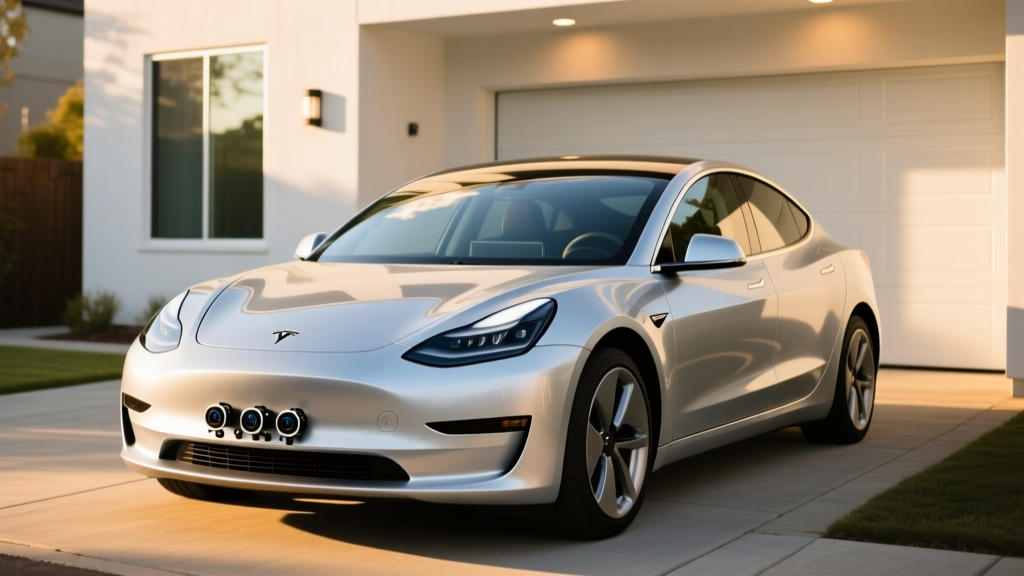
The Tesla Model 3 Highland refresh brought more than a facelift—it overhauled the vehicle's entire vision system. For buyers researching Tesla Model 3 cameras, the current-generation sedan packs eight exterior cameras feeding Tesla's HW4.0 (Hardware 4) computer, powering everything from basic Autopilot to the optional Full Self-Driving (Supervised) system. But cameras are only one part of the ownership equation. This review covers the full picture: real-world range, DC fast-charging speeds, pricing after federal tax credits, and how the Model 3 stacks up against rivals like the Hyundai Ioniq 6 and BMW i4.
Tesla Model 3 Camera System and Vision Hardware
The 2025 Tesla Model 3 uses a pure-vision approach—no radar, no ultrasonic sensors (USS was removed in late 2022). The eight-camera array provides 360-degree coverage:
- Front main camera: Mounted behind the windshield, wide-angle lens for lane detection and traffic-sign recognition
- Front narrow camera: Telephoto-style lens for long-range object detection at highway speeds
- Front side cameras (×2): Mounted on the front fenders, covering blind spots and intersection cross-traffic
- Rear side cameras (×2): Integrated into the B-pillars, monitoring adjacent lanes
- Rear-view camera: Above the license plate, used for reversing and Autopilot lane-change confirmation
These cameras feed data to Tesla's HW4.0 computer, which processes images at significantly higher resolution than the older HW3.0 system. The practical result: better detection of small objects (curbs, debris, pedestrians) and more confident lane-keeping in faded-marking scenarios. Cabin-facing cameras were also upgraded for improved driver-monitoring fidelity—a key requirement for FSD Supervised operation.
SAE Automation Level: Tesla Autopilot and FSD (Supervised) are Level 2 driver-assistance systems under the SAE J3016 standard. The driver must remain attentive, keep hands on the wheel, and be prepared to take over at any moment. These are not self-driving systems. Only Level 4 robotaxi services like Waymo operate without a human driver in defined geofenced areas.
Range, Efficiency, and Battery Specs
The 2025 Model 3 lineup offers three trims with distinct range profiles. Here's the breakdown:
| Specification | RWD (Base) | Long Range AWD | Performance AWD |
|---|---|---|---|
| EPA Range | 272 miles | 363 miles | 315 miles |
| Battery Capacity (usable) | ~60 kWh (LFP) | ~79 kWh (NMC) | ~79 kWh (NMC) |
| Battery Chemistry | LFP (Lithium Iron Phosphate) | NMC (Nickel Manganese Cobalt) | NMC |
| MPGe (combined) | 132 MPGe | 131 MPGe | 116 MPGe |
| Efficiency (kWh/100 mi) | 25 kWh | 26 kWh | 29 kWh |
| Drivetrain | Rear-Wheel Drive | Dual-Motor AWD | Dual-Motor AWD |
| Horsepower | 271 hp | 346 hp | 510 hp |
| 0–60 mph | 5.8 sec | 4.2 sec | 2.9 sec |
Real-World Range Reality Check: The EPA 363-mile figure on the Long Range AWD is achievable in mild-weather city and suburban driving at moderate speeds. Expect approximately 300–320 miles on highway trips at 70–75 mph, dropping to 250–280 miles in cold weather (below 32°F) due to battery chemistry resistance and cabin heating load. The RWD trim's LFP battery actually handles cold somewhat better than NMC in terms of long-term degradation, but still loses 15–25% range in freezing temperatures. Plan charging stops conservatively on winter road trips.
The LFP chemistry in the RWD trim deserves special attention. LFP batteries tolerate regular 100% charging better than NMC, meaning Tesla recommends charging the RWD Model 3 to full regularly—helpful for drivers who need every mile of range. The trade-off: LFP has lower energy density, which is why the RWD's range trails the Long Range despite similar vehicle weight. NMC batteries in the Long Range and Performance trims should ideally be charged to 80% for daily use and saved at 100% only for long trips.
Charging Speed: DC Fast Charge and Home Level 2
Charging speed remains one of the Model 3's strongest competitive advantages, thanks to Tesla's Supercharger network and efficient charge-curve management.
| Charging Method | Max Power (kW) | Speed (miles/hr added) | Notes |
|---|---|---|---|
| Level 1 (120V household) | ~1.4 kW | ~3–5 mi/hr | Emergency/trickle only |
| Level 2 (240V home, 48A) | 11.5 kW | ~37–44 mi/hr | Full charge overnight (~8–10 hrs) |
| DC Fast Charge (CCS/NACS) | 250 kW (peak) | ~175 mi in 15 min | 10–80% in ~25–30 min |
| Tesla Supercharger V3 | 250 kW | Peak rate to ~50% SoC | Curve tapers above 60% |
| Tesla Supercharger V4 | Up to 350 kW (cabinet) | Model 3 limited to ~250 kW | V4 cabinet capable; car-side limit applies |
A critical nuance for prospective owners: the 250 kW peak rate is not sustained. The Model 3's charge curve is aggressive in the 10–50% State of Charge (SoC) window, often holding 200+ kW. Above 60%, the rate tapers significantly—dropping to roughly 100 kW by 70% and below 50 kW past 85%. This is standard lithium-ion behavior to protect the battery, but it means charging from 80–100% takes almost as long as 10–80%. The practical takeaway: on road trips, charge to 80% and go. Only charge to 100% at your destination overnight.
For home Level 2 charging, the Model 3's onboard charger accepts up to 11.5 kW (48 amps on a 60-amp circuit). A full installation—Tesla Wall Connector or equivalent third-party unit like a ChargePoint Home Flex—typically runs $800–$2,000 all-in (equipment, electrician labor, permit), depending on panel proximity and whether your home needs a service upgrade from 100A to 200A. Consult a licensed electrician for a site-specific quote.
Pricing, Trims, and Federal Tax Credit Eligibility
The 2025 Tesla Model 3 pricing reflects Tesla's aggressive positioning against legacy automakers and Chinese-market competitors.
| Trim | Base MSRP | Federal Tax Credit (§30D) | Effective Price (if eligible) |
|---|---|---|---|
| RWD | $38,990 | Up to $7,500 | ~$31,490 |
| Long Range AWD | $47,740 | Up to $7,500 | ~$40,240 |
| Performance AWD | $52,990 | Up to $7,500 | ~$45,490 |
Federal tax credit eligibility under IRS §30D is not automatic. Buyers must meet several criteria:
- Income caps: Modified adjusted gross income (MAGI) must not exceed $150,000 (single), $225,000 (head of household), or $300,000 (married filing jointly)
- MSRP cap: The vehicle's MSRP must not exceed $55,000 for sedans (all Model 3 trims currently qualify)
- Battery sourcing: A percentage of critical minerals and battery components must be sourced from the U.S. or free-trade-agreement countries—rules that tighten annually. Tesla has shifted significant supply-chain sourcing, but verify current-year eligibility at fueleconomy.gov before purchasing
- Point-of-sale transfer: As of 2024, buyers can transfer the credit to the dealer at purchase, reducing the upfront cost rather than waiting for a tax refund
State and local incentives vary widely and are not covered here—check your state's energy office or the Alternative Fuels Data Center for current programs. Always consult a tax professional to confirm eligibility based on your specific financial situation.
Interior, Cargo, and Technology
The Highland refresh brought meaningful improvements to cabin quality. Ventilated front seats, ambient lighting, acoustic glass (front and rear), and a rear-seat touchscreen for climate and media controls are now standard across all trims. The minimalist interior remains polarizing—no physical turn-signal stalk (buttons on the steering wheel instead) and no gear selector stalk (touchscreen-based with backup buttons on the overhead console).
Cargo and passenger dimensions:
- Trunk volume: 21.0 cu ft (rear trunk) + 3.1 cu ft (frunk) = 24.1 cu ft total
- Front legroom: 42.2 inches
- Rear legroom: 35.3 inches (tight for taller passengers on long trips)
- Curb weight: 3,862–4,065 lbs depending on trim
The 15.4-inch center touchscreen runs Tesla's proprietary infotainment system—no Apple CarPlay or Android Auto. Navigation, media, and vehicle controls are all screen-based, with voice commands handling most secondary functions. The Tesla app enables remote preconditioning, charge scheduling, Sentry Mode camera access, and vehicle location tracking.
Driver-assistance features include standard Autopilot (adaptive cruise + lane centering), with the optional FSD (Supervised) package adding automatic lane changes, traffic-light and stop-sign recognition, and more assertive navigation-on-autopilot behavior. FSD costs $8,000 upfront or $99/month as of 2025 pricing. Whether FSD justifies the premium remains a personal calculation—it's impressive on highways but still requires constant supervision and occasionally makes conservative or erratic decisions in complex urban environments.
Warranty and Long-Term Ownership
Tesla's warranty coverage is competitive but not class-leading:
- Basic vehicle warranty: 4 years / 50,000 miles
- Battery and drive unit warranty: 8 years / 100,000 miles (RWD); 8 years / 120,000 miles (Long Range and Performance)
- Battery degradation threshold: Tesla warrants that the battery will retain at least 70% of its original capacity during the warranty period
For context, Hyundai backs the Ioniq 6's battery for 10 years / 100,000 miles. Real-world data from Tesla fleet telemetry suggests that NMC Model 3 batteries typically retain 88–92% capacity at 100,000 miles under normal charging habits. LFP batteries in the RWD trim show even slower degradation curves, often holding 93%+ at similar mileage. Battery replacement out of warranty currently ranges from $12,000–$16,000 depending on the pack, though prices continue to trend downward as battery manufacturing scales.
Pros, Cons, and Who Should Buy
Pros
- Class-leading DC fast-charging speed and Supercharger network access
- Top-tier efficiency (25–29 kWh/100 mi) translates to lower charging costs
- HW4.0 camera system provides excellent Autopilot performance on highways
- LFP battery option (RWD) allows worry-free 100% daily charging
- Strong resale value relative to most EV competitors
- Over-the-air updates continuously add features
Cons
- No Apple CarPlay or Android Auto—Tesla's walled-garden ecosystem
- Stalkless design (turn signals, gear selector) has a steep learning curve
- Rear seat legroom (35.3 in) is tight for adults on long trips
- FSD (Supervised) is expensive ($8,000) and still requires full driver attention
- No ultrasonic sensors means park-assist relies on camera estimates—occasionally inaccurate on low curbs
- Insurance premiums run 15–30% higher than comparable gas sedans in most states
Choose the Tesla Model 3 if: You prioritize charging speed and network reliability, commute on highways where Autopilot shines, want the lowest per-mile electricity cost in the segment, and are comfortable with Tesla's all-screen interface.
Look at competitors (Ioniq 6, BMW i4, Polestar 2) if: You need Apple CarPlay, prefer physical controls, want a longer battery warranty (Hyundai), or value a more traditional luxury interior (BMW).
Frequently Asked Questions
What is the real-world range of the Tesla Model 3?
The Long Range AWD achieves an EPA-estimated 363 miles, but real-world highway driving at 70–75 mph typically yields 300–320 miles. In cold weather (below freezing), expect 250–280 miles. The RWD trim's EPA 272 miles translates to roughly 230–245 miles highway and 200–215 miles in winter conditions.
How fast does the Model 3 charge at home and on the road?
At home on a 240V Level 2 charger (48A), the Model 3 adds roughly 37–44 miles of range per hour, reaching a full charge overnight in 8–10 hours. On DC fast chargers, it peaks at 250 kW, adding up to 175 miles in 15 minutes. A 10–80% charge takes approximately 25–30 minutes at a V3 Supercharger, with significant tapering above 80%.
Does the Tesla Model 3 qualify for the $7,500 federal EV tax credit?
All three Model 3 trims currently qualify for up to $7,500 under IRS §30D, provided the buyer meets income caps ($150K single / $300K joint), the MSRP is under $55,000 (all trims qualify), and battery-sourcing requirements are met for the current model year. The credit can be transferred at point of sale to reduce the purchase price directly. Verify current eligibility at fueleconomy.gov and consult a tax professional.
Is the Tesla Model 3 worth buying over the Hyundai Ioniq 6 or BMW i4?
The Model 3 wins on charging infrastructure access (Superchargers), efficiency, and software features. The Ioniq 6 SE Long Range offers comparable EPA range (361 miles) with Apple CarPlay and a 10-year battery warranty at a lower starting price. The BMW i4 provides a more premium interior and traditional driving dynamics but sacrifices range and DC charging speed. Your choice depends on whether network access and software (Tesla) or interior quality and warranty (BMW/Hyundai) matter more.
How do Tesla Model 3 cameras work without radar or ultrasonic sensors?
Tesla uses a vision-only approach called Tesla Vision. The eight cameras feed neural networks running on the HW4.0 computer, which interprets depth, velocity, and object classification from camera imagery alone. This works well for highway driving and lane-keeping, but can struggle in heavy rain, direct sun glare, or with dirty camera lenses. Tesla uses camera-based occupancy estimation in place of ultrasonic sensors for parking—a system that's improved through OTA updates but can occasionally misjudge distances to low obstacles.
What's the total cost of ownership compared to a gas sedan?
Over five years, a Model 3 Long Range driven 12,000 miles/year costs roughly $4,500–$5,500 in electricity (at $0.15/kWh national average) versus $7,500–$9,000 in gasoline for a comparable 30 MPG sedan. Factor in lower maintenance (no oil changes, fewer brake replacements due to regenerative braking), but higher insurance premiums ($200–$400/year more in most states). Total savings typically range from $3,000–$6,000 over five years, heavily dependent on your local electricity rate and annual mileage.