Quick Verdict: The Camera-Only Tesla Model 3 in 2026
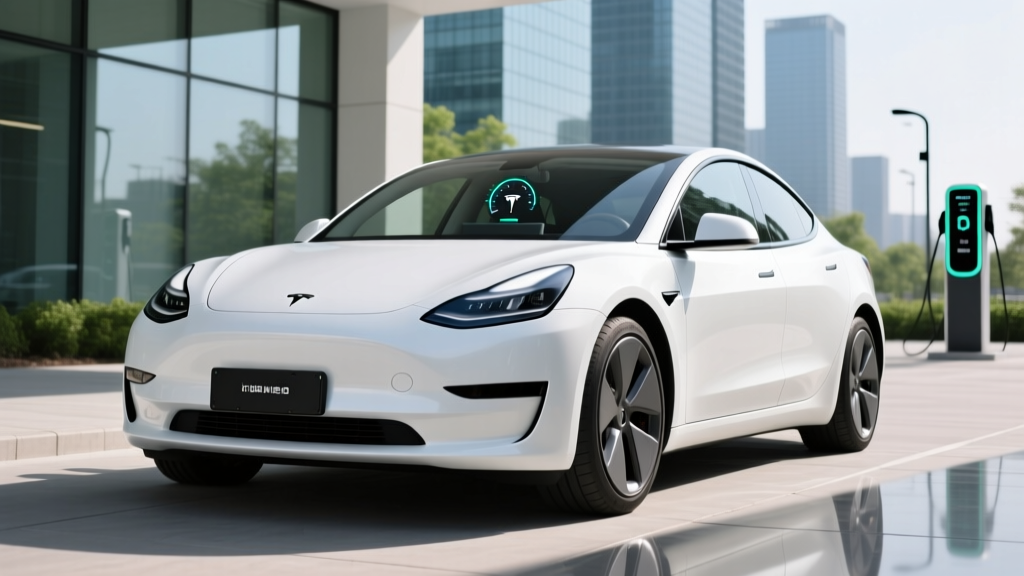
If you've searched "does Tesla have cameras" you've likely noticed that Tesla leans into its camera array more than any other automaker. The 2026 Tesla Model 3 (current-generation "Highland" refresh) uses an eight-camera Tesla Vision suite — no radar, no ultrasonic sensors, no LiDAR — to power everything from parking assist to its optional Full Self-Driving (Supervised) software. It's a bold, polarizing approach, and it shapes the entire ownership experience.
Beyond the camera question, the 2026 Model 3 remains one of the most efficient and best-charging sedans in the EV market. With EPA range up to 363 miles, a peak 250 kW DC fast-charge rate, and a starting price near $38,990, it competes directly with the Hyundai Ioniq 6, BMW i4, and Polestar 2. Here's the full data-driven breakdown.
Tesla's Camera System: How Tesla Vision Actually Works
Yes, Tesla has cameras — eight of them on the Model 3. The current Tesla Vision hardware includes:
- Front-facing main camera (behind the rearview mirror) with multiple focal lengths
- Front wide-angle camera for close-range intersection visibility
- Front narrow/telephoto camera for long-range object detection on highways
- Two front fender cameras (left and right) monitoring blind spots and cross-traffic
- Two rear quarter-panel cameras covering rear blind spots
- One rear-view camera for backup and highway following
Tesla removed ultrasonic parking sensors (USS) starting with 2022 production and radar from North American models in 2021. The 2026 Model 3 relies entirely on neural-net-processed camera data for features like Autopark, Summon, and distance estimation. In practice, this means parking-assist distance readouts are vision-estimated rather than sonar-precise — adequate for most drivers, but less reassuring in tight garages.
Range, Battery, and Efficiency Specs
| Spec | Model 3 RWD | Model 3 Long Range AWD | Model 3 Performance |
|---|---|---|---|
| EPA Range | 363 mi | 346 mi | 315 mi |
| Battery (usable) | ~60 kWh (LFP) | ~75 kWh (NMC) | ~75 kWh (NMC) |
| Efficiency | 132 MPGe / 25 kWh/100mi | 129 MPGe / 26 kWh/100mi | 119 MPGe / 28 kWh/100mi |
| Drivetrain | RWD, single motor | AWD, dual motor | AWD, dual motor |
| Horsepower | 271 hp | 346 hp | 510 hp |
| 0-60 mph | 5.8 sec | 4.2 sec | 2.9 sec |
The RWD trim uses lithium iron phosphate (LFP) cells — Tesla recommends charging to 100% regularly, which is a genuine daily-use advantage. The Long Range and Performance trims use nickel manganese cobalt (NMC) chemistry, where Tesla recommends an 80% daily charge limit to preserve long-term health. Source: fueleconomy.gov.
Charging Speed: DC Fast, Level 2, and Level 1
| Level | Power | Speed | Notes |
|---|---|---|---|
| DC Fast Charge | Peak 250 kW | 10-80% in ~25 min (Long Range); ~22 min (RWD LFP) | Tapers significantly above 80%; preconditioning essential for peak rate |
| Level 2 (Home/Public) | 11.5 kW (48A) | ~37 mi/hr | Full charge in ~6-7 hours; requires 60A circuit |
| Level 1 (120V) | ~1.4 kW | ~3-4 mi/hr | Emergency/trickle only; ~100 hours for a full charge |
Tesla's Supercharger network remains the gold standard for reliability. The Model 3 uses the NACS (North American Charging Standard) connector natively — no adapter needed at Superchargers, and increasingly compatible with Electrify America, EVgo, and other networks as they deploy NACS cables. At a 250 kW V3/V4 Supercharger, the Long Range peaks near 250 kW but sustains ~150-180 kW through the bulk of the 10-80% window. The LFP RWD has a flatter charge curve, meaning it holds peak rate longer — a practical advantage for road trips.
Home charging cost: At the US average electricity rate of ~$0.17/kWh, filling the RWD's 60 kWh battery from empty costs roughly $10.20 — about $0.03 per mile. Compare that to a 30 MPG gas car at $3.50/gallon: $0.12 per mile.
Interior, Cargo, and Tech Features
The Highland-refresh Model 3 interior is minimalist by design. A 15.4-inch center touchscreen handles virtually all controls — there's no traditional instrument cluster, and turn signals moved to the steering wheel (with backup buttons on the door panel). Rear passengers get a dedicated 8-inch screen for climate and media.
Cargo space: 23.0 cu ft behind the rear seats (trunk + frunk combined). The frunk holds about 3.1 cu ft — enough for a charging cable and small bag. Rear legroom measures 35.3 inches, which is competitive with the Hyundai Ioniq 6 (35.7 in) but tighter than the BMW i4 (36.2 in).
Standout tech:
- Ventilated front seats and ambient lighting (new with Highland)
- Acoustic glass all around — dramatically quieter cabin than pre-2024 models
- Over-the-air updates continuously add features
- 8-camera Tesla Vision with Autopark, Summon, and optional FSD (Supervised)
- Dashcam and Sentry Mode use the camera array for security recording
Notable drawbacks: No physical turn-signal stalk, no Apple CarPlay or Android Auto, no rear wiper (sedan), and the camera-only parking system can struggle in heavy rain or when lenses are dirty.
Pricing, Trims, and Federal Tax Credit Eligibility
| Trim | Base MSRP | Est. §30D Credit | Effective Price |
|---|---|---|---|
| Model 3 RWD | $38,990 | Up to $7,500 | ~$31,490* |
| Model 3 Long Range AWD | $45,740 | Up to $7,500 | ~$38,240* |
| Model 3 Performance | $53,740 | Up to $7,500 | ~$46,240* |
*Effective prices assume full §30D credit eligibility. Actual credit depends on your tax liability, income, and battery sourcing compliance.
- MSRP cap: Sedans must be ≤ $55,000 (all Model 3 trims qualify)
- Income cap: AGI ≤ $150,000 (single), ≤ $225,000 (head of household), ≤ $300,000 (joint)
- Battery sourcing: Critical minerals and battery components must meet phased-in thresholds; Tesla's US-built cells generally comply, but verify at fueleconomy.gov before purchase
- Point-of-sale transfer: You can transfer the credit to the dealer for an upfront price reduction (effective Jan 2024+)
- Tax liability: Credit is non-refundable — you need sufficient federal tax liability to claim it
Always confirm current eligibility on IRS.gov or consult a tax professional.
The Model 3 RWD at ~$31,490 after the credit is one of the most affordable premium-range EVs available. Adding the $8,000 FSD (Supervised) package or $2,000 paint/wheel upgrades pushes the as-tested price higher — a fully loaded Long Range typically lands around $48,000-$52,000 before credit.
Warranty and Long-Term Ownership
Tesla covers the Model 3 with:
- Basic vehicle warranty: 4 years / 50,000 miles
- Battery & drive unit: 8 years / 100,000 miles (RWD); 8 years / 120,000 miles (Long Range & Performance)
- Battery capacity retention: Tesla warrants at least 70% capacity during the warranty period
Real-world degradation data from fleet analyses suggests Model 3 NMC batteries retain roughly 90-93% capacity at 100,000 miles with typical charging habits. LFP batteries show even slower degradation, with many fleet vehicles retaining 95%+ at 80,000 miles. A full battery replacement outside warranty currently runs $12,000-$16,000 depending on pack size.
Pros, Cons, and Who Should Buy
✅ Pros
- Class-leading efficiency (132 MPGe RWD)
- 250 kW Supercharger network — most reliable in the US
- 363-mile EPA range on the affordable RWD trim
- LFP battery can charge to 100% daily without degradation concern
- Strong over-the-air update pipeline
- Low running cost: ~$0.03/mile on home electricity
❌ Cons
- No turn-signal stalk — steep learning curve
- Camera-only parking lacks ultrasonic precision
- No Apple CarPlay / Android Auto
- FSD (Supervised) remains Level 2 — $8,000 for driver-supervised assist
- Rear visibility is limited; no rear wiper
- Insurance premiums run 15-25% higher than comparable sedans
Who the Model 3 Suits Best
- Commuters: Excellent — 363-mile range means weekly charging for most. LFP's 100% daily charge is ideal.
- Road trippers: Great — Supercharger network is unmatched for cross-country reliability.
- Tech-forward buyers: Ideal — OTA updates, camera-based dashcam/Sentry, and FSD beta access.
- Families needing space: Consider Model Y instead — the sedan trunk and rear headroom are tight for car seats.
- Towing: Not rated for towing. Look at Model Y or Model X for that.
Frequently Asked Questions
Does Tesla have cameras for self-driving?
Tesla has eight external cameras powering its Tesla Vision system, which supports Autopilot and Full Self-Driving (Supervised). However, these are SAE Level 2 driver-assist features — not autonomous self-driving. You must remain fully engaged. True Level 4 driverless vehicles in the US include Waymo (in select cities) and are a different category entirely.
Does Tesla still use ultrasonic sensors or radar?
No. Since late 2022, Tesla removed ultrasonic parking sensors from the Model 3. Radar was removed from North American vehicles starting in 2021. All parking distance estimation and object detection is now camera-only via neural network processing.
What is the real-world range of the 2026 Tesla Model 3?
The RWD achieves an EPA-rated 363 miles. In real-world highway driving at 70-75 mph, expect 280-310 miles. In sub-freezing winter conditions, LFP chemistry can lose 15-25%, dropping effective range to 220-260 miles. Preconditioning via the app mitigates some cold-weather loss.
How fast does the Model 3 charge at home and on the road?
On a DC fast charger (250 kW Supercharger), 10-80% takes approximately 22-25 minutes depending on trim. At home on a Level 2 Wall Connector (11.5 kW / 48A), you gain about 37 miles per hour, filling the battery in 6-7 hours overnight.
Does the Tesla Model 3 qualify for the $7,500 federal tax credit?
All 2026 Model 3 trims fall under the $55,000 MSRP sedan cap. However, your personal eligibility depends on adjusted gross income (≤$150K single, ≤$300K joint), battery critical-mineral sourcing compliance, and having sufficient federal tax liability. The credit can be transferred to the dealer at point of sale for an immediate price reduction. Verify current details at IRS.gov.
Is the Model 3 worth buying over the Hyundai Ioniq 6 or BMW i4?
The Model 3 RWD wins on price-after-credit (~$31,490), Supercharger access, and efficiency. The Ioniq 6 SE (361 mi EPA) offers a comparable range with a conventional turn-signal stalk and 800V architecture for faster peak charging, but at a higher MSRP. The BMW i4 offers a more premium interior and physical controls but costs $10,000+ more. If Supercharger reliability and lowest total cost matter most, the Model 3 remains the benchmark.