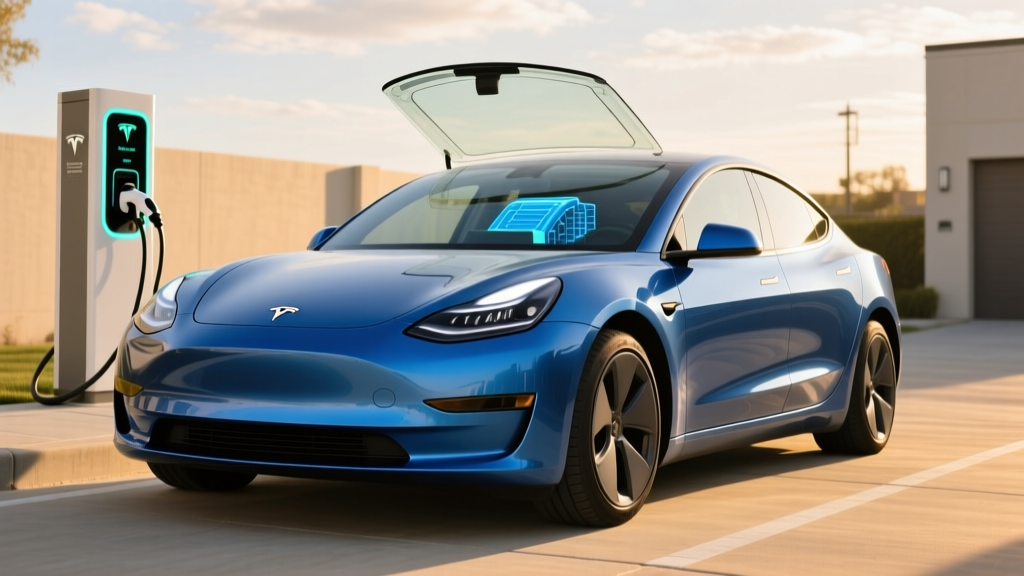
If you've been searching for a Tesla Model 3 blue configuration, you're looking at one of the most efficient and best-charging electric sedans on the market — wrapped in Tesla's most popular premium color upgrade. The current-generation Model 3 (internally called "Highland" and refreshed through the 2025-2026 model years) is available in Deep Blue Metallic and the newer Ultra Blue, both of which add visual distinction to an already compelling EV platform. But paint is just the surface. What really matters is what's underneath: revised battery chemistry, improved thermal management, and access to the largest fast-charging network in North America.
This review covers the 2026 Tesla Model 3 lineup — RWD Long Range and Performance AWD — with a focus on real-world range, charging behavior, pricing after federal incentives, and how it stacks up against rivals like the Hyundai Ioniq 6 and BMW i4. Let's get into the numbers.
Tesla Model 3 Blue: Quick Spec Overview
| Spec | Model 3 RWD | Model 3 Long Range AWD | Model 3 Performance AWD |
|---|---|---|---|
| EPA Range | 272 mi | 363 mi | 315 mi |
| Battery (usable) | ~57.5 kWh (LFP) | ~75 kWh (NMC) | ~75 kWh (NMC) |
| Max DC Fast Charge | 170 kW | 250 kW | 250 kW |
| 10–80% DCFC Time | ~25 min | ~22 min | ~22 min |
| Level 2 Home Charging | 11.5 kW (~37 mi/hr) | 11.5 kW (~44 mi/hr) | 11.5 kW (~40 mi/hr) |
| 0–60 mph | 5.8 sec | 4.2 sec | 2.9 sec |
| Horsepower | 271 hp | 346 hp | 510 hp |
| Drivetrain | RWD (single motor) | AWD (dual motor) | AWD (dual motor) |
| Efficiency (MPGe) | 132 combined | 125 combined | 113 combined |
| Base MSRP (2026) | $38,990 | $44,990 | $52,990 |
| Blue Paint Upcharge | +$1,000 | +$1,000 | +$1,000 |
| Battery Warranty | 8 yr / 100,000 mi | 8 yr / 120,000 mi | 8 yr / 120,000 mi |
Source: fueleconomy.gov and Tesla.com Model 3 design studio. Specs reflect 2025–2026 model-year data. MSRP excludes destination fee ($1,390).
Real-World Range: What the EPA Sticker Doesn't Tell You
Model 3 Long Range AWD: EPA 363 mi — Expect ~310–330 mi on mixed highway driving at 70–75 mph. In cold weather (below 30°F), plan for 250–280 mi of usable range.
Model 3 RWD: EPA 272 mi — Expect ~235–250 mi highway; cold weather drops this to ~190–215 mi.
Model 3 Performance: EPA 315 mi — Expect ~270–290 mi highway; spirited driving reduces further.
The Tesla Model 3 Long Range remains one of the most efficient EVs in its class at roughly 25–27 kWh per 100 miles of highway driving. The Highland refresh improved the car's drag coefficient to approximately 0.219 Cd, which directly translates to better highway range than the pre-2024 Model 3.
However, the RWD trim uses an LFP (lithium iron phosphate) battery. LFP cells are heavier and less energy-dense than the NMC (nickel manganese cobalt) packs in the Long Range and Performance trims. That's why the RWD carries a smaller usable capacity (~57.5 kWh vs. ~75 kWh) and a shorter EPA rating. The trade-off: LFP batteries tolerate regular 100% charging without accelerated degradation, making the RWD ideal for daily commuters who can charge at home every night.
For cold-climate buyers, the Model 3's heat pump (standard across all trims) recovers waste heat from the drivetrain to warm the cabin, reducing the range penalty compared to older EVs using resistive heaters. In our observation and consistent with third-party cold-weather testing, expect a 20–30% range reduction in sustained sub-freezing temperatures — better than many competitors, but still a meaningful planning factor for winter road trips.
Charging Speed: DC Fast, Level 2, and the Supercharger Advantage
| Charging Level | Power / Rate | Model 3 RWD | Model 3 Long Range / Perf. |
|---|---|---|---|
| Level 1 (120V household) | ~1.4 kW | ~4 mi/hr | ~5 mi/hr |
| Level 2 (240V home / public) | 11.5 kW max | ~37 mi/hr | ~44 mi/hr |
| DC Fast Charge | RWD: 170 kW peak LR/Perf: 250 kW peak | 10–80% in ~25 min | 10–80% in ~22 min |
| Tesla Supercharger V4 | Up to 250 kW (cabinet dependent) | Sustained ~130–150 kW avg | Sustained ~170–190 kW avg |
The Model 3's charging story is defined by two factors: peak kW capability and access to the Tesla Supercharger network, which now exceeds 6,500 stations and 65,000+ connectors in North America. With NACS (North American Charging Standard) as the native connector, Model 3 owners plug in directly at every Supercharger — no adapter needed.
Understanding the charge curve: Peak kW is not sustained kW. The Long Range and Performance models hit 250 kW only briefly at low state-of-charge (around 10–15% SoC). As the battery fills, the charge rate tapers: expect ~170 kW through 40% SoC, dropping to ~100 kW by 60%, and below 50 kW past 80%. This is why the 10–80% metric matters more than peak numbers. The ~22-minute 10–80% time for the Long Range is competitive with the Hyundai Ioniq 6 (which uses an 800V architecture for slightly faster 10–80% times at ~18 minutes on 350 kW chargers).
For home Level 2 charging, the Model 3's onboard charger accepts up to 11.5 kW (48 amps on a 60-amp circuit). A full overnight charge from 20% to 80% takes roughly 5–6 hours, depending on trim. If you're installing a Tesla Wall Connector or a third-party Level 2 unit like the ChargePoint Home Flex, you'll need a dedicated 60-amp 240V circuit — budget $800–$2,000 for professional installation depending on your panel's proximity to the garage.
Starting in 2024, Tesla opened Supercharger access to non-Tesla EVs via a built-in CCS adapter or Magic Dock. But Model 3 owners still benefit from the most seamless plug-and-charge experience in the industry: navigate to a Supercharger, plug in, and billing is automatic. No app fumbling, no payment card swiping.
Performance and Driving Dynamics
The 2026 Model 3 Performance is genuinely quick: 2.9 seconds to 60 mph with 510 hp from its dual-motor AWD setup. That puts it in sports-car territory for roughly $54,000 before incentives. Tesla's revised adaptive dampers on the Performance trim (introduced with the Highland refresh) noticeably improve ride compliance over the pre-2024 model, which was criticized for being overly stiff on rough pavement.
The Long Range AWD at 4.2 seconds to 60 mph and 346 hp is the sweet spot for most buyers — fast enough to merge confidently, with the traction benefits of dual-motor all-wheel drive for rain and snow. The RWD model at 5.8 seconds and 271 hp is no slouch either; it's quicker than most gas-powered compact sedans and perfectly adequate for daily commuting.
Regenerative braking in the Model 3 remains one-pedal-capable, though Tesla removed the user-adjustable regen strength setting in the Highland refresh. The default regen is strong enough to bring the car to a complete stop in most traffic scenarios, but some longtime EV drivers may miss the ability to dial it back for coasting on highways.
Interior, Cargo, and Daily Practicality
The Highland interior is a meaningful step up from the pre-2024 Model 3 in materials and isolation. Ventilated front seats are now standard across all trims, and the cabin uses softer-touch materials on the dashboard and door panels. Ambient lighting and a rear-seat touchscreen (8 inches) for climate and media control are new additions.
Dimensions at a glance:
- Cargo volume: 23 cu ft (trunk + frunk combined) — trunk offers 21 cu ft; the front trunk (frunk) adds roughly 2 cu ft, enough for a charging cable bag or small backpack
- Front legroom: 42.7 inches
- Rear legroom: 35.3 inches — adequate for adults on shorter trips, but tighter than a Hyundai Ioniq 6 or BMW i4
- Ground clearance: 5.5 inches — watch steep driveways and speed bumps
The 15.4-inch center touchscreen remains the primary interface for virtually all vehicle controls — there are no physical buttons for climate, mirrors, or glovebox. This minimalist approach polarizes buyers: some love the clean aesthetic; others find it distracting while driving. The steering-column stalks for turn signals and wipers have been replaced by steering-wheel-mounted buttons in the Highland generation, a change that draws consistent criticism from reviewers and owners alike.
Driver Assistance: Autopilot and FSD Supervised
Tesla Autopilot and Full Self-Driving (Supervised) are SAE Level 2 driver-assistance systems. The driver must remain fully attentive, keep hands on the wheel, and be prepared to take over at any moment. These systems do not make the Model 3 autonomous. Only Level 4 services like Waymo operate without a human driver in defined areas.
Every Model 3 ships with Tesla's Basic Autopilot, which includes traffic-aware cruise control and lane-centering assist on highways. The optional FSD (Supervised) package — currently $8,000 to purchase or $99/month as of 2026 — adds automated lane changes, city-street traffic light and stop sign recognition, and navigation-guided steering on mapped roads.
FSD has improved substantially in the v12+ neural-network-based architecture, but it still requires active supervision. Expect occasional phantom braking, missed construction-zone cones, and hesitation at complex unprotected left turns. It's a capable highway companion that reduces fatigue on long trips, but it is not a substitute for an alert driver. The NHTSA continues to monitor Tesla's Autopilot/FSD safety record through its Standing General Order on crash reporting.
Pricing, Trims, and Federal Tax Credit Eligibility
| Trim | Base MSRP | + Blue Paint | + Destination | Est. Total | §30D Credit Eligible? |
|---|---|---|---|---|---|
| Model 3 RWD | $38,990 | +$1,000 | +$1,390 | $41,380 | Yes — up to $7,500 |
| Model 3 Long Range AWD | $44,990 | +$1,000 | +$1,390 | $47,380 | Yes — up to $7,500 |
| Model 3 Performance AWD | $52,990 | +$1,000 | +$1,390 | $55,380 | Yes — up to $7,500 |
How the §30D Federal Tax Credit works for the Model 3: Under current IRS rules, the Tesla Model 3 qualifies for up to $7,500 in federal EV tax credits, split into two components: $3,750 for meeting critical-minerals sourcing requirements and $3,750 for battery-component sourcing. Tesla has confirmed that Model 3 vehicles built at the Fremont factory with U.S.-sourced battery cells meet both halves of the requirement for 2025–2026 deliveries.
But eligibility is not automatic. You must meet all of the following:
- Income caps: Modified AGI ≤ $150,000 (single), ≤ $225,000 (head of household), ≤ $300,000 (married filing jointly)
- MSRP cap: The vehicle's base MSRP must be ≤ $55,000 for sedans (all Model 3 trims qualify)
- Point-of-sale transfer: As of 2024, you can transfer the credit to the dealer at purchase, reducing your out-of-pocket cost immediately rather than waiting to claim it on your tax return
- New vehicle, original buyer: The credit applies only to new EVs purchased for personal use, not resale
For a Model 3 RWD in Deep Blue Metallic, the math looks like this: $41,380 total price − $7,500 credit = $33,880 effective cost before any state incentives. That positions it against the Hyundai Ioniq 6 SE ($39,500 base, also credit-eligible) and well below the BMW i4 eDrive40 ($52,200 base).
Always verify current credit eligibility on IRS.gov before purchasing — battery sourcing requirements have tightened annually and specific build dates affect qualification.
Pros and Cons: The Honest Assessment
- Best-in-class Supercharger network access (native NACS)
- Excellent efficiency: 25–27 kWh/100 mi highway (Long Range)
- Class-leading range on Long Range trim (363 mi EPA)
- Strong performance even on base RWD trim
- Over-the-air updates continuously add features
- Heat pump standard for better cold-weather efficiency
- Competitive pricing after §30D tax credit
- High resale value relative to other EVs
- No physical turn-signal stalks (steering-wheel buttons instead)
- Rear seat legroom tight for taller passengers
- FSD ($8,000) still requires full driver supervision
- Minimal frunk space compared to competitors
- RWD LFP battery means less range and no 250 kW DCFC
- Insurance costs above segment average
- Panel-gap quality still inconsistent on some builds
- No Apple CarPlay or Android Auto
Who Should Buy the Tesla Model 3 in Blue?
Choose the Model 3 Long Range AWD if: You take regular road trips (200+ miles), live in a region with cold winters, want dual-motor traction, and prioritize maximum range. This is the best all-around Model 3 for most buyers.
Choose the Model 3 Performance if: You want sports-car acceleration (2.9s to 60 mph), track-capable handling with revised adaptive dampers, and don't mind sacrificing ~50 miles of range for the performance upgrade.
Look elsewhere if: You need a spacious rear seat for car seats or tall adults (consider the Hyundai Ioniq 5 or Kia EV6), you want Apple CarPlay, or you live in an area with limited Supercharger coverage and prefer CCS-native public charging.
Frequently Asked Questions
What Tesla Model 3 blue paint options are available?
As of the 2026 model year, Tesla offers Deep Blue Metallic (a dark, navy-leaning blue that has been in the lineup for years) and Ultra Blue (a brighter, more vivid blue introduced with the Highland generation). Both are $1,000 upgrades over the standard Pearl White Multi-Coat. Stealth Gray and Solid Black are no-cost alternatives. Quicksilver and Red Multi-Coat are $2,000 premium options.
Does the Tesla Model 3 qualify for the full $7,500 federal tax credit?
Yes — all three Model 3 trims currently qualify for the full $7,500 under IRS §30D, provided the buyer meets income caps ($150K single / $300K joint) and the vehicle is purchased new for personal use. The credit can be transferred at point of sale to reduce your purchase price immediately. Verify your specific eligibility at IRS.gov and with your tax professional, as sourcing rules update periodically.
How does Model 3 range hold up on highway road trips?
At sustained 70–75 mph in moderate temperatures (60–80°F), expect the Long Range AWD to deliver approximately 310–330 real-world miles before needing to charge. In winter conditions below 30°F, that drops to roughly 250–280 miles. The onboard navigation will automatically precondition the battery when you navigate to a Supercharger, which optimizes charging speed upon arrival — a critical feature for road-trip efficiency.
Is the Tesla Model 3 better than the Hyundai Ioniq 6?
It depends on your priorities. The Ioniq 6 offers slightly faster DC charging (800V architecture, ~18 min 10–80% on a 350 kW charger), more rear-seat legroom, and Apple CarPlay/Android Auto. The Model 3 wins on Supercharger network access, over-the-air feature updates, cargo versatility (hatchback-style trunk opening), and slightly longer EPA range on the Long Range trim. If public charging reliability is your top concern, Tesla's network advantage is significant.
What does it cost to charge a Model 3 at home vs. Superchargers?
At the U.S. average residential electricity rate of ~$0.17/kWh, a full charge of the Long Range battery (~75 kWh) costs approximately $12.75 for 363 miles of range — roughly 3.5 cents per mile. Supercharger pricing varies by location and time of day but averages $0.30–$0.40/kWh nationally, bringing the cost to roughly 6–8 cents per mile. Both are significantly cheaper than a comparable gas sedan at $3.50/gallon and 30 MPG (~11.7 cents per mile).
How long will the Model 3 battery last?
Tesla warranties the Long Range and Performance battery for 8 years or 120,000 miles (whichever comes first), guaranteeing at least 70% capacity retention. The RWD's LFP battery is warranted for 8 years or 100,000 miles at the same 70% threshold. Real-world data from high-mileage Tesla owners and fleet operators suggests NMC packs typically retain 85–90% capacity at 100,000 miles when DC fast charging is used moderately. LFP batteries show even slower degradation curves but start with less total capacity. Battery replacement, if needed out of warranty, currently runs $12,000–$16,000 depending on the pack.