Tesla Model 3 Black Interior: What You're Actually Buying
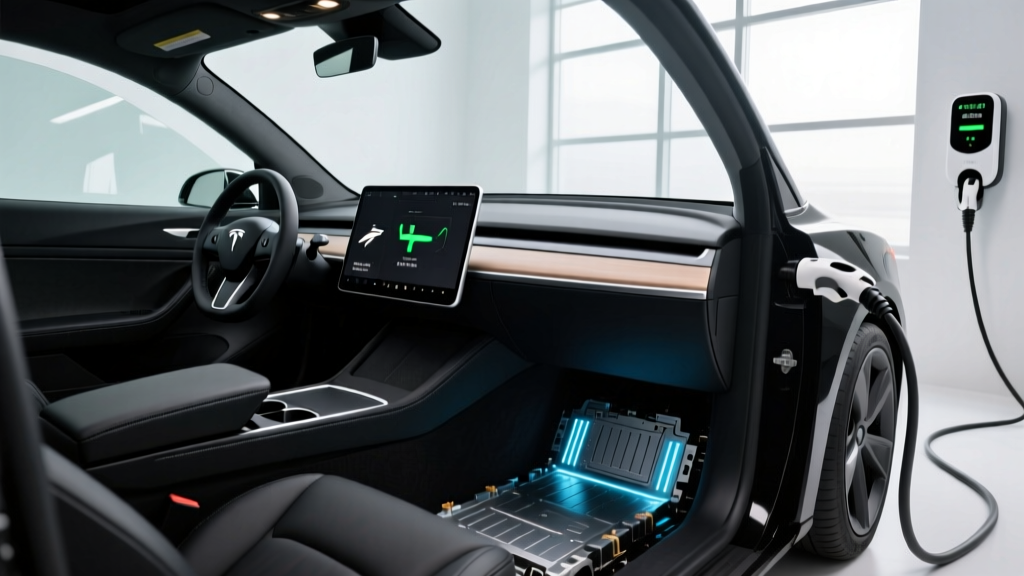
The Tesla Model 3 remains one of the most-searched electric sedans in the U.S., and the Tesla Model 3 black interior — Tesla's no-cost standard cabin option — is the configuration the majority of buyers drive home in. Unlike the $1,000 black-and-white premium interior upgrade, the all-black cabin uses Tesla's "partial premium" vegan leather upholstery on a darker palette that hides wear better over time and avoids the staining issues that plague white seats in daily-driver duty.
But an interior color choice is only the starting point. The real purchase decision hinges on which powertrain you pair it with, what the actual range looks like once you leave the showroom, whether the 2026 Model 3 still qualifies for the §30D federal tax credit, and how its charging speed stacks up against the Hyundai Ioniq 6, BMW i4, and Polestar 2. This profile covers every spec, number, and ownership variable you need to decide.
| Spec | Long Range RWD | Long Range AWD | Performance |
|---|---|---|---|
| EPA Range | 363 mi | 341 mi | 315 mi |
| Battery (usable) | ~79 kWh (NMC) | ~79 kWh (NMC) | ~79 kWh (NMC) |
| Horsepower | 346 hp | 440 hp | 510 hp |
| 0–60 mph | 4.9 sec | 4.2 sec | 2.9 sec |
| Drivetrain | Rear-Wheel Drive | Dual-Motor AWD | Dual-Motor AWD |
| Max DC Fast Charge | 250 kW | 250 kW | 250 kW |
| 10–80% DCFC Time | ~25 min | ~25 min | ~25 min |
| Level 2 Charge Rate | 11.5 kW (~44 mi/hr) | 11.5 kW (~44 mi/hr) | 11.5 kW (~44 mi/hr) |
| MPGe (combined) | 132 MPGe | 125 MPGe | 118 MPGe |
| Base MSRP | $44,130 | $47,130 | $55,130 |
Range Reality: EPA Sticker vs. What You'll Actually See
EPA Estimate: 363 mi (Long Range RWD) / 341 mi (Long Range AWD) / 315 mi (Performance)
Real-World Expectation: Plan for 280–310 mi on sustained 75-mph highway driving in mild weather. In sub-freezing winter conditions, expect a 20–30% reduction — dropping the Long Range RWD to roughly 250–280 mi per charge. City and suburban driving with regenerative braking recovers closer to the EPA figure.
The Model 3's efficiency is among the best in its class — roughly 25–27 kWh per 100 miles for the Long Range RWD, per fueleconomy.gov. That translates into real cost savings at the charger, but the EPA number assumes a blend of city and highway cycles at moderate temperatures. Sustained Interstate speeds, headwinds, and elevation changes all compress range noticeably. Tesla's navigation-based battery preconditioning helps mitigate charging delays, but it doesn't recover lost miles from aerodynamic drag at 80 mph.
For buyers in northern-tier states, the heat pump (standard since the 2021 refresh) is a meaningful advantage — it reduces cabin-heating energy draw by roughly 30–40% compared to resistive heaters, preserving winter range better than many competitors.
Charging Speed: DC Fast, Level 2, and the Curve That Matters
| Charging Method | Max Power | Typical Speed | Notes |
|---|---|---|---|
| Level 1 (120V household) | ~1.4 kW | ~5 mi/hr | Emergency/trickle only |
| Level 2 (240V home/wall connector) | 11.5 kW | ~44 mi/hr | Full charge in ~8–9 hrs |
| DC Fast (Supercharger V3/V4) | 250 kW peak | 10–80% in ~25 min | Peak sustained to ~50%, then tapers |
| DC Fast (CCS adapter, EA/others) | ~150–250 kW | Varies by station | Requires $250 Tesla CCS adapter |
The 250 kW peak figure requires context. The Model 3 holds peak charge rate only between roughly 10–50% State of Charge. Beyond 50%, the battery management system tapers aggressively to protect the NMC cells — by 80%, you're typically seeing 60–80 kW. This is why the 10–80% time of ~25 minutes is the more useful metric than the peak kW number.
At home on a Tesla Wall Connector wired to a 60-amp circuit, 11.5 kW is achievable, adding roughly 44 miles of range per hour. Most owners charging overnight from 20% to 80% will wake up fully topped off. A standard NEMA 14-50 outlet on a 50-amp circuit delivers roughly 32 amps / 7.7 kW (~30 mi/hr), which is adequate for most daily driving needs but will take longer on road-trip recovery nights.
The Model 3 ships with the NACS (North American Charging Standard) port natively, giving you seamless access to Tesla's Supercharger network — the most reliable DC fast-charging infrastructure in the U.S. by uptime metrics. For non-Tesla networks like Electrify America, the optional CCS adapter is required.
Performance and Drivetrain Breakdown
The 2026 Model 3 lineup continues with three trims, all using the refreshed "Highland" body introduced in late 2023 with improved NVH, ventilated front seats, ambient lighting, and a rear passenger touchscreen.
- Long Range RWD: 346 hp single-motor, 0–60 in 4.9 seconds. The efficiency champion of the lineup. Best for commuters who prioritize range over acceleration.
- Long Range AWD: 440 hp dual-motor, 0–60 in 4.2 seconds. Adds front motor for all-weather traction and stronger passing power. Loses ~22 miles of range vs. RWD.
- Performance: 510 hp dual-motor, 0–60 in 2.9 seconds. Track-tuned suspension, larger brakes, 20" wheels. Sacrifices ~48 miles of range for supercar-rivaling acceleration.
All trims use Tesla's latest-generation drive unit with silicon carbide inverters, contributing to the class-leading efficiency. The RWD base model that previously used an LFP (lithium iron phosphate) battery was discontinued after the 2024 model year in the U.S.; all 2026 Model 3 variants now use NMC chemistry for consistent range and cold-weather behavior across the lineup.
Pricing, Trims, and Federal Tax Credit Eligibility
| Trim | Base MSRP | Destination | As-Tested (Black Interior) | Est. After §30D Credit |
|---|---|---|---|---|
| Long Range RWD | $44,130 | $1,390 | $45,520 | ~$38,020* |
| Long Range AWD | $47,130 | $1,390 | $48,520 | ~$41,020* |
| Performance | $55,130 | $1,390 | $56,520 | Not eligible (over MSRP cap) |
*Assumes full $7,500 §30D credit eligibility. Actual credit depends on buyer income, battery sourcing, and point-of-sale transfer rules. See IRS §30D guidelines.
The black interior is Tesla's no-cost standard option, so it does not add to the MSRP. The black-and-white premium interior adds $1,000. Other cost adders include paint colors (Solid Black is free; Ultra Red, Deep Blue, Pearl White, and Stealth Grey cost $1,000–$2,500), the $1,500 Enhanced Autopilot package, and $8,000 Full Self-Driving (Supervised).
§30D Tax Credit Rules (2026): The Long Range RWD and Long Range AWD trims fall under the $55,000 MSRP cap for sedans. The Performance trim, at $55,130 base, exceeds this cap and is not eligible for the new-vehicle credit. Buyer income caps apply: $150,000 single / $225,000 head of household / $300,000 joint filers (modified AGI). Additionally, critical-mineral and battery-component sourcing requirements must be met for the full $7,500 — Tesla has generally qualified, but always verify current status on the IRS clean vehicle credit page before purchase. The credit can be transferred to the dealer at point of sale as an immediate price reduction.
Interior, Cargo, and the Black Cabin Experience
The Tesla Model 3 black interior uses a single-tone vegan leather (synthetic) on the seats, dashboard, and door panels. Compared to the black-and-white option, the all-black cabin:
- Hides scuffs and dye transfer from dark denim far better over 2–3 years of use
- Absorbs more solar heat — black seats can reach 150°F+ in direct summer sun, making ventilated seats (now standard post-Highland refresh) a practical necessity
- Creates a more cockpit-like, intimate feel vs. the airy, open sensation of the white interior
- Shows dust and lint more readily on the dark dashboard surface, requiring more frequent wipe-downs
Cargo and passenger dimensions:
- Trunk: 23 cu ft (rear trunk) + 3.1 cu ft frunk = ~26 cu ft total
- Front legroom: 42.7 in
- Rear legroom: 35.2 in (tight for tall passengers on long trips)
- Seating: 5-passenger capacity (rear middle seat is narrow and firm)
The minimalist cabin centers on a 15.4-inch touchscreen handling all vehicle functions — no physical instrument cluster, no traditional stalks (turn signals are steering-wheel buttons in the Highland generation). This is polarizing: some owners adapt within days, others find it a persistent frustration, especially for turn-signal use during roundabouts.
Tech, Autopilot, and Driver Assistance
SAE Automation Level: Tesla Autopilot and FSD (Supervised) are Level 2 driver-assistance systems. The driver must remain fully engaged, hands on or near the wheel, and eyes on the road at all times. These are NOT self-driving systems. Only Level 4 services like Waymo operate without a human driver in geofenced areas.
Standard Autopilot includes Traffic-Aware Cruise Control and Autosteer (lane centering) on divided highways. Enhanced Autopilot ($1,500) adds Auto Lane Change, Autopark, Summon, and Navigate on Autopilot. Full Self-Driving (Supervised) at $8,000 attempts to handle city streets, stop signs, and traffic lights but requires constant supervision and has variable reliability by geography and weather.
Other notable tech:
- 17-speaker premium audio with immersive sound
- Rear 8-inch touchscreen for passengers (climate, media, gaming)
- Over-the-air updates continuously add features
- Sentry Mode dashcam/surveillance (requires USB drive)
- Dashcam and USB-C ports front and rear
Key Limitations: FSD (Supervised) struggles with construction zones, faded lane markings, heavy rain, and unprotected left turns. Autopilot phantom braking events, while reduced, still occur. Turn-signal buttons on the steering wheel remain controversial and take adaptation. No Apple CarPlay or Android Auto — Tesla's proprietary infotainment only.
Warranty, Ownership Costs, and Who Should Buy
Warranty coverage:
- Basic vehicle: 4 years / 50,000 miles
- Battery & drive unit: 8 years / 120,000 miles (Long Range) with minimum 70% capacity retention
- Performance: 8 years / 120,000 miles battery & drive unit
Tesla's battery warranty is competitive but not class-leading — Hyundai offers 10-year/100,000-mile battery coverage on the Ioniq 6. However, Tesla's real-world degradation data is robust: most Model 3 owners report 5–8% capacity loss over the first 100,000 miles based on fleet telemetry, well within the 70% retention threshold.
Total cost of ownership advantages include lower fuel costs (~$0.04–0.06 per mile on home electricity vs. ~$0.12–0.15 for a comparable gas sedan), minimal brake wear thanks to regenerative braking, and no oil changes. Insurance premiums, however, tend to run 15–25% higher than comparable ICE sedans due to repair costs and Tesla's direct-repair model.
Who the Model 3 suits best:
- Daily commuters with home Level 2 charging who want efficiency and low running costs
- Tech-forward buyers comfortable with screen-centric controls and OTA updates
- Road trippers who value Supercharger network access for cross-country travel
Who should look elsewhere: Families needing rear-seat space (consider Model Y), buyers who want physical controls and Apple CarPlay (consider Ioniq 6 or BMW i4), and those in areas with limited Tesla Service Center coverage.
Pros
- Class-leading efficiency (25–27 kWh/100 mi)
- Supercharger network access — best DC charging reliability
- Strong real-world range (280–310 mi highway)
- Excellent performance across all trims
- Continuous OTA feature improvements
- Black interior hides daily wear better than white
Cons
- No Apple CarPlay / Android Auto
- Steering-wheel turn-signal buttons are divisive
- Rear seat legroom tight for adults (35.2 in)
- FSD (Supervised) reliability inconsistent
- Insurance premiums above segment average
- Performance trim exceeds §30D MSRP cap
Frequently Asked Questions
What is the real-world range of the 2026 Tesla Model 3?
On a mix of highway and suburban driving in moderate temperatures, expect 280–310 miles from the Long Range RWD (EPA 363 mi). In winter at highway speeds, plan for 250–280 miles. City driving with regen braking recovers closer to the EPA sticker.
How fast does the Model 3 charge at home and on the road?
On a Level 2 home charger (11.5 kW), the Model 3 adds ~44 miles of range per hour, fully charging overnight. On a V3/V4 Supercharger, 10–80% takes approximately 25 minutes, though peak 250 kW rates only hold to about 50% SoC before tapering.
Does the 2026 Tesla Model 3 qualify for the $7,500 federal tax credit?
The Long Range RWD ($44,130) and Long Range AWD ($47,130) fall under the $55,000 sedan MSRP cap and are generally eligible, subject to buyer income limits ($150K single / $300K joint) and battery-sourcing requirements. The Performance trim ($55,130) exceeds the MSRP cap and does not qualify. Always verify current eligibility on IRS.gov.
Is the black interior worth choosing over black-and-white?
The all-black interior is the no-cost standard option and hides wear, dye transfer, and staining far better over years of daily use. The black-and-white ($1,000) looks striking in photos but requires more care. Most long-term owners and fleet operators prefer the all-black cabin for durability.
Is the Tesla Model 3 worth buying vs. the Hyundai Ioniq 6 or BMW i4?
The Model 3 wins on Supercharger network access, efficiency, and OTA updates. The Ioniq 6 offers more rear-seat room, Apple CarPlay, and a longer battery warranty. The BMW i4 provides a more traditional luxury interior with physical controls. If charging infrastructure and software are your priorities, the Model 3 leads; if rear-seat comfort and CarPlay matter more, cross-shop the Ioniq 6.
Does the Model 3 have Apple CarPlay?
No. Tesla uses its proprietary infotainment system exclusively. There is no Apple CarPlay, Android Auto, or third-party integration for the main display. Navigation, media, and phone functions are handled natively or via Bluetooth.