Search volume for "Tesla Model 3 bed" reflects two distinct buyer intents: owners looking to convert their sedan into a makeshift camper for overnight trips, and shoppers evaluating whether the Model 3's trunk and frunk can serve as a practical cargo bed alternative to an SUV or truck. This review addresses both, while delivering the full 2026 Tesla Model 3 spec breakdown — range, charging, pricing, and federal tax credit eligibility — you need to make an informed purchase decision.
Quick Verdict: The Model 3 as a Bed or Cargo Hauler
The Tesla Model 3 is a compact executive sedan, not a pickup or hatchback. Its 23 cubic feet of trunk space (with the 2024+ Highland refresh) and 3.1 cu ft frunk give it decent cargo utility for a sedan, but the trunk opening is narrow and the rear seats don't fold completely flat. For camping, aftermarket inflatable bed platforms exist that span the folded rear seats, creating a roughly 6-foot sleeping surface — workable for one adult or two in a pinch, but tight compared to the Model Y's 76 cu ft with seats down.
If cargo versatility or a flat sleeping platform is your top priority, the Model Y or a Rivian R1T will serve you far better. But if you want an efficient, fun-to-drive sedan that can occasionally double as a weekend camper, the Model 3 is viable with the right accessories.
Real-World Range Reality Check
EPA Estimated: 363 miles (Long Range AWD, 18" wheels) | 346 miles (Long Range AWD, 19" wheels) | 272 miles (RWD Standard Range)
Expect in practice: Highway driving at 75 mph drops range to roughly 280–310 miles on Long Range trims. In freezing temperatures (below 32°F), expect a 15–30% reduction — bringing the Long Range down to 250–290 miles real-world. City driving with regenerative braking often matches or slightly exceeds EPA figures.
2026 Tesla Model 3 Full Spec Sheet
| Spec | RWD Standard Range | Long Range AWD | Performance (if available) |
|---|---|---|---|
| EPA Range | 272 mi | 363 mi (18" wheels) | ~315 mi (est.) |
| Battery Capacity | ~60 kWh usable (LFP) | ~82 kWh usable (NMC) | ~82 kWh usable (NMC) |
| Battery Chemistry | LFP (Lithium Iron Phosphate) | NMC (Nickel Manganese Cobalt) | NMC |
| Drivetrain | Rear-Wheel Drive | Dual-Motor AWD | Dual-Motor AWD |
| Horsepower | 271 hp | 346 hp | ~460 hp (est.) |
| 0–60 mph | 5.8 sec | 4.2 sec | ~3.1 sec |
| Peak DC Fast Charge | 170 kW | 250 kW | 250 kW |
| 10–80% DC Time | ~30 min | ~25 min | ~25 min |
| Level 2 Home Charge | 11.5 kW (~44 mi/hr) | 11.5 kW (~44 mi/hr) | 11.5 kW (~44 mi/hr) |
| Efficiency (MPGe) | 142 MPGe combined | 132 MPGe combined | ~121 MPGe (est.) |
| Efficiency (kWh/100 mi) | 24 kWh | 26 kWh | ~28 kWh |
| Trunk Volume | 23 cu ft (rear trunk) + 3.1 cu ft (frunk) | ||
| Rear Legroom | 35.2 inches | ||
| Base MSRP (2026 est.) | ~$38,990 | ~$44,990 | ~$52,990 |
| Battery Warranty | 8 yr / 100,000 mi | 8 yr / 120,000 mi | 8 yr / 120,000 mi |
| Basic Vehicle Warranty | 4 yr / 50,000 mi | ||
Sources: fueleconomy.gov, Tesla.com Model 3 specs. Pricing reflects estimated 2026 MSRP before destination fees. Performance trim availability varies by model year.
Charging Speed: Home, Supercharger, and CCS
The 2026 Model 3 comes equipped with the NACS (North American Charging Standard) connector natively — Tesla's proprietary plug that is now being adopted by Ford, GM, Rivian, and most major automakers. This means access to the full Tesla Supercharger network, which remains the most reliable DC fast-charging infrastructure in the U.S.
| Charging Level | Power | Miles of Range Per Hour | Notes |
|---|---|---|---|
| Level 1 (120V household) | ~1.4 kW | ~5–6 mi/hr | Emergency/trickle only; 272-mi RWD takes ~50+ hrs for full charge |
| Level 2 (240V home, 48A) | 11.5 kW | ~44 mi/hr | Full charge overnight (~7–8 hrs); requires NEMA 14-50 or hardwired Wall Connector |
| DC Fast (Supercharger V3) | Up to 250 kW (LR/AWD) | ~1,000+ mi/hr peak | 10–80% in ~25 min; tapers significantly above 80% SoC |
| DC Fast (Supercharger V4) | Up to 250+ kW | Similar to V3 | Newer stalls with cable management improvements |
Charging curve reality: The Long Range Model 3 peaks at 250 kW only between roughly 10–30% State of Charge. By 50% SoC, the rate drops to ~150 kW, and above 80%, it falls below 60 kW. This is why Tesla's onboard navigation preconditions the battery when you navigate to a Supercharger — arriving with a warm battery maximizes peak-rate time. Plan for ~25 minutes 10–80%, but a 10–90% stop takes closer to 40 minutes.
Tax Credit, Pricing, and What You'll Actually Pay
The Tesla Model 3 qualifies for the IRS §30D federal tax credit, but eligibility depends on your income, the vehicle's MSRP, and battery-component/critical-mineral sourcing requirements that tighten annually.
| Trim | Est. 2026 MSRP | Max §30D Credit | Effective Price (if eligible) |
|---|---|---|---|
| RWD Standard Range | $38,990 | Up to $7,500 | ~$31,490 |
| Long Range AWD | $44,990 | Up to $7,500 | ~$37,490 |
| Performance | $52,990 | Up to $7,500 | ~$45,490 |
§30D Credit Eligibility Checklist (2026 Rules)
- MSRP cap: Sedans must be ≤$55,000 (all Model 3 trims qualify on sticker price)
- Buyer income cap: AGI ≤$150,000 (single) / ≤$300,000 (married filing jointly)
- Battery sourcing: Increasing percentages of critical minerals and battery components must be sourced from U.S. or FTA partners — this requirement tightens each year and may reduce the credit to $3,750 or eliminate it for some configurations
- Point-of-sale transfer: You can transfer the credit to the dealer at purchase for an immediate price reduction (effective Jan 2024 onward)
- Verification: Always check the latest IRS guidance and Tesla's current credit status at purchase time — rules change frequently
Tesla Model 3 Bed & Cargo: What Actually Fits
The "Tesla Model 3 bed" search primarily reflects camping interest. Here's the practical reality:
Sleeping in the Model 3
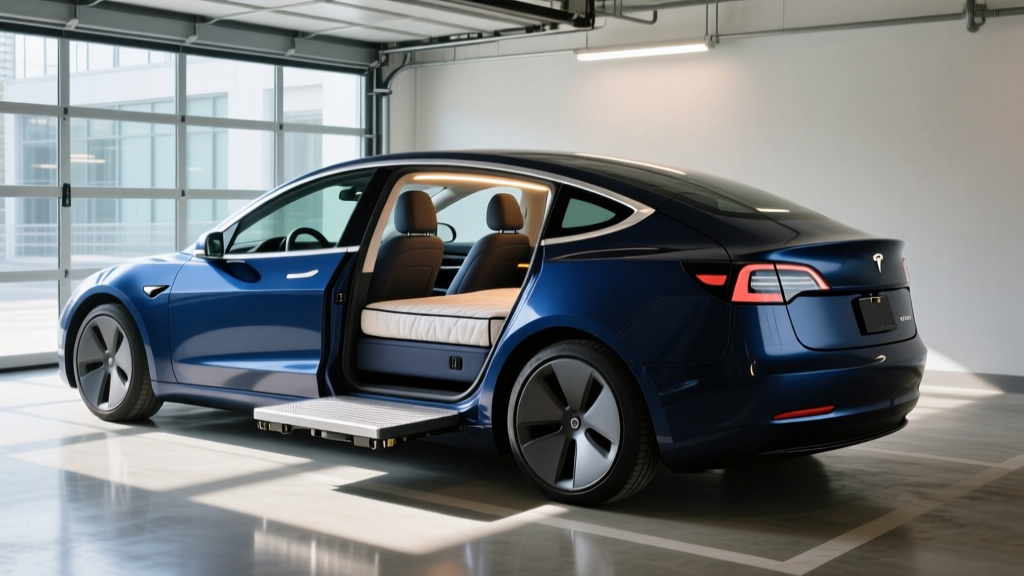
With the 60/40 split rear seats folded, the Model 3 creates a cargo floor roughly 54–60 inches long from the back of the front seats to the trunk wall — not quite enough for a 6-foot adult to lie fully flat. Aftermarket solutions like inflatable bed platforms (from brands such as Teslary or EV-specific camping outfitters) bridge the gap between the folded seatbacks and the trunk floor, creating a surface approximately 70–74 inches long. These setups typically cost $80–$200 and work best with a sleeping pad and sleeping bag rather than a full mattress.
Camp Mode, built into Tesla's software, keeps climate control running overnight using the traction battery — expect roughly 1–2% battery drain per hour of climate use, meaning a full night's sleep costs roughly 10–15% SoC depending on outside temperature.
Cargo Capacity vs. Key Competitors
| Vehicle | Rear Cargo (seats up) | Max Cargo (seats down) | Frunk |
|---|---|---|---|
| Tesla Model 3 | 23 cu ft | ~43 cu ft (est., uneven floor) | 3.1 cu ft |
| Tesla Model Y | 30 cu ft | 76 cu ft | 4.1 cu ft |
| Hyundai Ioniq 6 | 12.3 cu ft | ~40 cu ft (est.) | None (on AWD) |
| BMW i4 Gran Coupe | 16.6 cu ft | ~46 cu ft (est.) | None |
| Polestar 2 | 14.4 cu ft (hatchback) | ~40 cu ft | 1.4 cu ft |
The Model 3's trunk is deep but the opening is a traditional sedan slot — large items like a full-size bicycle or furniture won't pass through without creative angling. The Model Y's hatchback design and 76 cu ft flat floor make it dramatically more practical for cargo and camping.
Technology, Driver Assistance, and Drawbacks
The refreshed Model 3 (internally called "Highland") introduced for 2024 and continuing into 2026 features a significantly quieter cabin, ventilated front seats, ambient lighting, a rear touchscreen for passengers, and improved suspension tuning. The 15.4-inch front touchscreen handles all vehicle controls — there are no physical buttons, turn-signal stalks, or a traditional instrument cluster. Turn signals are on the steering wheel, which remains polarizing among owners.
Autopilot and FSD (Supervised)
Every Model 3 includes basic Autopilot (lane centering + adaptive cruise). The optional Full Self-Driving (Supervised) package adds automatic lane changes, city-street navigation, and traffic-light recognition — but it remains an SAE Level 2 system requiring continuous driver attention and hands on the wheel.
⚠️ FSD Is NOT Self-Driving
Tesla's FSD (Supervised) is an SAE Level 2 driver-assist system. The driver must remain fully engaged, monitor the road, and be prepared to take over at any instant. Only Level 4 robotaxi services like Waymo operate without a human driver. Do not use FSD as a substitute for attentive driving.
Notable Drawbacks
- No physical controls for turn signals, wipers, or climate — everything routes through the touchscreen or steering-wheel buttons
- Rear visibility is limited due to the sloping roofline; the camera-based rearview mirror helps but takes adjustment
- Rear seat headroom is tight for passengers over 6'2"
- No Apple CarPlay or Android Auto — Tesla's proprietary infotainment only
- Insurance costs run 15–30% higher than comparable gas sedans in most states
✅ Pros
- Best-in-class efficiency: 24–26 kWh/100 mi
- Access to Tesla Supercharger network (most reliable in U.S.)
- Strong real-world range (280–310 mi highway on Long Range)
- Excellent performance (4.2s 0–60 on Long Range AWD)
- Over-the-air updates add features post-purchase
- Camp Mode enables overnight climate-controlled sleeping
❌ Cons
- Sedan trunk opening limits cargo versatility
- No flat-folding rear floor for camping without aftermarket bed kits
- No physical buttons or stalks — steep learning curve
- Higher insurance premiums than gas equivalents
- FSD costs extra ($8,000 or $99/mo) and is still Level 2
- LFP battery on RWD has lower energy density and cold-weather performance
Who Should Buy the Tesla Model 3 (and Who Shouldn't)
Choose the Model 3 if:
- You're a daily commuter covering 30–80 miles round-trip who values efficiency and low running costs
- You want access to the Supercharger network for road trips without range anxiety
- You occasionally car-camp and are okay with an aftermarket bed setup
- You prioritize driving dynamics and acceleration over cargo space
- You qualify for the §30D credit and want a sub-$35K effective price on the RWD trim
Choose something else if:
- You need a flat sleeping platform without aftermarket mods → Model Y, Rivian R1S
- You regularly haul large cargo or tow → Model Y, Ford F-150 Lightning, Rivian R1T
- You want physical buttons and Apple CarPlay → Hyundai Ioniq 6, BMW i4
- You need rear-seat space for tall passengers → Model Y, Hyundai Ioniq 5
Is the Tesla Model 3 Worth It vs. Competitors?
The Model 3 Long Range AWD at ~$44,990 (before credit) remains the efficiency and Supercharger-access benchmark in the compact electric sedan segment. The Hyundai Ioniq 6 offers a similar range (361 mi on the SEL RWD) and a more traditional interior with physical controls, but its CCS charging ecosystem is less reliable than Tesla's network. The BMW i4 delivers a more premium ride but starts ~$12K higher and offers less range.
If you're cross-shopping based on "Tesla Model 3 bed" searches specifically — meaning you want a sedan that can occasionally serve as a camper — the Model 3 works with an inflatable bed kit and Camp Mode, but the Model Y is meaningfully better for this use case with its flat-folding hatchback floor and 76 cu ft of space.
Frequently Asked Questions
What is the real-world range of the Tesla Model 3?
The Long Range AWD is EPA-rated at 363 miles on 18" wheels. In real-world highway driving at 75 mph, expect 280–310 miles. In sub-freezing temperatures, plan for 250–290 miles. The RWD Standard Range (272 mi EPA) delivers roughly 220–250 miles highway, with greater cold-weather loss due to its LFP battery chemistry.
How fast does the Model 3 charge at home and on the road?
At home on a 240V Level 2 charger (48A/11.5 kW), the Model 3 adds roughly 44 miles of range per hour — a full charge takes 7–8 hours overnight. On a Tesla V3 Supercharger, the Long Range peaks at 250 kW and charges 10–80% in approximately 25 minutes. The RWD model peaks at 170 kW with a 10–80% time of about 30 minutes.
How much does the Model 3 cost after tax credits?
If you meet all IRS §30D requirements (income below $150K single/$300K joint, battery sourcing compliance), the RWD Standard Range can drop to approximately $31,490, the Long Range to ~$37,490, and Performance to ~$45,490. The credit can now be transferred at point of sale for an immediate price reduction. Always verify current eligibility on IRS.gov before purchasing.
Can you put a bed in a Tesla Model 3 for camping?
Yes, with aftermarket inflatable bed platforms that span the folded rear seats and trunk area, creating roughly a 70–74 inch sleeping surface. Tesla's Camp Mode keeps climate control running overnight at roughly 1–2% battery per hour. However, the setup is tighter than a Model Y, and taller adults may find it cramped.
Does the Tesla Model 3 qualify for the federal EV tax credit?
The Model 3 has historically qualified for up to $7,500 under §30D, but eligibility depends on battery-component and critical-mineral sourcing requirements that tighten each year, plus buyer income caps and the $55,000 sedan MSRP cap. All current Model 3 trims fall under the MSRP cap. Check Tesla's website and the IRS Clean Vehicle provisions for the latest status.
What are the biggest pros and cons?
Top pros: class-leading efficiency (24–26 kWh/100 mi), Supercharger network access, strong acceleration, OTA updates, and competitive pricing after tax credits. Top cons: sedan trunk limits cargo, no physical buttons, higher insurance costs, LFP cold-weather limitations on the RWD trim, and FSD remains an expensive Level 2 system.