The Rear Seat Question That Won't Go Away
For all its accolades as a driver's EV, the Tesla Model 3 has carried one persistent criticism since 2017: the back seat. With the 2024 Highland refresh and subsequent 2025–2026 updates, Tesla addressed suspension harshness, cabin noise, and material quality — but did the rear passenger experience actually improve? This review focuses on what rear-seat riders and the families who ferry them need to know, while covering the full spectrum of range, charging, pricing, and ownership data that every buyer should weigh before signing.
Back Seat Dimensions: The Numbers Behind the Controversy
Let's start with what the tape measure says. According to Tesla's official specifications, the current-generation Model 3 provides 35.3 inches of rear legroom and 37.5 inches of rear headroom. For comparison, the Hyundai Ioniq 6 delivers 36.0 inches of rear legroom, while the BMW i4 offers 35.5 inches. The Model 3's sloping roofline — central to its aerodynamic efficiency — cuts headroom for taller passengers more aggressively than boxier sedans like the Hyundai Ioniq 5 (39.4 inches rear headroom, though that's a crossover).
The rear bench itself seats three, but the center position is best suited for a child or a short trip. The seat cushion is relatively flat and firm — improved in density over pre-2024 models — with a 60/40 split-folding function that expands cargo flexibility. Rear passengers get dedicated USB-C ports (two), a small center armrest with cupholders on Long Range AWD trims, and access to the 8-inch rear touchscreen introduced with the Highland redesign for climate and media control.
| Measurement | Value |
|---|---|
| Rear Legroom | 35.3 in |
| Rear Headroom | 37.5 in |
| Rear Shoulder Room | 53.1 in |
| Rear Hip Room | 51.7 in |
| Seat Split-Fold | 60/40 |
| Rear USB-C Ports | 2 |
| Rear Touchscreen | 8.0 in (climate/media) |
| ISOFIX/LATCH Anchors | 2 outboard positions |
Real-World Rear Seat Comfort
Adults up to about 5'10" will find the legroom adequate on longer trips, with sufficient thigh support from the revised cushion angle. Taller riders (6'0"+) will feel the sloping roofline pressing on hair and the relatively upright seatback limiting recline options. The panoramic glass roof creates an airy feel that partially offsets the snug dimensions, but it also means no shade in bright conditions — a common complaint from rear passengers on summer road trips.
Ride quality for rear occupants improved substantially post-Highland. The updated suspension uses frequency-selective dampers that reduce the sharp impacts earlier models transmitted to the rear axle. Cabin noise is down measurably — Tesla added acoustic glass all around and additional sound-deadening material. On rough highway surfaces at 70 mph, rear-seat conversation is now genuinely comfortable, a meaningful shift from the pre-2024 experience.
Range, Efficiency, and the Real-World Gap
The 2026 Tesla Model 3 lineup includes three primary trims, each with distinct range and drivetrain profiles:
| Trim | EPA Range | Battery (kWh) | Chemistry | Drivetrain | 0–60 mph | HP |
|---|---|---|---|---|---|---|
| RWD (Standard Range) | 272 mi | ~60 kWh (usable) | LFP | Rear-Wheel Drive | 5.8 sec | 283 |
| Long Range AWD | 341 mi | ~79 kWh (usable) | NMC | Dual-Motor AWD | 4.2 sec | 346 |
| Performance AWD | 315 mi | ~79 kWh (usable) | NMC | Dual-Motor AWD | 2.9 sec | 510 |
EPA sticker: 341 miles. In mixed suburban/highway driving at moderate temperatures (60–75°F), expect approximately 290–310 miles before needing a charge. Sustained highway driving at 75–80 mph drops that to roughly 260–280 miles. In cold weather (20–35°F) with cabin heating active, plan for 220–250 miles of usable range. The Model 3's heat pump (standard since 2021) mitigates cold-weather losses better than resistance-heated competitors, but physics still applies.
Efficiency remains a Model 3 stronghold. The Long Range AWD achieves an EPA-rated 132 MPGe combined (approximately 25 kWh/100 mi), making it one of the most efficient all-wheel-drive EVs on the market. The RWD trim pushes even further at roughly 142 MPGe. This efficiency translates directly to lower charging costs and more miles per minute at a DC fast charger.
Charging Speed: Home and Public Networks
Charging remains where Tesla maintains a structural advantage, though the gap has narrowed as competitors adopt NACS connectors and access Supercharger networks.
| Charging Method | Power | Speed (Approx.) | Notes |
|---|---|---|---|
| Level 1 (120V household) | ~1.4 kW | 3–5 mi/hr | Emergency/trickle only |
| Level 2 (240V, 32A Wall Connector) | 7.7 kW | ~30 mi/hr | Full charge overnight (~10 hr for LR) |
| Level 2 (240V, 48A capable) | 11.5 kW | ~44 mi/hr | Requires 60A circuit; ~7 hr for LR |
| DC Fast Charge (V3 Supercharger) | 250 kW peak | 10–80% in ~25 min | Peak rate sustained to ~50% SoC, then taper |
| DC Fast Charge (V4 Supercharger) | Up to 325 kW | 10–80% in ~20 min | Availability expanding; Model 3 architecture limits full utilization |
The Model 3's 400-volt architecture caps its peak DC charge rate at 250 kW on most V3 Superchargers, which is competent but no longer class-leading. The Hyundai Ioniq 5 and Kia EV6, using 800-volt architectures, can peak at 350 kW and complete 10–80% charges in roughly 18 minutes. The practical difference: on a road trip with three DC fast-charge stops, a Model 3 Long Range owner might spend 15–20 extra minutes total compared to an 800V competitor. For most owners who charge at home overnight, this is a minor concern.
Home Level 2 charging is where the Model 3 excels. The onboard charger accepts up to 11.5 kW (48 amps), which is faster than many competitors limited to 7.7 kW or 9.6 kW. Paired with Tesla's Wall Connector ($420, hardwired, requires a 60-amp circuit), a depleted Long Range battery replenishes fully in about 7 hours. For most daily driving (30–60 miles), a standard overnight session replaces far more than consumed.
Pricing, Tax Credits, and Total Cost
The 2026 Model 3 lineup starts at a price point that — after the federal tax credit — undercuts many gas-powered luxury sedans on a monthly-payment basis.
| Trim | Base MSRP | §30D Credit | Effective Price |
|---|---|---|---|
| RWD (Standard Range) | $38,990 | Up to $7,500* | ~$31,490* |
| Long Range AWD | $45,740 | Up to $7,500* | ~$38,240* |
| Performance AWD | $52,990 | Up to $7,500* | ~$45,490* |
*Federal §30D tax credit eligibility depends on buyer income (≤$150K single / ≤$300K joint), vehicle MSRP (sedans must be ≤$55,000), and battery critical-mineral/component sourcing requirements that shift annually. The credit can now be transferred to the dealer at point of sale as an instant discount. Always verify current eligibility at IRS.gov and through Tesla's checkout flow before committing.
All three trims fall under the $55,000 MSRP cap for sedans, making them eligible for the full $7,500 credit — assuming the buyer meets income thresholds and the specific vehicle's battery satisfies critical-mineral and North American component sourcing rules. These sourcing requirements tighten each year under the Inflation Reduction Act, and not every individual vehicle in a given trim may qualify. Tesla's order page displays credit eligibility per configuration; double-check before finalizing.
Five-Year Ownership Cost Snapshot
For a Long Range AWD owner driving 12,000 miles annually with home Level 2 charging at $0.14/kWh (national average), annual electricity cost runs approximately $420. A comparable gas sedan at 30 MPG combined and $3.50/gallon fuel would cost roughly $1,400/year. Over five years, the fuel savings alone approach $4,900 — and that's before accounting for the elimination of oil changes, transmission fluid, and reduced brake wear from regenerative braking. Insurance remains a cost head: Model 3 premiums average 15–25% higher than comparable non-Tesla sedans, driven by repair-cost data and parts pricing.
Technology, Driver Assistance, and Safety
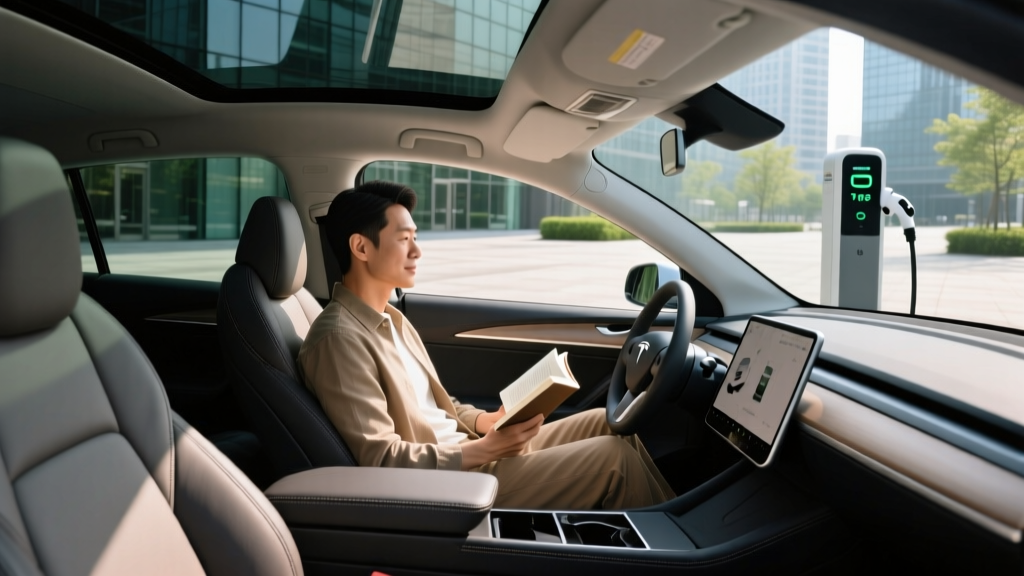
The Model 3's cabin centers on a single 15.4-inch touchscreen that handles everything from navigation and media to climate and vehicle settings. There are no physical buttons, stalks, or instrument cluster — a design choice that still divides opinion. Rear passengers interact through their dedicated 8-inch screen for climate and entertainment, which partially addresses the "everything through one screen" limitation for front-seat adjustments.
Tesla's Autopilot comes standard and includes adaptive cruise control, lane-keeping assist, and automatic emergency braking. The optional Full Self-Driving (Supervised) package ($8,000 or $99/month) adds automated lane changes, intersection handling, and Navigate on Autopilot — but this is firmly SAE Level 2 driver assistance. The driver must remain attentive, hands on the wheel (or providing steering-torque input), and ready to take over at any moment. It is not autonomous driving.
Tesla Autopilot and FSD (Supervised) are SAE Level 2 systems. The human driver is the responsible operator at all times. Only Level 4 services (like Waymo's driverless robotaxis in designated metro areas) operate without a human driver in the loop. Do not treat any Model 3 feature as a substitute for active driving attention.
Safety ratings remain excellent. The Model 3 earned a 5-star overall rating from NHTSA and has consistently scored as an IIHS Top Safety Pick+ in recent evaluation cycles. Standard active safety features include automatic emergency braking with pedestrian detection, blind-spot monitoring, rear cross-traffic alert, and lane-departure prevention.
Cargo Space and Practicality
The Model 3's trunk offers 23.0 cubic feet of cargo volume — generous for a compact sedan and aided by the wide hatchback-style opening on the refreshed model. The front trunk (frunk) adds approximately 3.1 cubic feet, useful for charging cables, a small bag, or groceries you want separated from the main trunk. The 60/40 split-folding rear seats extend cargo capacity for longer items, though the sedan's trunk opening limits what you can slide through compared to a hatchback or crossover.
For families: two rear-facing child seats fit in the outboard positions with adequate front-seat clearance for average-height drivers. Three-across installations are tight and generally not recommended for anything beyond short trips. The Model Y remains Tesla's family-oriented option for a reason — its 30.2 cu ft rear cargo area and taller roofline address the Model 3's core compromises.
Pros, Cons, and Who Should Buy
Pros
- Class-leading efficiency (132 MPGe LR AWD) reduces charging cost
- Extensive Supercharger network with reliable plug-and-charge experience
- Strong real-world range (290–310 mi mixed driving for LR)
- 11.5 kW Level 2 onboard charger — faster home replenishment than most rivals
- Excellent safety ratings (NHTSA 5-star, IIHS TSP+)
- Substantially improved ride comfort and NVH post-Highland refresh
- Over-the-air updates continuously add features
Cons
- Rear headroom (37.5 in) limits tall-passenger comfort
- No physical controls — all adjustments route through touchscreen
- 250 kW DC fast-charge peak trails 800V competitors (Ioniq 5, EV6, Taycan)
- Insurance premiums run 15–25% above segment average
- Center rear seat is cramped and best for children only
- FSD (Supervised) costs $8,000 extra and remains Level 2 — not autonomous
- Minimal dealer-style service network; mobile/center-based repair model
Who This EV Suits Best
Ideal for: Solo commuters, couples without rear-seat passengers most days, tech-forward buyers who prioritize efficiency and charging infrastructure, and drivers who value over-the-air feature evolution. The Long Range AWD is the sweet spot for road-trip capability without the Performance trim's ride-harshness trade-off.
Look elsewhere if: You regularly carry adults in the rear seats (consider the Model Y, Ioniq 5, or BMW i4), you need maximum DC fast-charge speed for frequent long-distance driving, or you prefer physical buttons and a traditional instrument cluster.
Frequently Asked Questions
What is the real-world range of the Tesla Model 3?
The Long Range AWD carries an EPA rating of 341 miles, but real-world mixed driving typically yields 290–310 miles. Highway driving at 75+ mph reduces this to roughly 260–280 miles, and cold-weather operation (20–35°F) with cabin heat can drop usable range to 220–250 miles. The RWD trim (EPA 272 miles) is more range-sensitive in all conditions due to its smaller LFP battery.
How fast does the Model 3 charge at home and on the road?
At home on a Level 2 Wall Connector (11.5 kW / 48A), the Long Range adds roughly 44 miles per hour of charging, completing a full charge in about 7 hours. On a V3 Supercharger, DC fast charging peaks at 250 kW, reaching 10–80% in approximately 25 minutes. The charge curve tapers meaningfully above 50% state of charge — a characteristic of all lithium-ion batteries, not unique to Tesla.
How much does the Model 3 cost after federal tax credits?
The RWD starts at $38,990 and the Long Range AWD at $45,740. Both qualify for up to $7,500 under IRS §30D if the buyer meets income caps ($150K single / $300K joint modified AGI) and the vehicle's battery satisfies critical-mineral and component sourcing requirements. The credit can be applied as a point-of-sale discount, reducing the RWD to approximately $31,490. Always verify eligibility on your specific configuration at the time of order, as sourcing rules tighten annually.
Is the Tesla Model 3 worth buying over competitors?
Against the Hyundai Ioniq 6 (EPA 361 mi, 800V architecture, $42,000+), the Model 3 trades slightly lower range and slower DC charging for superior Supercharger network access, higher efficiency, and Tesla's software ecosystem. Against the BMW i4 (EPA 307 mi, ~$57,000), the Model 3 wins decisively on price and efficiency but loses on interior material quality and traditional luxury feel. The Model 3 remains the default recommendation for buyers who prioritize charging convenience and efficiency over rear-seat space or luxury trim.
Does the Tesla Model 3 qualify for the federal EV tax credit?
Yes — all three 2026 trims fall under the $55,000 MSRP cap for sedans, making them potentially eligible for the full $7,500 §30D credit. Eligibility is not automatic: buyer income must not exceed IRS thresholds, and the individual vehicle must meet evolving battery-sourcing requirements for critical minerals and North American components. Tesla displays credit eligibility during the order process. Consult a tax professional or IRS.gov for your specific situation.
Can three adults fit in the Model 3 back seat?
Three adults can physically occupy the rear bench, but the center position is narrow, has a raised floor section, and offers minimal shoulder room. It's suitable for short trips or a child in a booster seat. For regular three-across adult transport, a wider sedan or crossover (Model Y, Ioniq 5, Kia EV6) is a more honest choice.
What is the battery warranty on the Model 3?
Tesla covers the Model 3 battery and drive unit for 8 years / 100,000 miles (RWD) or 8 years / 120,000 miles (Long Range and Performance), whichever comes first. The warranty guarantees a minimum of 70% battery capacity retention over the coverage period. Replacement costs outside warranty, based on current service data, range from approximately $12,000 to $16,000 depending on the pack — though real-world degradation data from high-mileage Model 3 owners suggests most packs retain 85–90% capacity at 100,000 miles under normal use patterns.
Sources: EPA Fuel Economy, Tesla Model 3 Specifications, IRS Clean Vehicle Credit, NHTSA Safety Ratings.