If you are researching the Tesla Model 3 back seat fold down configuration, you are likely trying to answer a practical question: can this compact electric sedan actually haul bulky cargo? The short answer is yes — but with caveats that matter for real-world utility. This 2026 profile breaks down the Model 3's cargo dimensions, range, charging performance, pricing, and how it stacks up against rivals when you need to carry more than just passengers.
Tesla Model 3 Cargo Space: Back Seat Fold Down Dimensions
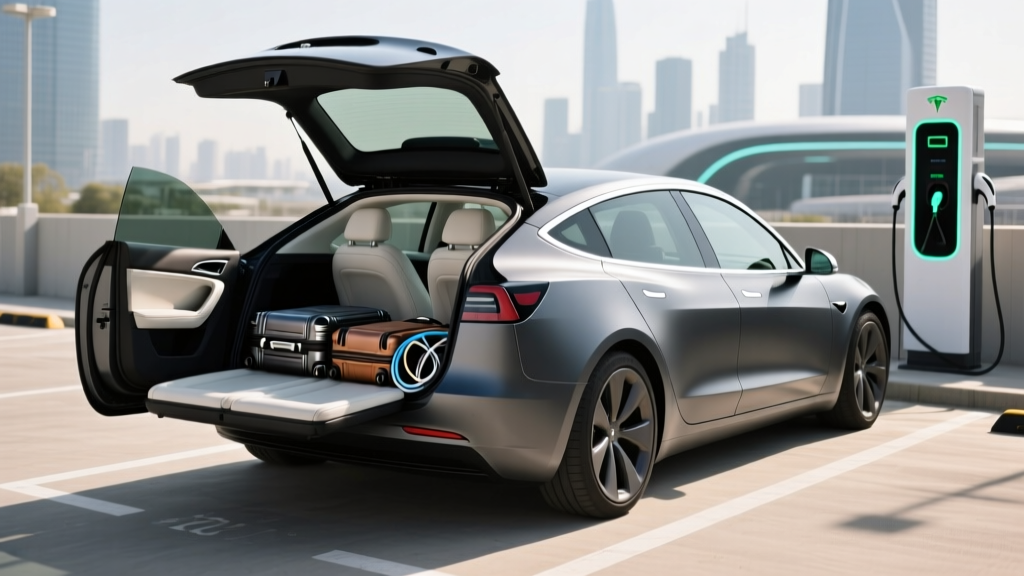
The Tesla Model 3 is a sedan, not a hatchback, which immediately limits its cargo flexibility compared to liftback rivals like the Hyundai Ioniq 6 or Polestar 2. Behind the second row, the Model 3 offers 23 cubic feet of trunk space — generous for a compact sedan. When you fold the rear seats down, Tesla does not publish an official total cubic-foot figure, but independent measurements place the expanded volume at approximately 43 to 46 cubic feet depending on how the trunk pass-through and seat gap are measured.
The rear seats split 60/40, allowing you to fold one or both sides while still seating a passenger on the remaining section. The pass-through from trunk to cabin is relatively narrow compared to a true hatchback or wagon, meaning long items like skis or lumber fit, but wide objects such as a full sheet of plywood will not slide through cleanly.
- Tesla Model 3: ~43–46 cu ft (sedan trunk + pass-through)
- Tesla Model Y: ~72 cu ft (hatchback/crossover)
- Hyundai Ioniq 6: ~42 cu ft (sedan trunk)
- Polestar 2: ~40.5 cu ft (liftback)
- BMW i4 Gran Coupe: ~46 cu ft (liftback)
The Model 3 also includes a front trunk (frunk) with approximately 3.1 cubic feet of storage — enough for a charging cable bag or a small backpack. Combined, the total enclosed storage with seats folded is roughly 46 to 49 cubic feet.
Practical takeaway: If you regularly haul large boxes, furniture, or multiple suitcases for airport runs, the Model 3's sedan trunk opening is the bottleneck. The seatbacks fold, but the trunk aperture restricts what you can load. Buyers who need frequent cargo flexibility should seriously consider the Model Y or a liftback alternative.
EPA Range and Real-World Efficiency
For the 2026 model year, the Tesla Model 3 lineup includes the Standard Range RWD, Long Range AWD, and Performance AWD variants. Here is how the range and efficiency break down:
| Trim | Drivetrain | EPA Range | MPGe (Combined) | kWh/100 mi |
|---|---|---|---|---|
| Standard Range RWD | RWD | 272 mi | 132 MPGe | 25 |
| Long Range AWD | Dual-Motor AWD | 341 mi | 125 MPGe | 27 |
| Performance AWD | Dual-Motor AWD | 315 mi | 115 MPGe | 29 |
Sources: fueleconomy.gov
The EPA numbers above assume a mix of city and highway driving at moderate temperatures. In real-world use:
- Highway driving at 75+ mph: Expect 10–15% less range. A Long Range AWD rated at 341 miles may deliver 290–305 miles on a flat interstate run.
- Cold weather (below 32°F): Range can drop 20–30% due to battery resistance and cabin heating. The same Long Range model might see 240–270 miles in freezing conditions.
- City/regenerative driving: You may match or slightly exceed EPA estimates thanks to aggressive regen braking recapturing energy.
The Model 3's heat pump (standard on all 2026 trims) mitigates cold-weather losses compared to older resistive-heater EVs, but physics still applies.
Battery Chemistry and Capacity
Tesla uses two distinct battery chemistries across the Model 3 lineup:
| Trim | Chemistry | Usable Capacity (kWh) | Key Trade-off |
|---|---|---|---|
| Standard Range RWD | LFP (Lithium Iron Phosphate) | ~60 kWh | Heavier, less energy-dense, but longer cycle life and can charge to 100% daily |
| Long Range AWD | NMC (Nickel Manganese Cobalt) | ~79 kWh | Higher energy density, better cold performance; Tesla recommends 80% daily charge limit |
| Performance AWD | NMC | ~79 kWh | Same as Long Range, tuned for higher discharge rate |
LFP vs NMC — what it means for owners:
- LFP batteries (Standard Range) tolerate daily 100% charging without accelerated degradation. Tesla actually recommends charging LFP cells to 100% at least weekly for accurate state-of-charge calibration. LFP has a lower energy density, which is why the Standard Range model has a smaller battery and shorter range despite similar vehicle weight.
- NMC batteries (Long Range, Performance) offer more range per kilogram but degrade faster if held at 100% state of charge for extended periods. Daily charging to 80% is recommended, with 100% reserved for road trips.
Charging Speed: DC Fast Charge and Home Level 2
Charging speed is a top concern for EV buyers, and the refreshed Model 3 (Highland platform) brought meaningful improvements over the pre-2024 generation.
| Charging Level | Standard Range RWD | Long Range / Performance AWD |
|---|---|---|
| DC Fast Charge (Peak kW) | ~170 kW | ~250 kW |
| 10–80% DC Fast Charge Time | ~25 min | ~18–20 min |
| Level 2 Home Charging (kW) | 11 kW (48A) | 11.5 kW (48A) |
| Level 2 Miles per Hour | ~37 mi/hr | ~44 mi/hr |
| Connector | NACS (native Tesla); CCS adapter included | |
Charging-curve reality: The peak 250 kW rate on Long Range/Performance models is not sustained across the entire session. The battery accepts maximum power between roughly 10–45% state of charge, then tapers progressively. From 80–100%, charging slows dramatically — adding that final 20% can take as long as the 10–80% session. This is normal lithium-ion behavior, not a Tesla-specific flaw.
The Model 3's native NACS connector is now the North American standard. Non-Tesla chargers increasingly offer NACS cables, and Tesla includes a CCS1 adapter in the glovebox for legacy Electrify America and other CCS-only stations. Access to the Tesla Supercharger network — the most reliable DC fast-charging network in the U.S. — remains a significant ownership advantage.
Performance and Drivetrain
| Spec | Standard Range RWD | Long Range AWD | Performance AWD |
|---|---|---|---|
| Horsepower | 271 hp | 346 hp | 510 hp |
| 0–60 mph | 5.8 sec | 4.2 sec | 2.9 sec |
| Top Speed | 125 mph | 125 mph | 163 mph |
| Drivetrain | Rear-Wheel Drive | Dual-Motor AWD | Dual-Motor AWD |
Even the base RWD Model 3 delivers brisk acceleration that outpaces most gas-powered compact sedans. The Performance variant's 2.9-second 0–60 time places it in supercar territory, aided by instant electric torque and all-wheel-drive traction. The Highland refresh also brought a redesigned suspension with frequency-selective dampers, noticeably improving ride compliance over the firm pre-2024 setup.
Pricing, Trims, and Federal Tax Credit Eligibility
| Trim | Base MSRP | Est. Federal Credit (§30D) | Effective Price |
|---|---|---|---|
| Standard Range RWD | $38,990 | Up to $7,500* | ~$31,490 |
| Long Range AWD | $45,990 | Up to $7,500* | ~$38,490 |
| Performance AWD | $52,990 | Up to $7,500* | ~$45,490 |
*Federal tax credit eligibility is subject to IRS §30D rules. See checklist below. Point-of-sale transfer is available, reducing your purchase price at the dealer rather than waiting for a tax refund.
- MSRP cap: Sedans must be $55,000 or below. All current Model 3 trims qualify (SUVs/vans have an $80,000 cap).
- Buyer income limits: Modified AGI must not exceed $150,000 (single), $225,000 (head of household), or $300,000 (joint).
- Battery sourcing: A percentage of critical minerals and battery components must be sourced from the U.S. or FTA partners. These thresholds increase annually. Check the current-year list at IRS.gov qualifying vehicles.
- Point-of-sale transfer: You can elect to transfer the credit to the dealer at purchase, reducing your out-of-pocket cost immediately.
Consult a tax professional to confirm eligibility for your specific situation.
Interior, Technology, and Driver Assistance
The Model 3's cabin is dominated by a 15.4-inch center touchscreen that handles nearly all vehicle functions — climate, navigation, media, and vehicle settings. The 2026 Highland interior added ventilated front seats, ambient lighting, a rear passenger touchscreen (8 inches), and improved sound insulation that significantly reduces road noise at highway speeds.
Notable tech features:
- Tesla navigation with real-time Supercharger routing and battery preconditioning
- Over-the-air software updates that add features post-purchase
- Sentry Mode (360° dashcam recording when parked)
- Dog Mode and Camp Mode for climate-controlled cabin while unattended
- Vehicle-to-load (V2L) capability via aftermarket adapter (not native as of 2026)
Tesla's Autopilot and Full Self-Driving (Supervised) are SAE Level 2 driver-assistance systems. They provide lane-centering, adaptive cruise control, and automatic lane changes — but the driver must remain fully engaged, hands on the wheel, and eyes on the road at all times. These systems are not self-driving. Only Level 4 robotaxi services like Waymo operate without a human driver in defined zones.
Notable drawbacks:
- No physical buttons or stalks — turn signals are on the steering wheel rim, gear selection is via touchscreen (with backup console buttons). This is polarizing and takes adaptation.
- Rear visibility is compromised by the sloping rear glass and thick C-pillars; the rear camera partially compensates.
- No Apple CarPlay or Android Auto — Tesla's proprietary infotainment only.
- Rear-seat headroom is tight for passengers over 6 feet due to the low roofline.
Warranty Coverage
| Component | Coverage |
|---|---|
| Basic Vehicle | 4 years / 50,000 miles |
| Battery & Drive Unit (RWD) | 8 years / 100,000 miles |
| Battery & Drive Unit (AWD) | 8 years / 120,000 miles |
| Battery Capacity Retention | Minimum 70% over warranty period |
Tesla's battery warranty guarantees that the pack will retain at least 70% of its original capacity during the warranty period. If degradation exceeds 30%, Tesla will repair or replace the battery at no cost. Real-world data from fleet operators and owner surveys suggest that Model 3 NMC packs typically retain 85–90% capacity at 100,000 miles, while LFP packs show even slower degradation due to their inherently longer cycle life.
Who the Tesla Model 3 Suits Best
- You are a daily commuter who values efficiency (the Model 3 is among the most efficient EVs on the market at 25–29 kWh/100 mi)
- You want access to the Supercharger network for hassle-free road trips
- You need a compact sedan with enough trunk space for groceries and luggage, but not frequent bulky cargo
- You want strong performance without paying luxury-badge premiums
- You have home Level 2 charging access for overnight top-ups
- You regularly need to fold seats and haul large items — the Model Y, Hyundai Ioniq 5, or a wagon-style EV will serve you better
- You prefer physical buttons, Apple CarPlay, or traditional dealership service
- You live in an apartment without charging access and your area has limited public DC fast chargers
- You need more than 272 miles of range and cannot stretch to the Long Range trim's price
Frequently Asked Questions
Does the Tesla Model 3 back seat fold completely flat?
No. The 60/40 split rear seatbacks fold forward but create a slight incline rather than a perfectly flat load floor. There is also a step-up from the trunk floor to the folded seat surface. For sliding long items through the pass-through, this is manageable; for stacking boxes flat, it is less ideal than a crossover with a flat-fold rear row.
What is the real-world range of the Tesla Model 3 Long Range?
The EPA rates the 2026 Model 3 Long Range AWD at 341 miles. Expect approximately 290–310 miles during sustained highway driving at 70–80 mph, and 240–270 miles in sub-freezing winter conditions. City driving with regenerative braking can match or slightly exceed the EPA estimate.
How fast does the Model 3 charge at home?
On a Level 2 home charger (240V, 48 amps), the Model 3 Long Range adds approximately 44 miles of range per hour, or a full charge in about 8 hours. The Standard Range RWD adds about 37 miles per hour. A full overnight charge is easily achievable with a properly installed Level 2 station.
Does the Tesla Model 3 qualify for the $7,500 federal tax credit?
All 2026 Model 3 trims fall under the $55,000 MSRP cap for sedans and may qualify for up to $7,500 under IRS §30D, provided the buyer meets income limits ($150K single / $300K joint) and the vehicle meets battery critical-mineral and component sourcing thresholds. The credit can be transferred at point of sale to reduce your purchase price. Always verify current eligibility at IRS.gov.
Is the Model 3 worth buying over the Hyundai Ioniq 6 or BMW i4?
The Model 3 wins on efficiency (lowest kWh/100 mi in its class), Supercharger network access, and software features. The Ioniq 6 offers comparable range with faster 800V charging architecture (~18 min 10–80% at 350 kW chargers) and physical buttons. The BMW i4 provides a more traditional luxury interior and liftback cargo versatility but costs significantly more. If cargo flexibility is your top priority and you are cross-shopping the Model 3's back seat fold down utility, the BMW i4's liftback design gives it a meaningful edge in practical loading.