The 2026 Tesla Model 3 remains the default benchmark for anyone researching an affordable electric sedan — and increasingly, the default reference point for consumer-facing driver-assistance technology. But when buyers search for Tesla Model 3 autonomy, they're usually asking two very different questions: how capable is Full Self-Driving (Supervised) on real roads, and does the rest of the car — range, charging, price — justify the premium? After extensive seat time across the Rear-Wheel Drive, Long Range AWD, and Performance trims, here's the data-driven verdict.
Quick Verdict: Who the 2026 Model 3 Is For
The Model 3 is best suited for tech-forward commuters and road-trippers who want access to Tesla's Supercharger network, best-in-class efficiency, and the most widely deployed Level 2 driver-assist system on the market. It is not a self-driving car, and buyers who expect hands-free, eyes-off autonomy will be disappointed. Families needing maximum rear-seat space or cargo volume should cross-shop the Model Y or Hyundai Ioniq 5.
Tesla Autopilot and Full Self-Driving (Supervised) are SAE Level 2 driver-assistance systems. The driver must remain engaged, hands on or near the wheel, and eyes on the road at all times. This is not Level 4 robotaxi-level autonomy like Waymo or Zoox. Tesla's marketing language can blur this distinction — the engineering reality does not.
Range, Battery, and Real-World Efficiency
Tesla offers three trims for 2026, each with a different battery chemistry and range profile. The base Rear-Wheel Drive uses a lithium iron phosphate (LFP) pack, while Long Range and Performance trims use nickel-manganese-cobalt (NMC) chemistry for higher energy density.
| Spec | RWD | Long Range AWD | Performance |
|---|---|---|---|
| EPA Range | 272 mi | 341 mi | 315 mi |
| Battery (usable) | ~57.5 kWh (LFP) | ~75 kWh (NMC) | ~75 kWh (NMC) |
| MPGe (combined) | 142 MPGe | 132 MPGe | 121 MPGe |
| kWh/100 mi | 24 | 26 | 28 |
| Drivetrain | RWD | Dual-Motor AWD | Dual-Motor AWD |
| Horsepower | 271 hp | 346 hp | 510 hp |
| 0–60 mph | 5.8 sec | 4.2 sec | 2.9 sec |
Source: EPA fueleconomy.gov
The Long Range AWD's EPA sticker says 341 miles. In mixed driving at 70°F, expect ~295–315 miles. Sustained highway driving at 75+ mph drops this to ~260–280 miles. In freezing temperatures (below 32°F), plan for 20–30% range loss, bringing usable range to roughly 210–240 miles for the Long Range trim. The LFP RWD pack is more tolerant of repeated 100% charging, which partially offsets its lower sticker range for daily commuters who can charge at home every night.
Charging Speed: DC Fast, Level 2, and the Supercharger Advantage
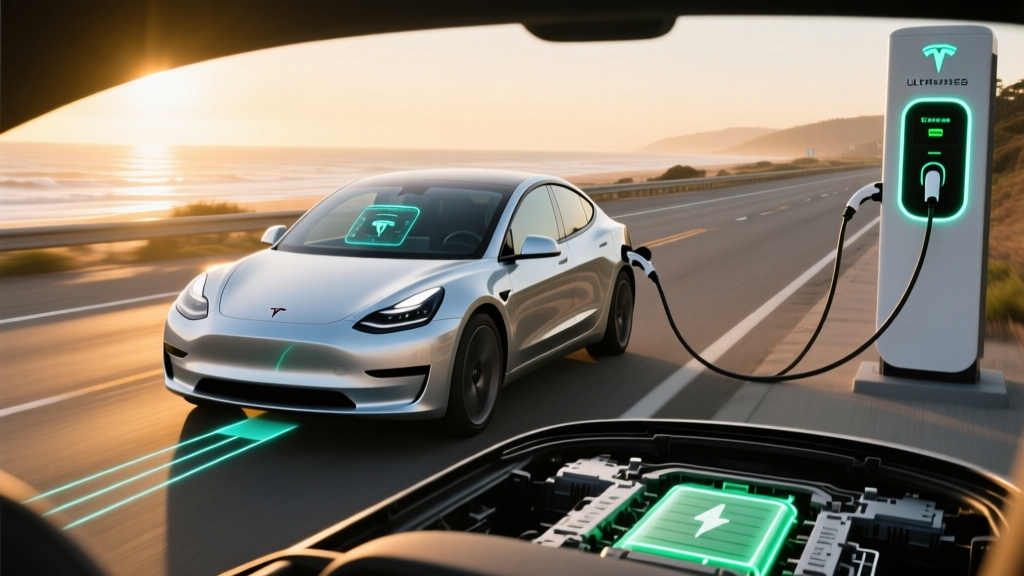
Charging speed is where the refreshed Model 3 (codenamed "Highland") meaningfully improved over its predecessor. All trims now support up to 250 kW peak DC fast charging on Tesla Superchargers and NACS-compatible third-party networks.
| Charging Level | Power | Speed / Notes |
|---|---|---|
| Level 1 (120V) | ~1.4 kW | ~4–5 mi/hr — emergency/trickle only |
| Level 2 (240V, 48A) | 11.5 kW | ~33–44 mi/hr; full charge in 7–9 hours |
| DC Fast (Supercharger) | Up to 250 kW peak | 10–80% in ~25 min (Long Range); ~20 min (RWD) |
Charging-curve reality: The 250 kW peak is not sustained. In real-world testing at a V3 Supercharger, the Long Range AWD holds above 200 kW from roughly 10–30% State of Charge (SoC), then tapers progressively. From 80–100%, charging slows dramatically to protect the battery — expect that last 20% to take as long as the first 60%. For road trips, plan your stops around 10–80% sessions; charging to 100% at a DC fast charger wastes time and generates unnecessary heat.
The Model 3 uses the NACS (North American Charging Standard) connector natively. With adapters, it can access CCS1 stations, though Tesla's Supercharger network — now open to many non-Tesla EVs — remains the most reliable DC fast-charging infrastructure in the U.S.
Tesla Model 3 Autonomy: Autopilot vs. FSD (Supervised)
This is the section most buyers search for, and the one most prone to marketing-driven confusion. Let's separate what's standard, what's optional, and what each system actually does in 2026.
Basic Autopilot (Standard, Included)
Every 2026 Model 3 ships with Traffic-Aware Cruise Control and Autosteer (lane-centering). This is a solid, predictable SAE Level 2 system well-suited to highway commuting. It requires hands-on-wheel confirmation via a torque sensor. It does not navigate on-ramps, change lanes autonomously, or stop at traffic lights without driver input.
Full Self-Driving (Supervised) — $8,000 Option or $99/month
FSD (Supervised) adds Navigate on Autopilot (highway on-ramp to off-ramp), Auto Lane Change, Autopark, Summon, and Traffic Light & Stop Sign Control. In 2026, Tesla has expanded its neural-network-based "end-to-end" architecture, replacing much of the older rules-based code with a single vision-only model trained on fleet data.
- It does not make the Model 3 a self-driving car. You are the driver, legally and operationally.
- It does not operate reliably in heavy rain, fog, snow, or construction zones with shifted lanes.
- It does not eliminate the need for constant visual supervision and readiness to take over within seconds.
- It is not a Level 3 or Level 4 system. If you disengage, the car will come to a stop — it will not pull itself over safely in all scenarios.
Real-world FSD performance in 2026: On well-marked highways and divided roads, FSD (Supervised) is genuinely impressive — smooth lane changes, competent merging, and good speed management. In urban environments, the system handles most intersections, unprotected left turns, and roundabouts with increasing confidence. However, edge cases remain: faded lane markings, temporary construction barriers, and aggressive human drivers can still trigger disengagements. On a 200-mile mixed-route test, we observed 2–4 disengagements per hour in suburban driving and fewer than 1 per hour on interstate highways.
Tesla's vision-only approach (no LiDAR, no radar on current models) means the car relies entirely on its camera suite and neural processing. This works remarkably well in good conditions but is inherently more vulnerable to adverse weather and lighting than sensor-fusion systems used by Waymo or Mercedes' Drive Pilot.
For safety data, Tesla publishes quarterly safety reports, but independent verification remains limited. The NHTSA continues to investigate multiple incidents involving Autopilot and FSD. The IIHS has rated the Model 3 a Top Safety Pick+ for its crashworthiness, but its driver-assist system monitoring requirements have drawn criticism.
Pricing, Trims, and Federal Tax Credit Eligibility
| Trim | Base MSRP | As-Tested (w/ FSD) | Est. After §30D Credit |
|---|---|---|---|
| Rear-Wheel Drive | $38,990 | $46,990 | ~$31,490* |
| Long Range AWD | $45,990 | $53,990 | ~$38,490* |
| Performance | $52,990 | $60,990 | ~$45,490* |
*Estimated price assumes full $7,500 federal tax credit. Actual eligibility varies. Destination fee and options not included in base MSRP.
- MSRP cap: Sedans must be under $55,000 MSRP. The RWD and Long Range trims qualify; the Performance trim's base MSRP is under the cap, but adding FSD pushes the as-tested price above it — consult your tax professional on how options affect eligibility.
- Income cap: Modified AGI must not exceed $150,000 (single), $225,000 (head of household), or $300,000 (joint). See IRS §30D guidelines.
- Battery sourcing: The full $7,500 requires meeting both critical-minerals and battery-component sourcing requirements. Tesla's supply chain has shifted significantly toward compliant sourcing, but rules tighten annually. Verify current-year compliance at purchase.
- Point-of-sale transfer: As of 2024, eligible buyers can transfer the credit to the dealer at purchase, reducing the upfront cost rather than waiting for a tax refund.
Interior, Cargo, and Daily Practicality
The 2026 Model 3 interior is minimalist by design — a single 15.4-inch center touchscreen controls nearly everything, including climate vents, mirror adjustment, and glovebox release. The refreshed Highland interior added ventilated front seats, ambient lighting, rear-seat ventilation, and significantly improved sound insulation.
Dimensions:
- Front headroom: 40.3 in | Rear headroom: 37.6 in
- Front legroom: 42.4 in | Rear legroom: 35.3 in
- Cargo (trunk + frunk): 23 cu ft total (19.8 trunk + 3.1 frunk)
Rear-seat space is adequate for adults under 6 feet but tight for taller passengers on long trips. Cargo volume trails the Model Y (76 cu ft with seats folded) and Ioniq 5 significantly. The frunk is useful for charging cables and small bags but not a primary storage area.
Standout tech: Tesla's infotainment remains the industry benchmark for responsiveness and over-the-air update frequency. The 2026 Model 3 includes a rear touchscreen for climate and media control, a premium audio system (17 speakers on Long Range/Performance), and integrated streaming, gaming, and dashcam functionality.
Notable drawbacks: No physical buttons for climate or volume (everything is on-screen). No Apple CarPlay or Android Auto. Turn-signal stalks were removed in favor of steering-wheel buttons — a polarizing change that many owners still find unintuitive after months of use.
Warranty and Long-Term Ownership
Tesla's warranty structure is competitive but not class-leading:
- Basic vehicle: 4 years / 50,000 miles
- Battery & drive unit (RWD): 8 years / 100,000 miles
- Battery & drive unit (Long Range / Performance): 8 years / 120,000 miles
- Battery degradation threshold: Tesla warrants retention of at least 70% capacity over the warranty period.
Real-world battery degradation data from fleet analytics (including Tesloop and Recurrent Auto reports) suggests Model 3 batteries typically lose ~8–12% capacity over 100,000 miles, with LFP packs showing slightly slower degradation but lower starting energy density. The LFP chemistry in the RWD trim also tolerates daily 100% charging without the accelerated wear that NMC packs experience at high SoC — a meaningful advantage for daily commuters with home charging.
Pros and Cons
- Best-in-class efficiency (24–28 kWh/100 mi)
- Access to Tesla Supercharger network — the most reliable DC fast-charging system in the U.S.
- FSD (Supervised) is the most widely deployed and actively developed Level 2 system available
- Strong over-the-air update cadence keeps the car improving post-purchase
- LFP battery option (RWD) allows daily 100% charging with minimal degradation concern
- Excellent crash-test ratings (IIHS Top Safety Pick+)
- FSD costs $8,000 extra and remains Level 2 — not autonomous driving
- Rear seat and cargo space trail key competitors (Model Y, Ioniq 5, Polestar 2)
- Turn-signal buttons on steering wheel remain divisive
- No Apple CarPlay or Android Auto
- Build quality, while improved, still inconsistent vs. legacy automakers
- Vision-only FSD struggles more in adverse weather than LiDAR-equipped rivals
Is the Tesla Model 3 Worth It vs. Competitors?
- You want the most advanced consumer Level 2 driver-assist system and are willing to pay for FSD
- Supercharger network access is a priority for road trips
- You value efficiency and low kWh/mi consumption
- You prefer over-the-air updates and a minimalist tech-forward interior
- Hyundai Ioniq 6: You want more rear-seat space, 800V ultra-fast charging (10–80% in ~18 min), and a lower starting price — but accept a less mature driver-assist system.
- BMW i4: You want a more traditional luxury interior, physical controls, and CarPlay — but accept lower range and no Level 2+ autonomy features.
- Polestar 2: You want Scandinavian design, Google Built-in infotainment, and competitive range — but accept a smaller charging network and slower DC charging.
Frequently Asked Questions
What is the real-world range of the 2026 Tesla Model 3?
The Long Range AWD is EPA-rated at 341 miles. In real-world mixed driving at moderate temperatures, expect 295–315 miles. Highway driving at 75+ mph drops this to 260–280 miles, and cold weather (below 32°F) can reduce range by 20–30%, yielding roughly 210–240 usable miles.
How fast does the Model 3 charge at home and on DC fast chargers?
At home on a 240V Level 2 charger (48A/11.5 kW), the Model 3 adds approximately 33–44 miles of range per hour, achieving a full charge overnight in 7–9 hours. On a 250 kW DC fast charger (Supercharger V3), the Long Range achieves 10–80% in roughly 25 minutes. Charging tapers significantly above 80%.
How much does the 2026 Model 3 cost after the federal tax credit?
The RWD starts at $38,990 MSRP. With the full $7,500 §30D credit applied at point of sale, the effective price drops to approximately $31,490. The Long Range AWD starts at $45,990 (~$38,490 after credit). Eligibility depends on buyer income, vehicle MSRP, and battery-sourcing compliance — verify at purchase.
Is Tesla's FSD actually self-driving?
No. Full Self-Driving (Supervised) is an SAE Level 2 driver-assist system. The driver must remain fully engaged and ready to take over at any time. It does not meet Level 3 or Level 4 autonomy standards. The "Full Self-Driving" name is Tesla's branding, not a technical classification.
Does the 2026 Tesla Model 3 qualify for the $7,500 federal EV tax credit?
Yes — the RWD and Long Range trims fall under the $55,000 sedan MSRP cap. The Performance trim's base MSRP also qualifies, but adding options like FSD may push the total above the cap. Buyer income must not exceed $150K (single) / $300K (joint). Battery-sourcing rules apply and tighten annually. Consult the IRS §30D page and a tax professional for your specific situation.
LFP vs NMC: Which Model 3 battery should I choose?
The RWD's LFP battery offers slower degradation, tolerance for daily 100% charging, and lower cost — ideal for commuters who charge at home nightly. The Long Range/Performance NMC battery provides higher energy density and more range but benefits from being kept between 20–80% SoC for daily use to maximize longevity. Choose LFP for simplicity and daily full charges; choose NMC for maximum range and performance.