If you've searched for Tesla geofence Austin while researching a Model 3 purchase in Texas, you've likely hit a wall of forum posts, Reddit threads, and fragmented info. Here's the deal: Tesla's Full Self-Driving (Supervised) system operates under specific Operational Design Domains (ODDs), and Austin — as both Tesla's corporate headquarters and a major robotaxi testing zone — has unique geofencing rules that affect what FSD can and cannot do on local roads. This review covers the 2026 Tesla Model 3 in full — range, charging, pricing, tax credits, and the Austin-specific geofence dynamics you won't find on a spec sheet.
2026 Tesla Model 3 at a Glance: Core Specs
| Spec | Model 3 RWD | Model 3 Long Range AWD | Model 3 Performance |
|---|---|---|---|
| EPA Range | 272 mi | 363 mi | 315 mi |
| Battery (usable) | ~60 kWh (LFP) | ~82 kWh (NMC) | ~82 kWh (NMC) |
| Drivetrain | RWD, single motor | AWD, dual motor | AWD, dual motor |
| Horsepower | 271 hp | 346 hp | 510 hp |
| 0–60 mph | 5.8 sec | 4.2 sec | 2.9 sec |
| Peak DC Charge Rate | 170 kW | 250 kW | 250 kW |
| 10–80% DC Time | ~30 min | ~25 min | ~25 min |
| Level 2 Charge Rate | 11 kW (~30 mi/hr) | 11.5 kW (~44 mi/hr) | 11.5 kW (~44 mi/hr) |
| MPGe (combined) | 132 MPGe | 131 MPGe | 118 MPGe |
| Base MSRP | $38,990 | $45,990 | $52,990 |
| Battery Warranty | 8 yr / 100,000 mi | 8 yr / 120,000 mi | 8 yr / 120,000 mi |
All trims carry a $1,390 destination fee. The Long Range AWD remains the sweet spot for most buyers — its 363-mile EPA rating is among the highest of any EV under $50,000, and the dual-motor setup adds all-weather confidence without a huge efficiency penalty.
Real-World Range: What the EPA Number Doesn't Tell You
Real-World Expectation: ~290–320 miles on mixed highway/city driving at 70–75 mph; ~240–270 miles in sustained cold weather (below 40°F) with cabin heat; ~330–350 miles in ideal city/regen-heavy conditions at moderate temperatures.
The Model 3 Long Range's efficiency is genuinely excellent — around 25 kWh/100 mi on the highway, which is best-in-class for a dual-motor sedan. Tesla's heat pump (standard on all 2026 trims) significantly reduces cold-weather range loss compared to older resistive-heater EVs, but physics is physics: expect a 15–25% range reduction when temperatures drop below freezing.
For Austin specifically, the climate works in your favor. Central Texas winters are mild (average January low around 40°F), so cold-weather range loss is minimal most of the year. Summer heat does impact efficiency slightly — battery thermal management and cabin A/C draw power — but the Model 3's thermal system handles this well, with real-world summer highway range still hitting ~300+ miles.
The RWD trim's 60 kWh LFP battery delivers 272 EPA miles, but real-world highway driving at Texas speed limits (75–85 mph on many corridors) will net closer to 220–240 miles. That's adequate for most commutes but requires planning for longer trips like Austin to Houston (160 miles) or Austin to Dallas (195 miles) — both doable on a single charge with a comfort margin, but tight if you're running A/C hard in August.
Charging Speed: DC Fast, Level 2, and the Austin Supercharger Network
| Charging Level | Power | Miles Added/Hour | Best For |
|---|---|---|---|
| Level 1 (120V outlet) | ~1.4 kW | ~3–5 mi/hr | Emergency/trickle only |
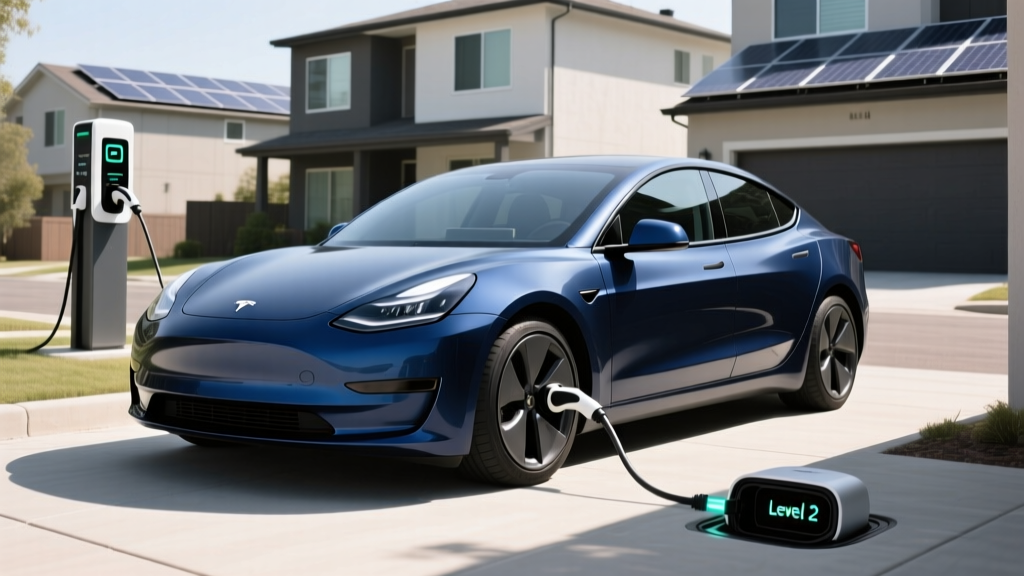
| Level 2 (240V home) | 11–11.5 kW | 30–44 mi/hr | Daily home charging |
| DC Fast (Supercharger V3) | 170–250 kW peak | Up to ~1,000 mi/hr at peak | Road trips, quick top-ups |
| DC Fast (Supercharger V4) | Up to 325 kW (capable) | Varies by vehicle acceptance | Next-gen stations |
Understanding kW vs kWh: kW (kilowatts) measures charging power — how fast energy flows into the battery. kWh (kilowatt-hours) measures battery capacity — how much energy the battery stores. A 250 kW charger delivers energy faster than a 150 kW charger, but the car's battery management system controls the actual acceptance rate.
The Model 3 Long Range and Performance peak at 250 kW on V3 Superchargers, but — and this is critical — that peak only sustains roughly from 10% to 30% State of Charge. Above 50% SoC, the charge curve tapers significantly. By 80%, you're pulling maybe 60–80 kW. This is why Tesla (and all EV makers) quote 10–80% times rather than 0–100%. The Long Range's ~25-minute 10–80% window is competitive, though rivals like the Hyundai Ioniq 6 (800V architecture, 10–80% in ~18 minutes) are faster.
The RWD trim with its LFP battery charges at a lower peak (170 kW) but has a flatter charge curve — it sustains a higher percentage of peak rate longer. LFP batteries also tolerate regular 100% charging without degradation concerns, which is a practical advantage for daily use.
Austin Supercharger reality: The Austin metro area has one of the densest Supercharger networks in the country, with V3 and V4 stations at the Domain, Southpark Meadows, Barton Creek, and along I-35 and Mopac corridors. Tesla's Gigafactory Texas presence means the local charging infrastructure is well-maintained and expanding. Typical Austin Supercharger pricing runs $0.28–$0.36/kWh depending on time of day, making a 10–80% charge on the Long Range roughly $12–$16.
Performance and Driving Dynamics
The Model 3 Performance remains one of the quickest sedans under $60,000, hitting 60 mph in 2.9 seconds with 510 hp from its dual-motor setup. But even the base RWD model feels responsive — 271 hp and instant electric torque make it quicker off the line than most gas-powered compact sedans.
The 2026 Highlandland refresh (introduced for the 2024 model year and carried forward) brought meaningful improvements: ventilated front seats, ambient lighting, rear-seat touchscreen, improved sound insulation, and a slightly retuned suspension that absorbs Texas-size potholes and highway expansion joints better than the pre-refresh car. Ride quality still leans firm, but it's no longer the crashy experience early Model 3 owners complained about.
Handling remains sharp. The low center of gravity (battery pack under the floor) and precise steering make the Model 3 genuinely engaging on twisty roads like RM 2222 west of Austin or the Hill Country loops. The Performance trim adds adaptive dampers and a track mode that's legitimate for occasional track days at Circuit of the Americas.
The Austin Geofence: What Tesla Owners Need to Know
This is where the Tesla geofence Austin topic gets specific. Tesla's FSD (Supervised) system operates within defined Operational Design Domains — essentially, geographic and condition-based boundaries where the software is authorized to function. Austin holds a unique position in Tesla's FSD ecosystem for several reasons:
Why Austin matters for FSD: Tesla relocated its corporate headquarters to Austin in 2021, and the city serves as a primary real-world testing ground for FSD development. Tesla employees and selected early-access users in Austin frequently receive FSD builds before wider rollout. This means Austin drivers may experience newer FSD versions earlier than owners in other markets.
Geofencing specifics: FSD (Supervised) does not have hard geographic geofences that prevent activation in Austin — it can be engaged on most roads. However, the system's performance varies by road type. Tesla's FSD excels on well-marked suburban and highway roads (think Mopac Expressway, TX-130, or the 183 toll road) but can struggle on Austin's older, poorly marked surface streets, construction zones along I-35, and the confusing frontage road systems common in Texas. These aren't geofences in the traditional sense — the system will engage — but the ODD limitations mean you'll find yourself intervening more frequently on complex urban roads.
Robotaxi context: Tesla has announced plans for a robotaxi service (branded as the Tesla Network) with Austin as a likely early deployment city. As of 2026, this service has not launched commercially. Any future robotaxi operation would likely use stricter geofencing, limiting service to mapped and approved zones — similar to how Waymo operates in defined areas of Phoenix and San Francisco. Until then, FSD remains a Level 2 assist system, regardless of how advanced the software appears.
Pricing, Tax Credits, and Total Cost
| Trim | Base MSRP | With Dest. | Est. After §30D Credit* |
|---|---|---|---|
| Model 3 RWD | $38,990 | $40,380 | ~$32,880 |
| Model 3 Long Range AWD | $45,990 | $47,380 | ~$39,880 |
| Model 3 Performance | $52,990 | $54,380 | ~$46,880 |
*Federal tax credit caveat: The IRS §30D Clean Vehicle Credit provides up to $7,500 for qualifying new EVs, but eligibility depends on multiple factors that change frequently:
- MSRP cap: Sedans must be under $55,000 MSRP. All 2026 Model 3 trims currently qualify.
- Buyer income cap: Modified AGI must not exceed $150,000 (single), $225,000 (head of household), or $300,000 (joint filers).
- Battery sourcing: A percentage of critical minerals and battery components must be sourced from the US or FTA-partner countries. Tesla's shift to LFP batteries from CATL (China) for the RWD trim has complicated eligibility — the RWD trim's credit eligibility has fluctuated. Check the current status on fueleconomy.gov before purchasing.
- Point-of-sale transfer: As of 2024+, you can transfer the credit to the dealer at purchase, reducing your out-of-pocket cost immediately rather than waiting for a tax refund.
The Long Range AWD, with its US-sourced NMC battery from Panasonic at Giga Nevada, has maintained more consistent §30D eligibility. Always verify current credit status with your tax professional and the IRS before finalizing a purchase — rules change, sometimes mid-year.
Interior, Cargo, and Daily Practicality
The Model 3's minimalist interior remains polarizing. Everything runs through the 15.4-inch center touchscreen — there are no physical buttons for climate, mirrors, or glovebox. The 2026 Highlandand refresh improved this slightly with rear-seat ventilation controls on a dedicated 8-inch rear screen, but front-seat passengers still tap through menus for basic adjustments.
Dimensions:
- Cargo volume: 23 cu ft (trunk) + rear frunk — total ~28 cu ft usable
- Front legroom: 42.3 inches
- Rear legroom: 35.2 inches (tight for tall adults on long trips)
- Ground clearance: 5.5 inches (low — watch Austin's steep driveway aprons and speed bumps)
Compared to rivals, the Model 3's rear seat and cargo space trail the Hyundai Ioniq 6 (which is larger overall) and the BMW i4 (more traditional sedan proportions). The frunk is small — useful for charging cables and a bag of groceries, not much more.
Tech highlights include Tesla's excellent navigation with real-time Supercharger routing, over-the-air updates that add features regularly, Sentry Mode (dashcam/security recording), and a 17-speaker audio system that punches well above its price class. The absence of Apple CarPlay and Android Auto remains a dealbreaker for some buyers — Tesla's native infotainment is capable, but if you live in the Apple/Google ecosystem, it takes adjustment.
Pros and Cons: The Honest Take
Pros
- Class-leading efficiency — 131+ MPGe across trims
- Extensive Supercharger network, especially dense in Austin
- Strong real-world range (300+ mi highway on Long Range)
- OTA updates continuously improve the car
- Excellent performance, especially Performance trim
- Low operating costs — electricity vs. gas savings significant in Texas
- Strong resale value relative to most EVs
Cons
- No Apple CarPlay or Android Auto
- Rear seat space is tight for adults
- All-screen interface frustrates some drivers
- FSD costs $8,000 extra (or $99/mo) and is NOT self-driving
- RWD LFP trim's tax credit eligibility is inconsistent
- Insurance premiums run 15–30% higher than comparable gas sedans
- Ride quality firm on rough Austin roads
Model 3 vs. the Competition: Is It Still the One to Beat?
The 2026 Model 3 faces serious competition it didn't have a few years ago:
vs. Hyundai Ioniq 6: The Ioniq 6 SE Long Range offers 361 EPA miles and charges faster (10–80% in ~18 minutes on 350 kW chargers thanks to 800V architecture). It has CarPlay and more rear-seat room. But it lacks Supercharger access (though Hyundai is gaining NACS access via adapter) and doesn't match Tesla's software ecosystem. MSRP is similar.
vs. BMW i4 eDrive40: More refined interior, better ride quality, and CarPlay. But it costs ~$10,000 more, offers only 307 EPA miles, and charges slower. Choose the i4 if build quality and driving refinement matter more than maximum range and tech.
vs. Chevrolet Equinox EV: Cheaper (starts ~$33,000), qualifies for the full tax credit, and offers 319 EPA miles. But it charges slower, has less performance, and the software experience isn't in Tesla's league. A strong budget alternative.
Choose a competitor if: You need CarPlay/Android Auto (Ioniq 6, i4), want the fastest DC charging available (Ioniq 6), prioritize interior luxury (i4), or need the lowest possible purchase price after incentives (Equinox EV).
Frequently Asked Questions
What is the real-world range of the 2026 Tesla Model 3?
The Long Range AWD delivers approximately 290–320 miles in mixed real-world driving, with the RWD trim providing 220–240 miles on the highway. Austin's mild climate helps — you'll see less cold-weather range loss than northern states, but summer A/C usage and highway speeds above 75 mph will reduce range below the EPA sticker.
How fast does the Model 3 charge at home and on the road?
At home on a 240V Level 2 charger (like a Tesla Wall Connector on a 60A circuit), the Long Range adds about 44 miles of range per hour — a full overnight charge easily replenishes a day's driving. On DC fast chargers, the Long Range peaks at 250 kW and charges from 10–80% in about 25 minutes. The RWD trim peaks at 170 kW with a ~30-minute 10–80% time.
How much does the Model 3 cost after federal tax credits?
With the full $7,500 §30D credit, the RWD starts around $32,880, the Long Range around $39,880, and the Performance around $46,880 (all including destination). However, credit eligibility depends on your income, the vehicle's battery sourcing, and current IRS rules. The RWD trim's LFP battery (sourced from CATL, China) has had inconsistent credit eligibility — verify before purchasing.
Is the Tesla Model 3 worth buying vs. competitors in 2026?
For Austin buyers specifically, the Model 3 remains a top choice due to the dense local Supercharger network, strong range, competitive pricing, and Tesla's Austin presence ensuring good service infrastructure. If CarPlay support, faster DC charging, or a more traditional interior are priorities, the Hyundai Ioniq 6 and BMW i4 are worthy alternatives.
What does the Tesla Austin geofence mean for FSD users?
FSD (Supervised) can be activated on most Austin roads — there are no hard geofence blocks preventing use. However, the system performs better on well-marked highways and suburban roads than on Austin's complex urban streets, construction zones, and frontage roads. Austin's role as Tesla's HQ means local users often get newer FSD builds earlier, but the system remains Level 2 and requires full driver attention at all times.
Does the 2026 Model 3 qualify for the federal EV tax credit?
The Long Range AWD and Performance trims have maintained consistent eligibility for the full $7,500 credit, as their NMC batteries are US-sourced. The RWD trim's eligibility fluctuates due to its Chinese-sourced LFP battery. Check fueleconomy.gov for the latest status and consult a tax professional to confirm your personal eligibility based on income and filing status.
Who Should Buy the 2026 Tesla Model 3?
Best for: Daily commuters with home charging access, tech-forward buyers who want continuous OTA improvements, Austin-area drivers who benefit from the local Supercharger density and Tesla service infrastructure, and performance-oriented buyers (the Performance trim at $53K undercuts most sports sedans on 0–60 time).
Not ideal for: Families needing spacious rear seats (look at the Model Y), buyers who refuse to live without CarPlay, rural drivers far from Supercharger stations, and anyone expecting FSD to replace attentive driving.
The 2026 Model 3 isn't the only good EV sedan anymore, but in Austin — where Tesla's infrastructure, software development, and charging network converge — it remains the default choice for good reason. Just go in with realistic expectations about range, FSD limitations, and the all-screen interface, and you'll likely be satisfied.