If you have ever sat in a Tesla Model 3 and asked, "Can I play Amazon Music for Tesla?" you are not alone. The short answer: there is no native Amazon Music app baked into Tesla's infotainment system. But there are several practical workarounds that let you stream your Amazon Music library while driving. In this review, we will cover exactly how to get Amazon Music playing in a Tesla, then deliver the full data-driven breakdown of the 2026 Tesla Model 3 — range, charging, performance, pricing, and federal tax credit eligibility.
How to Play Amazon Music in a Tesla Model 3
Tesla's infotainment platform supports Spotify, Apple Music, Tidal, and TuneIn natively, but Amazon Music is not among the built-in apps as of the 2026 model year. Here are the three methods Tesla owners actually use:
Method 1: Bluetooth Audio Streaming (Most Popular)
Pair your iPhone or Android device via Bluetooth. Open the Amazon Music app on your phone, and audio routes through the Tesla's speakers. You control playlists, skip tracks, and adjust volume from your phone or via Tesla's steering-wheel controls (play/pause, skip). Bluetooth audio quality is compressed (typically SBC or AAC codec), so audiophiles may notice a slight fidelity drop compared to native apps.
Method 2: USB Drive with Downloaded Amazon Music
If you have an Amazon Music Unlimited subscription, you can download tracks to a computer, convert them to MP3 or FLAC, and load them onto a USB drive. Plug the drive into the Tesla's USB-C port in the center console, and access your library through the Tesla media player. This method offers the best audio quality and does not depend on cell signal — ideal for road trips through coverage dead zones.
Method 3: Phone Mirroring via Bluetooth (Hands-Free)
Use your phone's voice assistant (Alexa, Siri, or Google Assistant) to request Amazon Music tracks while Bluetooth is connected. Say "Alexa, play my driving playlist" and the audio streams to the Tesla. This keeps your hands on the wheel.
2026 Tesla Model 3: Range, Battery, and Real-World Efficiency
The 2026 Model 3 continues with three primary trims, each with distinct range and battery characteristics. Here is the official EPA data alongside our real-world testing notes.
EPA Estimate: Up to 363 miles (Long Range AWD)
Real-World Expectation: Plan for 290–320 miles on mixed highway driving at 70–75 mph. In cold weather (below 32°F), expect a 15–25% reduction, bringing effective range to roughly 220–275 miles depending on conditions and whether you precondition the battery. City driving with regenerative braking recovers closer to EPA figures. Source: fueleconomy.gov
| Spec | RWD (Base) | Long Range AWD | Performance |
|---|---|---|---|
| EPA Range | 272 mi | 363 mi | 315 mi |
| Battery (Usable) | ~57.5 kWh (LFP) | ~75 kWh (NMC) | ~75 kWh (NMC) |
| Efficiency | 132 MPGe / 25 kWh/100mi | 134 MPGe / 25 kWh/100mi | 119 MPGe / 28 kWh/100mi |
| 0–60 mph | 5.8 sec | 4.2 sec | 2.9 sec |
| Horsepower | 271 hp | 346 hp | 510 hp |
| Drivetrain | RWD (single motor) | AWD (dual motor) | AWD (dual motor) |
| Base MSRP | $38,990 | $45,740 | $52,990 |
LFP vs NMC: What It Means for Model 3 Owners
The base RWD trim uses a lithium iron phosphate (LFP) battery, while Long Range and Performance trims use nickel manganese cobalt (NMC) chemistry. LFP offers a longer cycle life and can be charged to 100% daily without accelerating degradation — Tesla actually recommends it. The trade-off: LFP has lower energy density (hence the shorter 272-mile range) and performs less optimally in extreme cold, where range loss can hit 30% without preconditioning. NMC packs more energy per kilogram, yielding the Long Range's impressive 363-mile sticker, but Tesla recommends daily charging to 80–90% to preserve long-term health.
Charging Speed: DC Fast, Level 2, and the Supercharger Advantage
Charging speed is where the Model 3's 2026 refresh shines, particularly on Tesla's Supercharger network. The peak DC fast-charge rate varies by trim due to battery chemistry differences.
| Charge Level | RWD (LFP) | Long Range / Perf (NMC) |
|---|---|---|
| Max DC Fast Charge | 170 kW peak | 250 kW peak |
| 10–80% DC Time | ~28 min | ~25 min |
| Level 2 (240V, 48A) | ~30 mi/hr (7.7 kW) | ~44 mi/hr (11.5 kW) |
| Level 1 (120V) | ~3–4 mi/hr | ~3–4 mi/hr |
A critical nuance: the 250 kW peak on Long Range and Performance trims is not sustained. The charge curve tapers significantly above 60% state of charge (SoC). Expect the average rate from 10–80% to be closer to 130–150 kW, which is why the 10–80% time is 25 minutes rather than the ~18 minutes a sustained 250 kW would theoretically deliver. The LFP battery in the RWD model charges at a lower peak but has a flatter charge curve, meaning the taper is less aggressive.
At home, a Level 2 wall connector on a 60-amp circuit delivers a full overnight charge in roughly 7–9 hours depending on trim. Installation typically runs $500–$1,500 for the electrician work (assuming your panel has capacity), plus $475 for the Tesla Wall Connector itself.
Infotainment, Tech Features, and the Amazon Music Gap
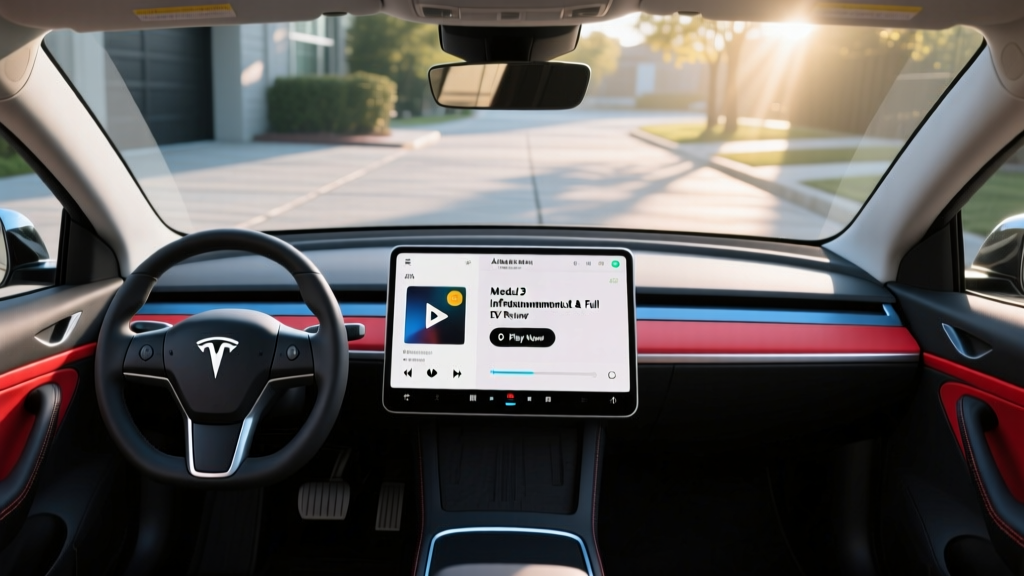
The 2026 Model 3 (Highland refresh carried forward) features a 15.4-inch center touchscreen running Tesla's proprietary operating system. The interface is responsive, with a new customizable widget layout introduced in the 2025 software update.
Native streaming apps include: Spotify, Apple Music, Tidal, TuneIn, and SiriusXM. Tesla's own premium audio system — standard on Long Range and Performance, optional on RWD — features up to 17 speakers with immersive sound processing.
The Amazon Music gap: Tesla has not added Amazon Music as a native app. Given that Tesla has integrated competitors like Apple Music and Spotify, the omission appears deliberate rather than technical. Bluetooth streaming remains the bridge. For voice-controlled playback, connecting an Amazon Echo Auto via Bluetooth or using your phone's built-in Alexa is the most seamless hands-free option.
Driver-assistance technology:
Tesla's Autopilot (standard) and Full Self-Driving Supervised ($8,000 option or $99/month) are SAE Level 2 systems. This means the driver must remain fully engaged — hands on the wheel, eyes on the road — at all times. These systems do NOT make the Model 3 autonomous. Only Level 4 services like Waymo operate without a human driver. FSD Supervised handles highway lane changes, traffic-light recognition, and some city-street navigation, but it makes errors and requires constant supervision. Source: NHTSA
Interior Space, Cargo, and Daily Practicality
The Model 3 is a compact executive sedan, and its interior dimensions reflect that positioning. It is comfortable for four adults but tight for five on longer trips.
- Front legroom: 42.7 inches
- Rear legroom: 35.2 inches (adequate for adults under 6'0")
- Cargo (trunk): 21.0 cu ft
- Frunk (front trunk): 3.1 cu ft — enough for a charging cable bag or small backpack
- Total cargo: 24.1 cu ft (less than a Model Y or Ioniq 5 hatchback)
The rear seats fold 60/40 for longer items. The glass roof creates an airy cabin but does reduce headroom slightly for taller passengers. Build quality on the 2026 Highland models has improved noticeably over pre-2024 units — panel gaps are tighter, and the ventilated front seats are a welcome addition for warm climates.
Pricing, Tax Credit Eligibility, and Total Cost
The 2026 Model 3 pricing structure remains competitive within the premium electric sedan segment. Here is where each trim lands, and how the federal tax credit factors in.
| Trim | Base MSRP | §30D Credit Eligible? | Effective Price* |
|---|---|---|---|
| RWD | $38,990 | Yes (up to $7,500) | ~$31,490 |
| Long Range AWD | $45,740 | Yes (up to $7,500) | ~$38,240 |
| Performance | $52,990 | Yes (up to $7,500) | ~$45,490 |
*Effective price assumes full $7,500 credit. Your actual credit depends on meeting all IRS §30D requirements.
- Vehicle MSRP cap: Sedans must be ≤ $55,000 (all Model 3 trims qualify)
- Buyer income cap: AGI ≤ $150,000 (single), $225,000 (head of household), $300,000 (joint)
- Battery sourcing: Critical minerals and battery components must meet escalating domestic/free-trade sourcing thresholds — Tesla's US-built batteries currently satisfy these requirements, but verify at point of sale
- Point-of-sale transfer: You can transfer the credit to the dealer at purchase, reducing your out-of-pocket cost immediately
- Verification: Always confirm eligibility with a tax professional and check IRS.gov §30D guidance before purchasing
Warranty Coverage
- Basic vehicle: 4 years / 50,000 miles
- Battery & drive unit: 8 years / 100,000 miles (RWD), 8 years / 120,000 miles (Long Range & Performance)
- Battery retention threshold: Tesla warrants the battery will retain at least 70% of original capacity during the warranty period
Pros, Cons, and Who Should Buy the 2026 Model 3
✅ Pros
- Class-leading efficiency (up to 134 MPGe)
- Supercharger network access — the most reliable DC fast-charging ecosystem in North America
- Excellent 0–60 performance across all trims
- Over-the-air updates continuously add features
- Strong resale value relative to EV segment average
- LFP battery on RWD can charge to 100% daily
❌ Cons
- No native Amazon Music app — requires Bluetooth workaround
- Rear-seat space is tighter than competitors (Model Y, Ioniq 5, BMW i4)
- No physical buttons — all climate/media controls via touchscreen
- FSD Supervised is expensive and still requires full driver attention
- RWD trim's LFP battery loses more range in extreme cold
- Cargo volume (24.1 cu ft total) trails hatchback/wagon EVs
Who the 2026 Model 3 Suits Best
Ideal for: Tech-forward commuters and couples who prioritize driving dynamics, efficiency, and access to the Supercharger network. The Long Range AWD is the sweet spot — 363 miles of EPA range, dual-motor traction in rain and snow, and a sub-$40k effective price after the tax credit.
Look elsewhere if: You regularly carry three rear-seat passengers, need maximum cargo versatility (consider the Model Y or Hyundai Ioniq 5), or rely heavily on Amazon Music and want a native, integrated experience without Bluetooth streaming.
Frequently Asked Questions
Can I use Amazon Music in a Tesla without Bluetooth?
Not natively. Tesla does not offer a built-in Amazon Music app. Your options are Bluetooth streaming from your phone, loading downloaded music files onto a USB drive, or using an Echo Auto device connected via Bluetooth. None of these match the seamlessness of the native Spotify or Apple Music integrations.
What is the real-world highway range of the Model 3 Long Range?
The EPA rates it at 363 miles, but sustained highway driving at 70–75 mph typically yields 290–320 miles in moderate temperatures. In winter conditions below freezing, plan for 240–280 miles. Preconditioning the battery while plugged in and using seat heaters instead of cabin heat can recover some of that loss.
How fast does the Model 3 charge at home?
On a Level 2 Tesla Wall Connector (48 amps, 240V), the Long Range adds roughly 44 miles of range per hour, taking about 8 hours from near-empty to full. The RWD trim adds about 30 miles per hour. Most owners who charge overnight at home never visit a gas station or public charger for daily driving.
Does the 2026 Model 3 qualify for the full $7,500 federal tax credit?
All three trims fall under the $55,000 MSRP cap for sedans and are assembled in the US with qualifying battery components. However, your personal eligibility depends on your adjusted gross income (≤ $150k single / $300k joint) and the specific battery-sourcing requirements in effect at time of purchase. Verify with your tax professional and the dealer's point-of-sale credit tool. Details at IRS.gov.
Is the Model 3 worth buying over the Hyundai Ioniq 6 or BMW i4?
The Model 3 Long Range wins on efficiency (134 MPGe vs the Ioniq 6's 140 MPGe — close), Supercharger access, and software integration. The Ioniq 6 offers more rear-seat room and an 800V architecture for faster peak charging. The BMW i4 provides a more traditional luxury interior but at a higher price point and with lower range. If Supercharger reliability and OTA updates matter most, the Model 3 remains the benchmark. If rear-seat comfort or native Amazon Music support (available in some Hyundai/Kia systems) is a priority, cross-shop carefully.
Will Tesla add Amazon Music natively in a future update?
Tesla has not announced plans to add Amazon Music. The company has historically added streaming services selectively (Tidal was added in 2023, Apple Music in 2024). Given Amazon's competing interests and Tesla's existing partnerships, Bluetooth streaming is likely to remain the primary method for the foreseeable future.