Quick Verdict: The Benchmark AWD Electric Sedan
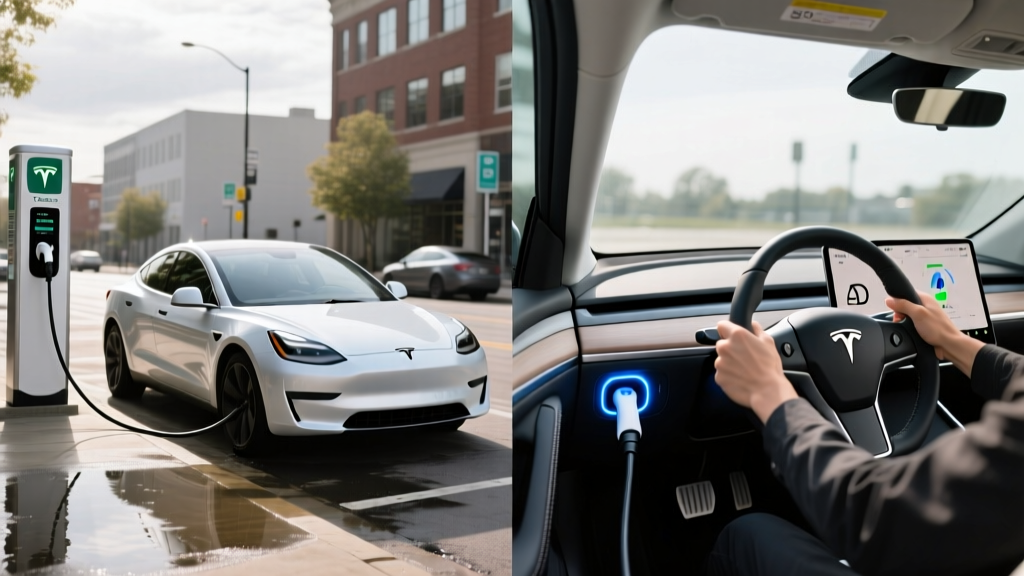
The Tesla Model 3 All Wheel Drive (also badged as the Long Range AWD) remains one of the most capable and efficient electric sedans on the market. With a 341-mile EPA range, dual-motor traction, and access to the most reliable DC fast-charging network in North America, it solves the three biggest concerns EV buyers raise: range, weather confidence, and road-trip viability. The 2025/2026 refresh brings a quieter cabin, improved suspension tuning, and ventilated front seats — addressing the most common complaints from pre-2024 owners.
But it isn't perfect. The minimalist interior polarizes, the absence of traditional driver-assist sensors (no radar, limited ultrasonic) draws criticism, and insurance premiums run higher than segment averages. Here's everything you need to know before configuring one.
Range, Efficiency & Real-World Expectations
Real-World Expectation: 290–320 miles highway at 70 mph in mild weather; 240–270 miles in freezing conditions (below 32°F) with cabin heat. City/regenerative driving can match or slightly exceed EPA figures.
The Long Range AWD variant pairs a 78.1 kWh usable battery pack (NMC chemistry, nickel-manganese-cobalt) with Tesla's highly efficient dual-motor powertrain. On the EPA's fueleconomy.gov listing, the Model 3 Long Range AWD achieves 130 MPGe combined (126 city / 134 highway), translating to roughly 26 kWh per 100 miles — among the most efficient all-wheel-drive EVs available.
Efficiency is where Tesla's engineering shows. The heat pump (standard on all current Model 3 variants) recovers waste heat from the drivetrain and ambient air, dramatically reducing cold-weather range loss compared to resistance-heated competitors. In our experience, expect roughly 15–20% range reduction at 20°F versus 25–30% on similarly sized EVs without heat pumps.
Wheel choice matters: the standard 18" Photon wheels yield the 341-mile figure, while upgrading to 19" Nova wheels drops EPA range to approximately 316 miles due to increased rolling resistance and weight.
Charging Speed & Infrastructure
| Charging Level | Power / Rate | Speed (Miles Added) | Notes |
|---|---|---|---|
| Level 1 (120V household) | ~1.4 kW | ~4–5 miles per hour | Emergency/trickle only |
| Level 2 (240V home, 48A) | 11.5 kW | ~44 miles per hour | Full charge in ~8 hours |
| DC Fast Charge (Supercharger V4) | Peak 250 kW | Up to 175 miles in 15 min | 10–80% in ~25 minutes |
The Model 3 Long Range AWD supports a peak DC fast-charge rate of 250 kW via its NACS (North American Charging Standard) port — the connector now adopted by Ford, GM, Rivian, Volvo, and most major automakers for the North American market. At a Tesla Supercharger V3 or V4 stall, the charge curve is aggressive: the battery accepts peak power from roughly 10% to 40% State of Charge, then tapers progressively. Expect a 10–80% session to take approximately 25 minutes under ideal thermal conditions.
Preconditioning is essential. When you navigate to a Supercharger in the car's navigation system, the battery management system automatically warms or cools the pack to optimal temperature, often shaving 5–10 minutes off your charge session compared to arriving cold. If you use third-party networks (Electrify America, EVgo) via the included NACS-to-CCS adapter or the Magic Dock at compatible Superchargers, preconditioning won't activate automatically — plan accordingly.
For home charging, a Tesla Wall Connector on a 60-amp circuit delivers up to 11.5 kW (48 amps continuous), adding roughly 44 miles of range per hour. Most owners with a daily commute under 80 miles can fully replenish overnight on a standard 40-amp Level 2 circuit (~9.6 kW).
Performance & Driving Dynamics
| Specification | Model 3 Long Range AWD |
|---|---|
| Drivetrain | Dual-motor AWD (permanent magnet rear + induction front) |
| Horsepower | ~384 hp combined |
| 0–60 mph | 4.2 seconds |
| Top Speed | 125 mph (electronically limited) |
| Suspension | MacPherson strut front / multi-link rear (refresh-tuned) |
| Turning Circle | 38.1 feet |
The dual-motor setup uses a permanent magnet synchronous motor on the rear axle for efficiency and an induction motor up front that can freewheel (decouple) during light-load cruising to reduce drag. This is why the Long Range AWD is nearly as efficient as the RWD variant despite the added hardware and weight.
The 4.2-second 0–60 time is brisk — quick enough for confident highway merging and genuinely fun on back roads — without crossing into the Performance variant's 2.9-second territory. The refresh's revised suspension bushings, new damper tuning, and acoustic glass noticeably improve ride quality over pre-2024 Model 3s, which were criticized for harshness over expansion joints and rough pavement.
Interior, Cargo & Technology
The Model 3 cabin is defined by its minimalism: a single 15.4-inch central touchscreen handles navigation, climate, media, vehicle settings, and even the speedometer (no instrument cluster). The 2024+ refresh added ambient lighting, ventilated front seats, a rear-seat touchscreen for climate and entertainment, and power-folding side mirrors with auto-dimming.
Dimensions:
- Front headroom: 40.3 inches | Rear headroom: 37.8 inches
- Front legroom: 42.7 inches | Rear legroom: 35.2 inches
- Trunk (rear): 21.0 cubic feet (including under-floor storage)
- Frunk (front trunk): 3.1 cubic feet
- Total cargo: 24.1 cubic feet
Rear-seat space is adequate for adults under 6 feet but tighter than a Hyundai IONIQ 6 or BMW i4. The trunk is deep and well-shaped, though the sedan's fixed rear glass (no hatchback/liftback) limits bulk cargo flexibility.
Tech highlights:
- Tesla's native navigation with real-time Supercharger routing and availability
- Over-the-air updates that add features post-purchase
- Sentry Mode (360° dashcam recording when parked)
- Dog Mode and Camp Mode for climate control while stationary
- Phone-as-key via Bluetooth with NFC backup card
Driver Assistance & Autonomy
Standard Basic Autopilot includes Traffic-Aware Cruise Control and Autosteer (lane centering) on divided highways. The optional Full Self-Driving (Supervised) package ($8,000 one-time or $99/month as of 2025) adds Navigate on Autopilot (automatic on/off-ramp transitions), Auto Lane Change, Autopark, Summon, and traffic-light/stop-sign recognition.
Tesla's vision-only approach (no LiDAR, no radar on current vehicles) has drawn scrutiny. FSD (Supervised) performs impressively in many scenarios but requires constant vigilance — it can misjudge construction zones, fail to detect certain stationary objects, and occasionally make unexpected lane-change decisions. Review NHTSA's guidance on automated driving systems before relying on any Level 2 system.
Pricing, Tax Credits & Ownership Costs
| Trim | Base MSRP | Est. After §30D Credit |
|---|---|---|
| Model 3 Long Range AWD (18") | $47,740 | ~$40,240* |
| Model 3 Long Range AWD (19") | $49,240 | ~$41,740* |
| Model 3 Performance AWD | $54,990 | ~$47,490* |
*Tax credit estimates assume full eligibility. Federal incentives are subject to change.
The Model 3 Long Range AWD qualifies for the full $7,500 federal tax credit under IRS §30D as of 2025, thanks to Tesla's North American battery-cell sourcing and critical-mineral supply chain compliance. Under the current IRS clean vehicle credit rules, eligibility requires:
- MSRP cap: Sedans must be under $55,000 (Model 3 qualifies)
- Buyer income cap: AGI ≤ $150,000 (single) / $225,000 (head of household) / $300,000 (joint)
- Battery sourcing: Minimum percentages of critical minerals and battery components must be sourced from the US or free-trade-agreement countries
- Point-of-sale transfer: You can transfer the credit to the dealer at purchase, reducing the purchase price directly rather than waiting for tax filing
Consult a tax professional to confirm your personal eligibility. Income and sourcing rules are subject to legislative change.
Total cost of ownership: Over 5 years and 75,000 miles, the Model 3 Long Range AWD benefits from near-zero scheduled maintenance (no oil, no spark plugs, minimal brake wear due to regenerative braking), estimated electricity costs of ~$0.04–$0.06 per mile (varies by utility rate), and strong resale value. Insurance averages $1,800–$2,400 annually depending on state and driving record — roughly 15–25% higher than a comparably priced gasoline sedan.
Warranty Coverage
- Basic Vehicle: 4 years / 50,000 miles
- Battery & Drive Unit: 8 years / 120,000 miles (whichever comes first), with minimum 70% capacity retention guaranteed
The 120,000-mile battery warranty is competitive with Hyundai/Kia (10yr/100k) and slightly exceeds BMW and Mercedes-Benz EV coverage. Tesla's NMC pack degradation data from real-world fleets shows an average capacity loss of approximately 10–12% at 100,000 miles, well within warranty thresholds.
Who Should Buy the Model 3 All Wheel Drive?
- You need all-weather traction for snow, rain, or mountain commutes
- You road-trip regularly and want Supercharger network reliability
- You value over-the-air updates and a tech-forward ownership experience
- Your daily commute is under 200 miles round-trip (easily covered on a single charge)
- You need hatchback/SUV cargo flexibility (consider the Model Y or Hyundai IONIQ 5)
- You prefer physical buttons, a traditional instrument cluster, or Apple CarPlay/Android Auto
- You want a hands-free Level 2+ system on par with GM's Super Cruise for highway cruising
Pros & Cons at a Glance
Pros
- Class-leading efficiency (130 MPGe combined) with AWD
- 341-mile EPA range eliminates most range anxiety
- 250 kW peak DC charging; Supercharger network is the gold standard
- 4.2s 0–60 is genuinely quick for a daily driver
- Full $7,500 federal tax credit eligibility
- Over-the-air updates continually improve the vehicle
- Strong resale value relative to EV competitors
Cons
- Minimalist interior not for everyone; no physical climate knobs
- No Apple CarPlay or Android Auto
- Rear seat is tighter than some competitors
- Vision-only Autopilot/FSD requires high vigilance; no radar backup
- Insurance premiums run 15–25% above segment average
- Sedan trunk limits bulk cargo vs liftback/hatchback rivals
Frequently Asked Questions
What is the real-world range of the Tesla Model 3 All Wheel Drive?
In mild weather at highway speeds (70 mph), expect 290–320 miles on a full charge. In freezing temperatures with cabin heat, plan for 240–270 miles. City driving with regenerative braking can match or exceed the 341-mile EPA estimate.
How fast does it charge at home and on the road?
At home on a 240V Level 2 charger (48A), it charges at 11.5 kW, adding roughly 44 miles per hour — a full charge in about 8 hours. On a Tesla Supercharger, it peaks at 250 kW, reaching 10–80% in approximately 25 minutes.
Does the Tesla Model 3 All Wheel Drive qualify for the federal EV tax credit?
Yes. As of 2025, the Model 3 Long Range AWD qualifies for the full $7,500 credit under IRS §30D, subject to buyer income limits ($150K single / $300K joint), the $55K sedan MSRP cap, and battery-sourcing requirements. The credit can be transferred at the point of sale to reduce your purchase price directly.
Is the Model 3 AWD worth it vs the Hyundai IONIQ 6 or BMW i4?
The IONIQ 6 offers comparable range (up to 361 miles) with a more traditional interior and often lower pricing, but its public charging experience doesn't match Tesla's Supercharger network. The BMW i4 xDrive40 offers a premium interior and CarPlay but at a higher starting price and lower range. The Model 3 wins on charging infrastructure, software, and efficiency; choose the IONIQ 6 for interior comfort and value, or the i4 for luxury feel.
What battery chemistry does the Model 3 Long Range AWD use?
The Long Range AWD uses NMC (nickel-manganese-cobalt) chemistry, which offers higher energy density than LFP (lithium iron phosphate). LFP is reserved for the RWD base model. NMC packs are typically recommended to charge to 80% daily for longevity, with 100% reserved for trips.
Is Autopilot or FSD self-driving?
No. Both Basic Autopilot and Full Self-Driving (Supervised) are SAE Level 2 driver-assistance systems. You must remain fully engaged, monitor the road, and be prepared to take over at any moment. Only Level 4 systems like Waymo's robotaxi operate without a human driver.