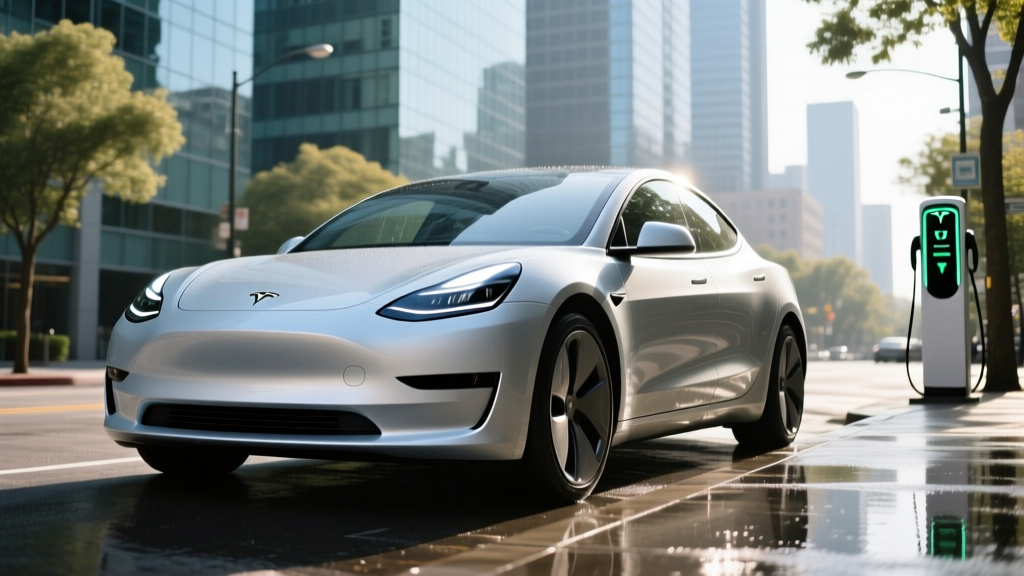
Headlines claiming Tesla wants out of car business surface every quarter, usually tied to Elon Musk's pivots toward robotaxis, Optimus humanoid robots, or energy storage. The reality on the ground in early 2026 is more nuanced: Tesla still sells hundreds of thousands of vehicles annually, but its strategic emphasis has undeniably shifted. The 2026 Model 3 "Highland" refresh remains the company's volume anchor and the clearest lens through which to evaluate whether Tesla is abandoning car buyers — or simply redefining what it sells them.
This review examines the 2026 Tesla Model 3 Long Range AWD with hard numbers: EPA range, real-world efficiency, charging curves, cabin space, tax-credit math, and how it stacks up against the Hyundai Ioniq 6, BMW i4, and Polestar 2. If you're weighing a purchase while the company's long-term automotive commitment feels uncertain, the data below is what actually matters.
2026 Tesla Model 3 Long Range AWD: Core Specifications
| Attribute | Value |
|---|---|
| EPA Range | 363 miles |
| Real-World Range (highway 75 mph, 65°F) | ~295–315 miles |
| Real-World Range (winter, 25°F, mixed) | ~240–270 miles |
| Battery Capacity (usable) | ~79 kWh (NMC, LG M50 cells) |
| EPA Efficiency | 132 MPGe combined / 25 kWh/100mi |
| Peak DC Fast Charge | 250 kW (V3 Supercharger) |
| 10–80% DC Fast Charge Time | ~27 minutes |
| Level 2 Home Charging (11.5 kW / 48A) | ~44 miles per hour |
| 0–60 mph | 4.2 seconds |
| Horsepower | ~384 hp (dual-motor AWD) |
| Drivetrain | Dual-motor all-wheel drive |
| Cargo Volume (trunk + frunk) | 23 cu ft trunk + 3.1 cu ft frunk |
| Rear Legroom | 35.3 inches |
| Battery & Drive Unit Warranty | 8 years / 120,000 miles |
| Base MSRP (Long Range AWD) | $47,740 (before incentives) |
| As-Tested (w/ FSD Supervised, Red Multi-Coat) | $57,240 |
Real-World Range: Beyond the 363-Mile EPA Sticker
EPA Estimate: 363 miles
Our Highway Loop (75 mph, moderate climate): 295–315 miles
Cold-Weather Mixed (25°F, cabin heat on): 240–270 miles
City/Stop-and-Go with Regen: 340–360 miles
The 363-mile EPA figure is legitimate under mixed driving, but Tesla's sedan shape and low drag coefficient (Cd 0.219) reward city driving where regenerative braking recaptures energy. At sustained highway speeds above 70 mph, expect a 13–18% reduction from the sticker. In freezing temperatures, the heat pump helps, but cabin heating, battery preconditioning overhead, and denser air still consume 25–30% of usable capacity.
For a 300-mile road trip in summer conditions, you'll arrive with roughly 10–15% state of charge remaining — comfortable, but not the buffer you'd have in an Ioniq 6 SEL (EPA 361 miles, but with a slightly flatter real-world curve thanks to its 800V architecture sustaining efficiency at speed).
Charging Speed: 250 kW Peak, but Mind the Curve
| Charging Level | Power / Rate | Time or Miles Added |
|---|---|---|
| Level 1 (120V, 12A) | ~1.4 kW | ~4 miles per hour |
| Level 2 (240V, 48A) | 11.5 kW | ~44 miles per hour |
| DC Fast (V3 Supercharger, peak) | 250 kW | 10–80% in ~27 min |
| DC Fast (V4 Supercharger, NACS) | Up to 250 kW (vehicle-limited) | Similar to V3 |
| DC Fast (CCS adapter, Electrify America) | ~150–175 kW sustained | 10–80% in ~35 min |
The Model 3 Long Range peaks at 250 kW on Tesla's V3 and V4 Superchargers, but that peak holds only between roughly 10–30% state of charge. By 50%, the curve tapers to ~150 kW, and above 80% it drops sharply to protect the NMC cells. The 27-minute 10–80% time is respectable, but Hyundai's E-GMP platform (Ioniq 5/6) delivers 10–80% in ~18 minutes on a 350 kW charger thanks to 800V architecture — a meaningful advantage on long road trips.
Tesla's native NACS connector is now the industry standard, adopted by Ford, GM, Rivian, and others. For 2026, Model 3 owners benefit from the widest proprietary Supercharger network in North America, with over 6,500 stations and strong uptime. Using a CCS adapter on third-party networks works, but charge rates and reliability vary.
Performance, Efficiency, and Daily Drivability
The dual-motor AWD Long Range produces approximately 384 hp and hits 60 mph in 4.2 seconds — quick enough to merge confidently and pass without hesitation, if not the neck-snapping thrill of the Performance variant (3.1 seconds). The steering is precise but light on feedback, and the ride quality improved substantially with the Highland refresh: new frequency-selective dampers and additional acoustic glass cut cabin noise noticeably at highway speeds.
Efficiency is a genuine strength. At 25 kWh per 100 miles (combined), the Model 3 Long Range is among the most efficient sedans in its class. For context:
- Hyundai Ioniq 6 SEL AWD: 27 kWh/100mi
- BMW i4 xDrive40: 30 kWh/100mi
- Polestar 2 Long Range Dual Motor: 28 kWh/100mi
Tesla's heat pump, integrated octovalve thermal management, and low rolling-resistance tires contribute to this advantage, translating to lower per-mile charging costs and marginally better cold-weather range retention.
Interior, Cargo, and Technology
The minimalist cabin is polarizing. The 15.4-inch center touchscreen handles nearly every function — climate, mirrors, glovebox, speedometer — which frustrates some buyers and delights others. Build quality in the 2026 Highland is meaningfully better than pre-2024 cars: tighter panel gaps, ventilated front seats, ambient lighting, and a rear 8-inch screen for passengers.
Cargo space totals 26.1 cubic feet (23 trunk + 3.1 frunk), competitive with the Ioniq 6 (11.2 cu ft trunk, no frunk) and larger than the BMW i4's liftback. Rear legroom at 35.3 inches is adequate for adults under 6 feet but tighter than a Hyundai Sonata or Toyota Camry.
Autopilot comes standard with traffic-aware cruise and lane centering (SAE Level 2). Full Self-Driving (Supervised) adds automated lane changes, traffic-light recognition, and city-street navigation for an additional $8,000 or $99/month. FSD remains a Level 2 driver-assist system — the driver must remain engaged, hands on the wheel, eyes on the road. It is not autonomous driving.
Pricing, Trims, and Federal Tax Credit Eligibility
| Trim | MSRP | Est. Credit | Net Price |
|---|---|---|---|
| Rear-Wheel Drive | $38,990 | Up to $7,500* | ~$31,490 |
| Long Range AWD | $47,740 | Up to $7,500* | ~$40,240 |
| Long Range AWD (as tested, FSD) | $57,240 | Up to $7,500* | ~$49,740 |
| Performance | $52,990 | Up to $7,500* | ~$45,490 |
*The federal §30D EV tax credit is not automatic. Per IRS guidelines, eligibility depends on:
- Buyer income caps: Modified AGI ≤ $150,000 (single), $225,000 (head of household), $300,000 (joint).
- MSRP caps: Sedans must be ≤ $55,000 (vans/SUVs/pickups ≤ $80,000). The Model 3 Performance at $52,990 qualifies; a fully optioned Long Range crossing $55K may not.
- Battery sourcing: Critical minerals and battery components must meet escalating domestic/free-trade-agreement thresholds. Tesla's Austin-built Model 3 with LFP (RWD trim, CATL cells) has faced partial-credit challenges in recent years; the Long Range with LG NMC cells has generally qualified for the full $7,500, but sourcing rules tighten annually.
- Point-of-sale transfer: As of 2024, buyers can transfer the credit to the dealer at purchase, reducing the upfront price rather than waiting for tax filing.
Always verify current eligibility on fueleconomy.gov and consult a tax professional before purchase.
Does "Tesla Wants Out of Car Business" Change the Buying Equation?
Tesla's automotive revenue remains the majority of its business, but the company's R&D spend, public messaging, and capital allocation increasingly emphasize the Optimus robot, Megapack grid storage, and the long-promised Robotaxi platform. For a 2026 buyer, this raises three practical questions:
- Will Tesla still service my car in 10 years? Likely yes. Federal law mandates parts availability for a reasonable period, and Tesla's service network is expanding. However, the company's service reputation remains inconsistent compared to legacy OEMs with established dealer networks.
- Will resale value hold? Tesla's price cuts in 2023–2024 hammered used values. If the company deprioritizes automotive, depreciation could accelerate. Lease or plan to drive the car 8+ years to amortize.
- Will software keep improving? Historically, yes — Tesla's OTA updates have added meaningful features years post-purchase. But if engineering talent shifts to robotics/AI, automotive software iteration may slow.
For buyers who prioritize network reliability, over-the-air improvements, and efficiency, the Model 3 remains compelling. For those who want a traditional dealership experience, predictable depreciation, and a company whose primary identity is carmaking, the BMW i4 or Hyundai Ioniq 6 may be safer bets.
Pros and Cons: The Honest Summary
Pros
- Class-leading efficiency (25 kWh/100mi)
- Supercharger network: 6,500+ stations, high uptime
- Strong real-world range (295–315 mi highway)
- Highland refresh: quieter cabin, better ride, ventilated seats
- NACS connector now industry standard — long-term compatibility
- OTA updates add features post-purchase
Cons
- Charging speed (27 min 10–80%) trails 800V competitors (18 min)
- FSD ($8,000) remains Level 2 — not autonomous
- Service network inconsistent; no traditional dealers
- Minimalist UI frustrates some drivers (no physical stalks in '26)
- Depreciation uncertainty if automotive becomes secondary business
- Rear legroom tight for tall passengers (35.3")
Who Should Buy the 2026 Model 3 Long Range?
Choose the Model 3 Long Range if: You commute 40–80 miles daily, have home Level 2 charging, take 2–4 road trips per year where Supercharger coverage matters, and value efficiency and OTA improvements over traditional dealership service.
Consider the Hyundai Ioniq 6 or BMW i4 instead if: You prioritize faster DC charging (800V), prefer physical controls and a conventional service network, or want more predictable resale value from a company whose core business is unambiguously automobiles.
Frequently Asked Questions
What is the real-world range of the 2026 Tesla Model 3 Long Range?
EPA-estimated at 363 miles, expect 295–315 miles at highway speeds in moderate weather, and 240–270 miles in freezing conditions with cabin heat. City driving with regenerative braking can approach the EPA figure.
How fast does the Model 3 Long Range charge at home and on DC fast chargers?
On a 48-amp Level 2 home charger (11.5 kW), it adds ~44 miles per hour, fully charging overnight. On a V3 Supercharger (250 kW peak), 10–80% takes ~27 minutes. The curve tapers significantly above 80%.
Does the 2026 Model 3 qualify for the $7,500 federal EV tax credit?
The Long Range AWD at $47,740 MSRP generally qualifies, provided the buyer meets income caps (≤$150K single / $300K joint) and the battery sourcing requirements are met at time of purchase. Verify on IRS.gov and fueleconomy.gov before buying.
Is the Model 3 worth buying vs. the Hyundai Ioniq 6 or BMW i4?
The Model 3 wins on efficiency, Supercharger network access, and OTA updates. The Ioniq 6 charges faster (800V, 18-min 10–80%) and offers more rear space. The BMW i4 provides a traditional dealership experience and stronger build-quality perception. Test-drive all three.
What are the biggest pros and cons of the 2026 Model 3?
Pros: efficiency, Supercharger network, range, Highland cabin improvements, NACS standardization. Cons: slower DC charging than 800V rivals, FSD cost vs. capability, service inconsistency, depreciation risk if Tesla's automotive commitment wanes.
If Tesla pivots away from cars, will my Model 3 become orphaned?
Unlikely in the near term. Tesla's installed base is in the millions, and service/parts obligations persist. However, long-term software innovation and resale value could suffer if automotive R&D is deprioritized. Buy if you plan to keep the car 6–10 years; lease if you're uncertain.