Quick Verdict: The Tesla Model 3 in 2026
The refreshed Tesla Model 3 (internally dubbed "Highland") continues to set the benchmark for the electric sport sedan segment. With acceleration ranging from a quick 5.8 seconds to a blistering 2.9 seconds depending on trim, the Model 3 offers performance that punches well above its price class. But speed is only part of the story. With up to 363 miles of EPA-estimated range, access to the Supercharger network, and a starting price that undercuts most luxury EV rivals, the Model 3 remains the default comparison point for every new electric sedan that enters the market.
This review breaks down every trim's Tesla Model 3 0 to 60 time, real-world range expectations, charging speeds, and ownership costs — so you can pick the exact configuration that matches your driving needs.
Tesla Model 3 0 to 60 Times by Trim: Full Performance Breakdown
The 2026 Tesla Model 3 is offered in three trims, each with a distinct powertrain and performance profile. Here's how the acceleration numbers stack up:
| Specification | RWD (Base) | Long Range AWD | Performance |
|---|---|---|---|
| 0–60 mph | 5.8 seconds | 4.2 seconds | 2.9 seconds |
| Horsepower | ~271 hp | ~384 hp | ~510 hp |
| Drivetrain | Rear-Wheel Drive | Dual-Motor AWD | Dual-Motor AWD |
| Top Speed | 125 mph | 125 mph | 163 mph |
| Battery (usable) | ~57.5 kWh (LFP) | ~75 kWh (NMC) | ~75 kWh (NMC) |
| EPA Range | 272 miles | 363 miles | 315 miles |
| MPGe (combined) | 132 MPGe | 132 MPGe | 119 MPGe |
| kWh/100 mi | 25 kWh | 25 kWh | 28 kWh |
| Curb Weight | ~3,862 lbs | ~4,034 lbs | ~4,065 lbs |
The RWD model's 5.8-second sprint is competitive with a turbocharged four-cylinder sport sedan. The Long Range AWD drops that to 4.2 seconds — firmly in sports-car territory — while the Performance trim's 2.9-second 0–60 time rivals supercars costing three to four times as much. Tesla's instant electric torque delivery means these numbers are repeatable and don't require launch-control fiddling.
On the road, the Performance trim's dual-motor AWD system provides exceptional grip during hard acceleration, even in wet conditions. The RWD model, while slower, feels lighter and more agile through corners thanks to its lower curb weight and the inherent balance of a rear-driven layout.
Real-World Range: What to Actually Expect
The Long Range AWD carries a 363-mile EPA estimate — the highest of any Model 3 trim. In real-world highway driving at 70–75 mph, expect approximately 290–320 miles before needing to charge. In cold weather (below 32°F), range can drop by 15–25%, reducing effective range to roughly 250–280 miles on the Long Range. The RWD's LFP battery handles cold somewhat better in terms of long-term degradation, but its smaller capacity means a shorter absolute range of roughly 220–245 miles in winter highway conditions.
The RWD trim's 272-mile EPA figure is adequate for commuting but requires more planning on road trips. The Performance trim, despite sharing the Long Range's battery, sacrifices range (315 miles EPA) for wider tires, more aggressive motor mapping, and additional weight.
According to fueleconomy.gov, the Model 3 Long Range achieves 132 MPGe combined — translating to roughly 25 kWh per 100 miles. That efficiency figure is among the best in the EV sedan class and directly contributes to the Model 3's range advantage over heavier competitors.
Charging Speeds: DC Fast Charging and Home Level 2
| Charging Level | Power / Rate | Time / Miles Added | Connector |
|---|---|---|---|
| Level 1 (120V household) | ~1.4 kW | ~3–4 miles per hour | NACS (native) |
| Level 2 (240V home, 48A) | 11.5 kW | ~44 miles per hour | NACS (native) |
| DC Fast Charge (RWD) | Peak 170 kW | 10–80% in ~25 min | NACS (native) |
| DC Fast Charge (LR / Perf) | Peak 250 kW | 10–80% in ~18 min | NACS (native) |
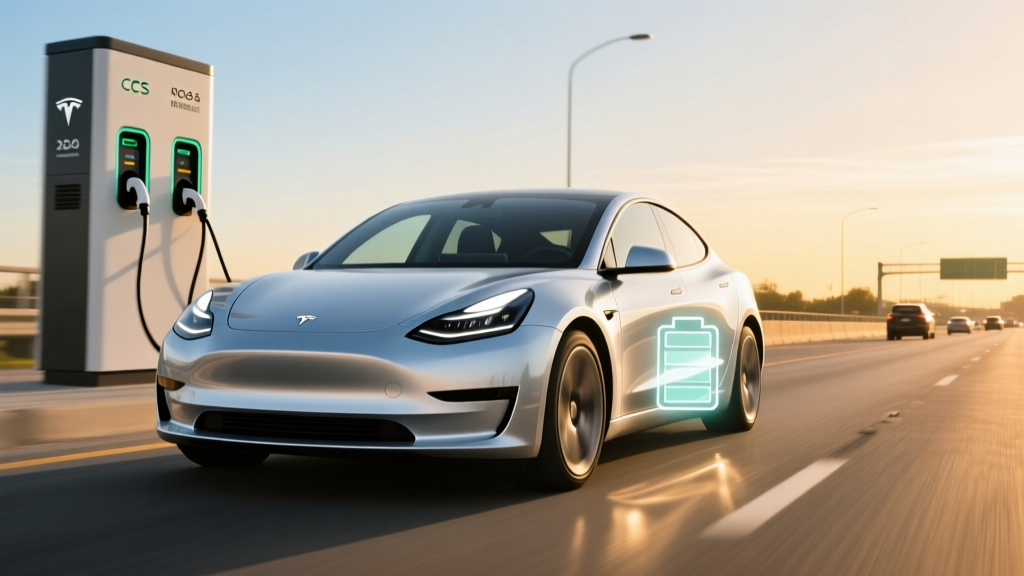
All 2026 Model 3 vehicles come equipped with the North American Charging Standard (NACS) connector natively — no adapter needed for Tesla Superchargers. This is a significant advantage: Tesla's Supercharger network remains the most reliable and widely deployed DC fast-charging infrastructure in the U.S.
The Long Range and Performance trims can accept up to 250 kW at V3 Superchargers, though sustained rates taper after 50% State of Charge (SoC). Expect an average rate closer to 150–175 kW across the full 10–80% session, which is why the 10–80% time is 18 minutes rather than the theoretical minimum at peak rate.
The RWD's LFP battery charges at a lower peak of 170 kW, and its smaller battery means 10–80% takes about 25 minutes. One advantage of the LFP chemistry: Tesla recommends periodic charging to 100% for battery calibration, whereas the NMC batteries in the Long Range and Performance trims are best kept between 20–80% for daily use to minimize degradation.
For home charging, a Tesla Wall Connector on a 60-amp circuit delivers 11.5 kW (48 amps), adding roughly 44 miles of range per hour. A full overnight charge easily replenishes any daily driving.
Pricing, Trims, and Federal Tax Credit Eligibility
| Trim | Base MSRP | Est. After §30D Credit* | Federal Credit Eligible? |
|---|---|---|---|
| RWD | $38,990 | ~$31,490 | Yes (if sourcing rules met) |
| Long Range AWD | $45,740 | ~$38,240 | Yes (if sourcing rules met) |
| Performance | $52,990 | ~$45,490 | Yes (if sourcing rules met) |
*Prices exclude destination fee (~$1,390). Tax credit estimates assume full $7,500 eligibility under IRS §30D. Eligibility depends on buyer income caps, battery critical-mineral sourcing, and MSRP limits. Tesla vehicles are assembled in the U.S. (Fremont, CA), but critical-mineral and battery-component sourcing requirements must be verified at point of sale. The credit can be transferred to the dealer at purchase for an immediate price reduction.
- Income caps: $150K single / $225K head of household / $300K joint filers (modified AGI)
- MSRP cap: $55,000 for sedans (all Model 3 trims qualify)
- Battery sourcing: Critical minerals and battery components must meet phased-in percentage thresholds that tighten annually — confirm with Tesla at order time
- Point-of-sale transfer: Eligible buyers can apply the credit as an immediate discount rather than waiting for tax filing
Interior, Tech, and Cargo Space
The Model 3's minimalist interior centers on a single 15.4-inch touchscreen that handles all vehicle controls, navigation, media, and climate. The Highland refresh added ventilated front seats, ambient lighting, a rear-seat touchscreen for passengers, and significantly improved sound insulation — addressing two of the prior generation's most common complaints (road noise and seat comfort).
Cargo capacity totals 23 cubic feet (trunk plus front trunk/frunk), which is competitive with compact luxury sedans. Rear legroom measures 35.2 inches — adequate for adults on shorter trips but tighter than midsize competitors like the Hyundai Ioniq 6. The glass roof creates an airy cabin but offers no shade option beyond the factory tint.
Tech highlights include:
- Autopilot (standard): Adaptive cruise, lane centering, automatic emergency braking — SAE Level 2 driver assist
- Full Self-Driving (Supervised) ($8,000 option): Adds automatic lane changes, navigate-on-autopilot, traffic light/stop sign recognition — still SAE Level 2, requires active driver supervision
- Over-the-air updates that periodically add features and refine performance
- Sentry Mode and dashcam recording using the vehicle's external cameras
Despite the "Full Self-Driving" branding, Tesla's FSD (Supervised) is classified as SAE Level 2 automation. The driver must remain fully attentive, keep hands on the wheel, and be prepared to take over at any moment. It is not a self-driving system. Only Level 4 services like Waymo operate without a human driver in defined areas.
Warranty and Battery Longevity
Tesla's warranty coverage for the 2026 Model 3:
- Basic vehicle: 4 years / 50,000 miles
- Battery & drive unit (RWD): 8 years / 100,000 miles (70% minimum capacity retention)
- Battery & drive unit (LR/Performance): 8 years / 120,000 miles (70% minimum capacity retention)
The LFP battery in the RWD trim tends to degrade more slowly over time compared to NMC, with real-world data suggesting 5–8% loss over 100,000 miles for typical use. The NMC packs in the Long Range and Performance trims show similar degradation curves when kept within 20–80% SoC for daily charging. Battery replacement out of warranty remains expensive — estimated at $12,000–$16,000 depending on the pack — but premature failures within the warranty period are covered.
Pros, Cons, and Who Should Buy
- Class-leading 0–60 times at every price point
- Superior Supercharger network access (NACS native)
- Excellent energy efficiency (25 kWh/100 mi)
- Strong over-the-air update cadence
- Competitive pricing within the luxury EV sedan class
- LFP option (RWD) for degradation-conscious owners
- No physical controls — everything via touchscreen
- Rear seat space tighter than some competitors
- FSD (Supervised) is expensive and still Level 2
- Turn signal stalks removed (steering-wheel buttons)
- Insurance costs tend to be above segment average
- No Apple CarPlay or Android Auto support
- Commuters: The RWD at ~$31,500 (after credit) is one of the best-value EVs for daily driving under 60 miles round trip.
- Road trippers: Long Range AWD with 363 miles EPA + Supercharger access makes cross-country travel straightforward.
- Performance enthusiasts: The Performance trim's 2.9-second 0–60 and track mode deliver supercar acceleration at a fraction of the cost.
- Not ideal for: Large families needing spacious rear seats, or drivers who prefer physical buttons and CarPlay integration.
Frequently Asked Questions
What is the real-world range of the Tesla Model 3?
The Long Range AWD is EPA-rated at 363 miles, but real-world highway driving at 70+ mph yields approximately 290–320 miles. In cold weather below freezing, expect 250–280 miles. The RWD's 272-mile EPA estimate translates to roughly 220–245 miles in winter highway conditions.
How fast does the Tesla Model 3 charge at home and on the road?
At home on a Level 2 Tesla Wall Connector (11.5 kW), the Model 3 adds about 44 miles of range per hour — a full charge overnight. On DC fast chargers, the Long Range and Performance peak at 250 kW and charge from 10–80% in approximately 18 minutes. The RWD peaks at 170 kW with a 10–80% time of about 25 minutes.
Does the Tesla Model 3 qualify for the federal EV tax credit?
All Model 3 trims fall under the $55,000 MSRP cap for sedans under IRS §30D rules. Tesla assembles the Model 3 in Fremont, California. However, eligibility for the full $7,500 credit depends on battery critical-mineral sourcing thresholds and the buyer's modified adjusted gross income. Verify eligibility with Tesla and a tax professional before purchase.
Is the Tesla Model 3 worth buying vs. competitors?
Against the Hyundai Ioniq 6, BMW i4, and Polestar 2, the Model 3 offers the best combination of range, charging infrastructure access, and performance-per-dollar. The Ioniq 6 offers a more spacious rear seat and CarPlay; the BMW i4 offers a more traditional luxury interior. But no competitor matches Tesla's Supercharger network or the Model 3's efficiency-to-range ratio at this price point.
What is the Tesla Model 3's fastest 0 to 60 time?
The 2026 Model 3 Performance achieves a 0–60 mph time of 2.9 seconds with dual-motor AWD and approximately 510 horsepower. This rivals the acceleration of a Porsche 911 Carrera S while seating four and costing under $55,000 before incentives.
Is Tesla Autopilot or FSD actually self-driving?
No. Both Autopilot (standard) and Full Self-Driving (Supervised) are classified as SAE Level 2 driver-assistance systems. The driver must remain fully engaged, monitor the road, and keep hands on the steering wheel at all times. These systems assist with steering, acceleration, and braking but do not replace the driver.