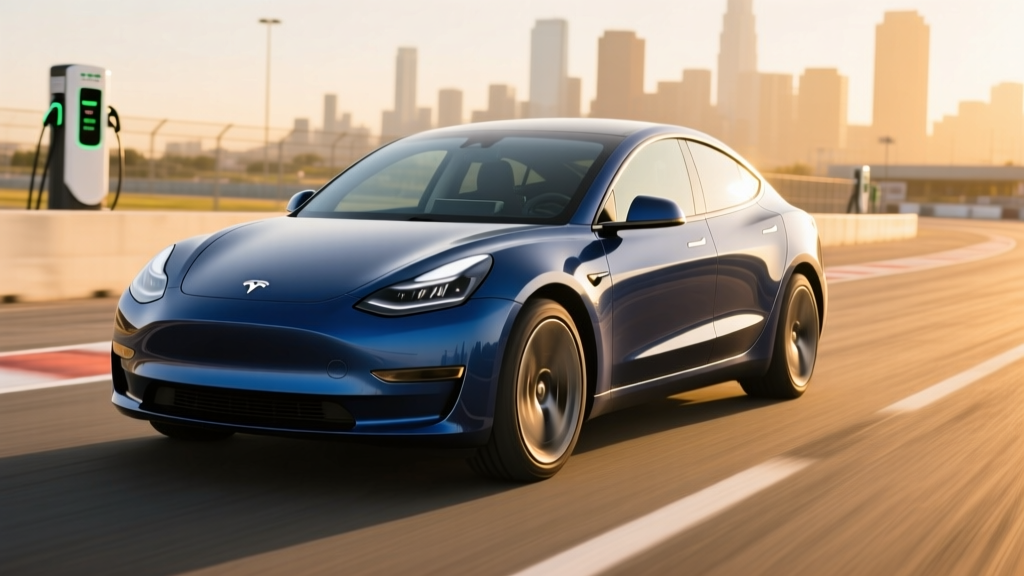
The Tesla Model 3 remains the default benchmark for compact electric sedans, and for good reason: few rivals match its blend of acceleration, efficiency, and Supercharger network access. For buyers researching the Tesla Model 3 0-60 performance, the numbers vary significantly across the three current trims — from a respectable 5.8 seconds in the base Rear-Wheel Drive to a supercar-rivaling 2.9 seconds in the Performance variant. But straight-line speed is only one chapter in the ownership story.
This review covers the 2026 Tesla Model 3 lineup with exact EPA range figures, real-world range expectations, charging-curve behavior, §30D tax-credit eligibility, and the practical trade-offs that spec sheets don't reveal. Whether you're cross-shopping the Hyundai Ioniq 6, BMW i4, or Polestar 2, the data below will tell you what it's actually like to live with one.
2026 Tesla Model 3 Trim Lineup at a Glance
| Spec | Rear-Wheel Drive | Long Range AWD | Performance |
|---|---|---|---|
| Base MSRP | $38,990 | $45,490 | $52,990 |
| EPA Range | 272 mi | 341 mi | 315 mi |
| Battery (usable) | ~57.5 kWh (LFP) | ~75 kWh (NMC) | ~75 kWh (NMC) |
| Drivetrain | RWD, single motor | AWD, dual motor | AWD, dual motor |
| Horsepower | 271 hp | 346 hp | 510 hp |
| Torque | 317 lb-ft | 389 lb-ft | 546 lb-ft |
| 0-60 mph | 5.8 sec | 4.2 sec | 2.9 sec |
| Top Speed | 125 mph | 125 mph | 163 mph |
| Max DC Charge Rate | 170 kW | 250 kW | 250 kW |
| 10-80% DCFC Time | ~25 min | ~27 min | ~27 min |
| Level 2 Charge Rate | 11.5 kW | 11.5 kW | 11.5 kW |
| EPA Efficiency | 132 MPGe / 25 kWh/100mi | 131 MPGe / 26 kWh/100mi | 118 MPGe / 29 kWh/100mi |
| Warranty (Battery) | 8 yr / 100,000 mi | 8 yr / 120,000 mi | 8 yr / 120,000 mi |
Tesla Model 3 0-60 Performance: What the Numbers Mean on the Road
The headline figure most shoppers search for — the Tesla 3 0-60 time — varies by nearly three full seconds across the lineup. Here's how each trim translates that spec into real driving:
Rear-Wheel Drive (5.8 seconds): This is the entry point and the volume seller. A 5.8-second sprint is quicker than most gas-powered compact sedans (the Toyota Camry V6, for comparison, hits 60 in about 6.6 seconds). Off the line, the instant torque delivery makes it feel punchier than the number suggests, especially in city driving. For daily commuting and highway merging, this is more than adequate.
Long Range AWD (4.2 seconds): The dual-motor setup adds all-weather traction and a meaningful jump in acceleration. This is the sweet spot for buyers who want confident passing power and the security of AWD without paying the Performance premium. The 4.2-second time puts it in sports-sedan territory — comparable to a BMW 340i.
Performance (2.9 seconds): This is where the Model 3 enters exotic-car territory. A sub-3-second 0-60 time rivals a Porsche 911 Carrera S, and because electric torque is instantaneous (no turbo lag, no transmission downshift), the seat-of-the-pants sensation is startling. Tesla's Track Mode on the Performance trim allows adjustable torque distribution and enhanced regen for closed-course driving. However, repeated hard launches will thermally manage the battery, temporarily reducing power output — a reality for all EVs under sustained high-load conditions.
Real-world note: Tesla's published 0-60 times use a 1-foot rollout subtraction (common in drag racing). Independent testing by outlets like Car and Driver typically records times 0.2-0.3 seconds higher with standard measurement. Surface conditions, tire temperature, and battery state of charge (below 20% SoC reduces peak power) also affect results.
Real-World Range: Beyond the EPA Sticker
- RWD (EPA 272 mi): Expect ~230-245 mi on highway road trips at 70 mph; ~190-210 mi in freezing temperatures (below 32°F).
- Long Range AWD (EPA 341 mi): Expect ~280-305 mi highway; ~230-260 mi in cold weather.
- Performance (EPA 315 mi): Expect ~255-280 mi highway; ~210-240 mi in cold weather. Aggressive driving cuts range further.
The EPA cycle includes low-speed city driving that favors EVs with strong regenerative braking. Sustained 75-80 mph highway driving, cold temperatures (which increase cabin heating load and reduce battery efficiency), and elevation changes all reduce range. The LFP battery in the RWD model has slightly higher internal resistance in cold weather compared to the NMC packs in Long Range and Performance trims.
The Model 3's heat pump (standard on all trims since the 2024 Highland refresh) significantly reduces cold-weather range loss compared to older resistive-heater EVs. In our experience, expect a 15-25% range reduction in 20-30°F weather with the heat pump, versus 30-40% in older EVs without one. Preconditioning the battery while plugged in — using the Tesla app's scheduled departure feature — mitigates much of this loss by warming the pack before you drive.
Charging Speed and Infrastructure: DC Fast, Level 2, and Home Setup
| Charging Method | Power (kW) | Miles Added per Hour | Notes |
|---|---|---|---|
| Level 1 (120V household) | ~1.4 kW | ~3-5 mi/hr | Emergency/trickle only; overnight adds ~40 mi |
| Level 2 (240V, 48A home charger) | 11.5 kW | ~44 mi/hr | Full charge in 6-8 hours; requires 60A circuit |
| Level 2 (240V, 32A mobile connector) | 7.7 kW | ~30 mi/hr | Works on a NEMA 14-50 outlet; slower but cheaper install |
| DC Fast Charge (RWD) | 170 kW peak | ~150 mi in 15 min | Sustained rate drops above 50% SoC |
| DC Fast Charge (LR / Perf) | 250 kW peak | ~200 mi in 15 min | Peak only at low SoC; tapers significantly above 80% |
The Model 3 uses the NACS (North American Charging Standard) connector natively — no adapter needed at Tesla Superchargers. Since 2025, the Model 3 can also access select non-Tesla DC fast chargers (Electrify America, EVgo, ChargePoint) using Tesla's included CCS adapter or the growing number of stations that have added NACS cables.
Charging-curve reality: The 250 kW peak on Long Range and Performance trims is only achievable at low state of charge (roughly 5-20% SoC) and with a preconditioned battery. By 50% SoC, the rate typically drops to ~120-150 kW. Above 80%, expect ~50-70 kW. This is why the 10-80% time is the meaningful metric — not the peak kW number. Plan road-trip charging stops around the 10-80% window for fastest sessions.
Home charging: Tesla's Wall Connector ($420) delivers up to 11.5 kW on a 60-amp dedicated circuit. A licensed electrician will typically charge $800-$2,000 for installation depending on panel proximity and whether a subpanel or service upgrade is needed. For most owners driving 30-40 miles daily, even a NEMA 14-50 outlet with the Mobile Connector ($200) provides sufficient overnight replenishment. According to fueleconomy.gov, home Level 2 charging costs roughly $0.04-$0.06 per mile depending on local electricity rates — about one-third the per-mile cost of a 30 MPG gas car at $3.50/gallon.
Pricing, Tax Credits, and Total Cost
| Trim | Base MSRP | §30D Credit | Effective Price* |
|---|---|---|---|
| Rear-Wheel Drive | $38,990 | Up to $7,500 | From ~$31,490 |
| Long Range AWD | $45,490 | Up to $7,500 | From ~$37,990 |
| Performance | $52,990 | Up to $7,500 | From ~$45,490 |
*Effective price assumes full §30D credit eligibility. Actual credit depends on battery sourcing, buyer income, and MSRP caps — see checklist below.
- MSRP Cap: Sedans must be ≤$55,000. All Model 3 trims qualify (Performance at $52,990 clears the cap).
- Buyer Income Cap: Modified AGI must not exceed $150,000 (single), $225,000 (head of household), or $300,000 (joint filers).
- Battery Sourcing: The credit splits into two $3,750 halves — one for critical-mineral sourcing and one for battery-component manufacturing. Sourcing requirements tighten annually; verify current-year compliance on IRS.gov or with your tax professional.
- Point-of-Sale Transfer: Since 2024, buyers can transfer the credit to the dealer at purchase, reducing the upfront price rather than waiting for a tax refund. Tesla supports this at checkout.
- Frequency Limit: You can only claim the new-vehicle credit once every 3 years per VIN.
Destination fees ($1,390), paint upgrades ($1,000-$2,500), Full Self-Driving capability ($8,000 one-time or $99/month), and the premium interior package add to the as-tested price. A Long Range AWD with Ultra Red paint and FSD can approach $56,000 before credit — still under the sedan MSRP cap, but the income and sourcing rules may reduce or eliminate the credit for some buyers.
Interior, Cargo, and Daily Practicality
The refreshed Model 3 (post-Highland update) brought meaningful interior improvements: ventilated front seats, ambient lighting, a rear-seat touchscreen for climate and media control, acoustic glass all around, and improved ride quality from retuned suspension. The minimalist cabin means virtually all controls live on the 15.4-inch center touchscreen — including gear selection (swipe on the screen edge) and turn signals (buttons on the steering wheel, with backup capacitive buttons on the wheel rim).
Cargo volume: 23 cu ft combined (trunk + frunk). The trunk offers 21 cu ft with a wide opening and 60/40 split-folding rear seats. The frunk (front trunk) adds ~2 cu ft — useful for charging cables or a small bag.
Passenger space: Front legroom is 42.7 inches (generous for the class); rear legroom is 35.2 inches, which is tighter than a Hyundai Ioniq 6 (37.0 in) or BMW i4 (36.1 in). Adults over 6 feet may find the rear seat cramped on long trips. The panoramic glass roof creates an airy feel but contributes to cabin heat in summer — the updated tint helps but doesn't eliminate the need for a sunshade in hot climates.
Tech highlights: Tesla's infotainment system remains the industry benchmark for responsiveness. Over-the-air updates continuously add features. The 17-speaker audio system (Long Range and Performance) is impressive. Navigation with real-time Supercharger routing and battery preconditioning is seamlessly integrated. However, there is no Apple CarPlay or Android Auto — a dealbreaker for some buyers who prefer phone-mirroring interfaces.
Driver Assistance and Safety
Basic Autopilot (standard) and Full Self-Driving Supervised ($8,000 option) are both SAE Level 2 systems. The driver must remain fully attentive, keep hands on the wheel (or demonstrate attention via Tesla's cabin camera), and be prepared to take over at any moment. These systems do not make the vehicle autonomous. Only Level 4 services like Waymo operate without a human driver — and those are limited to specific geofenced areas.
Basic Autopilot includes Traffic-Aware Cruise Control and Autosteer (lane centering). FSD Supervised adds automatic lane changes, Navigate on Autopilot (highway on/off-ramp routing), Autopark, and Smart Summon (low-speed parking-lot navigation). In practice, FSD has improved significantly on highway driving but still requires active supervision in construction zones, at complex intersections, and in adverse weather.
Safety ratings: The Model 3 earned a 5-star overall rating from NHTSA and was named an IIHS Top Safety Pick+ with good ratings across all crashworthiness tests. Standard active safety features include automatic emergency braking, blind-spot monitoring, lane departure warning, and rear cross-traffic alert.
Pros, Cons, and the Verdict
- Best-in-class Supercharger network access (20,000+ stalls in North America)
- Sub-3-second 0-60 on Performance trim; strong acceleration across all trims
- Industry-leading efficiency (25-29 kWh/100mi)
- Continuous OTA updates add features post-purchase
- Heat pump standard — reduces cold-weather range loss
- All trims under $55K MSRP cap for §30D tax credit eligibility
- No Apple CarPlay or Android Auto
- Rear seat legroom is tighter than key rivals (35.2 in)
- Steering-wheel turn signal buttons require adaptation
- 170 kW peak DC charge rate on RWD trails rivals with 800V architecture
- Panel gaps and build consistency improved but still lag premium German rivals
- Insurance costs run 20-40% higher than comparable gas sedans
Who Should Buy the 2026 Tesla Model 3?
- Choose the RWD ($38,990) if: You commute under 50 miles daily, have reliable home charging, want the lowest entry price, and live in a mild climate. The LFP battery is durable and Tesla recommends charging to 100% daily — convenient for maximizing usable range.
- Choose the Long Range AWD ($45,490) if: You take regular road trips (341 mi EPA range means fewer charging stops), need AWD for snow/rain, or want the quickest 10-80% charging at 250 kW. This is the best all-around trim for most buyers.
- Choose the Performance ($52,990) if: You prioritize driving excitement and want a sub-3-second 0-60 time with Track Mode capability. You accept a ~26-mile range penalty and stiffer ride for the performance upgrade.
- Look elsewhere if: You need a spacious rear seat for adults (consider the Ioniq 6 or BMW i4), want CarPlay/Android Auto, prefer physical buttons and a traditional instrument cluster, or need a hatchback for cargo versatility (consider the Model Y or Ioniq 5).
Frequently Asked Questions
What is the real-world range of the Tesla Model 3?
The EPA rates the Long Range AWD at 341 miles, the RWD at 272 miles, and the Performance at 315 miles. In real-world highway driving at 70-75 mph, expect roughly 80-85% of the EPA figure. In freezing weather (below 32°F), expect a 15-25% reduction with the heat pump running. Preconditioning the battery while plugged in helps recover some of this loss.
How fast does the Tesla Model 3 charge at home and on the road?
At home on a Level 2 Wall Connector (11.5 kW), the Model 3 gains about 44 miles of range per hour — a full overnight charge in 6-8 hours. On DC fast chargers, the Long Range and Performance peak at 250 kW and can add ~200 miles in 15 minutes (10-80% in ~27 minutes). The RWD peaks at 170 kW with a 10-80% time of ~25 minutes. Charging speed tapers significantly above 80% SoC.
How much does the Tesla Model 3 cost after federal tax credits?
If you qualify for the full $7,500 §30D credit (income under the cap, battery sourcing requirements met), the effective prices are approximately $31,490 for the RWD, $37,990 for the Long Range AWD, and $45,490 for the Performance. Credit can be applied as a point-of-sale discount at Tesla. Always verify current-year eligibility on IRS.gov or with a tax professional, as sourcing requirements tighten annually.
Is the Tesla Model 3 worth buying vs. the competition?
The Model 3's advantages are its Supercharger network access (the most reliable DC fast-charging ecosystem in North America), strong efficiency, continuous software updates, and strong resale value. Competitors like the Hyundai Ioniq 6 offer more rear-seat space and 800V ultra-fast charging, while the BMW i4 provides a more traditional luxury interior with CarPlay. If charging infrastructure reliability is your top priority, the Model 3 still leads. If rear-seat comfort or CarPlay matters more, test-drive the alternatives.
What are the biggest pros and cons of the Tesla Model 3?
The biggest pros are Supercharger access, acceleration, efficiency, and OTA updates. The biggest cons are the lack of CarPlay/Android Auto, tight rear legroom, steering-wheel turn signal buttons that require an adjustment period, and higher-than-average insurance costs. Build quality has improved with the Highland refresh but doesn't quite match German luxury rivals in panel consistency.
Does the Tesla Model 3 qualify for the federal EV tax credit?
Yes — all three trims fall under the $55,000 MSRP cap for sedans. However, eligibility for the full $7,500 credit also depends on your modified adjusted gross income (≤$150K single / ≤$300K joint) and whether the battery meets current-year critical-mineral and component-sourcing thresholds. These thresholds tighten each year under the Inflation Reduction Act. Check the latest requirements at IRS.gov before purchasing.
Sources: EPA fuel economy data from fueleconomy.gov; Tesla official specifications; IRS §30D Clean Vehicle Credit guidance; NHTSA 5-star safety ratings; IIHS crash test results. All pricing and specifications reflect 2026 model year at time of publication and are subject to change.