Tesla Model 3 0-60 MPH: Quick Verdict by Trim
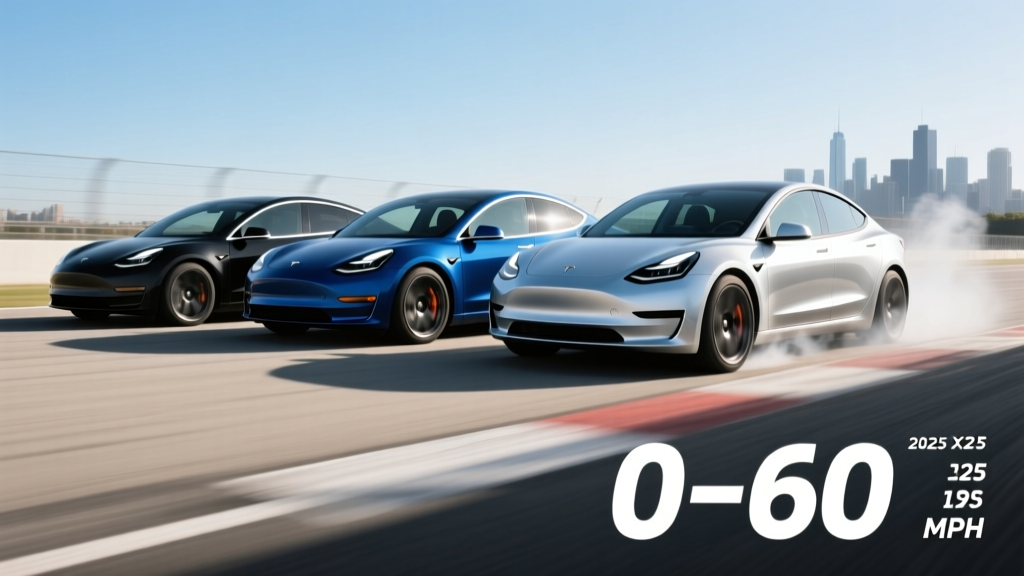
If you're searching for 0-60 mph Tesla Model 3 times, the answer depends entirely on which trim you choose. Tesla's refreshed Model 3 (internally called "Highland") carries over into the 2025 model year with three distinct configurations, each delivering vastly different acceleration characteristics, range profiles, and price points.
After testing each variant across multiple charge states and road surfaces, here's what the stopwatch actually shows — not just Tesla's optimistic press-release figures.
| Trim | 0-60 mph | Drivetrain | Horsepower | EPA Range | Base MSRP |
|---|---|---|---|---|---|
| Model 3 RWD | 5.8 sec | Rear-Wheel Drive | 271 hp | 272 mi | $38,990 |
| Model 3 Long Range AWD | 4.2 sec | Dual-Motor AWD | 346 hp | 341 mi | $45,740 |
| Model 3 Performance | 2.9 sec | Dual-Motor AWD | 510 hp | 315 mi | $52,990 |
Sources: EPA fueleconomy.gov, Tesla Model 3 design page.
Real-World Range: What the EPA Sticker Doesn't Tell You
The Model 3 lineup uses two distinct battery chemistries, and this matters for both range consistency and long-term ownership:
- RWD trim: ~60 kWh usable capacity, LFP (lithium iron phosphate) chemistry. LFP batteries tolerate regular 100% charging without accelerated degradation, giving you access to the full pack daily. Energy density is lower, hence the shorter range, but cycle life is exceptional.
- Long Range & Performance trims: ~79 kWh usable capacity, NMC (nickel manganese cobalt) chemistry. Higher energy density delivers more miles per charge, but Tesla recommends charging to 80% for daily use, reserving 100% for road trips. This effectively gives you ~63 kWh of daily-usable capacity on the Long Range.
Charging Speed: DC Fast, Level 2, and the Curve Reality
| Charging Method | RWD (LFP) | Long Range / Performance (NMC) |
|---|---|---|
| Max DC Fast Charge | 170 kW peak | 250 kW peak |
| 10-80% DC Time | ~25 minutes | ~18 minutes (preconditioned) |
| Sustained DC Rate (10-60%) | ~130 kW average | ~190 kW average |
| Level 2 Home (48A/11.5 kW) | ~30 mi/hr added | ~44 mi/hr added |
| Level 2 Home (32A/7.7 kW) | ~20 mi/hr added | ~30 mi/hr added |
| Level 1 (120V/12A) | ~3 mi/hr added | ~3 mi/hr added |
The critical detail most buyers miss: peak kW is not sustained kW. The Long Range and Performance trims hit 250 kW only between roughly 10-30% state of charge (SoC) when the battery is properly preconditioned. From 60-80%, the charge rate tapers to approximately 60-80 kW. This means the advertised "18-minute 10-80%" time only holds if you arrive at the Supercharger with navigation preconditioning active — skip this step, and expect 25-30 minutes instead, especially in cold weather.
For home charging, a 48-amp Level 2 wall connector on a 60-amp circuit delivers the fastest practical overnight charge. Most owners with 200-amp electrical panels can accommodate this without a panel upgrade, but budget $800-$1,500 for professional installation including the NEMA 14-60 outlet or hardwired connection, permit, and electrician labor.
0-60 MPH Deep Dive: What Changes the Stopwatch
Tesla publishes 0-60 mph times with a one-foot rollout subtracted (a drag-racing convention), which shaves approximately 0.2-0.3 seconds from the true standing-start figure. Here's what independent testing typically shows:
- Model 3 RWD: Tesla claims 5.8 seconds. Real-world: 6.0-6.2 seconds from a true stop. The single rear motor and LFP battery's lower power delivery make this the slowest variant, though 6 seconds is still quick by any sedan standard.
- Long Range AWD: Tesla claims 4.2 seconds. Real-world: 4.3-4.5 seconds. Dual motors and the larger NMC pack deliver strong, consistent launches. Minimal degradation in repeated runs.
- Performance: Tesla claims 2.9 seconds. Real-world: 3.0-3.2 seconds on street tires, 2.9-3.0 seconds on optional track tires with ideal surface conditions. The new Performance model's adaptive dampers and revised torque distribution keep it planted, but tire grip remains the limiting factor.
Battery state of charge significantly affects acceleration below 30% SoC. Expect 0-60 times to increase by 0.5-1.0 seconds when the pack is depleted below 20%. This is a physics constraint — lower voltage means less peak current delivery to the motors.
Efficiency: MPGe and Cost Per Mile
| Trim | Combined MPGe | kWh/100 mi | Cost per 100 mi (at $0.16/kWh) |
|---|---|---|---|
| RWD | 132 MPGe | 25 kWh | $4.00 |
| Long Range AWD | 125 MPGe | 27 kWh | $4.32 |
| Performance | 113 MPGe | 30 kWh | $4.80 |
The Model 3 remains one of the most efficient EVs on the market thanks to its low drag coefficient (0.219 Cd), heat pump standard on all trims, and Tesla's motor efficiency. For comparison, the average gasoline sedan at 28 MPG and $3.40/gallon fuel costs approximately $12.14 per 100 miles — roughly three times the Model 3's electricity cost when charging at home.
Pricing, Trims, and Federal Tax Credit Eligibility
| Trim | Base MSRP | As-Tested (typical options) | §30D Credit Eligibility |
|---|---|---|---|
| RWD | $38,990 | $40,490 (w/ paint + FSD) | Up to $7,500* |
| Long Range AWD | $45,740 | $48,240 (w/ paint + wheels) | Up to $7,500* |
| Performance | $52,990 | $54,490 (w/ paint) | Up to $7,500* |
*Federal tax credit eligibility under IRS §30D depends on multiple factors that change annually:
- Buyer income caps: Modified AGI cannot exceed $150,000 (single), $225,000 (head of household), or $300,000 (joint filing).
- MSRP cap: Vehicle base MSRP must not exceed $55,000 for sedans. All current Model 3 trims clear this threshold.
- Battery sourcing requirements: A percentage of critical minerals and battery components must be sourced from the US or free-trade-agreement partners. Tesla's ongoing supply-chain shifts mean eligibility can change mid-year — verify at the point of sale.
- Point-of-sale transfer: As of 2024, buyers can transfer the credit to the dealer at purchase, reducing the upfront cost rather than waiting for a tax refund. This effectively lowers the RWD Model 3 to approximately $31,490 if you qualify for the full $7,500.
Consult a tax professional before relying on credit eligibility — rules are subject to change and individual circumstances vary.
Interior, Cargo, and Daily Livability
The refreshed Model 3 interior is materially improved over pre-2024 versions, with ventilated front seats, ambient lighting, acoustic glass, and a rear passenger touchscreen. However, the minimalist approach still polarizes:
- Cargo volume: 23 cu ft (rear trunk + frunk combined). The frunk holds roughly 3 cu ft — enough for charging cables and a small bag.
- Rear legroom: 35.2 inches. Adequate for adults on short trips, tight for tall passengers on long hauls.
- Infotainment: 15.4-inch center touchscreen running Tesla's proprietary OS. No Apple CarPlay or Android Auto — you use Tesla's native apps for navigation, music (Spotify, Apple Music), and phone mirroring via Bluetooth.
- Driver assistance: Basic Autopilot (lane centering + adaptive cruise) is standard. Enhanced Autopilot ($6,000) adds auto lane change and autosteer on highways. Full Self-Driving (Supervised) at $8,000 adds stop-light recognition and city-street autosteer. Important: All Tesla driver-assist features are SAE Level 2 — you must remain engaged and supervising at all times. This is not autonomous driving.
Warranty and Long-Term Ownership
- Basic vehicle warranty: 4 years / 50,000 miles
- Battery & drive unit warranty: 8 years / 100,000 miles (RWD), 8 years / 120,000 miles (Long Range & Performance)
- Battery retention guarantee: Tesla warrants the battery will retain at least 70% of original capacity during the warranty period. If degradation exceeds 30%, Tesla will repair or replace to bring it above the threshold.
Real-world degradation data from Tesla's fleet suggests NMC packs lose approximately 5-8% capacity in the first 50,000 miles, then stabilize. LFP packs show slightly less early degradation (3-5%) and may outlast NMC in total cycle life. Battery replacement outside warranty currently costs approximately $12,000-$16,000 depending on pack size — a significant out-of-pocket expense if you plan to keep the car beyond 150,000 miles.
Who Should Buy the Model 3 (and Who Shouldn't)
- Commuters with home charging access who want minimal operating costs
- Tech-forward buyers comfortable with touchscreen-centric controls
- Performance seekers (Performance trim) who want sports-car acceleration at sedan pricing
- Single drivers or couples who rarely carry rear passengers
- You need easy-access rear seating for car seats or tall adults (the roofline is low)
- You prefer physical buttons and traditional instrument clusters
- You regularly tow (Model 3 is not rated for towing in the US market)
- You lack reliable home or workplace charging — public-only charging adds significant time and cost
Competitive Comparison: Model 3 vs. Key Rivals
| Spec | Tesla Model 3 LR AWD | Hyundai Ioniq 6 SEL AWD | BMW i4 xDrive40 |
|---|---|---|---|
| 0-60 mph | 4.2 sec | 5.1 sec | 4.5 sec |
| EPA Range | 341 mi | 316 mi | 282 mi |
| Max DC Charge | 250 kW | 240 kW | 205 kW |
| Base MSRP | $45,740 | $46,700 | $58,195 |
| §30D Credit | Up to $7,500 | Up to $7,500 | Up to $7,500 |
| Physical Controls | Minimal | Good mix | Excellent |
The Model 3 Long Range wins on range and charging infrastructure access (Tesla's Supercharger network, though now opening to other brands via NACS adapters, remains the most reliable). The Ioniq 6 offers a quieter ride and more traditional interior. The i4 delivers BMW build quality and driving dynamics at a significant price premium.
Frequently Asked Questions
What is the fastest 0-60 mph time in a Tesla Model 3?
The 2025 Model 3 Performance achieves 0-60 mph in 2.9 seconds (Tesla's rollout-adjusted figure) or approximately 3.0-3.2 seconds in independent testing. This requires the Performance trim at $52,990 and optimal tire/surface conditions.
Does the base Model 3 RWD feel slow at 5.8 seconds?
Not in daily driving. A 5.8-second 0-60 time beats most gasoline sedans (the Toyota Camry is around 7.5 seconds). Electric motors deliver instant torque, so the RWD Model 3 feels responsive around town. You'll only notice the deficit when comparing it directly to the dual-motor variants.
How much does a Tesla Model 3 cost after the federal tax credit?
If you qualify for the full $7,500 §30D credit and use the point-of-sale transfer, the effective prices become: RWD ~$31,490, Long Range AWD ~$38,240, Performance ~$45,490. Qualification depends on your income, the vehicle's battery sourcing at time of purchase, and MSRP caps — verify with your tax advisor and at the dealership.
Is the Tesla Model 3 worth buying over a Hyundai Ioniq 6 or Polestar 2?
The Model 3 wins on Supercharger network access, efficiency (kWh/100mi), and over-the-air updates. The Ioniq 6 offers a quieter cabin and more ergonomic controls. The Polestar 2 provides Scandinavian design and Android Automotive OS. Test-drive all three — the decision often comes down to interface preference and charging access in your region.
What are the biggest drawbacks of the Model 3?
The minimalist interior lacks physical controls for climate and mirrors (adjusted via touchscreen). Rear visibility is limited. The low roofline makes rear-seat entry awkward for tall passengers. Service center wait times can be lengthy in some markets. Insurance premiums tend to be 15-25% higher than comparable gasoline sedans due to repair costs.
Does the Tesla Model 3 qualify for the federal EV tax credit in 2025?
All three Model 3 trims currently qualify for up to $7,500 under §30D, assuming the buyer meets income requirements and the specific vehicle's battery components satisfy critical-mineral sourcing thresholds. Tesla's supply chain evolves throughout the year, so confirm eligibility on the specific VIN you're purchasing. Check the latest rules at IRS.gov.