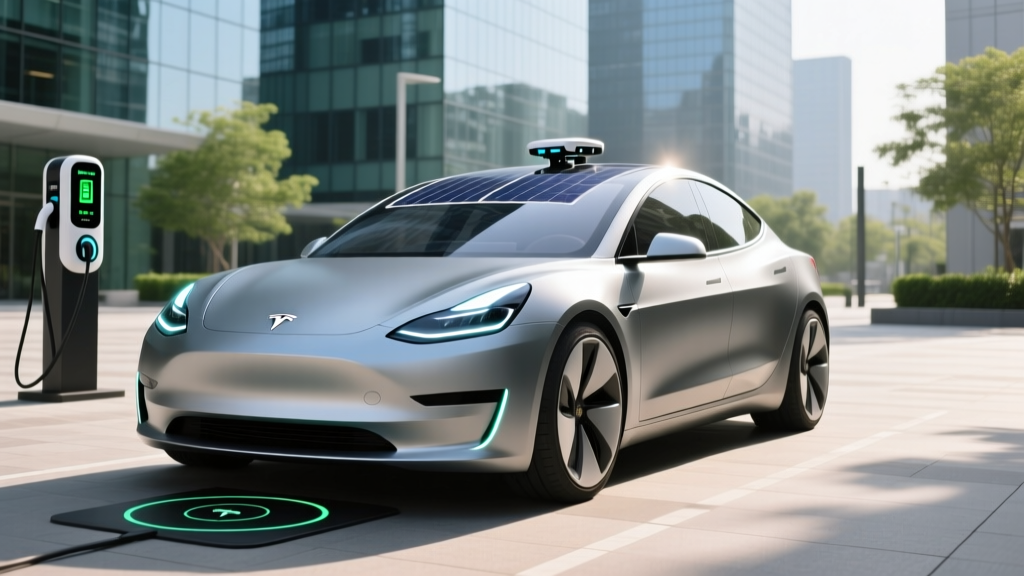
Search for "Tesla Model 2.0" and you will find thousands of forum posts, YouTube videos, and speculative articles about a sub-$30,000 Tesla EV. The idea is compelling: a compact, affordable electric car that brings Tesla's software and Supercharger network to a mass-market price point. But as of mid-2026, Tesla has not officially unveiled, priced, or opened reservations for a vehicle called the Model 2.0, Model 2, Model C, or any other nameplate for its long-rumored budget EV.
This article separates confirmed facts from speculation, examines what Tesla's recent product strategy tells us about a potential compact EV, and provides a practical framework for buyers deciding whether to wait or purchase an existing affordable EV today.
The Tesla Model 2.0: What Has Tesla Actually Confirmed?
Let's be direct: Tesla has not announced a production model called "Model 2.0" or any variant targeting the $25,000 price point as of mid-2026. The vehicle is not listed on Tesla's official vehicle lineup, is not available for reservation, and has no confirmed EPA range, battery specs, or delivery timeline.
What we do know from public statements and reporting:
- Elon Musk mentioned a lower-cost vehicle platform during Tesla's 2024 investor discussions, referencing a "next-generation" architecture aimed at significantly reducing manufacturing costs through techniques like gigacasting and a simplified wiring harness.
- Reuters reported in early 2024 that Tesla had paused or scaled back plans for a dedicated low-cost consumer vehicle, instead redirecting engineering resources toward robotaxi development and the Cybercab concept.
- Tesla's 2025 and 2026 product focus has been on the refreshed Model Y ("Juniper"), the Cybertruck production ramp, and the next-generation Roadster — not a compact economy car.
- The Model 3 remains Tesla's most affordable vehicle at a base MSRP of approximately $38,990 in 2026, placing it well above the rumored $25,000 target.
Rumored Tesla Model 2.0 vs. Reality Check
| Spec / Claim | Rumored / Speculative | Confirmed Status |
|---|---|---|
| Model name | Model 2, Model C, Model Q, Model 2.0 | Not confirmed |
| Target price | $25,000 MSRP | Not confirmed |
| EPA range | 250–300 miles | Not confirmed |
| Battery chemistry | LFP (CATL or BYD Blade) | Likely if built, not confirmed |
| Platform | Next-gen "unboxed" manufacturing | Concept discussed, not in production |
| Production start | 2025–2026 | No timeline announced |
| Reservations open | N/A | No |
Why the "Model 2.0" Search Trend Persists
The search volume for "Tesla Model 2.0" (approximately 2,400 monthly searches in the U.S.) reflects genuine consumer demand for an affordable Tesla. Several factors keep the speculation alive:
Tesla's master plan precedent. Elon Musk's original 2006 master plan outlined a sequence: build an expensive sports car (Roadster), use that money to build a moderately priced car (Model S/X), then use that money to build an affordable car. The Model 3 was supposed to fulfill step three, but at ~$39,000, it remains out of reach for many buyers. The market expects Tesla to eventually deliver a true budget EV.
Competitive pressure. Affordable EVs are arriving from other manufacturers. The Chevrolet Equinox EV starts around $33,000 with up to 319 miles of EPA range. The Volvo EX30 undercuts at roughly $34,950. In China, BYD's Dolphin and Seagull models sell for the equivalent of $10,000–$20,000 — vehicles that demonstrate a low-cost EV is technically feasible, even if U.S. regulatory and tariff environments make direct import unlikely.
Content creator economics. YouTube channels and blogs generate significant traffic from speculative Tesla content, creating a self-reinforcing cycle of rumors, renders, and "leaked" details that are rarely verified.
What a Budget Tesla Could Look Like — If It Happens
If Tesla does eventually produce a compact, affordable EV, industry analysts and supply-chain reporting suggest a plausible spec profile. Treat these as educated projections, not specifications:
Projected Range & Battery (Speculative)
Likely battery: 50–60 kWh usable capacity, LFP chemistry (lithium iron phosphate) sourced from CATL or BYD. LFP offers lower energy density than NMC but excels in cycle life (3,000+ cycles), thermal stability, and lower raw-material cost — ideal for a budget vehicle where buyers prioritize longevity and safety over maximum range.
Estimated EPA range: 230–280 miles, depending on drivetrain and aerodynamics.
Real-world expectation: If EPA-rated at 260 miles, expect approximately 210–230 miles in sustained highway driving at 70+ mph, and 170–200 miles in freezing temperatures (below 32°F). LFP batteries experience similar cold-weather range loss to NMC — typically 15–30% in extreme cold — though Tesla's heat pump and thermal management system should mitigate this compared to budget EVs without active thermal management.
Projected charging performance:
| Charging Level | Estimated Spec | Practical Impact |
|---|---|---|
| Level 1 (120V household) | ~1.4 kW / ~4 mi/hr | Emergency trickle only |
| Level 2 (240V home) | ~7.7–11.5 kW / 25–37 mi/hr | Full overnight charge in 5–7 hours |
| DC Fast Charge | ~150–170 kW peak | 10–80% in ~25–30 min (estimated) |
A budget Tesla would almost certainly use the NACS (North American Charging Standard) connector, granting access to the Tesla Supercharger network — currently the most reliable DC fast-charging network in the U.S. by uptime and availability metrics. This is a significant competitive advantage over CCS-equipped vehicles still reliant on Electrify America and other third-party networks with historically lower reliability scores.
Projected performance:
- Drivetrain: Single-motor RWD (cost reduction; AWD unlikely at this price point)
- Horsepower: 200–250 hp (estimated)
- 0–60 mph: 5.5–6.5 seconds (estimated)
- Efficiency: 120–135 MPGe combined (estimated, based on Model 3 RWD benchmark of 132 MPGe combined per fueleconomy.gov)
The Real Alternatives: Affordable EVs You Can Buy Right Now
Rather than wait for an unconfirmed vehicle, here is how the most affordable new EVs on the U.S. market compare as of mid-2026:
| Vehicle | Base MSRP | EPA Range | Battery (kWh) | DC Peak kW | 10–80% Min | §30D Credit |
|---|---|---|---|---|---|---|
| Chevrolet Equinox EV 2LT | ~$33,600 | 319 mi | 85 kWh (NMC) | 150 kW | ~28 min | Eligible* |
| Tesla Model 3 RWD | ~$38,990 | 272 mi | 60 kWh (LFP) | 170 kW | ~25 min | Eligible* |
| Volvo EX30 Single Motor | ~$34,950 | 265 mi | 69 kWh (NMC) | 153 kW | ~27 min | Check sourcing |
| Hyundai Kona Electric | ~$32,975 | 261 mi | 64.8 kWh (NMC) | 100 kW | ~43 min | Eligible* |
* Federal §30D tax credit eligibility depends on MSRP caps (vehicles must be under $55,000 for sedans, $80,000 for SUVs/trucks/vans), buyer income limits ($150,000 single / $300,000 joint AGI), and battery critical-mineral and component sourcing requirements that change annually. See IRS §30D guidance for current-year rules. Credits may be transferred to the dealer at point of sale as an upfront price reduction.
Should You Wait for a Tesla Model 2.0?
Decision Framework: Wait or Buy Now?
Wait for a budget Tesla if:
- You are not in immediate need of a vehicle and can comfortably wait 1–3 years for an unconfirmed product.
- Access to the Supercharger network and Tesla's software ecosystem (OTA updates, app integration, FSD Supervised) is a top priority.
- You believe Tesla's "unboxed" manufacturing process will deliver a meaningfully lower price than current affordable EVs.
Buy an existing affordable EV now if:
- You need a vehicle within 6 months — the Model 2.0 has no confirmed timeline, and early-production Tesla launches historically involve significant delays and quality-control issues.
- You want to lock in the current §30D federal tax credit (up to $7,500), which is subject to legislative change and could be reduced or restructured in future years.
- Competitors like the Equinox EV (319 mi EPA) or Model 3 (Supercharger access, proven platform) already meet your range, charging, and budget requirements.
- You value IIHS/NHTSA safety ratings — existing models have been crash-tested; an unannounced vehicle has no safety data.
Tesla's Actual 2026 Lineup: What You Can Order Today
For buyers committed to the Tesla brand, here are the current options with confirmed specs:
| Model | Base MSRP | EPA Range | 0–60 mph | Drivetrain | §30D Eligible |
|---|---|---|---|---|---|
| Model 3 RWD | $38,990 | 272 mi | 5.8 sec | RWD | Yes* |
| Model 3 Long Range AWD | $44,990 | 341 mi | 4.2 sec | AWD | Yes* |
| Model Y Long Range AWD | $44,990 | 320 mi | 4.8 sec | AWD | Yes* |
| Model Y Performance | $49,990 | 293 mi | 3.5 sec | AWD | Yes* |
*MSRP under $55,000 sedan cap (Model 3) or $80,000 SUV cap (Model Y). Buyer income limits and battery-sourcing rules still apply per IRS §30D.
The Model 3 RWD at $38,990 is the closest Tesla currently offers to a budget EV. After the $7,500 federal credit (if eligible) and typical state incentives, effective pricing can drop to approximately $31,490 before destination fees — not far from the rumored Model 2.0 target, though in a midsize sedan rather than a compact hatchback form factor.
The Bottom Line: Manage Expectations and Have a Backup Plan
The Tesla Model 2.0 remains one of the most searched but least confirmed vehicles in the EV space. Tesla's engineering capability means a budget EV is technically feasible, and the company's manufacturing innovations could theoretically deliver a compelling product. However, the lack of any official announcement, reservation page, or confirmed timeline means buyers should not base their transportation plans on this vehicle's arrival.
If a budget Tesla does materialize, expect:
- An LFP battery with 230–280 miles of EPA range
- A single-motor RWD drivetrain
- NACS connector with Supercharger access
- Basic Autopilot with FSD Supervised available as a subscription or purchase add-on
- A minimalist interior similar to the Model 3 Highland refresh
- Production delays — Tesla's Cybertruck launched roughly two years behind its originally projected timeline
Smart buyers will identify a backup vehicle now, monitor Tesla's official investor presentations and product announcements, and avoid paying deposits to third parties claiming to offer "early access" to an unannounced Tesla model.
Potential Pros (If Released)
- Sub-$30,000 price point (rumored)
- Supercharger network access via NACS
- Tesla OTA software and app ecosystem
- LFP battery durability and safety
- Strong resale value typical of Tesla products
Key Concerns
- Not announced — no confirmed specs, price, or timeline
- Tesla's history of production delays for new models
- Early-build quality control issues common with Tesla launches
- Possible reduced features to hit price target (no heat pump, basic interior)
- §30D tax credit rules may change before vehicle launches
- Competitors already offer 300+ mi range in this price range today
Frequently Asked Questions
What is the real-world range of the Tesla Model 2.0?
The Tesla Model 2.0 is not a confirmed or available vehicle as of 2026. No EPA range testing has been conducted. If released with a 50–60 kWh LFP battery, a reasonable projection would be 230–280 miles EPA, with real-world highway driving yielding approximately 15–20% less (roughly 190–230 miles at 70 mph), and cold-weather driving reducing range by an additional 15–30% in sub-freezing temperatures.
How fast would the Tesla Model 2.0 charge?
No official charging specs exist. Based on Tesla's current LFP-equipped Model 3 RWD, a reasonable estimate would be a peak DC fast-charge rate of 150–170 kW, achieving a 10–80% charge in approximately 25–30 minutes at a V3 or V4 Supercharger. Home Level 2 charging at 11.5 kW (48A circuit) would add roughly 37 miles of range per hour, fully recharging the battery in 5–7 hours.
How much would the Tesla Model 2.0 cost after tax credits?
The rumored $25,000 price is unconfirmed. If a budget Tesla launches at $25,000–$28,000 and qualifies for the full $7,500 §30D federal tax credit (subject to income caps of $150K single/$300K joint, and battery sourcing requirements), the effective price could drop to $17,500–$20,500. However, the tax credit's future is uncertain, and eligibility rules tighten annually. Consult a tax professional and check IRS §30D guidance for the purchase year.
Is it worth waiting for the Tesla Model 2.0 vs. buying a Chevrolet Equinox EV or Tesla Model 3?
If you need a vehicle now, waiting for an unconfirmed product is risky. The Equinox EV offers 319 EPA miles at ~$33,600 with §30D eligibility — a known quantity you can test-drive today. The Model 3 RWD offers Supercharger access and proven software at $38,990. Either is a rational purchase without the uncertainty of a multi-year wait for a vehicle that may never arrive, may cost more than rumored, or may face lengthy production delays.
Does the Tesla Model 2.0 qualify for the federal EV tax credit?
Since the vehicle does not exist as a confirmed product, tax credit eligibility cannot be determined. If and when Tesla announces the vehicle, eligibility will depend on: (1) MSRP under the $55,000 sedan cap, (2) buyer AGI within income limits, (3) battery critical-mineral and component sourcing meeting current-year thresholds, and (4) final assembly in North America. These rules change annually — refer to the IRS for the year of purchase.
What are the biggest risks of waiting for a budget Tesla?
The primary risks are: (1) the vehicle is never produced, as Tesla has redirected resources toward robotaxi and AI development; (2) the price ends up higher than $25,000 due to inflation, supply-chain costs, or feature additions; (3) production is delayed 1–3 years past any announced date, as happened with the Cybertruck and Roadster; (4) the §30D federal tax credit is reduced or eliminated before the vehicle launches, increasing effective cost; (5) competing EVs continue to improve, making the Tesla less compelling by the time it arrives.