Why Tire Rotation Matters More on a Tesla Than a Gas Car
Electric vehicles are heavier than their gas counterparts, and they deliver instant torque from a standstill. Both factors accelerate tire wear — especially on the drive wheels. A Tesla Model Y Long Range, for example, tips the scales at roughly 4,400 lbs, and its dual-motor AWD system can rotate all four wheels independently. If you skip rotations, you'll see uneven tread depth, reduced range (worn tires increase rolling resistance), and potentially premature replacement of a $1,200+ set of EV-rated tires.
Tesla recommends rotating tires every 6,250 miles or when tread depth variance reaches 2/32 inch or more, whichever comes first. That's a tighter interval than many legacy automakers suggest for ICE vehicles, and it reflects the real physics of EV weight and torque delivery.
What Tesla Mobile Service Tire Rotation Actually Includes
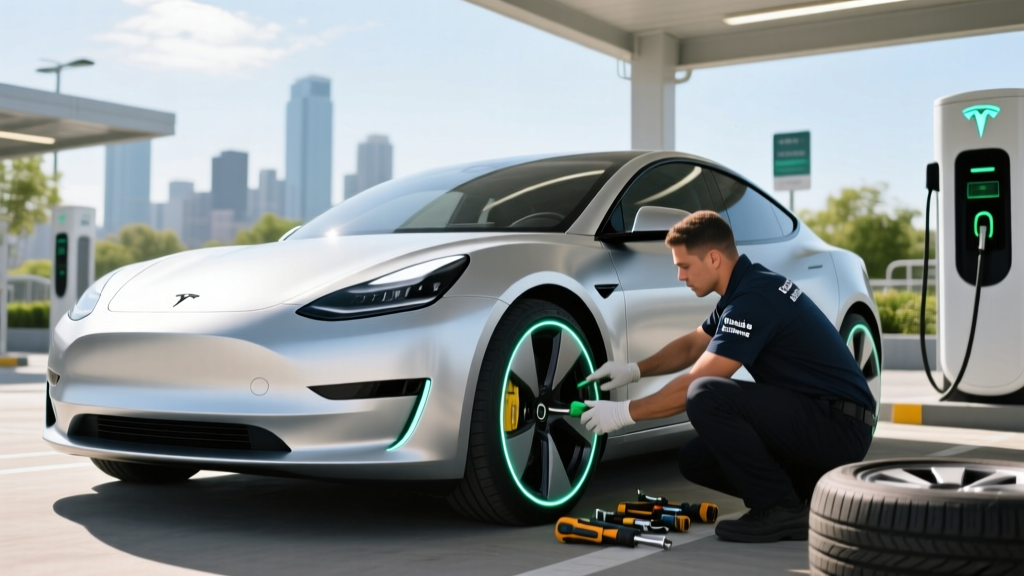
When you schedule a tire rotation through the Tesla app, a Mobile Service technician comes to your home, office, or any location with a flat, paved surface. Here's what the visit typically covers:
- Tire rotation — cross-rotation pattern (front-to-rear on same side for directional tires; X-pattern for non-directional) per Tesla's service manual
- Tire pressure check and adjustment — set to the door-jamb placard spec (usually 42 PSI cold for Model Y, 45 PSI for Model 3)
- Visual brake inspection — pad thickness and rotor condition check (EVs use regen heavily, so friction brakes see less wear but can develop surface rust)
- Tread depth measurement — recorded at multiple points per tire to flag uneven wear patterns that might indicate alignment issues
- Torque verification — lug nuts torqued to spec (129 lb-ft for most Tesla models) with a calibrated torque wrench
The entire visit usually takes 30–45 minutes. You don't need to be present the entire time — many owners leave the car in the driveway and unlock it remotely via the app if needed, though most rotations are done with the car off and locked.
Cost Breakdown: Tesla Mobile Service vs. Third-Party Shops
Tesla's Mobile Service tire rotation pricing is straightforward but not the cheapest option available. Here's how it compares:
| Provider | Typical Cost | Convenience | Warranty/Record |
|---|---|---|---|
| Tesla Mobile Service | $60–$100 (varies by market) | Comes to you; app-scheduled | Logged in Tesla service history |
| Tesla Service Center | $50–$80 | Requires drop-off or wait | Logged in Tesla service history |
| Costco Tire Center | Free (with purchase) / $20–$30 | Walk-in; may wait 1+ hr | Costco record only |
| Independent tire shop | $25–$50 | Varies; appointment or walk-in | Shop record only |
| DIY (jack stands + torque wrench) | $0 (after tool purchase) | Your schedule entirely | Your own log |
The premium you pay for Tesla Mobile Service buys convenience and a documented service record within the Tesla ecosystem. That record matters if you sell the car — buyers and Tesla's own certified pre-owned program value complete service history. However, using a third-party shop does not void your warranty, despite what some forum posts claim. The Magnuson-Moss Warranty Act protects your right to service anywhere.
How to Schedule Tesla Mobile Service Tire Rotation
The process is entirely app-based:
- Open the Tesla app and tap Service
- Select Request Service → Tires → Tire Rotation
- Describe any concerns (e.g., "vibration at highway speed" or "uneven wear on front left")
- Choose Mobile Service as the service type
- Select a date, time window, and location (home address, work, etc.)
- Confirm — you'll receive a confirmation with an estimated cost
Availability varies by metro area. In major markets (LA, SF, Austin, Miami, NYC), you can often get an appointment within 2–5 days. In rural areas, mobile service may not be available, and you'll be directed to the nearest Service Center.
Tesla Tire Rotation Patterns: What You Should Know
Not all Teslas use the same rotation pattern, and getting it wrong can cause accelerated wear or handling issues.
Non-Directional Tires (Most Common)
If your Tesla has standard all-season or summer tires (non-directional tread), the recommended pattern is a forward cross: fronts move straight to the rear, and rears cross to the opposite front positions. This is the standard for most AWD vehicles.
Directional Tires
Some Tesla owners upgrade to directional performance tires (e.g., Michelin Pilot Sport 4S in certain sizes). These can only be rotated front-to-rear on the same side of the vehicle. If your Tesla has a staggered setup (wider rear tires, as on some Model S Plaid configurations), rotation isn't possible at all — you can only swap side-to-side if the tires are non-directional, which most staggered setups are not.
Staggered Wheel Setups
Model S and some Model 3 Performance variants come with wider rear wheels (e.g., 255/40 front, 275/35 rear). With staggered, non-directional tires, a side-to-side swap is the only option. With staggered and directional tires, no rotation is possible — plan for replacement when tread reaches 4/32 inch.
Real-World Tire Wear on Teslas: What Owners Report
Based on aggregated owner data from Tesla forums and tire retailer reports, here's what to expect:
- Model 3 RWD: OEM tires (Michelin e.Primacy or Hankook iON) typically last 30,000–40,000 miles with regular rotations. Without rotations, front tires can wear to replacement at 20,000–25,000 miles.
- Model Y Long Range AWD: OEM Michelin Primacy All-Season tires average 35,000–45,000 miles with 6,250-mile rotation intervals. The heavier curb weight accelerates rear wear on the drive-dominant axle.
- Model S/X Plaid: High-performance compounds (Pirelli P Zero, Michelin Pilot Sport) wear faster — expect 15,000–25,000 miles even with rotations. The combination of 1,020+ hp and 4,800+ lb curb weight is brutal on rubber.
One often-overlooked factor: regenerative braking settings. Running regen on "Standard" (strong) mode increases load on the drive wheels during deceleration, which can accelerate rear-tire wear on RWD models and even out wear on AWD models. If you notice unusual rear wear patterns, consider switching regen to "Low" for a few thousand miles to assess the impact.
Tesla Tire Options and Replacement Costs
When rotation can no longer save your tires, here's what replacement looks like for the most common Tesla models:
| Model | OEM Tire | Size | Per-Tire Cost | Set of 4 (Installed) |
|---|---|---|---|---|
| Model 3 RWD | Michelin e.Primacy / Hankook iON evo | 235/45R18 | $220–$280 | $950–$1,200 |
| Model 3 Long Range AWD | Michelin Primacy All-Season | 235/40R19 | $260–$320 | $1,100–$1,400 |
| Model Y Long Range | Michelin Primacy All-Season / Goodyear Eagle Touring | 255/45R19 | $270–$340 | $1,150–$1,500 |
| Model Y Performance | Pirelli P Zero (PZ4) | 255/40R20 (F) / 275/35R20 (R) | $300–$380 | $1,300–$1,700 |
| Model S Long Range | Michelin Pilot Sport 5 | 255/40R19 | $320–$400 | $1,400–$1,800 |
EV-specific tire lines (Hankook iON, Michelin e.Primacy, Pirelli Elect) use lower-rolling-resistance compounds and foam-lined construction to reduce road noise — important since EVs lack engine noise to mask tire hum. Switching to a non-EV tire can reduce range by 3–7% and increase cabin noise noticeably.
Does Mobile Service Cover Other Maintenance Too?
Yes. Tesla Mobile Service handles a growing list of services beyond tire rotation:
- Cabin air filter replacement (HEPA filter on Model S/X, standard filter on Model 3/Y) — $80–$150
- Wiper blade replacement — $40–$70
- 12V battery replacement (lithium-ion auxiliary battery) — $200–$350
- Brake fluid flush (recommended every 2 years) — $120–$180
- Minor body trim and seal repairs
- Software-related diagnostics and module resets
What Mobile Service does not handle: high-voltage battery replacements, structural collision repair, drive unit swaps, or any service requiring a lift and extended bay time. Those require a Service Center visit.
Frequently Asked Questions
How often should I rotate my Tesla's tires?
Every 6,250 miles or when tread depth variance reaches 2/32 inch. For a driver covering 12,000 miles per year, that's roughly twice annually. Set a calendar reminder or use the Tesla app's service scheduling to stay on track.
Can I rotate Tesla tires myself?
Yes, if you have a proper floor jack, jack stands rated for your vehicle's weight (at minimum 2-ton stands for a 4,400-lb Model Y), and a calibrated torque wrench. Tesla's jack points are reinforced but require care — using the wrong lift point can damage the battery pack enclosure. Consult your owner's manual for exact jack-point locations. After rotation, drive 50 miles and re-check lug nut torque.
Does Tesla Mobile Service bring their own equipment?
Yes. The technician arrives in a service van with a portable lift, torque wrench, tire pressure gauges, and tread depth gauges. You only need to provide a flat, paved surface (driveway, parking lot, or garage). They do not need access to electrical outlets or water.
Will using a third-party shop void my Tesla warranty?
No. Under the Magnuson-Moss Warranty Act, Tesla cannot void your warranty because you had maintenance performed by an independent shop. However, if a third-party shop damages a component (e.g., strips a lug stud), that specific damage won't be covered under warranty. Keep receipts from any third-party service.
Do Tesla tires wear faster than gas car tires?
Generally, yes. The combination of higher vehicle weight (battery packs add 800–1,500 lbs vs. a comparable gas car) and instant torque delivery accelerates tread wear by 20–30% on average. Regular rotations at the 6,250-mile interval are the single most effective way to maximize tire life.
How do I know if my Tesla needs an alignment, not just a rotation?
Signs include: the car pulls to one side on a flat, straight road; the steering wheel is off-center when driving straight; or tread wear is uneven across the width of a tire (inner shoulder worn more than outer). Rotation addresses front-to-rear wear differences; alignment corrects side-to-side and camber issues.
Can Tesla Mobile Service replace tires, not just rotate them?
In most markets, no. Mobile Service typically handles rotation and minor tire services (pressure adjustment, puncture repair for small tread-area nails). Full tire replacement requires a tire mounting and balancing machine, which isn't part of the standard Mobile Service van equipment. For replacement, Tesla can ship tires to a Service Center, or you can purchase from a retailer like Tire Rack and have them installed at a local shop.