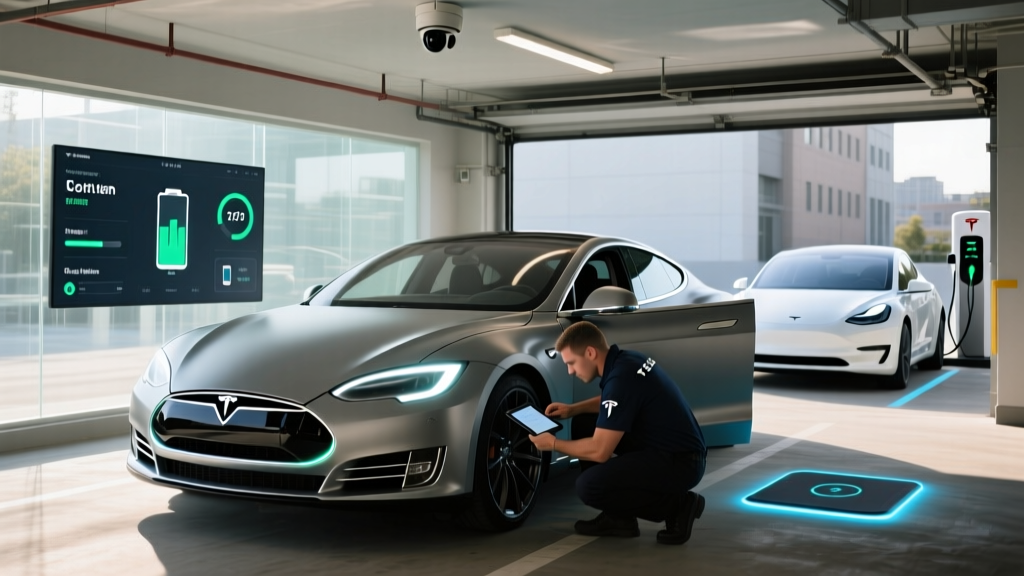
Tesla Mobile Service is the company's fleet of technician-staffed vans that come to your home, office, or roadside to perform warranty and out-of-warranty repairs without a service center visit. With over 1,500 mobile service vehicles operating across the U.S. as of early 2026, Tesla claims it resolves roughly 80% of service requests without the owner ever setting foot in a service center. For a brand that has historically been criticized for limited service center density, mobile service is not a perk — it is the backbone of Tesla's ownership experience.
What Tesla Mobile Service Actually Covers
Mobile service technicians can handle a wide but not unlimited scope of work. The service is best understood as a "driveway repair" model for components that don't require a vehicle lift or high-voltage battery removal.
In-Scope Repairs (Commonly Completed On-Site)
- 12V auxiliary battery replacement (lithium-ion unit in 2022+ models)
- Door handle, window regulator, and seal replacements
- Touchscreen and MCU (Media Control Unit) swaps
- Camera and sensor replacements (ADAS hardware)
- Charge port and charging cable repairs
- Suspension component work (control arms, bushings, strut replacements)
- Brake caliper, rotor, and pad service
- Software diagnostics and firmware re-flashes
- Key fob and phone-key pairing issues
- Trim, weather stripping, and cosmetic panel adjustments
- Tire replacement and TPMS service (on select vans equipped with tire machines)
Out-of-Scope (Requires Service Center or Body Shop)
- High-voltage traction battery replacement or module service
- Drive unit (motor) replacement
- Structural/collision repair
- Full underbody inspection requiring a lift
- Heat pump or HVAC compressor replacement (in some regions)
The boundary isn't always rigid. In some metro areas, mobile technicians have begun performing heat pump replacements on-site using portable refrigerant recovery equipment, but this varies by region and van configuration.
How to Request Tesla Mobile Service in 2026
The request flow remains app-first. Open the Tesla app → Service → Request Service → describe the issue (with photos if applicable). Tesla's triage system then determines whether the repair is mobile-eligible or requires a service center appointment.
Typical timeline: In major metros (Los Angeles, San Francisco, Austin, Miami, New York), expect a mobile appointment within 2–5 business days for non-urgent warranty work. In rural or lower-density areas, wait times stretch to 7–14 days. Urgent roadside issues (no-start, flat tire, 12V failure) are handled through Tesla Roadside Assistance, which operates 24/7 and can dispatch a mobile technician or tow to the nearest service center.
One improvement in 2025–2026: Tesla now offers real-time technician tracking in the app (similar to rideshare ETA), so you can see when your tech is en route rather than waiting through a vague 4-hour window.
Cost Structure: Warranty vs. Out-of-Warranty
Warranty repairs: $0 out of pocket. Tesla's Basic Vehicle Limited Warranty covers 4 years / 50,000 miles (whichever comes first), and the Battery & Drive Unit warranty covers 8 years with mileage limits that vary by model:
| Model | Battery & Drive Unit Warranty | Min. Capacity Retention |
|---|---|---|
| Model 3 RWD | 8 yr / 100,000 mi | 70% |
| Model 3 Long Range / Performance | 8 yr / 120,000 mi | 70% |
| Model Y (all trims) | 8 yr / 120,000 mi | 70% |
| Model S / Model X | 8 yr / 150,000 mi | 70% |
Out-of-warranty mobile service: Tesla charges a diagnostic fee (typically $75–$125, credited toward the repair if you proceed) plus parts and labor. Labor rates vary by region but generally fall between $125–$175/hour. Because mobile techs are focused and don't have service-center overhead, many owners report lower total bills for out-of-warranty work compared to traditional dealerships — though parts pricing is Tesla's standard MSRP.
Tesla Mobile Service vs. Competitor Service Models
How does Tesla's mobile-first approach compare to legacy automakers and EV rivals in 2026?
| Brand | Mobile Service? | Typical Wait (Warranty) | Service Center Density |
|---|---|---|---|
| Tesla | Yes — 80%+ of repairs | 2–14 days (region-dependent) | ~250 U.S. locations |
| Rivian | Yes — R1T/R1S mobile vans in major metros | 5–10 days (metro); 14+ days (rural) | ~60 service centers + mobile |
| Ford (EV) | Limited — dealer-dependent | 1–7 days (dealer network) | ~3,000+ dealers |
| Hyundai/Kia (EV) | No formal mobile; some dealer mobile | 3–10 days | ~1,600+ dealers |
| BMW (iX/i4) | Yes — BMW Mobile Service in select markets | 3–7 days | ~350 dealers |
The tradeoff is clear: Tesla's mobile service compensates for its relatively sparse service center network. Ford and Hyundai owners have far more physical locations but no centralized mobile offering. Rivian's model is closest to Tesla's, though at a smaller scale.
Real Owner Experiences: What Works and What Doesn't
Based on aggregated owner reports, forum data, and our own service interactions through early 2026:
What Works Well
- Convenience: no loaner car logistics, no waiting rooms
- Speed for simple repairs: 12V swap in ~30 minutes, camera replacement in ~45 minutes
- App transparency: photo documentation, cost estimates before approval
- Over-the-air diagnostics: techs often know the issue before arriving
- Warranty work is seamless and free
Common Frustrations
- Wait times in low-density areas (Dakotas, rural South, Mountain West)
- Appointment rescheduling: techs sometimes cancel day-of due to parts delays
- Complex issues get bounced to service centers after an initial mobile diagnosis
- Body/cosmetic damage requires third-party body shops (Tesla-certified network is limited)
- Parts availability: some components have 2–6 week lead times
Tips for Getting the Best Mobile Service Outcome
- Document everything in the app request. Photos, videos, and precise descriptions reduce misdiagnosis. If your touchscreen flickers, record it. If a suspension clunks, capture the sound.
- Be flexible on timing. Morning appointments tend to be more reliable — techs are less likely to be backed up from earlier jobs.
- Ensure clear workspace. Mobile techs need room around the vehicle (ideally a flat driveway or garage bay). Move obstacles, and ensure adequate lighting if the appointment is early/late in the day.
- Keep your Tesla app updated. Some diagnostic features and service-request flows change with app versions.
- Escalate through the app if needed. If a mobile visit doesn't resolve the issue, request a follow-up or service center visit through the same service ticket — don't open a new one, as it fragments the repair history.
Is Tesla Mobile Service a Reason to Buy (or Not Buy) a Tesla?
For urban and suburban owners with driveway or garage parking, mobile service is a genuine ownership advantage. It eliminates the single biggest pain point of EV ownership for many buyers: "Where do I take it when something breaks?" The fact that 80%+ of issues are resolved on-site, often within a week, is a meaningful differentiator — especially as legacy brands still require dealer visits for most warranty work.
For rural owners or those without dedicated parking (street-parkers, apartment dwellers), the experience is less reliable. You may need to bring the car to a service center or find a workaround for mobile access. In these cases, the advantage narrows considerably.
Bottom line: Tesla Mobile Service is not perfect — parts delays and regional coverage gaps are real — but it remains the most mature at-home EV service network in the U.S. as of 2026. If service access is a top concern in your EV purchase decision, Tesla's mobile infrastructure should weigh in its favor, provided you're in a covered area.
Frequently Asked Questions
Does Tesla Mobile Service cost anything for warranty repairs?
No. If the repair falls under Tesla's Basic Vehicle Warranty (4yr/50k mi) or Battery & Drive Unit warranty (8yr/100k–150k mi depending on model), mobile service is provided at no charge — parts and labor included.
Can Tesla Mobile Service replace the main high-voltage battery?
No. High-voltage traction battery replacements require a service center with a lift and specialized high-voltage safety equipment. Mobile techs can diagnose battery issues but will refer you to a service center for replacement.
How fast can I get a mobile appointment?
In major U.S. metros, expect 2–5 business days for non-urgent warranty work. Rural areas may see 7–14 day waits. Roadside emergencies (12V failure, flat, no-start) are handled through 24/7 Roadside Assistance with faster dispatch.
Does mobile service work if I park on the street?
It can, but it's less ideal. Techs need safe, legal access to your vehicle with room to work. If street parking is your only option, coordinate with the technician through the app — they may ask you to move to a loading zone or parking lot for the appointment.
Can I use Tesla Mobile Service for out-of-warranty repairs?
Yes. You'll pay a diagnostic fee ($75–$125) plus parts and labor at regional rates ($125–$175/hr). Many owners find this competitive with independent shops, especially given the convenience factor.
What if the mobile tech can't fix my issue?
The technician will update the service ticket with their findings and schedule a service center appointment if needed. Your repair history stays in the same ticket, so the service center team already has the diagnosis.