Why Tesla Owners Rely on Mobile Mechanics Instead of Dealerships
When your Tesla needs service, the traditional dealership model doesn't apply. Tesla's direct-to-consumer approach means no franchised dealer network, and service centers are often hours away with weeks-long appointment backlogs. Enter the Tesla mobile mechanic — either Tesla's own Mobile Service technicians or independent EV specialists who come to your home or workplace.
This guide breaks down exactly what mobile mechanics can (and can't) fix on a Tesla, what it costs, and how to evaluate whether mobile service makes sense for your situation. We'll also review the underlying vehicles — the Model 3 and Model Y — with the exact specs, range, and ownership economics that inform your service decisions.
What Tesla Mobile Mechanics Can Actually Fix
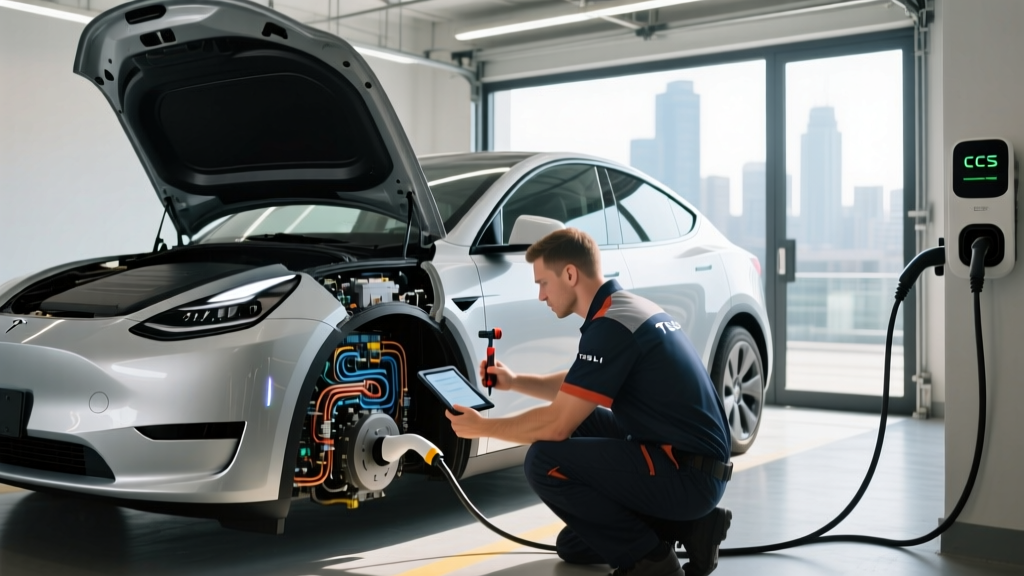
Tesla's official Mobile Service handles roughly 80% of warranty repairs without a service center visit. Independent mobile EV mechanics fill gaps for out-of-warranty work, pre-purchase inspections, and modifications. Here's the reality of what gets fixed in your driveway:
Mobile Service Capabilities
- Software issues: Firmware updates, bug fixes, connectivity troubleshooting
- 12V battery replacement: The auxiliary battery (not the traction pack) fails every 4-6 years
- Tire service: Rotation, replacement, flat repair — EVs wear tires 20-30% faster due to instant torque and heavier weight
- Cabin air filters: HEPA filter swaps take 30 minutes on-site
- Wiper blades and exterior trim: Simple hardware replacements
- Charge port issues: Latch replacements, connector diagnostics
- Door handle mechanisms: Common failure point on pre-2024 Model S/X
What Requires a Service Center
- Traction battery replacement: The high-voltage pack requires a lift, specialized safety protocols, and high-voltage certification
- Drive unit (motor) swaps: Heavy components need hydraulic equipment
- Structural damage: Frame straightening, collision repair
- Heat pump and HVAC compressor: Refrigerant handling requires recovery equipment
- Glass replacement: Panoramic roof and windshield work need calibration tools
Independent mobile EV mechanics often handle brake caliper service, suspension work (control arms, bushings), and aftermarket accessory installation — jobs Tesla's mobile service won't touch but don't require a lift.
Tesla Mobile Service Costs vs. Independent EV Mechanics
Tesla's Mobile Service is free for warranty work. For out-of-warranty repairs, Tesla charges a trip fee (typically $75-125) plus parts and labor at service center rates ($150-200/hour in most markets).
Independent mobile EV mechanics typically charge:
- Diagnostic fee: $100-150
- Hourly labor: $120-180 (varies by region)
- No trip fee if within service radius (usually 30-50 miles)
The economics favor independents for older vehicles outside warranty. A 2018 Model 3 needing a new 12V battery and cabin air filter might cost $400-500 through an independent vs. $550-650 through Tesla (post-warranty). But for warranty work, always use Tesla Mobile Service first — it's free and preserves your service history.
The Vehicles: Model 3 and Model Y Specs That Affect Service Needs
Understanding your Tesla's specs helps you anticipate maintenance. Here's what you're working with:
| Spec | Value |
|---|---|
| EPA Range | 341 miles |
| Battery | 79 kWh usable, NMC (nickel manganese cobalt) |
| DC Fast Charge | 250 kW peak, 10-80% in ~25 min |
| Level 2 Home Charge | 11.5 kW (44 mi/hr) |
| Efficiency | 132 MPGe combined, 25 kWh/100mi |
| 0-60 mph | 4.2 seconds |
| Horsepower | 346 hp (dual motor AWD) |
| Cargo Space | 23 cu ft (rear seats up) |
| Base MSRP | $47,740 (before incentives) |
| Battery Warranty | 8 years / 120,000 miles (70% capacity retention) |
Real-World Range Reality
EPA sticker: 341 miles
Expect in practice: 270-290 miles highway at 75 mph, 310-330 miles mixed city/highway. Cold weather (below 32°F) reduces range 20-30%. The Model 3's heat pump (standard since 2021) minimizes winter loss compared to older resistive heating, but physics still applies.
| Spec | Value |
|---|---|
| EPA Range | 320 miles |
| Battery | 78.1 kWh usable, NMC |
| DC Fast Charge | 250 kW peak, 10-80% in ~27 min |
| Level 2 Home Charge | 11.5 kW (44 mi/hr) |
| Efficiency | 122 MPGe combined, 27 kWh/100mi |
| 0-60 mph | 4.8 seconds |
| Horsepower | 384 hp (dual motor AWD) |
| Cargo Space | 34 cu ft (rear seats up), 76 cu ft (seats folded) |
| Base MSRP | $47,740 (before incentives) |
| Battery Warranty | 8 years / 120,000 miles (70% capacity retention) |
Tesla's Maintenance Schedule: What Mobile Mechanics Actually Service
Tesla officially states EVs require minimal maintenance, but "minimal" isn't "none." Here's what wears out and when:
- Cabin air filter: Every 2 years ($50-80 parts, 30 min labor)
- HEPA filter (if equipped): Every 3 years ($120-150 parts)
- Tire rotation: Every 6,250 miles or when tread depth variance exceeds 2/32" — mobile mechanics handle this easily
- Brake fluid test: Every 2 years (test for contamination, replace if needed)
- A/C desiccant bag: Every 6 years (requires service center)
- 12V battery: Every 4-6 years — the #1 mobile service call for Teslas over 5 years old
- Cabin air intake cleaning: As needed if you notice musty odors
Notably absent: no oil changes, no spark plugs, no transmission fluid (the single-speed reduction gear is sealed for life). Regenerative braking extends pad life to 100,000+ miles in most driving conditions.
Finding a Qualified Tesla Mobile Mechanic
Not all mechanics can safely work on high-voltage EV systems. Tesla's 400V (Model 3/Y) and 800V (Cybertruck, next-gen) architectures require specific training and insulated tools. Here's how to vet an independent mobile EV mechanic:
- High-voltage certification: Ask if they're certified to work on EV systems (ASE L3 Light Duty Hybrid/Electric Vehicle Specialist certification is the baseline)
- Tesla-specific experience: Request references from other Tesla owners. Tesla's proprietary connectors, software, and diagnostic access differ from other EVs
- Insurance: Verify they carry liability insurance covering high-voltage work
- Diagnostic access: Tesla doesn't provide third-party OBD-II scanners with full system access. Independents use workarounds, but complex diagnostics still require Tesla service centers
- Parts sourcing: Tesla restricts OEM parts sales to owners and authorized shops. Independents often use aftermarket or salvaged parts — confirm before work begins
Platforms like YourMechanic and Wrench offer mobile EV service in major metros, but coverage is spotty. Dedicated EV specialist shops with mobile vans (common in California, Texas, Florida, and the Northeast corridor) are often more reliable.
Tax Credits and Ownership Economics: How Service Costs Fit In
Lower maintenance costs are a key EV ownership advantage, but only if you can afford the vehicle upfront. Here's where the 2026 Model 3 and Model Y stand:
| Model | Base MSRP | Federal Credit (§30D) | Effective Price |
|---|---|---|---|
| Model 3 RWD | $38,990 | $3,750 (partial credit) | $35,240 |
| Model 3 Long Range AWD | $47,740 | $3,750 (partial credit) | $43,990 |
| Model Y Long Range AWD | $47,740 | $3,750 (partial credit) | $43,990 |
IRS §30D Tax Credit Rules (2026)
Why partial credit? Tesla's battery components and critical minerals don't fully meet 2026 domestic sourcing requirements, reducing the credit from $7,500 to $3,750. The credit also phases based on:
- Income caps: $150K single / $300K joint modified AGI
- MSRP caps: $55K for sedans (Model 3), $80K for SUVs/trucks (Model Y)
- Point-of-sale transfer: You can apply the credit at purchase rather than waiting for tax filing
Verify current eligibility at IRS.gov — rules change annually.
With lower service costs ($300-500/year vs. $800-1,200 for comparable gas vehicles) and electricity at $0.13/kWh national average (vs. $3.50/gallon gas), total cost of ownership favors Tesla over 5-7 years despite higher insurance premiums (typically 15-25% above gas equivalents).
Pros and Cons: Tesla Ownership with Mobile Service Access
Pros
- 80% of repairs handled at home/office via Mobile Service
- Lower annual maintenance cost vs. gas vehicles
- Superior Supercharger network reliability (99%+ uptime)
- Over-the-air updates add features post-purchase
- Strong resale value (though depreciating faster than 2022 peaks)
Cons
- Service center backlogs: 2-4 weeks in most markets for non-mobile repairs
- Limited third-party parts access forces dependency on Tesla
- Insurance costs 15-25% higher than gas equivalents
- Build quality inconsistencies still reported (panel gaps, trim issues)
- No Apple CarPlay/Android Auto — Tesla's proprietary infotainment only
FAQ: Tesla Mobile Mechanic Questions
Can a mobile mechanic replace my Tesla's main battery?
No. Traction battery replacement requires a service center with a lift, high-voltage safety equipment, and Tesla-certified technicians. The battery pack weighs 1,000+ lbs and operates at 400V — this is not driveway work.
How do I request Tesla Mobile Service?
Use the Tesla app: Service > Request Service > select your issue. The app triages whether mobile service is appropriate and schedules a technician. For warranty work, there's no charge.
Will using an independent mobile mechanic void my warranty?
The Magnuson-Moss Warranty Act prevents Tesla from voiding your warranty simply because you used an independent mechanic. However, if the independent's work causes damage, Tesla won't cover that damage under warranty. Keep detailed records.
How often does a Tesla actually need service?
Beyond tire rotations (every 6,250 miles) and cabin air filters (every 2 years), most Teslas require minimal scheduled service. The most common unplanned repair for vehicles 5+ years old is 12V battery replacement.
Is Tesla Mobile Service available in rural areas?
Coverage varies. Tesla Mobile Service typically serves areas within 50-75 miles of a service center. Rural owners often need to tow to the nearest center for non-mobile repairs, or find an independent mobile EV mechanic willing to travel further (at higher cost).
What's the real-world range of the Model 3 and Model Y?
Model 3 Long Range: EPA 341 miles, expect 270-290 miles highway, 20-30% less in cold weather. Model Y Long Range: EPA 320 miles, expect 250-270 miles highway, similar cold-weather reduction. See the range callout box above for details.
Does the Model 3 or Model Y qualify for the full $7,500 federal tax credit?
As of 2026, both qualify for a partial $3,750 credit due to battery sourcing rules. Full eligibility depends on your income (under $150K single / $300K joint) and the vehicle's MSRP (under $55K sedan / $80K SUV cap). Check IRS.gov for current rules.
Final Take: When Mobile Service Makes Sense
Tesla's mobile mechanic model works well for routine maintenance and minor repairs, saving you service center time. For major high-voltage work, you'll still need a service center — and the 2-4 week wait times remain a pain point.
If you're considering a Tesla, factor in service accessibility: Do you live within 50 miles of a service center? Is there a qualified independent mobile EV mechanic in your area? These questions matter as much as range and charging speed when choosing an EV.
For current Tesla owners, the takeaway is clear: use Tesla Mobile Service for warranty work, build a relationship with a qualified independent for out-of-warranty needs, and budget $300-500 annually for maintenance — far less than your last gas car, but not zero.