The Tesla Minivan Question: What Buyers Actually Want
Type "Tesla minivan" into any search bar and you'll find thousands of hopeful buyers looking for a three-row, sliding-door family hauler from the EV giant. As of 2026, Tesla does not produce a dedicated minivan — no Model V, no Robovan, no sliding-door people-mover exists in their lineup or on any announced production timeline. But the search volume tells us something important: families want a Tesla that does minivan duty.
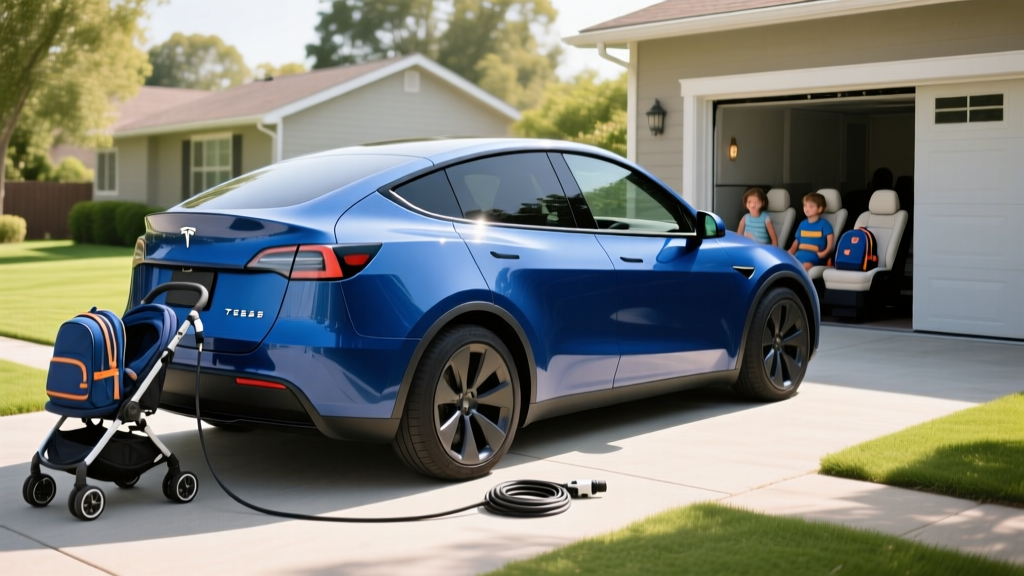
The closest vehicle Tesla offers to fill that role is the 2026 Model Y Long Range AWD with the optional third row, which seats seven in a compact crossover body. It's not a minivan in the traditional sense — no Honda Odyssey or Toyota Sienna competitor — but for many EV-curious families, it's the vehicle they're actually cross-shopping. This review evaluates whether the 7-seat Model Y can genuinely serve as a Tesla minivan substitute, with the exact range, charging, cargo, and pricing data you need to decide.
2026 Model Y Long Range AWD: Core Specifications
| Specification | 2026 Model Y Long Range AWD (7-Seat) |
|---|---|
| EPA Estimated Range | 303 miles |
| Battery Capacity (Usable) | ~75 kWh, NMC chemistry |
| Drivetrain | Dual-Motor All-Wheel Drive |
| Horsepower | 384 hp (combined) |
| 0–60 mph | 4.8 seconds |
| MPGe (Combined) | 122 MPGe |
| Efficiency | 28 kWh/100 mi |
| Max DC Fast Charge | 250 kW (peak) |
| 10–80% DC Fast Charge | ~25 minutes |
| Level 2 Home Charge Rate | 11.5 kW (~44 mi/hr) |
| Seating Capacity | 7 (2+3+2 configuration) |
| Cargo (Behind 3rd Row) | 12.4 cu ft |
| Cargo (3rd Row Folded) | 34.3 cu ft |
| Cargo (All Rear Rows Folded) | 72.1 cu ft |
| 3rd-Row Legroom | 26.5 inches |
| Battery Warranty | 8 years / 120,000 miles |
| Base MSRP | $49,990 |
| As-Tested (w/ 3rd Row + FSD) | $58,490 |
Sources: EPA Fueleconomy.gov, Tesla Model Y Design Studio
Real-World Range: What the EPA Sticker Doesn't Tell You
EPA Estimated: 303 miles
Real-World Highway (70 mph, mild weather): ~260–275 miles
Real-World Cold Weather (below 32°F, mixed driving): ~210–240 miles
Real-World City/Commuter (regen-heavy): ~290–310 miles
The 303-mile EPA figure is achievable under moderate conditions — suburban driving at 45–55 mph in 60–75°F weather with regenerative braking doing heavy lifting. Tesla's NMC battery pack delivers strong efficiency at 28 kWh per 100 miles, among the best in the midsize electric crossover segment.
However, families planning road trips should plan around 260 miles of usable highway range. At sustained 70–75 mph speeds, aerodynamic drag cuts efficiency by roughly 12–15%. In cold weather, the picture tightens further: battery preconditioning and cabin heating can reduce range by 20–30%, depending on whether your Model Y is equipped with Tesla's heat pump (standard on 2026 Long Range models, which helps significantly versus older resistive heaters).
For daily minivan-duty use — school runs, grocery trips, commuting — the 303-mile range means most families will charge at home every three to four days and rarely think about range. The gap between EPA and real-world matters primarily on road trips, where you'll be stopping at Superchargers roughly every 200–230 miles in practice.
Charging Speed: Home and DC Fast Charging Breakdown
| Charging Level | Power (kW) | Speed (mi/hr added) | Use Case |
|---|---|---|---|
| Level 1 (120V Standard Outlet) | ~1.4 kW | ~5 mi/hr | Emergency / overnight trickle |
| Level 2 (240V, 48A Wall Connector) | 11.5 kW | ~44 mi/hr | Daily home charging |
| DC Fast Charge (Tesla Supercharger V3) | 250 kW peak | Up to ~1,000 mi/hr (at peak) | Road trips |
| DC Fast Charge (CCS adapter at EA/others) | ~150–250 kW peak | Varies by station | Non-Tesla network backup |
The Model Y Long Range's 250 kW peak DC fast-charge rate is competitive but not class-leading — vehicles on 800V architectures (Hyundai Ioniq 5, Kia EV9) can sustain higher charge rates longer. The critical nuance is Tesla's charge curve: the Model Y peaks near 250 kW only between roughly 10–25% State of Charge (SoC), then tapers progressively. From 50–80%, expect sustained rates closer to 80–120 kW. This is why the 10–80% time is approximately 25 minutes rather than the ~18 minutes you'd calculate from peak rate alone.
For home charging, the Tesla Wall Connector at 48 amps on a 60-amp circuit delivers 11.5 kW, adding roughly 44 miles of range per hour of charging. A full overnight charge (8 hours) replenishes about 350 miles — more than enough for any daily minivan duty cycle. Installation typically runs $800–$2,000 depending on your electrical panel's capacity and distance from the panel to your parking spot; homes needing a 200-amp panel upgrade should budget an additional $1,500–$3,000.
One genuine Tesla advantage: Supercharger network access requires no adapters, no third-party apps, and no payment fumbling. You plug in and walk away. For families using this as a road-trip vehicle, that frictionless experience matters on trips with restless children in the back rows.
Interior, Cargo, and the Third-Row Reality
Here's where the "Tesla minivan" concept hits its hardest constraint. The Model Y's optional third row is best understood as occasional-use seating, not a true family-hauler third row.
Third-row legroom is 26.5 inches — that's roughly 6 inches less than a Honda Odyssey's third row and makes the space suitable only for children under about 5'4" or short trips. Adults in the third row will be uncomfortable beyond 20 minutes. The second row offers 40.9 inches of legroom, which is adequate for car seats and older children.
Cargo space tells a similar story: 12.4 cubic feet behind the third row is enough for two or three grocery bags or a small stroller, but not both simultaneously. Fold the third row and you get 34.3 cubic feet — a reasonable cargo area for a family of five. Fold everything and 72.1 cubic feet is respectable but falls well short of a traditional minivan's 140+ cubic feet.
What the Model Y lacks in raw space, it partially offsets with its front trunk (frunk), which adds roughly 4.1 cubic feet of secure, weatherproof storage — useful for charging cables, a small cooler, or items you want separated from the main cabin.
For families who genuinely need to carry six or seven people regularly with cargo, the Model Y is a compromise. For families who need a third row two or three times a month — for carpool duty, visiting grandparents, or an extra child's birthday party — it works.
Pricing, Tax Credits, and Total Cost
| Cost Factor | Amount |
|---|---|
| Base MSRP (Long Range AWD) | $49,990 |
| Third-Row Seat Option | $2,500 |
| FSD (Supervised) Add-On | $6,000 |
| As-Tested Price | $58,490 |
| Federal §30D Tax Credit (if eligible) | Up to $7,500 |
| Estimated Price After Max Credit | ~$50,990 |
| Est. 5-Year Fuel Cost (Electricity) | ~$3,200 |
| Est. 5-Year Fuel Cost (Gas Minivan, 22 MPG) | ~$9,800 |
Federal tax credit eligibility under IRS §30D is where things get complicated for 2026 buyers. The Model Y Long Range AWD qualifies for the full $7,500 credit only if all of the following apply:
- MSRP Cap: The vehicle's MSRP must not exceed $80,000 for SUVs — the Model Y clears this easily.
- Buyer Income Cap: Modified adjusted gross income must be ≤ $150,000 (single), $225,000 (head of household), or $300,000 (joint filers).
- Battery Sourcing: Critical minerals and battery components must meet phased-in domestic content requirements that tighten annually. Tesla's supply chain has largely adapted, but always verify the specific VIN's eligibility at purchase.
- Point-of-Sale Transfer: As of 2024, you can transfer the credit to the dealer at purchase, reducing your out-of-pocket cost directly rather than waiting for a tax refund.
The ownership economics are strong for families who drive 12,000+ miles annually and charge at home. At the national average electricity rate of ~$0.16/kWh and the Model Y's 28 kWh/100 mi efficiency, fuel costs run approximately $640 per year versus roughly $1,960 per year for a gas minivan averaging 22 MPG combined at $3.60/gallon. Over five years, that's a $6,600 fuel savings — meaningful, though it doesn't fully offset the Model Y's higher purchase price versus a used Sienna or Odyssey.
Tech, Driver Assistance, and What It Can't Do
The 2026 Model Y comes standard with Tesla's 15.4-inch center touchscreen, which handles navigation, media, climate, and vehicle settings. There is no instrument cluster — all information routes through the central display. This works well for most drivers but remains a dealbreaker for some who prefer a dedicated speedometer in their sight line.
Autopilot comes standard and includes adaptive cruise control, lane-keeping assist, and automatic emergency braking. Full Self-Driving (Supervised) — the $6,000 upgrade — adds automatic lane changes, Navigate on Autopilot (highway on/off-ramp capability), and city-street traffic-light recognition.
Both Autopilot and FSD (Supervised) are SAE Level 2 driver-assistance systems. The driver must remain fully attentive, keep hands on the wheel, and be prepared to take over at any moment. These systems are not autonomous and do not replace an engaged driver. Only Level 4 services like Waymo operate without a human driver in defined areas.
For family road trips, Autopilot reduces highway fatigue significantly — it handles stop-and-go traffic and long interstate stretches competently. But parents should not plan to turn around and tend to children while the system is active. Tesla's cabin camera monitors driver attention and will issue escalating warnings if you look away.
Notable tech drawbacks: the Model Y still lacks Apple CarPlay and Android Auto (Tesla uses its own interface exclusively), there's no head-up display, and rear-seat entertainment is limited to the single center screen visible from the second row (no dedicated rear screens as you'd find in a Pacifica or Odyssey).
Pros and Cons: The Honest Scorecard
- 303-mile EPA range covers most family needs
- Supercharger network: reliable, fast, no adapter needed
- 4.8-second 0–60 mph — quickest vehicle in any "minivan" conversation
- Dual-motor AWD handles snow and rain confidently
- Heat pump standard — strong cold-weather efficiency
- Over-the-air updates add features post-purchase
- Low running costs vs. gas minivans
- Third row fits children only — 26.5" legroom
- 12.4 cu ft cargo behind 3rd row is very limited
- No sliding doors (critical minivan feature)
- No Apple CarPlay / Android Auto
- 250 kW peak charge rate trails 800V competitors
- No dedicated rear-seat entertainment screens
- FSD is expensive and still requires full driver attention
- Higher insurance premiums than gas minivans
Who Should (and Shouldn't) Consider the Model Y as a Minivan
Choose the Model Y 7-seat if:
- You need a third row occasionally, not daily
- Your household has home charging access (garage or driveway with 240V)
- You value performance and technology alongside family utility
- You take 2–4 road trips per year and want Supercharger convenience
- Your family size is 5 or fewer on most days
Look elsewhere (Kia EV9, gas/hybrid minivan) if:
- You regularly carry 6–7 passengers including adults
- You need sliding doors for tight parking lots and young children
- You regularly haul large cargo with all seats in use
- You lack reliable home charging access
- You prefer Apple CarPlay or dedicated rear-seat screens
Frequently Asked Questions
Is Tesla making a real minivan?
As of early 2026, Tesla has not announced a dedicated minivan. The "Tesla Robovan" concept was teased during the 2024 Robotaxi event, but no production timeline, pricing, or specifications have been confirmed. The Model Y 7-seat remains Tesla's only vehicle that approaches minivan functionality.
Does the 7-seat Model Y qualify for the $7,500 federal tax credit?
It can, subject to IRS §30D rules. The MSRP is well under the $80,000 SUV cap. Eligibility depends on your household income (≤$300,000 joint), the battery's critical-mineral and component sourcing at time of manufacture, and taking delivery within the current tax year. Always verify VIN-level eligibility with your Tesla advisor and a tax professional before purchase.
How does the Model Y 7-seat compare to the Kia EV9 for family use?
The Kia EV9 is a genuinely larger three-row electric SUV with 379 miles of EPA range (Long Range RWD), usable third-row space for adults, and an 800V architecture that charges faster (10–80% in ~20 minutes at 350 kW). It's a stronger family hauler, though it costs more ($54,900+ base) and lacks Tesla's Supercharger ecosystem. For pure family utility, the EV9 wins. For software, performance, and charging-network convenience, the Model Y holds an edge.
What is the real cost to charge the Model Y at home?
At the US average residential rate of ~$0.16/kWh and the Model Y's 75 kWh usable battery, a full 0–100% charge costs approximately $12.00. For a typical 60 kWh refill (80% of the battery), expect about $9.60. Over a year of 12,000 miles of driving, home charging costs roughly $540–$640 depending on local rates.
Is the Model Y safe for families?
The Model Y earned a 5-Star Overall Safety Rating from NHTSA and a Top Safety Pick+ designation from IIHS. Standard active-safety features include automatic emergency braking, blind-spot monitoring, and lane-departure warning. For a family vehicle, it's among the safest options available in any powertrain category.
Can the Model Y tow?
Yes. The 2026 Model Y Long Range AWD has a 3,500-pound towing capacity when equipped with the factory tow package ($1,000). That's sufficient for a small utility trailer, a pair of dirt bikes, or a lightweight camper — but well below the 5,000+ pound capacity of a traditional minivan or midsize SUV. Towing also reduces range by approximately 30–40% at highway speeds.