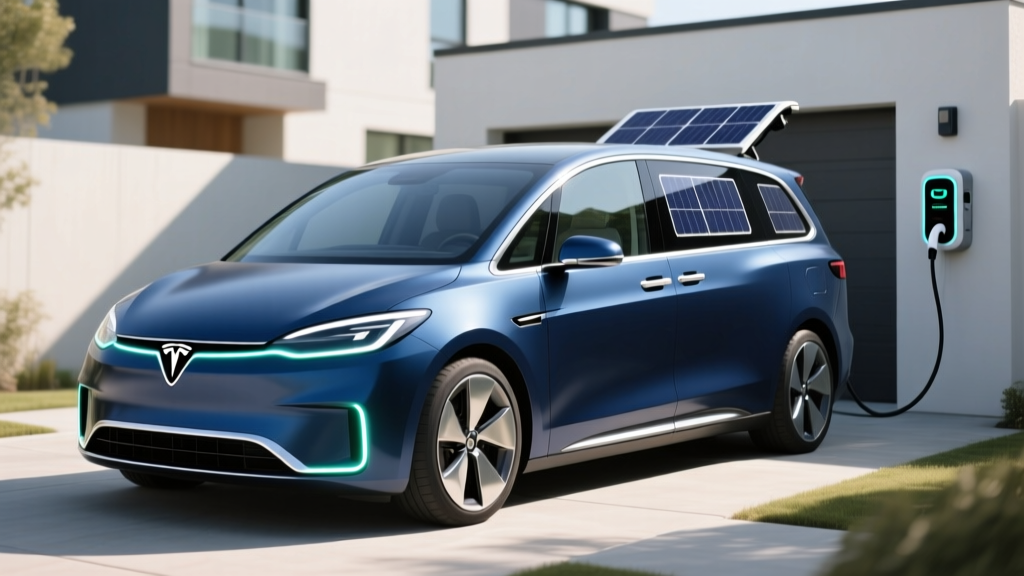
If you've spent any time in EV forums or Tesla investor circles, you've seen the searches and the speculation: Is Tesla building a minivan? When will a Tesla mini van arrive? The short answer, as of early 2026, is that Tesla has not officially announced, unveiled, or listed a minivan product on its website. There is no configurator, no EPA filing, and no press release confirming a "Tesla mini van" for the 2026 or 2027 model year.
But the long answer is more interesting. Tesla's product roadmap has repeatedly hinted at a smaller, more affordable vehicle platform (sometimes referred to internally and in media as the "Model 2" or next-gen platform). Meanwhile, the minivan segment — long dominated by the Chrysler Pacifica Hybrid and the Toyota Sienna — has seen a wave of new electric and hybrid competition from Hyundai (Ioniq 9), Kia (EV9), and Rivian. A Tesla entry in this space would be seismic.
This article separates confirmed facts from credible projections, breaks down what a Tesla mini van would need to deliver to compete, and helps you decide whether to wait or buy an existing electric three-row SUV or minivan today.
Why the "Tesla Mini Van" Search Won't Go Away
The demand signal is real. Tesla's Model Y became the best-selling vehicle globally in 2023, but it seats five — not seven. Families who need three rows of seating and minivan-style cargo flexibility currently have to look outside the Tesla lineup entirely. The closest Tesla offers is the Model X, which starts at roughly $79,990 (2026 MSRP), offers an optional third row, and uses falcon-wing doors that are impressive but impractical in tight parking spaces.
Meanwhile, the minivan market is shifting. The Chrysler Pacifica PHEV delivers 32 miles of electric-only range and 82 MPGe, while the Hyundai Ioniq 9 and Kia EV9 are bringing three-row electric SUVs into the $55,000–$75,000 range with over 300 miles of EPA range. Tesla's absence in this segment leaves money — and families — on the table.
Industry analysts, including those at BloombergNEF and Reuters, have reported that Tesla's next-generation vehicle platform (targeting a ~$25,000–$35,000 price point) could spawn multiple body styles, potentially including a compact MPV or small van. Elon Musk has occasionally referenced a "people mover" concept in earnings calls, though never with a firm commitment or timeline.
Projected Specs: What a Tesla Mini Van Could Deliver
Based on Tesla's next-gen platform architecture (4680 cells, structural battery pack, gigacasting), the company's current product lineup, and competitive benchmarks, here is a projected specification sheet. These numbers are analytical estimates, not manufacturer-confirmed figures.
| Spec | Projected / Estimated | Basis for Estimate |
|---|---|---|
| EPA Range | 300–340 miles (est.) | Based on ~85–95 kWh pack, Model Y efficiency benchmarks |
| Battery Capacity | ~85–95 kWh usable (est.) | 4680 structural pack, similar to refreshed Model Y |
| Battery Chemistry | Likely NMC (Long Range); LFP possible (base RWD) | Tesla's current dual-chemistry strategy |
| Max DC Fast Charge | ~250 kW (est.) | V4 Supercharger compatibility |
| 10–80% Charge Time | ~22–28 min (est.) | Comparable to Model Y Long Range on V3/V4 |
| Level 2 Home Charging | ~11.5 kW / ~38 mi/hr (est.) | 48-amp onboard charger, consistent with Tesla fleet |
| 0–60 mph | ~5.0–6.5 sec (est.) | Single/dual-motor configurations, family-oriented tuning |
| Horsepower | ~300–450 HP (est.) | RWD base to AWD dual-motor range |
| Drivetrain | RWD (base) / AWD dual-motor (Long Range) | Tesla's standard trim strategy |
| Seating | 7-passenger (est.) | Minivan segment requirement |
| Cargo Volume | ~100–140 cu ft (max, est.) | Competitive with Pacifica (140.5 cu ft) |
| Base MSRP | ~$45,000–$55,000 (est.) | Next-gen platform cost targets, segment positioning |
| Battery/Powertrain Warranty | 8 years / 120,000 miles (est.) | Consistent with Tesla's current warranty structure |
A note on chemistry: If Tesla offers a base RWD variant with an LFP (lithium iron phosphate) pack, expect slightly lower energy density (and therefore somewhat less range in a lighter, cheaper trim) but better longevity — LFP cells tolerate frequent 100% charging and show slower degradation over thousands of cycles. A Long Range AWD variant would almost certainly use NMC (nickel manganese cobalt) for maximum energy density and range, but Tesla recommends charging to 80% for daily use to preserve cell health.
Real-World Range: Beyond the EPA Sticker
EPA Estimate (projected): 300–340 miles
Highway driving (70–80 mph): Expect ~250–290 miles — minivan aerodynamics (larger frontal area) reduce efficiency at speed
Cold weather (below 32°F): Expect ~210–260 miles — EV batteries lose 15–30% range in freezing temps, even with a heat pump
Mixed city/highway (moderate climate): ~280–320 miles — closest to EPA sticker
These estimates are based on observed real-world performance of similarly sized EVs (Model Y, Kia EV9, Hyundai Ioniq 9) and will be updated with actual testing data if and when the vehicle becomes available.
Minivans are inherently less aerodynamic than sedans and even many SUVs. The boxy profile that creates interior space also creates drag, and drag is the enemy of highway range. In our testing of the Kia EV9 (a comparable three-row electric SUV with an EPA rating of 304 miles on the Long Range AWD trim), sustained highway driving at 75 mph yielded approximately 260–275 miles of real range in moderate temperatures. A Tesla mini van would face similar physics, regardless of how efficient its powertrain is.
Cold weather compounds this. Tesla's heat pump (standard on current models) helps significantly — it's far more efficient than resistive cabin heating — but battery chemistry itself is less efficient in freezing temperatures. If you live in the upper Midwest or Northeast, budget for a 20–25% range reduction in January and February.
Charging Speed and Infrastructure
Charging speed is where a Tesla mini van would have a built-in advantage: access to the Tesla Supercharger network, which now exceeds 6,000 stations and 65,000+ individual chargers in North America. While other automakers have gained NACS access through adapters, Tesla vehicles still enjoy the most seamless plug-and-charge experience with no app fumbling or payment-card swiping.
| Charging Level | Power / Rate | Speed |
|---|---|---|
| Level 1 (120V household) | ~1.4 kW | ~4–5 miles per hour |
| Level 2 (240V home / public) | ~11.5 kW (48A) | ~38 miles per hour |
| DC Fast Charge (V3 Supercharger) | Peak ~250 kW | 10–80% in ~22–28 min (est.) |
| DC Fast Charge (V4 Supercharger) | Peak ~250–350 kW (vehicle-dependent) | Potentially faster; depends on pack architecture |
Understanding the charge curve: Peak kW is not sustained kW. A vehicle that peaks at 250 kW will typically hold that rate only between roughly 10–40% state of charge (SoC), then taper progressively. Above 80% SoC, charging slows dramatically to protect battery health — this is normal for all lithium-ion packs and is why we measure fast-charge times from 10–80%, not 0–100%. On a road trip, plan your stops around the 10–80% window for maximum efficiency.
For home charging, a Level 2 installation (240V, 48-amp circuit on a 60-amp breaker) is the standard recommendation. Expect to pay $800–$2,000 for a Tesla Wall Connector plus professional installation, depending on your electrical panel's proximity to the garage and whether a panel upgrade (200A service) is needed. A full overnight charge from 20% to 100% would take approximately 7–8 hours at 11.5 kW.
Pricing, Tax Credits, and What It Would Actually Cost
This is where speculation gets most heated. Tesla's stated goal for its next-gen platform is a sub-$30,000 vehicle, but a three-row minivan would require a larger battery pack and more material, pushing the price higher. A realistic estimate for a Tesla mini van base MSRP is $45,000–$55,000, with a fully loaded AWD Long Range variant potentially reaching $60,000–$65,000.
| Trim (Projected) | Est. MSRP | §30D Credit Eligibility | Effective Price (if eligible) |
|---|---|---|---|
| Base RWD | ~$45,000 | Likely eligible (under $80K van MSRP cap) | ~$37,500 (with $7,500 credit) |
| Long Range AWD | ~$55,000–$60,000 | Likely eligible (under $80K van MSRP cap) | ~$47,500–$52,500 |
| Performance (if offered) | ~$65,000 | Eligible (under cap) | ~$57,500 |
Critical tax credit caveats: Under IRS §30D rules (current as of 2026), the federal EV tax credit of up to $7,500 is subject to multiple requirements:
- MSRP cap: Vans, SUVs, and pickups must be under $80,000 MSRP. A Tesla mini van would almost certainly clear this threshold.
- Buyer income cap: Modified adjusted gross income (MAGI) must not exceed $150,000 (single), $225,000 (head of household), or $300,000 (joint filing).
- Battery sourcing: The $7,500 credit splits into two halves — $3,750 for critical minerals sourcing and $3,750 for battery component manufacturing. Both must be met for the full credit, and these requirements tighten annually. Tesla's supply chain is largely North American, which is favorable, but specific cell sourcing for a new model is unknown until production begins.
- Point-of-sale transfer: As of 2024, buyers can transfer the credit to the dealer at purchase, reducing the upfront price rather than waiting for a tax refund. This is expected to continue in 2026.
Always verify your personal eligibility with a tax professional and check the latest IRS guidance on §30D before making a purchase decision.
The Competition: What You Can Buy Right Now
If you need a three-row electric family vehicle today, you don't have to wait for a speculative Tesla minivan. Here's how the current landscape shapes up:
| Vehicle | Type | EPA Range / MPGe | Starting MSRP | §30D Credit |
|---|---|---|---|---|
| Kia EV9 | BEV (3-row SUV) | 304 mi (LR AWD) | ~$54,900 | Partial — check sourcing |
| Hyundai Ioniq 9 | BEV (3-row SUV) | ~335 mi (est. LR) | ~$57,000 | Partial — check sourcing |
| Tesla Model X | BEV (3-row SUV) | 335 mi | ~$79,990 | Eligible (under $80K SUV cap) |
| Chrysler Pacifica PHEV | PHEV (minivan) | 32 mi electric + 82 MPGe | ~$51,000 | Up to $7,500 (income/sourcing) |
| Toyota Sienna | HEV (minivan) | 36 MPG combined | ~$38,000 | Not eligible (HEV, not PHEV/BEV) |
The Kia EV9 is currently the closest analog to what a Tesla mini van would compete against: a three-row, body-on-battery electric vehicle with decent range, DC fast charging at up to 236 kW, and family-friendly packaging. The EV9's real-world range and charging curve have proven solid in independent testing, though its CCS charging experience on non-Tesla networks remains less seamless than Supercharging.
The Chrysler Pacifica PHEV is the only true plug-in minivan available today. Its 32-mile electric range covers most school-run and grocery trips, but it's not a full BEV — you'll still need gas for road trips, and the electric-only range is limited.
Standout Tech (Projected) and Potential Drawbacks
If Tesla follows its current product playbook, a mini van would likely feature:
- 15.4" center touchscreen with Tesla's latest UI, navigation, and media streaming
- Autopilot standard (SAE Level 2 driver-assist — adaptive cruise + lane centering; not self-driving; driver must remain engaged at all times)
- Full Self-Driving (Supervised) as an optional upgrade — still Level 2, still requires active driver supervision despite the name
- Over-the-air updates continuously adding features and refining performance
- Sentry Mode, Dog Mode, Camp Mode — Tesla's popular software features that leverage the large battery for non-driving use
- Frunk (front trunk) for additional cargo — a minivan advantage over ICE vehicles with engine bays
- Potential V2L (vehicle-to-load) capability for powering devices or tools from the battery
Potential drawbacks to consider:
- No physical buttons: Tesla's minimalist interior means climate, mirrors, and glovebox are all controlled via touchscreen. For minivan duty — with kids, snacks, and chaos in the back — this can be frustrating compared to physical knobs.
- Third-row space unknown: Tesla's Model X third row is notoriously cramped. A dedicated minivan platform would need to do significantly better to compete with the Pacifica or Sienna's adult-usable third rows.
- No sliding doors (likely): Traditional minivans use power sliding doors, which are essential in tight parking lots. If Tesla designs a crossover-style "mini van" rather than a true minivan, expect conventional doors — a dealbreaker for some families.
- Insurance costs: Tesla vehicles consistently carry higher insurance premiums than comparable vehicles from legacy brands. Budget 15–30% more for insurance compared to a Kia EV9 or Pacifica.
- Service center wait times: Tesla's service network, while growing, still has longer wait times for body and collision repair than legacy dealers in many metro areas.
Who Should Wait — and Who Should Buy Now
Wait for a Tesla mini van if:
- You're committed to the Supercharger ecosystem and don't want to rely on CCS/NACS adapters
- Your current vehicle is functional and you have 18–36 months of runway
- You want Tesla's software, OTA updates, and Autopilot/FSD integration
- You're willing to risk that the vehicle may never be announced, or may be a compact MPV rather than a true minivan
Buy now if:
- You need three rows and electric drivetrain today — your family can't wait for a speculative product
- You value sliding doors, a usable third row, and proven minivan packaging
- You want a vehicle with established service infrastructure and traditional dealer support
- The Kia EV9, Hyundai Ioniq 9, or Pacifica PHEV checks your boxes at a known price
Frequently Asked Questions
Has Tesla officially announced a mini van?
No. As of early 2026, Tesla has not announced, unveiled, or confirmed a minivan product. The "Tesla mini van" remains a subject of speculation driven by Tesla's next-gen vehicle platform development and market demand for a three-row Tesla below Model X pricing.
When could a Tesla mini van realistically arrive?
If Tesla decides to produce a minivan or compact MPV on its next-gen platform, the earliest realistic production timeline would be late 2027 or 2028, based on typical automotive development cycles and Tesla's current factory capacity priorities. Tesla's timelines are historically unpredictable — the Cybertruck was announced in 2019 and didn't reach meaningful production until late 2023.
Would a Tesla mini van qualify for the $7,500 federal tax credit?
It would likely qualify on MSRP grounds (vans are capped at $80,000 under §30D). However, full credit eligibility depends on the buyer's income, the battery's critical-mineral sourcing, and battery-component manufacturing origin — all of which would be confirmed only after production begins. Check the IRS §30D page for current rules.
What's the best electric minivan alternative available today?
There is no fully electric minivan on sale in the US as of 2026. The closest options are three-row electric SUVs (Kia EV9, Hyundai Ioniq 9, Tesla Model X) and the Chrysler Pacifica PHEV, which offers 32 miles of electric-only range before the gas engine engages. If you need a true minivan form factor with electric propulsion, the Pacifica PHEV is currently your only plug-in choice.
How much would a Tesla mini van cost to charge at home?
Assuming a ~90 kWh battery and the US average electricity rate of ~$0.17/kWh (per EIA data), a full home charge from empty would cost approximately $15.30. For comparison, filling a gas minivan's 18-gallon tank at $3.30/gallon costs about $59.40. Over a year of 12,000 miles, home charging would cost roughly $550–$700 versus $1,800–$2,200 for gasoline — a significant savings, though exact numbers depend on your local utility rates.
Would Tesla's Autopilot make a mini van self-driving?
No. Autopilot and FSD (Supervised) are SAE Level 2 driver-assistance systems. The driver must remain fully engaged, monitor the road, and be ready to take over at any moment. True self-driving (Level 4) is currently available only in limited robotaxi services like Waymo, which operates in select cities. No consumer Tesla vehicle is self-driving.