Active-duty service members, veterans, and military families shopping for an electric vehicle often search for a Tesla military program or dedicated armed-forces discount. Unlike traditional automakers that participate in programs like GM's Military Discount or Ford's A-Plan/Z-Plan pricing, Tesla's approach to military incentives is unconventional — and frequently misunderstood. This guide breaks down exactly what benefits exist for military EV buyers in 2026, which Tesla models make the most sense for service life, and how to stack federal tax credits with available savings.
Does Tesla Offer a Military Discount in 2026?
The short answer: Tesla does not operate a formal, standalone military discount program the way legacy automakers do. There is no "military pricing tier" you can select at checkout on Tesla's website, and no verification through ID.me or a base PX that unlocks a reduced MSRP.
However, military buyers do have access to several tangible benefits when purchasing a Tesla:
- Referral credits: Tesla's referral program periodically offers both the referrer and the new buyer credits (often $500–$1,000 toward the purchase or Supercharging). Military community referral chains on bases and forums like MilitaryFactory or r/MilitaryFinance are active sources.
- Inventory/loaner vehicle discounts: Tesla periodically marks down demo, loaner, and inventory vehicles by $1,000–$5,000+. These appear on Tesla's inventory page and are first-come, first-served — no military verification required, but service members who monitor frequently can capture significant savings.
- Employer/affinity partnerships: Some military-affiliated employers and credit unions (e.g., Navy Federal Credit Union, USAA) have partnered with Tesla or offered member-only incentives. These rotate and should be verified directly with the institution.
- IRS §30D Federal Tax Credit: The $7,500 federal EV tax credit (detailed below) is available to all qualifying buyers, including military, and can now be transferred at point of sale as an instant price reduction.
Best Tesla Models for Military Buyers: Specs at a Glance
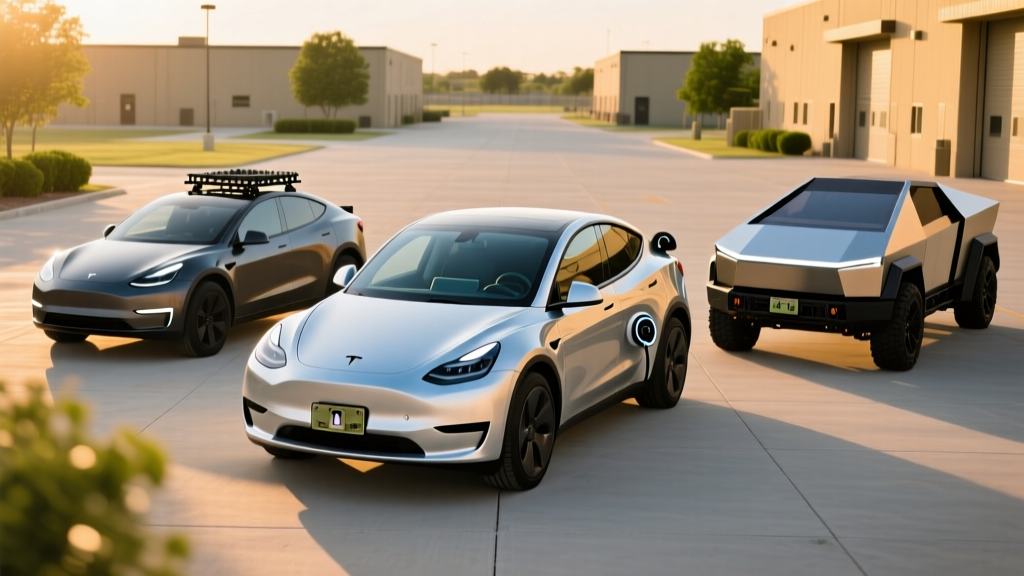
Military life demands versatility: PCS moves, long drives between bases, family hauling, and sometimes towing. Here's how the 2026 Tesla lineup stacks up across the specs that matter most.
| Spec | Model 3 LR AWD | Model Y LR AWD | Model X LR | Cybertruck AWD |
|---|---|---|---|---|
| EPA Range | 341 mi | 320 mi | 335 mi | 340 mi |
| Battery (kWh, usable) | ~79 kWh (NMC) | ~79 kWh (NMC) | ~100 kWh (NMC) | ~123 kWh (NMC) |
| Peak DC Fast Charge | 250 kW | 250 kW | 250 kW | 250+ kW |
| 10–80% DCFC Time | ~27 min | ~27 min | ~32 min | ~30 min |
| Level 2 Home Rate | 11.5 kW (~44 mi/hr) | 11.5 kW (~44 mi/hr) | 11.5 kW (~36 mi/hr) | 11.5 kW (~34 mi/hr) |
| 0–60 mph | 4.2 sec | 4.8 sec | 3.8 sec | 3.9 sec |
| Horsepower | 346 hp | 384 hp | 670 hp | 600 hp |
| Drivetrain | Dual Motor AWD | Dual Motor AWD | Dual Motor AWD | Dual Motor AWD |
| MPGe (combined) | 131 MPGe | 122 MPGe | 102 MPGe | 76 MPGe |
| Cargo Volume | 23 cu ft | 76 cu ft (rear seats folded) | 88 cu ft (rear seats folded) | ~121 cu ft (vault + frunk) |
| Base MSRP | $47,740 | $49,990 | $79,990 | $79,990 |
| Battery Warranty | 8 yr / 120,000 mi | 8 yr / 120,000 mi | 8 yr / 150,000 mi | 8 yr / 120,000 mi |
Real-World Range: What the EPA Sticker Doesn't Tell You
EPA estimates: Model 3 LR — 341 mi | Model Y LR — 320 mi | Model X — 335 mi | Cybertruck — 340 mi
Expect in practice: Highway driving at 75+ mph typically reduces range 10–15% below EPA. Cold weather (below 30°F) can reduce range 20–30% due to battery conditioning and cabin heating. A Model Y LR AWD rated at 320 mi EPA should realistically deliver ~260–280 mi on a highway road trip in moderate weather, and ~210–240 mi in freezing conditions.
Tesla's battery thermal management system is among the best in the industry — it preconditions the battery during navigation to a Supercharger, which preserves range and enables faster charging upon arrival. But physics is physics: the Model Y's ~79 kWh usable battery (NMC chemistry) will consume more energy at highway speeds and in cold weather than the EPA city-heavy test cycle suggests.
For military buyers stationed in cold-climate bases (Fort Drum, Elmendorf, Minot AFB), plan for 20–30% winter range loss. The Model 3 and Model Y both offer heat pump HVAC systems, which significantly reduce cabin-heating energy draw compared to resistive heaters — a meaningful advantage for northern postings.
Charging Speed: Supercharger Network & Home Setup
Charging speed is where Tesla maintains its strongest competitive advantage. The Supercharger network — now open to other EV brands via NACS adapters — remains the most reliable and extensive DC fast-charging network in North America, with over 25,000 stalls globally and growing.
| Charging Level | Power | Miles Added per Hour | Use Case |
|---|---|---|---|
| Level 1 (120V standard outlet) | ~1.4 kW | ~3–5 mi/hr | Overnight trickle; emergency top-up |
| Level 2 (240V home Wall Connector) | 11.5 kW | ~34–44 mi/hr | Daily home charging; full charge overnight |
| DC Fast Charge (V3 Supercharger) | Up to 250 kW | ~1,000+ mi/hr (peak) | Road trips; 10–80% in ~27 min (Model 3/Y) |
| DC Fast Charge (V4 Supercharger) | Up to 350 kW (future-capable) | Varies by vehicle | Newer stalls; current Tesla vehicles limited to ~250 kW peak |
Important kW vs kWh distinction: kW (kilowatts) measures charging power — how fast energy flows into the battery. kWh (kilowatt-hours) measures battery capacity — how much energy the battery stores. A 250 kW Supercharger doesn't deliver 250 kWh; it delivers energy at a rate of up to 250 kW, tapering as the battery fills (the charge curve). This is why 10–80% takes ~27 minutes but 80–100% can take nearly as long.
For military families living on-base or in base housing, Level 2 home charging installation depends on your housing situation. Privatized military housing (Linq, Balfour Beatty, Lendlease) varies widely in EV-readiness. Some installations now offer EV charging in parking areas; others require you to coordinate with the housing office for a 240V outlet. Budget $500–$2,500 for a licensed electrician to install a NEMA 14-50 outlet or hardwired Tesla Wall Connector, plus potential panel upgrade costs ($1,500–$3,000 if your panel is 100A and needs upgrading to 200A).
Pricing, Trims & Federal Tax Credit Eligibility
Here's what the 2026 Tesla lineup costs and how the IRS §30D Federal Clean Vehicle Credit applies. The credit is now available as a point-of-sale transfer, meaning the dealer (Tesla) reduces your purchase price by the credit amount at delivery — you don't have to wait until tax filing.
| Model | Base MSRP | As-Tested (typical config) | §30D Credit Eligible? | Effective Price (after max credit) |
|---|---|---|---|---|
| Model 3 RWD | $40,240 | $42,240 | Yes — up to $7,500 | ~$32,740 |
| Model 3 LR AWD | $47,740 | $49,740 | Yes — up to $7,500 | ~$40,240 |
| Model Y LR AWD | $49,990 | $52,990 | Yes — up to $7,500 | ~$42,490 |
| Model X LR | $79,990 | $85,990 | No — exceeds $80,000 SUV MSRP cap | $79,990 |
| Cybertruck AWD | $79,990 | $99,990 | No — exceeds $80,000 truck MSRP cap | $79,990 |
- MSRP caps: Vans/SUVs/pickups ≤ $80,000; sedans ≤ $55,000. Model X and Cybertruck exceed caps.
- Buyer income caps: AGI ≤ $150,000 (single), $225,000 (head of household), $300,000 (joint). Military BAH/BAS is typically excluded from AGI, which can help enlisted members qualify.
- Battery sourcing: Critical minerals and battery component requirements phase in annually. Verify current-year compliance on fueleconomy.gov before purchasing.
- Point-of-sale transfer: You can transfer the credit to Tesla at purchase for an instant price reduction, or claim it on your tax return.
Tech, Driver Assistance & Notable Drawbacks
Every 2026 Tesla comes standard with Basic Autopilot, which includes Traffic-Aware Cruise Control and Autosteer (lane centering). This is an SAE Level 2 driver-assistance system — you must keep your hands on the wheel and remain fully engaged at all times.
FSD (Supervised) remains an $8,000 option (or $99/month subscription) and adds features like automatic lane changes, intersection navigation, and parking assist. Despite the name, it still requires full driver supervision. Its real-world performance varies significantly by geography and road conditions.
Standout tech features:
- 15.4" central touchscreen (Model 3/Y) with all vehicle controls integrated
- Over-the-air updates that add features post-purchase
- Sentry Mode (360° surveillance when parked — popular on military bases)
- Dog Mode (climate control for pets/passengers while parked)
- Native Supercharger routing with battery preconditioning
- Phone-as-key with Bluetooth proximity unlock
Notable drawbacks:
- No traditional instrument cluster — all info on center screen (polarizing for some drivers)
- Turn signals via steering-wheel buttons (2024+ Model 3/Y refresh) take adjustment
- No Apple CarPlay or Android Auto — Tesla's native infotainment only
- Service center wait times can be 2–6 weeks in some regions
- Panel gaps and paint quality remain inconsistent across Fremont, Austin, and Shanghai builds
Who Should Buy a Tesla — And Who Should Look Elsewhere?
- You want access to the most reliable, extensive DC fast-charging network (Supercharger)
- You have home charging access (garage, driveway, or base housing with 240V)
- You value OTA updates, Sentry Mode, and integrated tech
- You drive a sedan or compact SUV footprint (Model 3/Y fit under tax credit MSRP caps)
- You want the lowest cost-per-mile among EVs (Model 3 at 131 MPGe ≈ $0.04–0.06/mi on residential electricity)
- You need 3-row seating under $55K (look at Kia EV9, Hyundai Ioniq 9)
- You need serious towing capacity (Ford F-150 Lightning, Rivian R1T)
- You want Apple CarPlay/Android Auto (Hyundai Ioniq 5, BMW iX)
- You live in an area with limited Tesla Service Center access
- You prefer a traditional dealership experience with military discount programs (GM, Ford)
Pros & Cons Summary
✅ Pros
- Best-in-class Supercharger network reliability
- Class-leading efficiency (Model 3: 131 MPGe)
- Heat pump standard — excellent cold-weather efficiency
- OTA updates continuously improve the vehicle
- Sentry Mode ideal for base/lot parking security
- Model 3/Y qualify for up to $7,500 federal credit
- Strong resale value relative to most EVs
❌ Cons
- No formal military discount program
- No Apple CarPlay / Android Auto
- Model X/Cybertruck exceed §30D MSRP caps — no federal credit
- Service center availability uneven in rural/remote areas
- Steering-wheel turn signals require adaptation
- Insurance premiums 15–30% higher than comparable ICE vehicles
- Minimal physical controls — everything through touchscreen
Frequently Asked Questions
Does Tesla offer a military discount?
Tesla does not have a formal military discount program. Military buyers can save through referral credits ($500–$1,000), inventory/demo vehicle markdowns, and credit union partnerships (Navy Federal, USAA). The largest savings come from the $7,500 federal tax credit on eligible models.
What is the real-world range of Tesla's most popular models?
The Model Y LR AWD is EPA-rated at 320 miles. Real-world highway driving at 70–80 mph yields approximately 260–280 miles in moderate weather and 210–240 miles in sub-freezing temperatures. The Model 3 LR AWD (341 mi EPA) performs similarly with slightly better efficiency.
How fast does a Tesla charge at home and on the road?
At home on a Level 2 Tesla Wall Connector (11.5 kW / 48A), a Model Y adds ~44 miles of range per hour — a full charge in roughly 7–8 hours. On a V3 Supercharger (250 kW DC), the Model 3/Y charges from 10–80% in approximately 27 minutes. Charging slows significantly above 80% to protect battery health (charge curve taper).
How much does a Tesla cost after tax credits?
The 2026 Model 3 RWD starts at $40,240 and drops to approximately $32,740 after the maximum $7,500 §30D federal credit (if you meet income and sourcing requirements). The Model Y LR AWD starts at $49,990, effectively ~$42,490 after the credit. Model X and Cybertruck do not qualify due to MSRP cap exceedance.
Is a Tesla worth it vs. competitors for military families?
For military families with home charging access who prioritize charging network reliability, efficiency, and tech, the Model Y is hard to beat at ~$42,490 after credits. However, if you need 3 rows, a traditional dealer military discount, or CarPlay, competitors like the Kia EV9 or Hyundai Ioniq 5 may be better fits. Test-drive both before committing.
Does Tesla qualify for the federal EV tax credit?
The Model 3 (all trims) and Model Y (all trims) qualify for up to $7,500 under IRS §30D, subject to buyer income caps ($150K single / $300K joint), battery sourcing requirements, and point-of-sale transfer availability. The Model X and Cybertruck exceed the $80,000 MSRP cap for SUVs/trucks and do not qualify. Always verify current eligibility at fueleconomy.gov before purchasing.
Sources: fueleconomy.gov (EPA range & efficiency data), IRS.gov §30D Clean Vehicle Credit, Tesla.com (manufacturer specifications). All pricing and specs reflect 2026 model year at time of publication. Tax credit rules are subject to legislative change — consult a tax professional for personal eligibility.