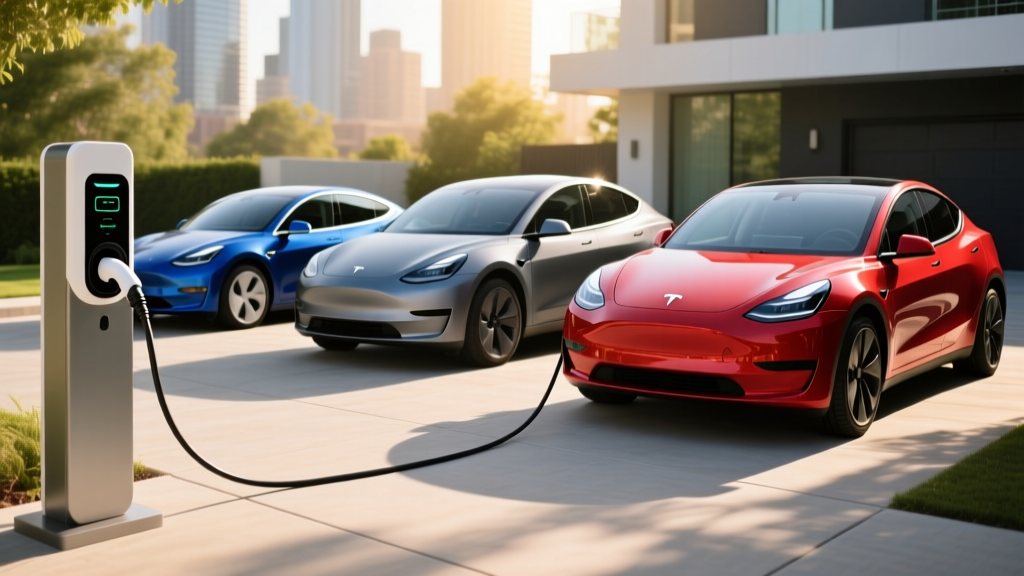
If you're researching electric vehicles, one question inevitably surfaces: how many miles on a charge does a Tesla actually get? The sticker answer — the EPA estimate — is only part of the story. Real-world range depends on highway speed, outside temperature, elevation changes, and how aggressively you use the accelerator. In this guide, we dissect the current 2026 Tesla lineup (Model 3 and Model Y, the volume sellers most buyers are cross-shopping) with exact range figures, battery specs, charging speeds, and ownership costs so you know precisely what to expect before signing a purchase agreement.
EPA range estimates assume a mix of city and highway driving at moderate temperatures. Expect 10–15% less range on sustained highway trips (70+ mph) and 20–30% less in freezing weather (below 32°F). A Model Y Long Range rated at 320 miles EPA may deliver ~270 miles on a winter interstate run. Plan charging stops accordingly.
2026 Tesla Model 3: Range, Battery & Efficiency Breakdown
The refreshed Model 3 (codenamed "Highland" and carried into 2026 with minor updates) remains Tesla's most affordable sedan and one of the most efficient EVs on the market. Its aerodynamic drag coefficient of 0.219 Cd is among the lowest of any production car, which directly translates to more miles per kilowatt-hour at highway speed.
| Specification | RWD (Standard Range) | Long Range AWD | Performance |
|---|---|---|---|
| EPA Range | 272 mi | 341 mi | 315 mi |
| Battery (usable) | ~57.5 kWh (LFP) | ~75 kWh (NMC) | ~75 kWh (NMC) |
| Efficiency | 132 MPGe / 25 kWh/100mi | 134 MPGe / 25 kWh/100mi | 124 MPGe / 27 kWh/100mi |
| 0–60 mph | 5.8 sec | 4.2 sec | 2.9 sec |
| Horsepower | 271 hp | 346 hp | 510 hp |
| Drivetrain | RWD (single motor) | AWD (dual motor) | AWD (dual motor) |
| Max DC Fast Charge | 170 kW | 250 kW | 250 kW |
| 10–80% DCFC Time | ~25 min | ~22 min | ~22 min |
| Level 2 Home Rate | 11.5 kW (~44 mi/hr) | 11.5 kW (~44 mi/hr) | 11.5 kW (~44 mi/hr) |
| Base MSRP | $38,990 | $45,990 | $52,990 |
Battery chemistry matters here. The RWD trim uses an LFP (lithium iron phosphate) pack, which is heavier but can be charged to 100% daily without accelerating degradation. Tesla actually recommends periodic 100% charges on LFP to keep the battery management system calibrated. The Long Range and Performance trims use NMC (nickel manganese cobalt) chemistry, which offers higher energy density (more range in the same space) but should ideally be charged to 80% for daily use, reserving 100% for road trips. According to fueleconomy.gov, the Long Range AWD achieves its 341-mile rating with combined city/highway driving.
2026 Tesla Model Y: Range, Battery & Efficiency Breakdown
The Model Y is America's best-selling EV and the vehicle most buyers are actually cross-shopping against the Hyundai Ioniq 5, Ford Mustang Mach-E, and Kia EV6. For 2026, the Juniper-refreshed Model Y carries updated styling, a slightly revised battery pack, and an improved interior. Range figures saw a modest bump over the pre-refresh generation.
| Specification | Long Range RWD | Long Range AWD | Performance |
|---|---|---|---|
| EPA Range | 320 mi | 308 mi | 277 mi |
| Battery (usable) | ~75 kWh (NMC) | ~75 kWh (NMC) | ~75 kWh (NMC) |
| Efficiency | 125 MPGe / 27 kWh/100mi | 122 MPGe / 28 kWh/100mi | 111 MPGe / 30 kWh/100mi |
| 0–60 mph | 5.8 sec | 4.6 sec | 3.5 sec |
| Horsepower | 346 hp | 384 hp | 510 hp |
| Drivetrain | RWD (single motor) | AWD (dual motor) | AWD (dual motor) |
| Max DC Fast Charge | 250 kW | 250 kW | 250 kW |
| 10–80% DCFC Time | ~24 min | ~24 min | ~24 min |
| Level 2 Home Rate | 11.5 kW (~37 mi/hr) | 11.5 kW (~37 mi/hr) | 11.5 kW (~37 mi/hr) |
| Base MSRP | $44,990 | $47,990 | $52,490 |
On a 75°F day at 70 mph on flat interstate, expect the Model Y Long Range AWD to deliver roughly 275–285 miles before reaching 5% SoC — about 10% below its 308-mile EPA rating. In winter (25°F), that same trip drops to 220–240 miles due to battery heating demands and denser air. The Model 3 Long Range, being lighter and more aerodynamic, holds up better on highway runs: expect ~305 miles summer, ~250 miles winter.
Charging Speed Deep Dive: How Fast Can a Tesla Recharge?
Knowing how many miles on a charge a Tesla gets is only half the equation. The other half: how quickly can you add those miles back? Tesla's Supercharger network remains the most reliable DC fast-charging ecosystem in North America, with over 6,500 V3 and V4 stalls across the U.S. as of early 2026.
| Charging Level | Power (kW) | Miles Added per Hour | Best Use Case |
|---|---|---|---|
| Level 1 (120V outlet) | ~1.4 kW | ~4–5 mi/hr | Emergency / overnight trickle |
| Level 2 (240V, 48A Wall Connector) | 11.5 kW | ~37–44 mi/hr | Daily home charging |
| DC Fast (V3 Supercharger) | Up to 250 kW | ~1,000+ mi/hr (peak) | Road trips |
Critical nuance on DC fast charging: The 250 kW peak rate applies only between roughly 10–30% state of charge (SoC) on NMC packs. Above 50%, the charge curve tapers significantly. By 80%, you're typically pulling 60–80 kW. This is why the industry-standard "10–80%" time (~22–25 minutes for Model 3/Y) is a more useful metric than peak kW alone. Charging from 80–100% on a Supercharger can add another 15–20 minutes — plan accordingly and skip topping off unless you genuinely need those last miles.
One ownership advantage: Tesla's NACS (North American Charging Standard) connector is now the industry standard adopted by Ford, GM, Rivian, Hyundai, and most other automakers. This means Tesla owners have native access to the Supercharger network without adapters, and will increasingly share it with non-Tesla EVs — though Tesla has committed to expanding stall counts to manage demand.
Pricing, Trim Levels & Federal Tax Credit Eligibility
Tesla's pricing has fluctuated frequently, but as of early 2026, the lineup sits in the following ranges. Whether you qualify for the federal §30D EV tax credit depends on a matrix of requirements that change yearly.
| Model / Trim | Base MSRP | Under MSRP Cap? | Potential §30D Credit | Est. Net Price* |
|---|---|---|---|---|
| Model 3 RWD | $38,990 | Yes (sedan cap: $55K) | Up to $7,500 | ~$31,490 |
| Model 3 Long Range | $45,990 | Yes (sedan cap: $55K) | Up to $7,500 | ~$38,490 |
| Model Y LR RWD | $44,990 | Yes (SUV cap: $80K) | Up to $7,500 | ~$37,490 |
| Model Y LR AWD | $47,990 | Yes (SUV cap: $80K) | Up to $7,500 | ~$40,490 |
| Model Y Performance | $52,490 | Yes (SUV cap: $80K) | Up to $7,500 | ~$44,990 |
*Est. Net Price assumes full $7,500 credit. Your actual credit may be $3,750 or $0 depending on battery component and critical mineral sourcing requirements. Always verify with a tax professional.
- MSRP caps: Sedans must be ≤$55,000; SUVs/trucks ≤$80,000 (all Model 3/Y trims currently qualify)
- Buyer income caps (MAGI): $150K single / $225K head of household / $300K joint filers
- Battery sourcing: The $7,500 credit splits into two halves — $3,750 for battery components manufactured in North America, and $3,750 for critical minerals sourced from the U.S. or FTA partners. Tesla's sourcing has shifted over time; check the current fueleconomy.gov credit listings for the specific trim you're buying
- Point-of-sale transfer: As of 2024+, you can transfer the credit to the dealer at purchase, reducing your out-of-pocket cost immediately rather than waiting for tax filing
- Final authority: See IRS.gov §30D guidelines for the latest rules — they change frequently
Cargo, Passenger Space & Daily Practicality
Range and charging matter for road trips, but most owners use their Tesla daily. Here's how the cabin and cargo areas measure up:
Model 3: 23 cu ft of trunk space (including the rear sub-trunk), plus a small front trunk (frunk) of ~3 cu ft. Rear legroom is 35.2 inches — adequate for adults on shorter trips but tight for anyone over 6 feet on long drives. The minimalist interior means no physical instrument cluster; all information routes through the 15.4-inch center touchscreen, including the speedometer and climate controls.
Model Y: 30.2 cu ft behind the second row, expanding to 72.1 cu ft with the rear seats folded (measured to the window line). An optional third row adds two small seats suitable only for children under ~4'9". Rear legroom is 40.5 inches — genuinely spacious. The frunk adds ~4.1 cu ft. For families hauling strollers, groceries, or road-trip luggage, the Model Y's hatchback form factor is a decisive advantage over the Model 3's sedan trunk.
Tech, Driver Assistance & Safety
Every 2026 Tesla includes Basic Autopilot (lane centering + adaptive cruise control), which is an SAE Level 2 driver-assistance system. This means you must keep your hands on the wheel and eyes on the road at all times — it is not self-driving.
Tesla Autopilot and FSD (Supervised) are Level 2 systems. They assist with steering, acceleration, and braking but require continuous driver engagement. Only Level 4 services like Waymo operate without a human driver. Never treat Autopilot as a substitute for attentive driving.
Full Self-Driving (Supervised) remains a $8,000 option (or $99/month subscription as of 2026). It adds automatic lane changes, traffic light/stop sign recognition, and city-street navigation. While impressive in controlled scenarios, it still requires active supervision and occasionally makes unpredictable decisions in construction zones or unusual intersections. According to NHTSA, all Level 2 systems demand that the driver remain the responsible operator.
Standard tech includes a 15.4-inch touchscreen with built-in navigation, streaming apps, a dashcam/surveillance system (Sentry Mode), over-the-air updates, and a phone-as-key system. No Apple CarPlay or Android Auto is offered — Tesla's native infotainment is the only option, which is a dealbreaker for some buyers.
Warranty Coverage & Battery Longevity
Tesla's warranty structure is straightforward:
- Basic vehicle warranty: 4 years / 50,000 miles (whichever comes first)
- Battery & drive unit warranty: 8 years / 100,000 miles for RWD (Standard Range); 8 years / 120,000 miles for Long Range and Performance trims
- Capacity retention threshold: Tesla warrants that the battery will retain at least 70% of its original capacity during the warranty period
In practice, Tesla battery degradation has proven modest. Data aggregated from fleet telemetry (via sources like TeslaFi) shows most Model 3/Y packs losing roughly 5–8% capacity in the first 50,000 miles, then flattening to a very gradual decline. Reaching 200,000 miles with 85%+ original capacity is common for NMC packs that aren't routinely charged to 100%. LFP packs show even slower degradation due to their inherently stable chemistry, though they sacrifice some energy density (hence the lower range on the RWD trim).
Out-of-warranty battery replacement remains expensive — typically $12,000–$16,000 for a Model 3/Y pack at a Tesla service center. This is a real long-term ownership risk that EV buyers should budget for, even if most packs outlast the car itself.
Who Should Buy a Tesla — And Who Shouldn't?
✅ Choose Tesla If:
- You want access to the Supercharger network — still the most reliable, widespread DC fast-charging infrastructure in North America
- You value efficiency: the Model 3 Long Range achieves 134 MPGe, among the highest of any EV, meaning lower per-mile electricity costs
- You prefer over-the-air updates that add features over time (Tesla's software update cadence is unmatched)
- You want a minimalist, screen-centric interior with strong performance even on base trims
❌ Look Elsewhere If:
- You need Apple CarPlay/Android Auto — Tesla does not offer either
- You prefer physical buttons for climate, volume, and glovebox (all are screen-only in Tesla)
- Service center proximity matters — Tesla's service network is thinner than legacy automakers', and mobile service can't handle everything
- You want a traditional dealership experience with negotiation and trade-in convenience
How Does Tesla Stack Up Against Competitors?
The Model 3 and Model Y face stiff competition in 2026. Here's how the core metrics compare:
| Metric | Tesla Model Y LR AWD | Hyundai Ioniq 5 Limited | Ford Mustang Mach-E ER AWD |
|---|---|---|---|
| EPA Range | 308 mi | 290 mi | 290 mi |
| Peak DC Charge | 250 kW | 350 kW (800V) | 150 kW |
| 10–80% Time | ~24 min | ~18 min | ~36 min |
| Cargo (rear seats up) | 30.2 cu ft | 27.2 cu ft | 29.7 cu ft |
| Base MSRP (comparable trim) | $47,990 | $52,600 | $48,995 |
| Charging Network | Supercharger (native NACS) | Supercharger w/ adapter (NACS) | Supercharger w/ adapter (NACS) |
The Hyundai Ioniq 5's 800-volt architecture gives it a decisive charging speed advantage — 10–80% in roughly 18 minutes on a 350 kW charger, beating Tesla by about 6 minutes. However, 350 kW chargers are less common than Tesla's 250 kW Superchargers, narrowing the real-world gap. Tesla's Supercharger reliability and plug-and-charge simplicity (no app or payment card needed at Superchargers) remains a significant ownership perk.
✅ Pros
- Best-in-class Supercharger network with native NACS plug
- Leading efficiency — more miles per kWh than most competitors
- Strong performance even on base trims (5.8 sec 0–60 on RWD)
- Over-the-air updates continuously add features
- Excellent safety ratings (IIHS Top Safety Pick+ for Model Y)
- LFP option on Model 3 RWD allows daily 100% charging
❌ Cons
- No Apple CarPlay or Android Auto
- All controls routed through touchscreen — no physical buttons
- DC fast charging slower than 800V competitors (Ioniq 5, EV6)
- Service network thinner than legacy brands; body shop wait times can be long
- Rear visibility limited in Model 3 (no rear wiper, small window)
- FSD (Supervised) remains Level 2 despite the "Full Self-Driving" name
Frequently Asked Questions
What is the real-world range of a Tesla Model Y on a road trip?
On a flat interstate at 70 mph in moderate weather (65–75°F), expect roughly 275–285 miles from the Model Y Long Range AWD before needing to charge (EPA: 308 mi). In freezing temperatures, plan for 220–240 miles. The Model 3 Long Range does better due to lower weight and drag: ~305 miles summer, ~250 miles winter.
How fast does a Tesla charge at home and on the road?
At home on a 240V Level 2 Tesla Wall Connector (48A/11.5 kW), you'll add roughly 37–44 miles of range per hour — enough to fully recharge overnight. On a V3 Supercharger (250 kW peak), the 10–80% charge takes about 22–25 minutes. Expect the full session (including plugging in, preconditioning, and taper above 80%) to take 30–35 minutes for a typical road-trip stop.
How much does a Tesla cost after the federal tax credit?
If you qualify for the full $7,500 §30D credit, a Model 3 RWD drops from $38,990 to approximately $31,490, and a Model Y Long Range AWD drops from $47,990 to approximately $40,490. However, eligibility depends on your income (MAGI caps apply), the vehicle's battery sourcing compliance, and MSRP limits. The credit can be transferred at point of sale, reducing your purchase price immediately. Consult IRS.gov or a tax professional to confirm your eligibility.
Is a Tesla worth buying vs. the Hyundai Ioniq 5 or Ford Mach-E?
It depends on your priorities. Tesla wins on Supercharger access, efficiency (more miles per kWh), and software updates. The Ioniq 5 wins on DC charging speed (800V architecture), physical buttons, and Apple CarPlay. The Mach-E offers a more traditional driving feel and Ford dealership service. If reliable road-trip charging is your top concern, Tesla's native Supercharger integration still holds an edge in 2026.
Does the Tesla Model 3 or Model Y qualify for the $7,500 federal EV tax credit?
As of early 2026, most Model 3 and Model Y trims fall under the MSRP caps ($55K sedan / $80K SUV) and may qualify for up to $7,500 — but the credit is split into two $3,750 halves based on battery component manufacturing and critical mineral sourcing. Tesla's supply chain compliance has varied; check the latest listings on fueleconomy.gov before purchasing, as eligibility can change with supply chain shifts.
How long will a Tesla battery last before needing replacement?
Based on fleet data, most Model 3/Y batteries retain 85–92% capacity at 100,000 miles with normal charging habits (80% daily limit for NMC, 100% OK for LFP). The battery warranty covers 8 years / 100,000–120,000 miles with a 70% retention floor. Many Tesla packs are reaching 200,000+ miles without replacement. If you do need one out of warranty, expect $12,000–$16,000.