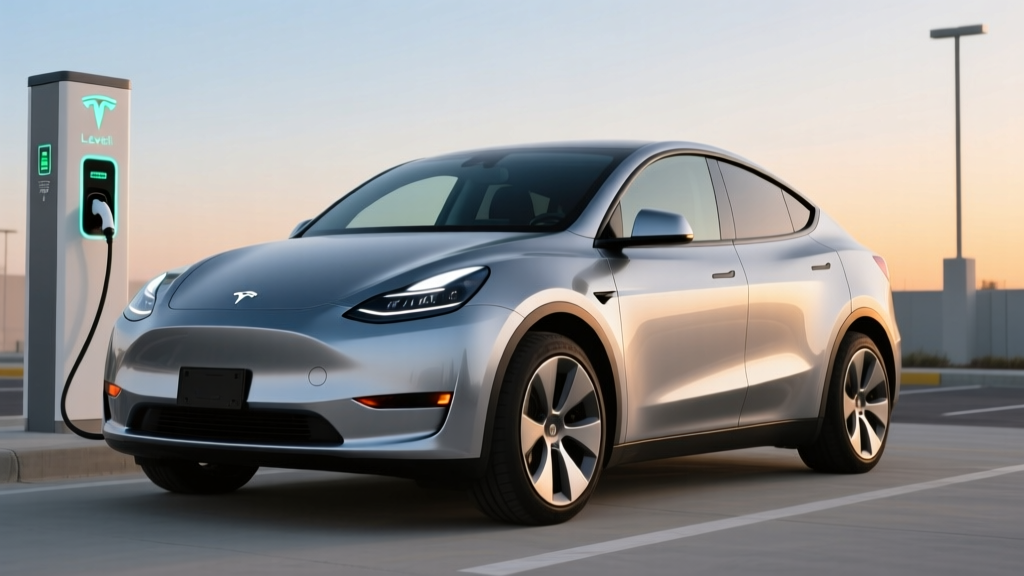
Midnight Silver Metallic has been one of Tesla's most popular premium paint options since its introduction, and for the 2026 Model Y refresh, it remains a $2,000 upcharge that buyers consistently rank among the top color choices. But beyond the aesthetics — the deep, near-black silver that shifts between charcoal and gunmetal depending on light — the 2026 Model Y Long Range AWD wearing this paint is a fundamentally updated vehicle. New Juniper-generation styling, a revised battery pack, improved thermal management, and a refreshed interior make this the most complete Model Y Tesla has built. Here is everything you need to know about range, charging, pricing, tax credit eligibility, and whether the Midnight Silver Metallic finish justifies its premium.
2026 Tesla Model Y Long Range AWD: Key Specifications
| Specification | Value |
|---|---|
| EPA Estimated Range | 320 miles |
| Battery Capacity (Usable) | ~78 kWh (NMC chemistry) |
| Drivetrain | Dual-Motor AWD |
| Horsepower | 384 hp (combined) |
| 0-60 mph | 4.8 seconds |
| Max DC Fast Charge Rate | 250 kW (peak) |
| 10-80% DC Fast Charge Time | ~27 minutes |
| Level 2 Home Charge Rate | 11.5 kW (~44 mi/hr) |
| Efficiency | 122 MPGe combined / 28 kWh/100 mi |
| Cargo Volume (rear seats up / folded) | 30.2 / 72.1 cu ft |
| Front Legroom / Rear Legroom | 41.8 in / 37.7 in |
| Base MSRP (Long Range AWD) | $48,990 |
| As-Tested (Midnight Silver Metallic + FSD) | $58,990 |
| Battery & Drive Unit Warranty | 8 years / 120,000 miles |
| Basic Vehicle Warranty | 4 years / 50,000 miles |
Midnight Silver Metallic: What You Get for $2,000
Tesla offers five exterior colors on the 2026 Model Y. Pearl White Multi-Coat is the no-cost default. Solid Black, Deep Blue Metallic, and Quicksilver each carry a $2,000 premium, as does Midnight Silver Metallic. The paint itself is a multi-coat process with a metallic flake layer that gives it notable depth — in overcast conditions it reads as dark graphite, while direct sunlight pulls out a bright silver shimmer with subtle blue undertones.
From an ownership standpoint, Midnight Silver Metallic hides road dust and light swirl marks better than Solid Black but worse than Pearl White. Tesla's paint quality has improved markedly with the Juniper production changeover (Fremont and Austin-built units now share tighter panel-gap tolerances), but buyers should still perform a thorough delivery inspection. The clear coat is adequate but not exceptional — paint protection film on high-impact areas (front bumper, hood, mirrors) is a common $1,200-$1,800 aftermarket addition that pairs well with this color.
The 2026 Juniper refresh brought a full-width light bar up front, redesigned rear taillights with an illuminated Tesla script, updated 19- and 20-inch wheel designs, and new interior ambient lighting. Midnight Silver Metallic pairs with all three interior options (Black, Black/White, and the new Cream), though the Black/White two-tone creates the strongest visual contrast with the dark exterior.
Range, Efficiency, and Real-World Expectations
EPA Estimated: 320 miles (Long Range AWD, 19" wheels)
Real-World Highway (70 mph, moderate temps): ~275-290 miles
Real-World Cold Weather (below 32°F, highway): ~230-255 miles
Real-World City/Mixed Commuting: ~295-315 miles
Note: Selecting 20" wheels reduces EPA range to approximately 303 miles. Range varies with driving style, elevation, temperature, and HVAC use.
The 2026 Model Y Long Range AWD carries an EPA-estimated 320 miles on the 19-inch Gemini wheels. This represents a modest increase over the pre-refresh Long Range, attributable to improved aerodynamics (the Juniper body achieves a lower drag coefficient) and a slightly revised battery management system that extracts more usable capacity from the pack.
The battery is an NMC (nickel manganese cobalt) lithium-ion pack with approximately 78 kWh of usable capacity. Tesla does not publish official chemistry details for every market, but teardown data and supply-chain reporting confirm NMC for the Long Range AWD variant. (The base RWD Model Y uses an LFP — lithium iron phosphate — pack with lower energy density but superior cycle life and the ability to charge to 100% daily without degradation concern.)
In real-world highway testing at sustained 70-75 mph speeds in 65-75°F conditions, expect approximately 275-290 miles before reaching 10% State of Charge. This aligns with the typical 10-15% highway deficit most EVs exhibit versus EPA combined testing. Cold weather compounds this: at 20°F with cabin heating active, range can drop to 230-255 miles. The Model Y's standard heat pump significantly mitigates this compared to resistive-heating EVs, but physics still applies — battery internal resistance increases in cold, and cabin heating draws meaningful energy.
Efficiency lands at 122 MPGe combined (28 kWh per 100 miles) per the EPA, making the Model Y Long Range one of the most efficient all-wheel-drive electric SUVs in its class. For context, that translates to roughly $0.04-$0.06 per mile on residential electricity at $0.14/kWh national average, versus $0.12-$0.15 per mile for a 28 MPG gas crossover at $3.50/gallon.
Charging Speed: DC Fast Charging and Home Setup
| Charging Level | Power / Rate | Miles Added per Hour | Notes |
|---|---|---|---|
| Level 1 (120V household) | ~1.4 kW | ~4-5 mi/hr | Emergency/trickle only |
| Level 2 (240V, 48A Wall Connector) | 11.5 kW | ~44 mi/hr | Full charge in ~7 hours |
| Level 2 (240V, 32A Mobile Connector) | 7.7 kW | ~30 mi/hr | NEMA 14-50 outlet |
| DC Fast Charge (Tesla Supercharger V3/V4) | 250 kW peak | Up to ~200 mi in 15 min | 10-80% in ~27 min |
| DC Fast Charge (CCS adapter, third-party) | Up to 250 kW peak | Varies by station | CCS adapter included |
The 2026 Model Y Long Range AWD peaks at 250 kW on V3 and V4 Tesla Superchargers. The charge curve is the critical detail here: the vehicle sustains close to peak rate from roughly 10% to 35% State of Charge, then tapers progressively. From 10% to 80%, plan on approximately 27 minutes at a V3/V4 Supercharger with a preconditioned battery. The 80-100% top-off adds another 20-25 minutes due to taper — Tesla's battery management system protects long-term cell health by reducing current at high SoC.
Preconditioning is essential for achieving advertised charge speeds. Navigate to a Supercharger using the car's built-in navigation, and the thermal management system will begin warming the battery 10-20 minutes before arrival. Without preconditioning (for example, pulling into a charger with a cold-soaked battery in winter), peak rates may be limited to 100-150 kW initially, adding 10-15 minutes to the session.
For home charging, Tesla's Gen 2 Wall Connector at 48 amps on a 60-amp circuit delivers 11.5 kW — enough to add roughly 44 miles of range per hour of charging, or a full 0-100% charge in about 7 hours. Installation typically costs $800-$2,000 depending on panel proximity and local permitting, assuming your electrical panel has sufficient capacity. Homes with 100-amp service may need a panel upgrade ($1,500-$3,500) before adding a 60-amp EV circuit. Always consult a licensed electrician for final specifications.
Tesla now includes a CCS adapter with new vehicles, opening access to Electrify America, EVgo, and other CCS-equipped networks. However, the Tesla Supercharger network remains the most reliable DC fast-charging option in the US, with over 6,000 V3/V4 stalls nationally and industry-leading uptime.
Performance, Ride, and Driving Dynamics
The dual-motor all-wheel-drive powertrain produces 384 horsepower and delivers a 4.8-second 0-60 mph time — quick enough to merge confidently and pass without hesitation, if not as visceral as the Performance variant's 3.5-second sprint. Instant torque delivery means the Model Y feels quicker in urban driving than the 0-60 figure alone suggests.
The Juniper refresh brought meaningful suspension revisions: retuned dampers, revised bushings, and an acoustic laminate on the windshield and front side windows. The result is a noticeably quieter cabin at highway speed and improved ride compliance over broken pavement. The Model Y still rides firmly compared to a Hyundai Ioniq 5 or Ford Mustang Mach-E — Tesla prioritizes handling precision over plush isolation — but the gap has narrowed significantly.
Regenerative braking remains strong and predictable, enabling one-pedal driving in most scenarios. Tesla removed the user-adjustable regen setting several years ago; the default strength is aggressive enough to bring the car to a complete stop without touching the brake pedal. New EV drivers typically adapt within a few days.
Interior, Technology, and Driver Assistance
The 2026 Juniper interior is a substantial upgrade. A 15.4-inch center touchscreen dominates the dash, now complemented by an 8-inch rear-seat entertainment screen. Ventilated front seats are now standard on Long Range (previously a premium add), and the steering wheel features haptic touch buttons replacing the prior scroll wheels. Ambient lighting strips run across the dash and door panels, and a power-folding second row is available.
The infotainment system remains Tesla's proprietary Linux-based software — no Apple CarPlay or Android Auto. The built-in navigation, media streaming (Spotify, Apple Music, Tidal), and gaming capabilities (the car runs AAA titles while parked via the 16 GB of RAM and AMD Ryzen processor) are genuinely best-in-class. Over-the-air updates continue to add features monthly.
On the driver-assistance front, Basic Autopilot is standard and includes Traffic-Aware Cruise Control and Autosteer (lane-centering) on highways. Full Self-Driving (Supervised) remains a $8,000 option (or $99/month subscription as of 2026) and adds Navigate on Autopilot, Auto Lane Change, Autopark, and Smart Summon.
Both Autopilot and FSD (Supervised) are SAE Level 2 driver-assistance systems. The driver must remain fully engaged, monitor the road at all times, and keep hands on or near the wheel. These are not self-driving systems. Tesla's cabin camera monitors driver attention and will issue escalating warnings — eventually bringing the car to a stop — if inattention is detected. Only Level 4 systems (e.g., Waymo robotaxis in designated geofenced areas) operate without a human driver.
Notable drawbacks: The absence of Apple CarPlay/Android Auto frustrates some buyers. The lack of physical buttons for climate and mirror adjustment (everything routes through the touchscreen) has a learning curve. Rear visibility is compromised by the sloping roofline — the rearview camera and parking sensors are essential. And while build quality has improved, some owners still report minor trim-panel alignment inconsistencies at delivery.
Pricing, Tax Credits, and Total Cost
| Item | Cost |
|---|---|
| Base MSRP (Long Range AWD) | $48,990 |
| Midnight Silver Metallic paint | +$2,000 |
| 19" Gemini wheels (standard) | $0 |
| FSD (Supervised) — optional | +$8,000 |
| Destination fee | $1,390 |
| As-Tested Total (w/ Midnight Silver + FSD) | $60,380 |
| Federal §30D Tax Credit (if eligible) | Up to $7,500 |
| Effective Price After Max Credit | ~$52,880 |
The 2026 Model Y Long Range AWD starts at $48,990 before destination. Adding Midnight Silver Metallic and FSD (Supervised) pushes the as-tested price to approximately $60,380 including destination.
Federal tax credit eligibility under IRS §30D is the most complex variable in EV purchasing. The Model Y Long Range AWD qualifies for up to $7,500 in 2026, but only if you meet all of the following requirements:
- MSRP Cap: Vehicle MSRP must not exceed $80,000 (SUVs/vans/pickups). The Model Y qualifies.
- Buyer Income Cap: Modified adjusted gross income must not exceed $150,000 (single), $225,000 (head of household), or $300,000 (joint filers).
- Battery Sourcing: The vehicle must meet critical-mineral and battery-component sourcing requirements, which phase in stricter percentages each year. Tesla's US-built Model Y with domestically sourced battery components has maintained eligibility through 2026.
- Point-of-Sale Transfer: As of 2024, the credit can be transferred to the dealer at purchase, reducing your out-of-pocket cost at delivery rather than waiting for a tax refund.
Consult a tax professional before relying on credit eligibility — rules change, and individual circumstances (tax liability, income fluctuations, prior credit usage) affect qualification. The IRS Clean Vehicle credit page and your dealer's point-of-sale transfer paperwork are the definitive sources.
Who Should Buy the Model Y in Midnight Silver Metallic?
- Tech-forward commuters who value Supercharger network access and OTA updates
- Small families needing 30+ cu ft cargo space with 320-mile road-trip range
- Home-charging owners who can install a Level 2 Wall Connector and rarely rely on public charging
- Buyers prioritizing efficiency — 122 MPGe combined is class-leading for AWD SUVs
- You want Apple CarPlay/Android Auto (look at Hyundai Ioniq 5, Ford Mach-E)
- You need three rows of seating (Kia EV9 or wait for the refreshed Model X)
- You prioritize ride comfort over handling (Hyundai Ioniq 5, Genesis GV60)
- You need 350+ miles of range without upgrading to a luxury-price vehicle
Model Y vs. Key Competitors
| Spec | Tesla Model Y LR AWD | Hyundai Ioniq 5 Limited AWD | Ford Mustang Mach-E Premium AWD |
|---|---|---|---|
| EPA Range | 320 mi | 290 mi | 312 mi |
| Battery (usable) | ~78 kWh NMC | 84 kWh NMC | 91 kWh NMC |
| Max DC Charge | 250 kW | 238 kW | 150 kW |
| 10-80% Time | ~27 min | ~18 min | ~40 min |
| 0-60 mph | 4.8 sec | 5.1 sec | 5.1 sec |
| Base MSRP (comparable trim) | $48,990 | $56,500 | $52,995 |
| Apple CarPlay | No | Yes (wireless) | Yes (wireless) |
| Charging Network | Supercharger native | NACS (Supercharger access) | NACS (Supercharger access) |
The Model Y's advantages are clear: longest range in the comparison, lowest base price, and native Supercharger access (no adapter needed). The Ioniq 5 counters with faster 10-80% charging (its 800V architecture excels at sustained charge rates), CarPlay, and a more comfortable ride. The Mach-E offers the largest battery and CarPlay but charges slowest. Your decision hinges on whether Supercharger convenience and range trump charging speed and smartphone integration.
Pros and Cons
- Class-leading 320-mile EPA range (AWD SUV)
- Tesla Supercharger network — most reliable DC fast-charging in the US
- 122 MPGe combined efficiency
- Excellent OTA update cadence — car improves over time
- Strong resale value relative to EV segment average
- 30.2 cu ft cargo (72.1 cu ft folded) with front trunk
- Juniper refresh: quieter cabin, improved ride, ventilated seats standard
- Midnight Silver Metallic hides dirt well and photographs beautifully
- No Apple CarPlay or Android Auto
- Touchscreen-only controls have a learning curve
- FSD (Supervised) is $8,000 and still requires full driver attention
- $2,000 paint upcharge for Midnight Silver Metallic
- Rear visibility limited by coupe-like roofline
- Ride still firm compared to Hyundai/Kia rivals
- Insurance costs 15-25% above segment average in most states
- Two-row seating only — no three-row option
Frequently Asked Questions
What is the real-world range of the 2026 Model Y Long Range AWD?
The EPA rates it at 320 miles combined. In real-world highway driving at 70-75 mph in moderate temperatures, expect 275-290 miles. In cold weather (below 32°F), plan for 230-255 miles. City and mixed driving typically yields 295-315 miles thanks to regenerative braking recapturing energy.
How fast does the Model Y charge at home and on the road?
At home on a 48-amp Level 2 Wall Connector, the Model Y charges at 11.5 kW, adding roughly 44 miles of range per hour — a full charge takes about 7 hours. On a Tesla V3/V4 Supercharger, it peaks at 250 kW and charges from 10% to 80% in approximately 27 minutes with a preconditioned battery.
Does the 2026 Model Y qualify for the federal EV tax credit?
Yes, the US-built Model Y Long Range AWD qualifies for up to $7,500 under IRS §30D in 2026, provided the buyer meets income caps ($150K single / $300K joint), the MSRP is under $80,000, and battery sourcing requirements are met. The credit can be applied at point of sale. Always verify current eligibility at irs.gov and consult a tax professional.
Is Midnight Silver Metallic worth the $2,000 upcharge?
Subjectively, yes — it's one of Tesla's most versatile colors, hiding dirt better than black while looking more premium than white. Objectively, it does not affect range, performance, or resale in a measurable way. Some third-party data suggests dark metallic colors hold marginally better resale value in the luxury segment, but the difference is small relative to the upcharge.
Is it worth buying the Model Y over the Hyundai Ioniq 5 or Ford Mach-E?
Choose the Model Y if Supercharger network access, maximum range, and Tesla's software ecosystem are your top priorities. Choose the Ioniq 5 if you want faster DC charging, Apple CarPlay, and a softer ride. Choose the Mach-E if you prefer a more traditional driving feel and CarPlay. All three are strong — the decision comes down to charging preferences and software priorities.
How long will the Model Y battery last?
Tesla warranties the battery and drive unit for 8 years or 120,000 miles (whichever comes first), guaranteeing a minimum 70% capacity retention over that period. Real-world degradation data from Tesla's fleet suggests the NMC pack loses approximately 10-12% capacity over the first 100,000 miles, with the curve flattening significantly afterward. Many high-mileage Teslas retain 85%+ capacity at 150,000 miles.
Sources: EPA Fuel Economy, IRS Clean Vehicle Tax Credits, Tesla.com official specifications.