Verdict: The Stealth Upgrade Worth $2,000?
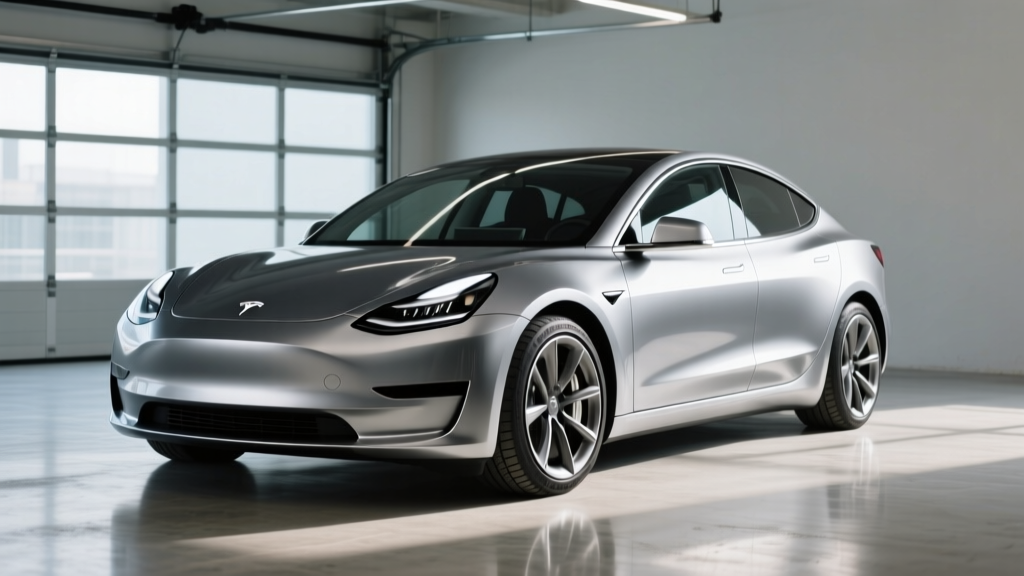
Tesla reintroduced Midnight Silver Metallic as a premium paint option for the 2026 Model 3 lineup, replacing the discontinued Midnight Cherry Red in North American markets. This deep, cool-toned silver with a subtle blue-black undertone has quickly become the most requested color at Tesla delivery centers — and for good reason. Beyond aesthetics, the 2026 Model 3 Long Range AWD wearing this paint remains one of the most efficient, best-charging, and best-value luxury electric sedans on the market.
But does the $2,000 paint premium make sense when stacked against the free Stealth Gray? And more importantly, does the underlying Model 3 Long Range platform deliver in real-world driving, charging, and ownership costs? We break down every spec, real-world number, and ownership variable you need before configuring yours.
Range, Efficiency & Real-World Expectations
The 2026 Tesla Model 3 Long Range AWD carries an EPA-estimated range of 341 miles on a full charge, powered by an 82 kWh (usable ~78 kWh) NMC (nickel manganese cobalt) lithium-ion battery pack. Efficiency is rated at 130 MPGe combined, translating to roughly 26 kWh per 100 miles — among the best in its segment.
EPA sticker: 341 miles. Expect ~290–310 miles on mixed highway driving at 70–75 mph. In cold weather (below 32°F), plan for 250–275 miles of usable range due to cabin heating demands and battery resistance. City driving with heavy regenerative braking use can push closer to the EPA figure or slightly above. The Model 3's heat pump is standard and significantly mitigates winter losses compared to resistive-heater-equipped EVs.
| Spec | Model 3 Long Range AWD (2026) |
|---|---|
| EPA Range | 341 miles |
| Battery (Usable) | ~78 kWh, NMC chemistry |
| Efficiency | 130 MPGe / 26 kWh/100 mi |
| 0–60 mph | 4.2 seconds |
| Horsepower | 384 hp (dual motor) |
| Drivetrain | Dual-motor AWD |
| Top Speed | 125 mph |
| Cargo Volume | 23 cu ft (trunk + frunk) |
| Rear Legroom | 35.3 inches |
| Battery Warranty | 8 years / 120,000 miles |
Charging Speed: DC Fast, Level 2 & Home Setup
Tesla's Supercharger network remains the gold standard for public DC fast charging, and the 2026 Model 3 Long Range takes full advantage. The vehicle supports a peak DC fast-charge rate of 250 kW at V3/V4 Superchargers, with a 10–80% charge time of approximately 25 minutes under optimal conditions (battery preconditioned via navigation routing to a charger).
Here's how charging breaks down across all levels:
| Charging Level | Power | Speed (Miles Added) | Notes |
|---|---|---|---|
| Level 1 (120V) | ~1.4 kW | ~3–4 mi/hr | Emergency/top-up only |
| Level 2 (240V, 48A) | 11.5 kW | ~44 mi/hr | Tesla Wall Connector; full charge in ~7 hrs |
| Level 2 (240V, 32A Mobile) | 7.6 kW | ~30 mi/hr | Mobile connector, NEMA 14-50 adapter |
| DC Fast (Supercharger V3/V4) | 250 kW peak | ~200 mi in 15 min | 10–80% in ~25 min; tapers above 80% |
| DC Fast (CCS via adapter) | ~150 kW peak | ~150 mi in 15 min | Non-Tesla networks; adapter included since 2025 |
Charging curve reality: The Model 3 sustains peak charge rates between roughly 10–45% State of Charge (SoC). Above 50%, the rate progressively tapers. By 80%, you're pulling roughly 60–80 kW. For road trips, charging to 80% and driving is faster than waiting for 100%. Always use the vehicle's navigation-based battery preconditioning — arriving at a Supercharger without preconditioning can add 5–10 minutes to your session in cold weather.
Performance & Driving Dynamics
The dual-motor AWD powertrain produces 384 horsepower and delivers a 0–60 mph time of 4.2 seconds. That's comfortably quick for daily driving and highway merging, though the Model 3 Performance (3.1 seconds, 510 hp) exists for those wanting sports-sedan thrust.
The 2026 refresh carries over the improved suspension tuning introduced with the Highland redesign: firmer damping, revised bushings, and acoustic glass that dramatically reduced cabin noise over the pre-2024 generation. Ride quality on 18-inch Photon wheels (standard on Long Range) strikes a good balance; the optional 19-inch Nova wheels look sharper but transmit more road imperfection.
Regenerative braking remains single-mode (strong, one-pedal-style driving), which Tesla simplified years ago. Most owners adapt within a week and rarely touch the friction brake pedal in daily driving.
Midnight Silver Metallic: Paint Details & Cost
Midnight Silver Metallic is a multi-coat premium finish that lists at $2,000 on Tesla's configurator. Under direct sunlight, it presents as a deep gunmetal silver with cool blue-gray undertones. In overcast or low-light conditions, it reads nearly black — which is precisely the aesthetic many buyers want without the swirl-mark visibility issues of true black paint.
Compared to Tesla's free Stealth Gray (a flat, dark gray), Midnight Silver Metallic has noticeably more depth and metallic flake. It also hides dust and light road grime better than either Solid Black or Ultra White. For buyers in snowy or dusty climates, it's arguably the most practical premium color Tesla offers.
Tesla's paint quality has improved meaningfully since the Fremont factory's 2023 production upgrades and the Gigafactory Texas paint shop's ramp-up, though we still recommend a post-delivery inspection and paint correction or ceramic coating for any dark metallic finish.
Pricing, Trims & Federal Tax Credit Eligibility
Here's how the 2026 Model 3 lineup is priced before incentives:
| Trim | Base MSRP | With Midnight Silver | Est. Federal Credit | Effective Price |
|---|---|---|---|---|
| Model 3 RWD | $38,990 | $40,990 | Up to $7,500* | ~$33,490 |
| Model 3 Long Range AWD | $45,990 | $47,990 | Up to $7,500* | ~$40,490 |
| Model 3 Long Range Max | $49,990 | $51,990 | Up to $7,500* | ~$44,490 |
| Model 3 Performance | $53,990 | $55,990 | Up to $7,500* | ~$48,490 |
*Federal tax credit (IRS §30D) caveats: The full $7,500 credit requires meeting all of the following criteria, per current IRS guidelines:
- Buyer income caps: AGI must not exceed $150,000 (single), $225,000 (head of household), or $300,000 (joint filers)
- MSRP cap: Sedans must be at or below $55,000 — all Model 3 trims qualify
- Battery sourcing: Critical minerals and battery components must meet phased-in domestic-content thresholds that tighten annually. Tesla has largely met these requirements for US-built Model 3 vehicles, but confirm at point of sale
- Point-of-sale transfer: Since 2024, you can transfer the credit to the dealer at purchase, reducing your out-of-pocket cost immediately rather than waiting for tax filing
Always verify eligibility with a tax professional. Rules are subject to legislative change, and battery-sourcing compliance can shift with supply-chain updates mid-year.
Interior, Tech & Driver Assistance
The 2026 Model 3 interior carries over the minimalist Highland-generation cabin: a 15.4-inch center touchscreen handles all infotainment, climate, and vehicle controls. There is no instrument cluster — speed and navigation appear on the left third of the main screen. A rear 8-inch touchscreen for passengers controls climate and media.
Standout tech features:
- Tesla's native navigation with real-time Supercharger routing and battery preconditioning
- Over-the-air (OTA) software updates that add features post-purchase
- Ventilated front seats (added in the Highland refresh)
- Ambient lighting with customizable color zones
- Dashcam and Sentry Mode with all-around cameras
- Phone-as-key with Bluetooth and UWB proximity
Tesla's Autopilot (standard) and Full Self-Driving Supervised ($8,000 option or $99/month) are SAE Level 2 driver-assistance systems per SAE International definitions. You must keep your hands on the wheel and eyes on the road at all times. These systems do not make the Model 3 self-driving. They offer adaptive cruise, lane centering, automatic lane changes (with FSD), and traffic-light recognition — useful on highways but requiring constant supervision.
Notable drawbacks:
- No physical stalks — turn signals are steering-wheel-mounted buttons (polarizing; takes adaptation)
- No Apple CarPlay or Android Auto (Tesla's native system only)
- Rear visibility is compromised by the sloped roofline; rely on the camera
- Rear seat cushion is relatively flat and low — tall passengers on long trips may find it less supportive than competitors like the Hyundai Ioniq 6
Who Should Buy the Model 3 in Midnight Silver Metallic?
- You commute 30–80 miles daily and want to charge at home overnight, rarely visiting a public charger
- You take 2–4 road trips per year and need Supercharger network reliability
- You value efficiency (130 MPGe) and low per-mile electricity cost over interior luxury materials
- You want AWD traction for rain or light snow without stepping to a crossover
- You need more than 23 cu ft of cargo or regularly carry 4+ adults (consider Model Y or Ioniq 5)
- You prefer physical controls, traditional gauge clusters, or Apple CarPlay integration
- You want a plush, luxury-brand interior at this price point (BMW i4, Genesis Electrified G80)
Pros & Cons at a Glance
- 341-mile EPA range; among the longest in its price class
- 250 kW Supercharger access; best-in-class charging network
- 130 MPGe efficiency keeps per-mile costs low (~$0.04–0.06/mi at home)
- Midnight Silver Metallic hides grime well and looks premium in all lighting
- OTA updates continuously improve the vehicle post-purchase
- Strong resale value relative to most EV competitors
- Turn-signal buttons (no stalks) require an annoying learning curve
- No Apple CarPlay / Android Auto
- $2,000 paint premium for Midnight Silver Metallic over free Stealth Gray
- Rear seat comfort trails competitors on long trips
- FSD at $8,000 remains a Level 2 system — expensive for what it delivers
- Insurance costs tend to run 15–30% higher than comparable gas sedans
Frequently Asked Questions
What is the real-world range of the 2026 Tesla Model 3 Long Range?
On the EPA cycle, the Model 3 Long Range AWD is rated at 341 miles. In real-world highway driving at 70–75 mph, expect 290–310 miles. In cold weather (below freezing), plan for 250–275 miles. City driving with regenerative braking can match or slightly exceed the EPA number.
How fast does the Model 3 charge at home and on the road?
At home on a Level 2 Tesla Wall Connector (48A / 11.5 kW), you'll add about 44 miles of range per hour, with a full 10–100% charge taking roughly 7 hours. On a V3 or V4 Supercharger, the Model 3 peaks at 250 kW and charges from 10–80% in about 25 minutes with battery preconditioning active.
Does the Model 3 qualify for the $7,500 federal EV tax credit?
All 2026 Model 3 trims fall under the $55,000 MSRP cap for sedans and are manufactured in the US, making them strong candidates for the full §30D credit. However, eligibility depends on your adjusted gross income (income caps apply), and battery-sourcing requirements must be met at time of delivery. Verify with your tax professional and the IRS clean vehicle credit page before purchasing.
Is Midnight Silver Metallic worth the $2,000 upgrade?
If you want a dark, understated color that hides dirt better than black and has more depth than the free Stealth Gray, yes — it's one of Tesla's best premium paints. If budget is the priority, Stealth Gray is a solid no-cost alternative that looks similar in overcast conditions, though it lacks the metallic flake and blue undertone of Midnight Silver.
How does the Model 3 compare to the Hyundai Ioniq 6 or BMW i4?
The Ioniq 6 SE Long Range offers a comparable 361-mile EPA range and slightly faster 10–80% charging (~18 minutes at 350 kW), but it lacks access to the Supercharger network (though CCS adapters help). The BMW i4 eDrive40 starts higher at ~$57,000 and offers a more traditional luxury interior but only 307 miles of range. The Model 3 wins on efficiency, charging infrastructure, and total cost of ownership; the Ioniq 6 wins on rear-seat comfort and the i4 on interior quality. Per fueleconomy.gov, the Model 3 Long Range's 130 MPGe edges out the Ioniq 6's 132 MPGe only when comparing the Long Range AWD variant — efficiency is nearly identical between the two.
What's the battery warranty and expected degradation?
Tesla covers the Model 3 Long Range battery and drive units for 8 years or 120,000 miles, whichever comes first, with a minimum 70% capacity retention threshold. Real-world data from high-mileage owners suggests NMC packs in the Model 3 typically lose 8–12% capacity over the first 100,000 miles, with degradation slowing significantly after the initial break-in period. To maximize longevity, Tesla recommends daily charging to 80–90% and reserving 100% charges for road trips.