What Is the Tesla Megaphone?
If you've been searching for information on the Tesla Megaphone, you've likely encountered a mix of speculation, forum rumors, and misattributed concept art. As of early 2026, Tesla has not officially announced or released a vehicle, product, or accessory under the name "Megaphone." The term appears to originate from enthusiast forums and patent-watch communities as a speculative codename—possibly associated with a next-generation commercial or fleet-oriented EV platform, a refreshed Tesla Semi variant, or a software/communication feature tied to Tesla's expanding robotaxi and fleet operations.
At AutoEdgeView, we don't present unreleased or unconfirmed vehicles as currently available. What follows is a comprehensive breakdown of what the "Megaphone" moniker likely references, the closest real Tesla products that match the rumored use case, and what buyers and fleet operators should actually be evaluating today.
The Likely Origin: Tesla's Fleet and Commercial Ambitions
Tesla's commercial vehicle strategy has expanded considerably since the Tesla Semi began limited production deliveries to PepsiCo and other fleet operators in late 2022. By 2025–2026, Tesla has been investing heavily in:
- Tesla Semi scale-up: The long-delayed dedicated Semi factory in Nevada has been progressing, with higher-volume production anticipated for 2026–2027.
- Fleet management software: Tesla's fleet dashboard and telematics platform have received significant updates, enabling operators to monitor charging, routing, and driver behavior across large vehicle deployments.
- Robotaxi and ride-hail fleet operations: Tesla's announced (though repeatedly delayed) robotaxi ambitions require a communication and dispatch infrastructure that some community members have speculated could carry an internal codename like "Megaphone."
- Vehicle-to-everything (V2X) communication: Patents filed by Tesla in 2023–2024 describe vehicle-to-grid and vehicle-to-infrastructure communication systems, which could theoretically be associated with a broadcast or "megaphone" metaphor internally.
None of these have been confirmed to carry the "Megaphone" name. But the pattern is clear: Tesla's next growth frontier isn't just selling individual cars—it's building fleet-scale platforms.
What to Buy Today: Tesla Semi Specs (The Real Commercial Tesla)
If you're a fleet operator or commercial buyer researching Tesla's heavy-duty EV offering—the vehicle most likely associated with the "Megaphone" speculation—here are the confirmed specs for the Tesla Semi as of the 2025–2026 production run:
| Specification | Tesla Semi (300 mi) | Tesla Semi (500 mi) |
|---|---|---|
| EPA Estimated Range | ~300 miles (loaded) | ~500 miles (loaded) |
| Battery Capacity | ~500 kWh (est., NMC) | ~900 kWh (est., NMC) |
| Max DC Fast Charge | ~1 MW (Megacharger) | ~1 MW (Megacharger) |
| Charge Time (10–80%) | ~30 min (at Megacharger) | ~45–60 min (at Megacharger) |
| 0–60 mph (loaded) | ~20 sec (80,000 lb GCW) | ~20 sec (80,000 lb GCW) |
| Horsepower | ~1,000+ hp (tri-motor) | ~1,000+ hp (tri-motor) |
| Energy Efficiency | ~1.7 kWh/mile | ~1.7 kWh/mile |
| Base MSRP | $250,000 | $290,000 |
| Drivetrain | Tri-Motor AWD | Tri-Motor AWD |
| Warranty | TBD (commercial terms) | TBD (commercial terms) |
Charging Infrastructure: Megachargers vs. Public Networks
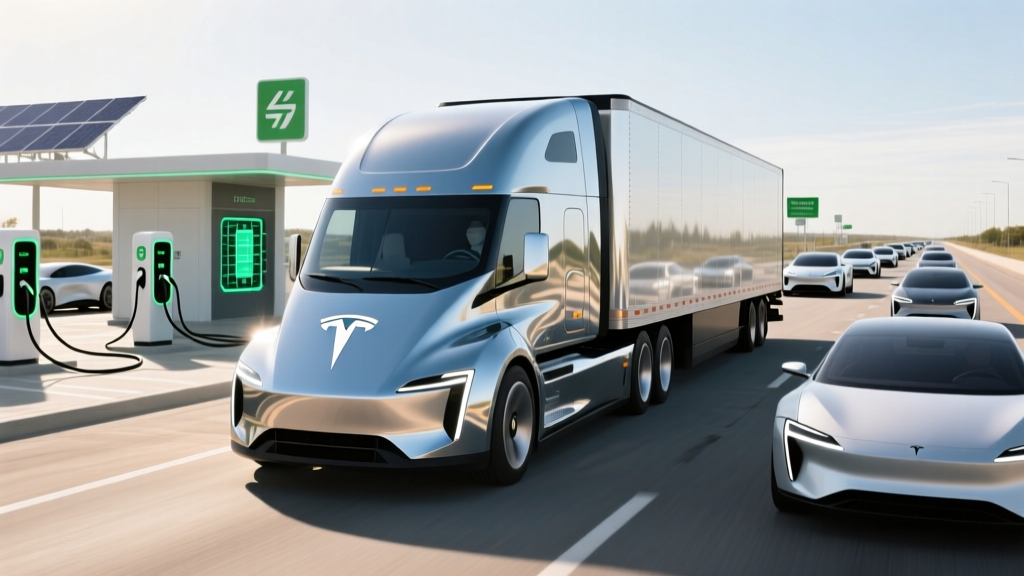
The Tesla Semi relies on Tesla's proprietary Megacharger network—a 1 MW+ DC fast-charging standard designed specifically for heavy-duty commercial vehicles. This is fundamentally different from the NACS (North American Charging Standard) connectors used on Tesla's consumer vehicles and increasingly adopted by other automakers.
| Charging Level | Power (kW) | Miles of Range Added | Typical Use Case |
|---|---|---|---|
| Level 2 (AC, depot charging) | 40–80 kW | ~20–40 mi/hr | Overnight depot top-up |
| Megacharger (DC) | 750–1,000+ kW | ~400–500 mi/hr | Mid-route fast charge |
| CCS2 / MCS (public) | 350–600 kW | ~200–350 mi/hr | Compatible public chargers (adapter needed) |
Key charging insight: The Semi's massive battery pack (500–900 kWh) means that even at 1 MW charging speeds, a 10–80% charge takes 30–60 minutes. The charge curve tapers significantly above 80% SoC to protect the NMC cells, so fleet operators are advised to charge to 80% for daily operations and only charge to 100% when route length demands it. Depot-based Level 2 charging at 40–80 kW overnight remains the most cost-effective strategy, adding enough range for most regional routes over an 8–10 hour layover.
Megacharger availability remains limited as of early 2026, with installations primarily along key freight corridors in California, Nevada, and Texas. Tesla has announced plans to expand the network, but fleet operators should verify Megacharger availability along their specific routes before committing to Semi-based operations. See Tesla's official Tesla Semi page for the latest infrastructure updates.
Fleet Economics: TCO and Tax Credit Eligibility
For commercial buyers, the Tesla Semi's economics depend heavily on route structure, electricity costs, diesel price volatility, and available incentives.
| Cost Factor | Tesla Semi (500 mi) | Comparable Diesel Class 8 |
|---|---|---|
| Base MSRP | $290,000 | $170,000–$200,000 |
| Federal Commercial Clean Vehicle Credit (§45W) | Up to $40,000 | N/A |
| Estimated Net Price (after credit) | ~$250,000 | $170,000–$200,000 |
| Fuel/Energy Cost per Mile | ~$0.17–$0.25 (electric) | ~$0.55–$0.75 (diesel) |
| Maintenance Cost per Mile | ~$0.05–$0.08 | ~$0.15–$0.20 |
| 5-Year TCO (100k mi/yr) | ~$1.5–1.8M | ~$1.8–2.2M |
Important tax credit note: The Tesla Semi, as a commercial vehicle over 14,000 lbs GVWR, does not qualify for the consumer §30D federal tax credit (which caps at $7,500 for light-duty vehicles with MSRP and income limits). Instead, fleet buyers should investigate the §45W Commercial Clean Vehicle Credit, which provides up to $40,000 for qualifying heavy-duty EVs. Eligibility depends on battery sourcing requirements, vehicle weight class, and business tax liability. Consult IRS guidance on §45W and a qualified tax professional before making purchasing decisions.
Additionally, many states and air quality management districts offer supplemental incentives for zero-emission heavy-duty vehicles. California's CARB programs, for example, can provide $50,000–$120,000 in additional point-of-sale or rebate incentives depending on the fleet's operating area and vehicle replacement criteria. These vary by jurisdiction and funding availability.
Tech, Safety, and Driver Assistance
The Tesla Semi carries much of the same technology stack found in Tesla's consumer vehicles, adapted for commercial operation:
- Autopilot (Level 2): Standard adaptive cruise control, lane-keeping, and automatic emergency braking. This is an SAE Level 2 driver-assistance system—the driver must remain fully engaged and attentive at all times. It is not self-driving.
- Fleet telematics dashboard: Real-time GPS tracking, energy consumption monitoring, driver behavior scoring, and remote preconditioning via Tesla's fleet management portal.
- Regenerative braking: Aggressive regen profiles optimized for loaded operation, significantly reducing brake wear compared to diesel Class 8 trucks. Tesla claims brake pad replacement intervals exceeding 500,000 miles in typical fleet use.
- Jackknife prevention: Tesla's tri-motor architecture allows independent torque vectoring across drive axles, with electronic stability systems designed to prevent trailer swing and jackknife events.
- Over-the-air updates: Like all Tesla vehicles, the Semi receives periodic OTA software updates that can improve efficiency, add features, and refine driver-assistance behavior.
Pros and Cons
✅ Pros
- Dramatically lower fuel cost per mile vs. diesel ($0.17–0.25 vs. $0.55–0.75)
- Reduced maintenance: no engine oil, DEF, DPF, or transmission fluid
- Strong regenerative braking extends brake life to 500k+ miles
- 1,000+ hp tri-motor provides exceptional grade-climbing ability
- OTA updates continuously improve vehicle performance
- Up to $40,000 federal §45W credit + state incentives
❌ Cons
- High upfront cost: $250k–$290k before incentives (vs. $170k–$200k diesel)
- Megacharger network still limited—route planning is critical
- Real-world loaded range 280–420 mi depending on conditions
- Long charge times (30–60 min) impact driver scheduling
- Limited production volume; long wait times for orders
- Commercial battery warranty terms still being established
Is It Worth It vs. Competitors?
If you're evaluating electric Class 8 trucks for fleet deployment, the Tesla Semi isn't the only option. Key competitors include:
- Freightliner eCascadia: ~230-mile range, ~$300,000 MSRP, widely available through Daimler Truck's dealer network. Better suited for short-haul drayage and regional routes. More established service infrastructure.
- Volvo VNR Electric: ~275-mile range (6-battery pack), ~$280,000 MSRP, strong dealer support. Good for regional distribution with predictable routes.
- Peterbilt 579EV / Kenworth T680E: Similar range and pricing, Paccar platform with established dealer support.
- Choose Tesla Semi if: Your routes are 300–450 miles, you can install depot Megachargers, you prioritize lowest per-mile energy cost, and you operate in regions with strong state incentives (CA, TX, Northeast).
- Choose Freightliner eCascadia or Volvo VNR Electric if: Your routes are under 200 miles, you need immediate delivery, you value established dealer service networks, and you primarily run drayage or short-haul distribution.
- Wait if: Your routes exceed 500 miles daily, you operate in extreme cold climates, or you lack depot charging infrastructure. Battery density improvements expected in 2027–2028 may shift the economics.
FAQ
What is the real-world range of the Tesla Semi?
Tesla rates the long-range Semi at ~500 miles at full load. Real-world fleet operations typically achieve 350–420 miles on highway-dominant routes, and as low as 280–350 miles in cold weather (below 32°F) or on routes with significant elevation changes. Plan with a 20–30% buffer.
How fast does the Tesla Semi charge?
At a Tesla Megacharger (up to 1 MW), the 500-mile variant charges from 10–80% in approximately 45–60 minutes. Depot Level 2 charging at 40–80 kW adds roughly 20–40 miles of range per hour, suitable for overnight replenishment. The charge curve tapers significantly above 80% SoC.
How much does the Tesla Semi cost after incentives?
The 500-mile Tesla Semi lists at $290,000 MSRP. After the federal §45W Commercial Clean Vehicle Credit (up to $40,000), the net price is approximately $250,000. Additional state incentives (especially in California) can reduce this further by $50,000–$120,000 depending on program eligibility and fleet replacement criteria.
Does the Tesla Semi qualify for the $7,500 federal EV tax credit?
No. The §30D consumer tax credit applies only to light-duty vehicles under 14,000 lbs GVWR. The Tesla Semi qualifies instead for the §45W Commercial Clean Vehicle Credit, which provides up to $40,000 for qualifying heavy-duty electric trucks. Eligibility depends on battery sourcing, business tax liability, and other IRS rules. Consult IRS.gov and a tax professional.
Is the "Tesla Megaphone" a real product I can buy?
No. As of early 2026, Tesla has not announced any product called "Megaphone." The term appears to be a community-generated codename associated with Tesla's fleet/commercial EV ambitions. This article covers the closest real product—the Tesla Semi—for buyers researching Tesla's commercial EV platform.
Who should buy the Tesla Semi?
The Tesla Semi is best suited for fleet operators running predictable regional routes of 200–450 miles, with access to depot charging and/or Tesla Megacharger corridors. It offers the lowest per-mile operating cost in the electric Class 8 segment but requires significant upfront infrastructure investment and careful route planning. Long-haul operators exceeding 500 miles daily should evaluate hybrid strategies or wait for next-generation battery improvements.