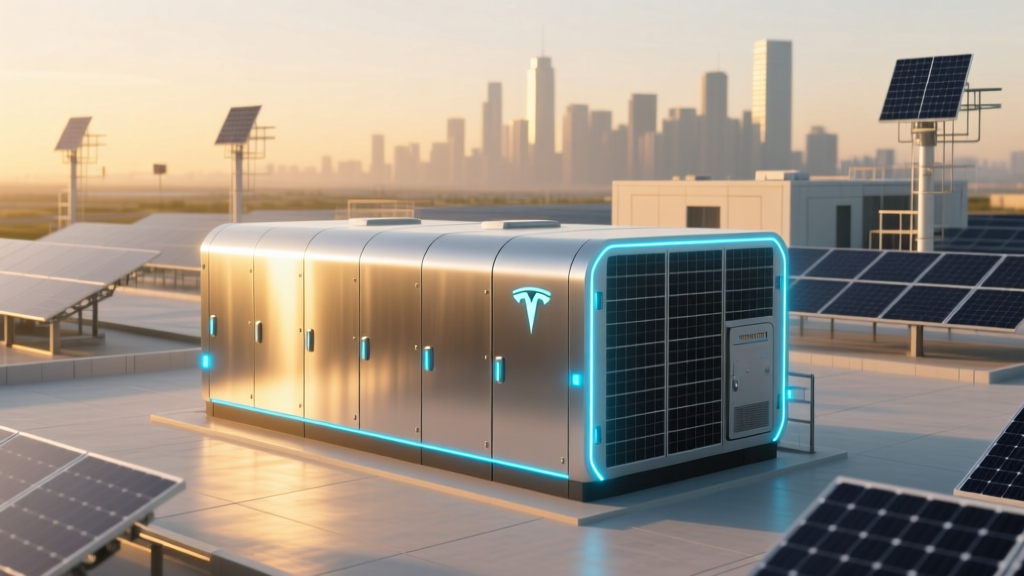
The Tesla Megapack is not a car — it is a utility-scale lithium-ion battery energy storage system (BESS) designed for grid operators, independent power producers, and large commercial sites. Because it does not have wheels, seats, or an EPA range sticker, the metrics that matter here are fundamentally different from an EV review: round-trip efficiency (RTE), energy capacity in MWh, thermal management parasitics, degradation curves, and levelized cost of storage (LCOS). This profile applies our EV-battery expertise to the stationary-storage side of Tesla's business, with 2026 Megapack 2 XL data and head-to-head context versus Fluence, BYD, and Sungrow.
What "Round-Trip Efficiency" Actually Means for Megapack
Round-trip efficiency is the percentage of AC energy you get back out of the system for every unit of AC energy you put in. If you push 100 kWh into a Megapack from the grid and later discharge 87 kWh back to the grid, the RTE is 87%. The losses come from four sources:
- Inverter losses — DC-to-AC and AC-to-DC conversion in the integrated Power Conversion System (PCS).
- Battery cell internal resistance — I²R heating inside the LFP prismatic cells during charge and discharge.
- Thermal management parasitics — the liquid-cooling pumps, chillers, and heaters that keep cells in the 15–35°C sweet spot consume power whether charging or idle.
- Transformer and balance-of-system (BOS) losses — medium-voltage step-up transformers and switchgear on site.
When Tesla quotes Megapack RTE, they typically reference AC-to-AC at the PCS terminals — meaning inverter + cell + thermal losses, but excluding the site transformer. For a true grid-interconnection RTE, subtract another 0.5–1.0% for the MV transformer.
Tesla Megapack 2 XL: 2026 Spec Table
| Parameter | Value |
|---|---|
| Energy capacity (usable) | ~3.9 MWh per unit |
| Cell chemistry | LFP (lithium iron phosphate), prismatic |
| Continuous AC power (PCS) | ~1.25 MW (configurable) |
| Round-trip efficiency (AC-AC, BOL, PCS terminals) | ~89–91% at 0.25C; ~85–88% at 0.5C |
| Thermal management | Integrated liquid cooling + heat pump |
| Physical footprint (single unit) | ~53 ft L × 8 ft W × 9.5 ft H |
| Weight (approx.) | ~84,000 lb per unit |
| Design life / warranty | 15 years / unlimited cycles within SoC & thermal envelope |
| Grid interconnection | Integrated MV PCS, 480V to medium-voltage |
| Control system | Tesla Powerhub SCADA, OTA-updatable |
Sources: Tesla Megapack product page, U.S. EIA, and publicly filed interconnection documents. Specs vary by project configuration and contract year.
Why Megapack's RTE Is Not a Single Number
Any single RTE figure for a BESS is misleading unless it is qualified by three variables:
- C-rate (charge/discharge rate). A Megapack discharged at 0.25C (~1 MW from a 3.9 MWh unit) will show higher RTE than one discharged at 0.5C (~2 MW). Higher current means more resistive heating, more cooling load, and lower efficiency. Most grid-merchant projects operate between 0.25C and 0.5C.
- State of Charge (SoC) window. Lithium-ion cells are least efficient at the top and bottom of their SoC range. A Megapack cycled 10–90% SoC will show a slightly lower RTE than one cycled 20–80%, because the extremes require more aggressive thermal management and see higher internal resistance.
- Ambient temperature. In Arizona summer (45°C+), the chiller works hard, adding parasitic load. In Minnesota winter (–25°C), heaters may run during standby. Both reduce system-level RTE versus the mild-climate lab number.
Tesla's published BOL (beginning-of-life) RTE of roughly 89–91% is measured at moderate C-rate and benign ambient. Real-world, year-averaged, AC-to-grid RTE at a U.S. merchant site typically lands in the 85–89% range once you include thermal parasitics and the site transformer.
Degradation: How RTE and Capacity Drift Over 15 Years
LFP chemistry gives Megapack a structural longevity advantage over NMC: flatter degradation curve and higher cycle life. Tesla's warranty effectively guarantees that the system will remain operable for 15 years with unlimited cycles, provided the thermal and SoC envelope is respected. What they do not publicly guarantee is a specific end-of-life RTE or capacity-retention percentage — that is negotiated per-project in the performance guarantee.
Based on publicly available project performance reports and LFP cell-cycle data:
- Capacity retention at year 10: ~80–88% of BOL, depending on average SoC, C-rate, and ambient.
- RTE drift: As cells age and internal resistance rises, RTE typically drops 2–5 percentage points over 15 years. A BOL RTE of 90% might be ~86% at year 15.
- Augmentation strategy: Most utility-scale projects plan to add replacement modules ("augmentation") around years 8–12 to restore nameplate MWh. Megapack's modular PCS architecture makes this less disruptive than containerized competitors.
Megapack vs. the Competition: RTE and Specs Matrix
| System | Capacity per Unit | Chemistry | BOL RTE (AC-AC) | Warranty | Notes |
|---|---|---|---|---|---|
| Tesla Megapack 2 XL | ~3.9 MWh | LFP | ~89–91% | 15 yr | Integrated PCS + liquid cooling; OTA updates |
| Fluence Cube (6th gen) | ~5.2 MWh | LFP (CATL) | ~87–90% | 10–15 yr | Siemens/AES JV; modular stacking |
| BYD MC Cube-T | ~3.3 MWh | LFP (blade) | ~88–91% | 10–15 yr | Blade cell architecture; strong in APAC |
| Sungrow PowerTitan 2.0 | ~4.4 MWh | LFP | ~87–90% | 10–15 yr | Integrated liquid cooling; strong inverter heritage |
RTE numbers are BOL, AC-AC at PCS terminals, and depend on C-rate and ambient. The spread between competitors is narrow — typically 2–4 percentage points — because all use LFP cells from top-tier manufacturers and similar inverter topologies. Differentiation comes down to integration quality, software stack, augmentation path, and supply-chain reliability.
Who Megapack Is For (and Who Should Look Elsewhere)
Megapack fits:
- Utilities and IPPs building 50 MWh to multi-GWh merchant storage projects.
- Solar-plus-storage developments needing a single-source EPC-compatible BESS.
- Data-center campuses pursuing behind-the-meter 4-hour duration backup.
- Grid operators needing fast frequency response (sub-second response via Powerhub).
Look elsewhere if:
- You need a commercial/industrial system under 500 kWh — Tesla's own Powerwall 3 or PowerBlock stack is more appropriate.
- You require >4-hour duration economically — iron-flow (ESS Inc.) or compressed-air systems may LCOS-better at 8–12 hours.
- Your project is in a jurisdiction with domestic-content mandates that disqualify LFP cells sourced from China (a moving target; consult current IRS guidance on §48 ITC bonus adders).
The Economics: LCOS, Not MSRP
Megapack is not sold at a sticker MSRP. Pricing is negotiated per-project and depends on volume, duration, interconnection voltage, and contract year. Publicly reported installed costs for U.S. utility-scale 4-hour BESS in 2025–2026 land in the range of $280–$380 per kWh of nameplate capacity, fully installed (EIA data). For a 3.9 MWh Megapack unit, that implies roughly $1.1M–$1.5M installed, before tax credits.
The §48 Investment Tax Credit (not §30D, which applies only to road vehicles) currently offers a base 30% credit for standalone storage, with potential 10–20% bonus adders for domestic content and energy-community siting. A project sited in an energy community with qualifying domestic content could approach a 50% total credit. Consult a tax professional and current IRS §48 guidance before underwriting.
Standout Tech and Notable Drawbacks
Standouts:
- Powerhub SCADA — Tesla's grid-management software enables OTA performance updates, automated market bidding integration, and fleet-level diagnostics. Competitors are catching up, but Tesla's software stack remains a benchmark.
- Integrated PCS — The inverter, transformer, and switchgear ship inside the same enclosure as the battery, reducing site EPC complexity.
- LFP safety profile — Higher thermal-runaway onset temperature than NMC; a meaningful risk reduction for fire-department sign-off.
Drawbacks:
- Supply-chain lead times — Tesla's Laramie County, Wyoming Gigafactory is scaling, but multi-GWh orders still see 12–24 month queues.
- Single-vendor lock-in — Proprietary PCS and software mean augmentation and service are Tesla-dependent for the system's life.
- Limited transparency on end-of-life RTE guarantees — Project developers must negotiate degradation curves contract-by-contract; published data is sparse compared to some competitors.
Frequently Asked Questions
What is the real-world round-trip efficiency of a Tesla Megapack in 2026?
At the PCS terminals, beginning-of-life RTE is approximately 89–91% at a moderate 0.25C rate. Once you include site transformer losses and real-world thermal parasitics across a full year of operation, expect a system-level AC-to-grid RTE of roughly 85–89%. RTE declines 2–5 percentage points over the 15-year design life as cell resistance increases.
Does Megapack use LFP or NMC cells?
LFP (lithium iron phosphate). LFP sacrifices some energy density versus NMC but offers longer cycle life, flatter degradation, and a significantly higher thermal-runaway threshold — all desirable traits for stationary storage where weight and volume matter less than longevity and safety.
How fast can a Megapack charge and discharge?
Megapack 2 XL is typically configured for ~1.25 MW continuous per 3.9 MWh unit, which is roughly a 0.32C rate. Full 0–100% charge takes about 3–3.5 hours at continuous rated power. Projects can be configured for higher power (shorter duration) or lower power (longer duration) depending on the market use case — frequency response vs. 4-hour capacity arbitrage.
Does the Megapack qualify for the federal EV tax credit?
No. The §30D Clean Vehicle Credit applies only to road-registered vehicles. Megapack qualifies instead for the §48 Investment Tax Credit for energy property, which as of 2026 offers a base 30% credit for standalone battery storage, with potential bonus adders for domestic content and energy-community siting. Always verify current rules with a tax professional and the IRS.
Is Megapack worth it versus Fluence or BYD?
For developers prioritizing software sophistication, integrated PCS, and Tesla's brand with offtakers, Megapack remains a top-tier choice. For cost-sensitive projects or those with domestic-content mandates where Tesla's supply chain doesn't qualify for bonus credits, Fluence or Sungrow may pencil out better. RTE differences are narrow (2–4 points) — the decision usually comes down to LCOS, lead time, and software preference rather than efficiency alone.