If you've been researching grid-scale battery storage, you've likely encountered the phrase Tesla Megapack Powerhub included in spec sheets and project announcements. Unlike consumer EVs that roll off the lot ready to drive, Tesla's Megapack system is a utility-scale energy storage platform where the Powerhub — the system's central control, thermal management, and power-conversion hub — ships as an integrated component rather than an optional add-on. This guide breaks down exactly what the Megapack platform offers in 2026, what the Powerhub does, and whether this system fits your project's needs.
What Is Tesla Megapack and Why Is Powerhub Included?
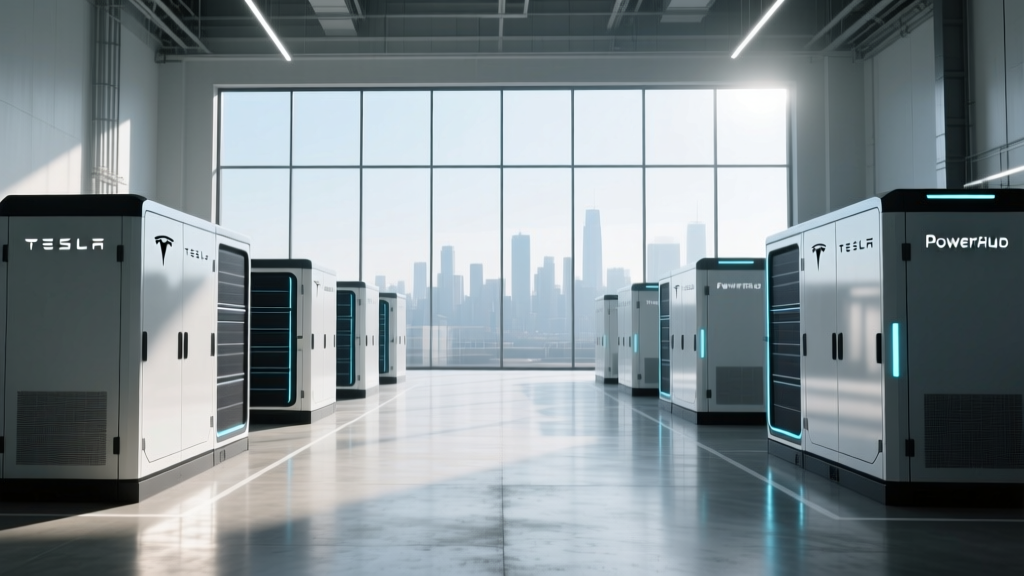
The Tesla Megapack is a pre-assembled, container-scale battery energy storage system designed for utility-scale solar farms, grid stabilization, peak shaving, and commercial microgrid applications. Each Megapack unit houses lithium iron phosphate (LFP) battery cells, a bidirectional inverter, thermal management systems, and safety equipment in a single enclosure roughly the size of a shipping container.
The Powerhub is the central nervous system of a Megapack installation. It serves as the point of common coupling (PCC) between the battery arrays and the electrical grid, handling:
- Power conversion coordination — managing AC/DC inversion across multiple Megapack units
- Thermal management oversight — directing liquid cooling loops to maintain optimal cell temperature (typically 15–35°C)
- Grid interconnection — providing the medium-voltage switchgear, transformer interface, and protection relays required for utility interconnection
- Control and communication — running Tesla's Powerhub Controller software, which interfaces with grid operators via SCADA protocols and Tesla's Autobidder energy trading platform
When project documentation states "Tesla Megapack Powerhub included," it means the Powerhub is not priced or procured separately — it ships as part of the integrated Megapack system package. This is a significant differentiator from competitors like Fluence or BYD, where power conversion systems (PCS) and balance-of-plant components are often sourced and contracted separately.
Megapack 2 XL Specifications: Capacity, Power, and Chemistry
The current-generation Megapack 2 XL (in production and deployment through 2026) represents a substantial upgrade over the original Megapack. Here are the key technical specifications based on Tesla's official Megapack documentation:
| Parameter | Value |
|---|---|
| Energy Capacity (per unit) | ~3.9 MWh (usable) |
| Continuous Power Output (per unit) | ~1.3 MW |
| Battery Chemistry | LFP (Lithium Iron Phosphate) |
| Round-Trip Efficiency | ~92–94% (system-level, AC-coupled) |
| Cycle Life (to 70% SoH) | ~6,000+ cycles (at 80% DoD) |
| Thermal Management | Liquid cooling with integrated HVAC |
| Enclosure Dimensions | ~38 ft L × 8.5 ft W × 9.5 ft H |
| Weight (per unit) | ~80,000–85,000 lbs |
| Auxiliary Power Draw | ~15–25 kW (thermal management at steady state) |
Why LFP Chemistry Matters for Grid Storage
Tesla's shift to LFP (lithium iron phosphate) for Megapack — mirroring the chemistry used in the standard-range Model 3 and Model Y — is a deliberate trade-off favoring longevity and safety over energy density. LFP cells offer:
- Superior cycle life: 6,000+ cycles at 80% depth of discharge versus ~2,000–3,000 for NMC (nickel manganese cobalt) chemistries
- Thermal stability: LFP is far less prone to thermal runaway, a critical safety factor for installations with hundreds of densely packed units
- No cobalt or nickel: Eliminates supply-chain risks and ethical sourcing concerns associated with NMC cathodes
- Lower cost per kWh: LFP cells are structurally cheaper to manufacture, contributing to Megapack's competitive project pricing
The trade-off is lower energy density — LFP cells are heavier and bulkier per kWh than NMC. For stationary storage where weight and volume are secondary to cost and lifespan, LFP is the clear engineering choice.
Powerhub Architecture: What "Included" Actually Covers
Understanding what the Powerhub encompasses is essential for accurate project budgeting. When Tesla states the Powerhub is included with a Megapack deployment, the following components are typically part of the package:
| Component | Included with Powerhub? |
|---|---|
| Medium-voltage switchgear | ✅ Yes |
| Inverter/PCS coordination hardware | ✅ Yes (integrated per Megapack unit) |
| Powerhub Controller (software + hardware) | ✅ Yes |
| Communication gateway (SCADA/Autobidder) | ✅ Yes |
| Step-up transformer (to transmission voltage) | ❌ Typically customer-scope |
| High-voltage interconnection line | ❌ Customer-scope |
| Civil works (concrete pads, fencing, access roads) | ❌ Customer-scope |
| Utility interconnection agreement fees | ❌ Customer-scope |
The distinction matters: while the Powerhub covers the electrical and control interface between Megapack units and the medium-voltage collection bus, the step-up to transmission-level voltage (often 115 kV or 230 kV) and the physical interconnection to the utility grid remain the project developer's responsibility. Budget accordingly — transformer procurement alone can add $500,000–$2 million+ depending on capacity and lead times.
Project Pricing and Economics: What Does a Megapack Installation Cost?
Tesla does not publish a consumer-style MSRP for Megapack. Pricing is project-specific and negotiated based on system size (MWh), site conditions, interconnection complexity, and contract duration. However, based on publicly filed project contracts, earnings call disclosures, and industry analyses through early 2026, here are approximate benchmarks:
| Cost Component | Estimated Range |
|---|---|
| Megapack hardware (incl. Powerhub) | $200,000–$280,000 per MWh |
| Balance of plant (civil, electrical, transformer) | $50,000–$120,000 per MWh |
| Installation and commissioning | $30,000–$60,000 per MWh |
| Total installed cost (turnkey) | $280,000–$460,000 per MWh |
For context, a 100 MW / 400 MWh project (a common utility-scale configuration providing 4 hours of duration) would carry an estimated total installed cost of roughly $112 million to $184 million. Tesla's Megapack hardware with Powerhub included would represent approximately 55–70% of that total.
Tax Credits and Incentives for Megapack (IRA §48E)
Under the Inflation Reduction Act, standalone battery energy storage systems now qualify for the §48E Clean Electricity Investment Tax Credit (ITC), which can provide a base credit of 30% of eligible project costs when prevailing wage and apprenticeship requirements are met. Additional bonus credits of 10–20% may apply for projects in designated energy communities or meeting domestic-content thresholds. Consult the IRS §48E guidance and a qualified tax professional for project-specific eligibility.
Important: The §30D Clean Vehicle Credit that applies to consumer EVs does not apply to Megapack. Megapack is not a vehicle. The relevant incentive is §48E (or §48 for projects that began construction under earlier rules).
Deployment Scale and Real-World Installations
Tesla's Lathrop, California Megafactory — purpose-built for Megapack production — has been ramping output significantly. By Tesla's own reporting, the facility is targeting 40 GWh of annual Megapack production capacity. Notable deployed and announced projects include:
- Victorian Big Battery (Australia): 300 MW / 450 MWh using Megapack — one of the world's largest grid batteries, providing frequency control and energy arbitrage in the National Electricity Market
- Edwards & Sanborn (California): 875 MW solar + 3,320 MWh storage — among the largest solar-plus-storage projects globally, using Megapack for extended-duration shifting
- Interconnection queue projects: As of 2026, Tesla reports a Megapack order backlog extending multiple years out, reflecting both IRA-driven demand and global grid modernization needs
According to U.S. Energy Information Administration (EIA) data, utility-scale battery storage capacity in the U.S. has grown from roughly 1 GW in 2019 to over 22 GW by late 2025, with Megapack capturing a significant share of new deployments.
Megapack vs. Competing Grid Storage Systems
Tesla's integrated approach — battery, inverter, Powerhub, and software in one package — competes against several established players. Here's how Megapack stacks up against key alternatives:
| Feature | Tesla Megapack 2 XL | Fluence Cube | BYD MC Cube-T |
|---|---|---|---|
| Energy per unit | ~3.9 MWh | ~3.7 MWh (6th gen) | ~3.3 MWh |
| Chemistry | LFP | LFP (CATL-supplied) | LFP (Blade cells) |
| Integrated PCS/Hub | Yes (Powerhub included) | Varies by configuration | Integrated inverter option |
| Software platform | Autobidder + Powerhub Controller | Fluence IQ / Mosaic | BYD B-Box Controller |
| Energy trading capability | Built-in (Autobidder) | Available via Fluence IQ | Third-party integration |
| Warranty | 10 years (performance guarantee) | 10–20 years (contract-dependent) | 10 years |
Warranty, Degradation, and Long-Term Performance
Tesla typically offers a 10-year product warranty on Megapack with a performance guarantee that the system will maintain a minimum capacity threshold (commonly 60–70% of nameplate capacity) over that period. Specific warranty terms are negotiated per project contract and may include augmentation options — the ability to add replacement battery modules in later years to maintain output.
LFP chemistry gives Megapack a degradation advantage. At typical utility cycling patterns (one full cycle per day), LFP cells are projected to retain approximately 80–85% of original capacity after 10 years, compared to 65–75% for heavily cycled NMC systems. This translates directly to higher revenue in later project years, since the system can still deliver meaningful energy to the grid.
Thermal management is critical to longevity. The Powerhub's integrated cooling system maintains cells within optimal temperature ranges even in extreme ambient conditions (Tesla rates Megapack for operation from approximately -20°C to 50°C ambient). However, auxiliary cooling loads increase in hot climates, slightly reducing round-trip efficiency — a factor worth modeling in your project's financial projections.
Who Should Consider Megapack (and Who Shouldn't)
Megapack with Powerhub included is purpose-built for a specific set of buyers:
Best fit for:
- Utility-scale solar developers needing co-located storage for time-of-use shifting
- Independent power producers (IPPs) pursuing capacity market and ancillary service revenue
- Utilities and co-ops requiring grid stabilization, peak shaving, or deferral of transmission upgrades
- Corporate campuses or industrial facilities pursuing large-scale behind-the-meter storage (typically 10+ MWh)
Not suited for:
- Residential or small commercial storage (Tesla Powerwall or Powerpack are the appropriate products)
- Projects requiring less than ~5 MWh of capacity — the minimum viable Megapack deployment is typically 10–20 units
- Developers needing immediate delivery — the multi-year backlog may not align with near-term COD (commercial operation date) targets
- Projects in jurisdictions with domestic-content mandates that Megapack's current supply chain cannot satisfy
Frequently Asked Questions
What does "Powerhub included" mean in a Megapack quote?
It means the Powerhub — the central control, switchgear, and grid-interconnection management system — is bundled into the Megapack system price rather than being a separately contracted component. You don't need to source a third-party power conversion system or SCADA controller; Tesla provides it as part of the integrated package.
Can I buy a single Megapack unit?
Practically, no. Tesla's Megapack is sold as project-scale deployments, typically starting at 10–20+ units (roughly 40–80 MWh). Single-unit purchases are not part of Tesla's standard commercial model. For smaller storage needs, Tesla offers the Powerwall (residential, ~13.5 kWh) and has historically offered Powerpack modules for mid-scale applications.
How long does Megapack installation take?
Once hardware arrives on-site, physical installation is relatively fast — Tesla advertises that a Megapack can be placed and connected in as little as a few hours per unit, since the system arrives pre-assembled and pre-tested. However, total project timelines from contract to commercial operation typically span 18–36 months, accounting for interconnection studies, permitting, civil works, and transformer procurement.
Does Megapack qualify for the federal EV tax credit (§30D)?
No. The §30D Clean Vehicle Credit applies only to qualified plug-in electric vehicles. Megapack is stationary battery storage and is not a vehicle. However, standalone energy storage systems may qualify for the §48E Clean Electricity Investment Tax Credit (ITC) under the Inflation Reduction Act, potentially providing a 30%+ base credit on eligible project costs. Consult IRS guidance and a tax professional.
What is the real-world round-trip efficiency of Megapack?
Tesla quotes system-level round-trip efficiency (AC-to-AC) in the range of 92–94% under optimal conditions. In real-world operation, expect effective efficiency closer to 85–90% when accounting for auxiliary loads (cooling, monitoring), partial-load operation, and ambient temperature effects. Hot climates with high cooling demand will push efficiency toward the lower end of that range.
How does Megapack compare to Tesla Powerwall for home use?
They serve entirely different markets. Powerwall is a residential battery (~13.5 kWh per unit) designed for backup power and solar self-consumption. Megapack is a utility-scale system (~3.9 MWh per unit — roughly 289× a Powerwall) designed for grid-scale energy management. A homeowner would never purchase Megapack, and a utility would never use Powerwall for grid services.
Final Assessment: Is Megapack with Powerhub Worth It?
For utility-scale project developers, the "Tesla Megapack Powerhub included" proposition offers a compelling single-vendor solution that reduces integration risk and simplifies procurement. The LFP chemistry provides strong cycle life and safety margins, Autobidder adds genuine revenue optimization capability, and the Megafactory's production scale positions Tesla to serve the rapidly growing BESS market.
The key constraints are lead time (multi-year backlog), minimum project scale, and single-vendor dependency. Developers with near-term COD requirements or those in markets requiring diverse supply chains may find Fluence, BYD, or Sungrow alternatives more practical.
Regardless of vendor selection, model your project economics using real-world efficiency figures (not nameplate), factor in augmentation costs for years 10+, and engage a tax professional early to maximize IRA incentive capture. The storage market is moving fast — securing interconnection queue position and hardware allocation may matter more than optimizing on $/kWh at the margin.