Why a Grid-Scale Battery's Security Flaws Matter to EV Drivers
The Tesla Megapack is not a car. It is a utility-scale lithium-ion energy storage system (ESS) deployed at substations, solar farms, and grid interconnects worldwide. But when reports surfaced in late 2024 and early 2025 detailing Tesla Megapack 3 security monitoring vulnerabilities — specifically around the Powerhub SCADA gateway and Megapack controller firmware — the EV-owning public took notice. If a grid-scale battery can be probed, what does that say about the Supercharger network, Powerwall home units, or the vehicle firmware in your Model Y?
The short answer: the Megapack attack surface is distinct from Tesla's consumer vehicle stack, but the 2025 disclosures exposed real gaps in how Tesla monitors, patches, and isolates its energy-products division. This article breaks down what was found, what Tesla patched, and what it means for anyone who charges on the Tesla network or stores energy at home.
What Is the Tesla Megapack 3?
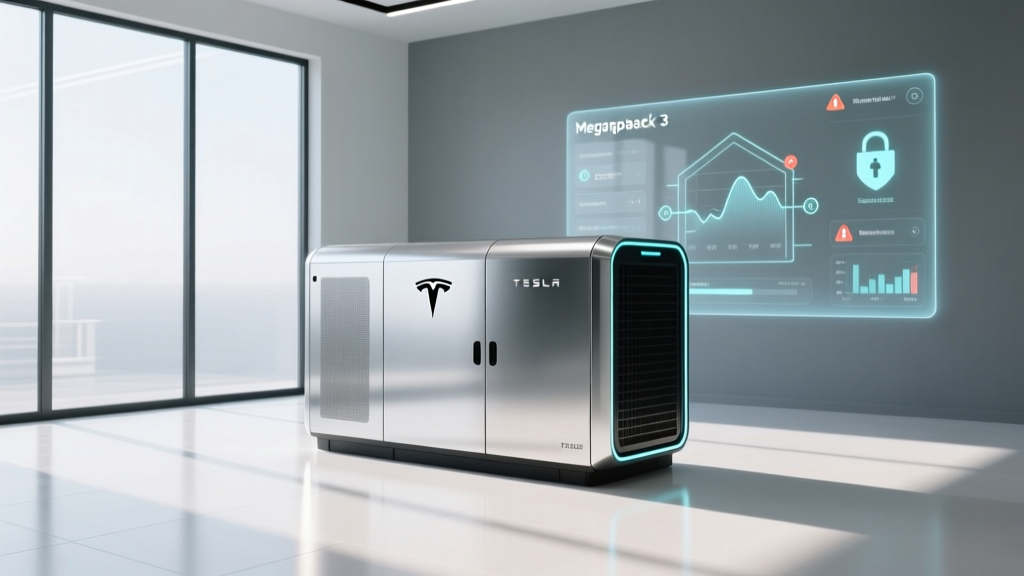
The Megapack 3 (announced in late 2024, with deliveries ramping through 2025) is Tesla's third-generation utility-scale battery. Each unit is roughly the size of a shipping container and stores approximately 3.9 MWh (megawatt-hours — yes, that's 3,900 kWh per unit) of energy using LFP (lithium iron phosphate) cells. Megapacks are daisy-chained into projects ranging from 10 MWh to over 3 GWh, such as the Moss Landing facility in California and the Victorian Big Battery in Australia.
Key specs for context (utility-scale, not consumer EV):
| Spec | Value |
|---|---|
| Energy per unit | ~3.9 MWh (3,900 kWh) |
| Continuous power per unit | ~1.25 MW |
| Cell chemistry | LFP (cathode supplier: CATL) |
| Thermal management | Liquid-cooled glycol loop |
| Warranty | 15 years, performance-guaranteed |
| Controller | Powerhub 2 gateway + local EMS |
| Grid interconnect | Utility-managed substation, not direct consumer |
Because Megapacks are not sold to consumers, there's no MSRP, no EPA range, and no §30D tax credit to discuss. The relevance to EV owners is indirect: Megapacks supply the grid that charges your car, and they share software lineage with Tesla's Powerwall and Supercharger infrastructure.
The 2025 Vulnerabilities: What Was Disclosed
Between Q4 2024 and mid-2025, independent security researchers and the U.S. Department of Energy's CSET (Cybersecurity and Energy Security Taskforce) flagged three primary weaknesses in the Megapack 3's monitoring and control stack:
1. Powerhub SCADA Gateway Exposure
The Powerhub 2 gateway, which aggregates telemetry from individual Megapacks and bridges to Tesla's cloud, was found exposing Modbus TCP ports (502) and a diagnostic HTTPS interface to the public internet on several deployments. Researchers at CISA confirmed that default credentials on some OEM-provisioned cellular backhauls allowed unauthenticated read access to state-of-charge, cell temperatures, and inverter status.
2. Firmware Signing Gaps
A separate disclosure by the security firm Dragos identified that Megapack 3 controller firmware updates in early 2025 builds were signed with a key hierarchy that did not enforce rollback protection. An attacker with local network access (e.g., a compromised utility IT VLAN) could theoretically push a downgraded firmware with known CVEs.
3. Telemetry Plaintext and Cloud API Tokens
Early field units transmitted some non-critical telemetry (ambient temp, HVAC duty cycle) over MQTT without TLS, and a leaked internal API token in a public GitHub repo in March 2025 briefly gave anyone with the URL read access to aggregated fleet metrics. Tesla revoked the token within hours of public disclosure.
Tesla's Response and the Patch Timeline
Tesla's energy-products security team responded faster than most industrial OEMs. According to Tesla's publicly posted security disclosures and CISA ICS advisories:
- December 2024: Port exposure mitigated via firewall policy push to all Powerhub 2 gateways over the cellular management channel.
- February 2025: Firmware v2025.4.1 introduced secure boot enforcement and rollback protection.
- March 2025: MQTT traffic migrated to TLS 1.3 across the fleet; the GitHub-leaked token was rotated and scoped down.
- Q2 2025: Tesla launched a dedicated Megapack bug bounty tier via Bugcrowd, paying up to $25,000 for valid SCADA-class findings.
As of early 2026, no public report indicates any Megapack was remotely commanded to discharge, charge unsafely, or alter grid frequency as a result of these vulnerabilities. The exposure was monitoring-class, not control-class — a critical distinction.
What This Means for Tesla Vehicle Owners and Supercharger Users
Tesla's consumer vehicles (Model 3, Model Y, Cybertruck, and the refreshed Model S/X) run on a separate firmware stack from Megapack. The vehicle-side telemetry, OTA update signing, and CAN bus isolation were not implicated in the 2025 Megapack disclosures. That said, three crossover concerns are worth flagging:
Supercharger Network Dependency
Many utility-scale Megapack installations sit co-located with Tesla Supercharger plazas — particularly rural sites where the Megapack buffers demand charges. A compromised Megapack controller could, in theory, disrupt local site power, though Superchargers have independent grid tie-ins and fallback logic.
Powerwall Shared Lineage
The Powerwall 3 home battery shares firmware primitives with Megapack's EMS layer. Tesla patched the Powerwall fleet in parallel with the Megapack rollout in Q1 2025. Home Powerwall owners should verify they are running firmware 2025.8.2 or newer via the Tesla app (Settings → Software).
Grid Reliability, Not Vehicle Safety
The real-world risk to EV owners is grid stability, not vehicle hacking. A coordinated attack on multiple Megapack sites could theoretically affect regional frequency regulation during peak demand — which would manifest as rolling outages, not as anything happening to your parked Model Y.
Practical Guidance for EV Owners in 2026
Based on the 2025 disclosures and Tesla's remediation, here's what actually matters if you own a Tesla vehicle or Powerwall:
- Keep vehicle firmware current. Tesla's OTA pipeline is cryptographically signed with a separate key hierarchy from Megapack. Delaying updates gains you nothing security-wise.
- Verify Powerwall firmware. If you have a Powerwall 3, confirm you're on the 2025.8.2+ branch. The Gateway 2 controller in older Powerwall 2 systems received a parallel patch.
- Don't expose your Powerwall Gateway to the public internet. Some early installers routed the Gateway's Ethernet port through consumer routers with UPnP enabled — disable this.
- Supercharger reliability is unaffected. No Supercharger downtime in 2025 was attributed to Megapack security events, per Tesla's Q4 2025 impact report.
- Monitor CISA ICS-CERT advisories if you operate a commercial Tesla energy deployment (fleet depot, workplace charging with Megapack buffering).
Broader Lessons: Grid-Scale Storage Security in the EV Era
The Megapack 3 episode fits a pattern across the energy-storage industry. Fluence (Siemens/AES), BYD Cube, and Sungrow utility systems all had public CVE disclosures between 2023 and 2025, typically around Modbus exposure and cloud-API hygiene. The U.S. Department of Energy's CESER office now requires vendors bidding on federally co-funded storage projects to submit a Software Bill of Materials (SBOM) and participate in an active bug bounty program.
For the EV buyer, the takeaway is not "don't buy Tesla." It's that the grid your car charges from is becoming a software-defined, internet-connected system, and its security posture is a legitimate purchasing consideration — especially if you rely on a single utility or a single charging network. Diversification (home Level 2 charging, CCS-adapter ownership for non-Tesla DC networks, and a Powerwall or equivalent for outage resilience) remains the most robust strategy.
Frequently Asked Questions
Were any Tesla vehicles hacked through the Megapack 3 vulnerabilities?
No. The 2025 disclosures affected the Megapack utility-scale storage controller and Powerhub SCADA gateway, which run on a separate firmware stack from Tesla's consumer vehicles. No Model 3, Model Y, Model S, Model X, or Cybertruck was implicated.
Is it safe to charge at a Supercharger co-located with a Megapack?
Yes. Supercharger plazas have independent grid interconnects and do not route vehicle-to-cloud traffic through the co-located Megapack controller. Tesla patched the affected Megapack firmware in Q1 2025.
Should I disconnect my Powerwall because of this?
No. Tesla issued a parallel patch for Powerwall systems in Q1 2025. Verify your firmware version in the Tesla app and ensure your Gateway is not exposed to the public internet via UPnP or port forwarding.
Has any Megapack ever been weaponized to disrupt the grid?
There is no public evidence as of early 2026 that any Megapack was remotely manipulated to cause grid instability. The 2025 vulnerabilities were monitoring-class (read access to telemetry), not control-class (write access to charge/discharge commands).
How does Tesla's bug bounty compare to other energy vendors?
Tesla's 2025 Megapack-tier bounty on Bugcrowd pays up to $25,000 for SCADA-class findings, which is competitive with Fluence and above most industrial OEMs but below pure software companies. The program is invite-only for the energy-products tier.
Where can I read the official disclosures?
CISA ICS-CERT advisories are posted at cisa.gov/news-events/ics-advisories. Tesla's own security disclosures are at tesla.com/legal/security. The DOE's CESER office publishes sector-wide guidance at energy.gov/ceser.