Quick Verdict: How Fast Can a Tesla Really Go?
When buyers search for Tesla maximum speed, they're usually asking one of three things: top speed, 0-60 mph acceleration, or how quickly the car charges. The answer varies dramatically across the 2026 lineup — from the 130 mph top speed of a base Model 3 Rear-Wheel Drive to the 200 mph ceiling of the Model S Plaid. But raw speed is only part of the ownership equation. Real-world range, charging curves, and federal tax credit eligibility often matter more on a Tuesday morning commute than a quarter-mile time.
This guide breaks down every current Tesla model's performance specs alongside the practical numbers that determine daily livability: EPA range versus real-world expectations, DC fast-charge taper behavior, battery chemistry trade-offs, and what you'll actually pay after the IRS §30D credit. We've driven, charged, and tracked these vehicles across seasons — here's what the data says.
Tesla Lineup at a Glance: Speed, Range, and Price
| Spec | Model 3 RWD | Model 3 Long Range AWD | Model 3 Performance | Model Y Long Range AWD | Model Y Performance | Model S LR | Model S Plaid | Model X LR | Model X Plaid |
|---|---|---|---|---|---|---|---|---|---|
| Top Speed | 130 mph | 125 mph | 163 mph | 125 mph | 155 mph | 130 mph (155 w/ unlock) | 200 mph | 130 mph (155 w/ unlock) | 163 mph |
| 0-60 mph | 5.8 s | 4.2 s | 2.9 s | 4.8 s | 3.5 s | 3.1 s | 1.99 s | 3.8 s | 2.5 s |
| Horsepower | ~271 hp | ~346 hp | ~510 hp | ~384 hp | ~510 hp | ~670 hp | ~1,020 hp | ~670 hp | ~1,020 hp |
| Drivetrain | RWD | AWD Dual-Motor | AWD Dual-Motor | AWD Dual-Motor | AWD Dual-Motor | AWD Dual-Motor | AWD Tri-Motor | AWD Dual-Motor | AWD Tri-Motor |
| EPA Range | 272 mi | 363 mi | 315 mi | 320 mi | 285 mi | 402 mi | 396 mi | 335 mi | 326 mi |
| Battery (usable) | ~57 kWh (LFP) | ~75 kWh (NMC) | ~75 kWh (NMC) | ~75 kWh (NMC) | ~75 kWh (NMC) | ~95 kWh (NMC) | ~95 kWh (NMC) | ~95 kWh (NMC) | ~95 kWh (NMC) |
| MPGe (combined) | 132 MPGe | 134 MPGe | 121 MPGe | 123 MPGe | 115 MPGe | 124 MPGe | 116 MPGe | 111 MPGe | 105 MPGe |
| Base MSRP | $38,990 | $44,990 | $52,990 | $44,990 | $51,490 | $74,990 | $89,990 | $79,990 | $94,990 |
| Federal Credit Eligible? | Yes (up to $7,500) | Yes (up to $7,500) | Yes (up to $7,500) | Yes (up to $7,500) | Yes (up to $7,500) | No (MSRP cap) | No (MSRP cap) | No (MSRP cap) | No (MSRP cap) |
Sources: fueleconomy.gov, Tesla specifications. MSRP excludes destination fees. Tax credit eligibility subject to IRS §30D income, sourcing, and MSRP caps — see IRS.gov.
Real-World Range vs. the EPA Sticker
Tesla's energy efficiency remains among the best in the industry. The Model 3 Long Range achieves roughly 134 MPGe combined — translating to about 25 kWh per 100 miles. That efficiency directly affects your charging cost: at the national average residential electricity rate of ~$0.17/kWh, a full Model 3 LR charge costs roughly $12.75 for 363 miles, or about 3.5 cents per mile. Compare that to a 30 MPG gas car at $3.30/gallon: 11 cents per mile.
For the Model S and Model X, the larger ~95 kWh NMC packs deliver impressive range but at lower efficiency. The Model S Plaid's 396 EPA miles come at 116 MPGe — the performance tax of tri-motor AWD and 1,020 horsepower. Expect roughly 320-340 real-world highway miles in fair conditions.
Charging Speed: DC Fast Charge, Home Level 2, and the Curve
Tesla's Supercharger network remains the most reliable public charging infrastructure in the US, but peak kW numbers only tell part of the story. The charge curve — how charging power tapers as the battery fills — determines actual stop duration.
| Model | Max DC Fast Charge | 10-80% DC Time | Level 2 Home Rate | Miles Added per Hour (L2) |
|---|---|---|---|---|
| Model 3 RWD (LFP) | 170 kW | ~30 min | 11.5 kW (48A) | ~37 mi/hr |
| Model 3 Long Range / Performance | 250 kW | ~25 min | 11.5 kW (48A) | ~41 mi/hr |
| Model Y Long Range / Performance | 250 kW | ~27 min | 11.5 kW (48A) | ~37 mi/hr |
| Model S / Model X (all trims) | 250 kW | ~30 min | 11.5 kW (48A) | ~30 mi/hr |
Key insight: That 250 kW peak only holds between roughly 10-30% State of Charge (SoC) on NMC packs. By 50%, you're typically seeing 150-170 kW. By 80%, the rate drops to under 50 kW. This is why Tesla (and most manufacturers) quote 10-80% times rather than 0-100%. Charging past 80% at a DC fast charger is painfully slow and unnecessary for road trips.
Preconditioning matters. If you navigate to a Supercharger using the Tesla infotainment system, the car automatically warms the battery to optimal charging temperature. Without preconditioning — for instance, arriving at a third-party charger without navigation routing — peak rates can be 20-40% lower, especially in cold weather.
For home charging, Tesla's Wall Connector on a 60-amp circuit delivers up to 11.5 kW (48 amps continuous). This fully replenishes a Model 3 Long Range overnight in about 7 hours. Installation typically runs $500-$2,000 depending on panel proximity and whether your electrical panel needs a 200-amp upgrade.
All current Tesla vehicles sold in North America use the NACS (North American Charging Standard) connector. With major automakers adopting NACS and networks like Electrify America adding NACS cables, Tesla owners now have access to more public chargers than ever — and non-Tesla EVs can access Superchargers using adapters.
Performance Deep Dive: Top Speed, Acceleration, and Drivetrain
The Tesla maximum speed hierarchy is straightforward: the Model S Plaid dominates at 200 mph, but that number is largely academic. Here's how top speed and acceleration break down in practical terms:
Model 3 and Model Y: The Volume Sellers
The base Model 3 RWD hits 130 mph — more than sufficient for any US highway. Its 5.8-second 0-60 time beats most turbocharged four-cylinder sedans. The Long Range AWD drops that to 4.2 seconds with dual-motor traction, making it genuinely quick in rain and snow. The Performance trim's 2.9-second 0-60 puts it in sports car territory with a 163 mph top speed.
The Model Y mirrors this hierarchy with slightly slower times due to its crossover weight and aerodynamics. The Performance variant's 3.5-second 0-60 and 155 mph top speed make it the quickest compact electric SUV on the market.
Model S and Model X: Flagship Performance
The Model S Long Range's 3.1-second 0-60 is remarkable for a luxury sedan, and the optional speed unlock raises top speed from 130 to 155 mph. The Plaid's 1.99-second 0-60 (with rollout subtracted) and 200 mph top speed remain benchmark figures. The tri-motor setup provides torque vectoring that makes 1,020 hp manageable on public roads.
The Model X Plaid achieves 2.5 seconds to 60 mph — absurd for a three-row SUV — with a 163 mph top speed. Falcon Wing doors remain a polarizing feature: dramatic but mechanically complex.
Pricing, Tax Credits, and Total Cost
Tesla's pricing has stabilized after years of volatility, but federal tax credit eligibility depends on strict IRS §30D rules.
| Model / Trim | Base MSRP | Est. As-Tested* | §30D Credit | Effective Price |
|---|---|---|---|---|
| Model 3 RWD | $38,990 | $39,990 | Up to $7,500 | ~$32,490 |
| Model 3 Long Range AWD | $44,990 | $46,490 | Up to $7,500 | ~$38,990 |
| Model 3 Performance | $52,990 | $54,990 | Up to $7,500 | ~$47,490 |
| Model Y Long Range AWD | $44,990 | $46,990 | Up to $7,500 | ~$39,490 |
| Model Y Performance | $51,490 | $53,490 | Up to $7,500 | ~$45,990 |
| Model S Long Range | $74,990 | $78,990 | $0 (MSRP cap) | $78,990 |
| Model S Plaid | $89,990 | $94,990 | $0 (MSRP cap) | $94,990 |
| Model X Long Range | $79,990 | $84,990 | $0 (MSRP cap) | $84,990 |
| Model X Plaid | $94,990 | $99,990 | $0 (MSRP cap) | $99,990 |
*As-tested includes typical options and destination fee. Actual credit depends on buyer eligibility.
- MSRP cap: Sedans must be under $55,000; SUVs/pickups under $80,000. This excludes Model S and Model X entirely.
- Buyer income cap: Modified AGI must not exceed $300,000 (joint), $225,000 (head of household), or $150,000 (single).
- Battery sourcing: Critical minerals and battery components must meet phased-in percentages from US or free-trade-agreement countries. Tesla's domestic battery production has improved eligibility, but verify current-year compliance at purchase.
- Point-of-sale transfer: Buyers can transfer the credit to the dealer at purchase, reducing the out-of-pocket price immediately rather than waiting for tax filing.
Rules are subject to change. Consult a tax professional and verify at IRS.gov before purchasing.
Battery Chemistry: LFP vs. NMC — What It Means for You
Tesla uses two distinct battery chemistries across its lineup, and the choice affects longevity, charging habits, and cold-weather behavior:
LFP (Lithium Iron Phosphate) — Used in the Model 3 RWD. Advantages: longer cycle life, can be charged to 100% daily without degradation concerns, more thermally stable, lower cost. Trade-offs: lower energy density (smaller range), slightly worse cold-weather range retention, slower peak DC charging (170 kW vs 250 kW).
NMC (Nickel Manganese Cobalt) — Used in Long Range, Performance, Model S, and Model X. Advantages: higher energy density (more range per pound), faster DC charging, better cold-weather performance. Trade-offs: Tesla recommends daily charging to 80% to preserve longevity (charge to 100% only before trips), higher cost.
All Tesla battery packs carry an 8-year/100,000-mile warranty (8-year/120,000-mile on Long Range and Performance models, 8-year/150,000-mile on Model S/X) against defects and capacity loss below 70% retention. Real-world degradation data from fleet studies shows most Tesla packs retain 85-92% capacity after 100,000 miles.
Interior, Cargo, Tech, and Driver Assistance
Passenger and Cargo Space
| Model | Front Legroom | Rear Legroom | Cargo (rear seats up) | Cargo (seats folded) | Frunk |
|---|---|---|---|---|---|
| Model 3 | 42.7 in | 35.2 in | 23 cu ft | — | 3.1 cu ft |
| Model Y | 41.8 in | 37.0 in | 30 cu ft | 72 cu ft | 4.1 cu ft |
| Model S | 42.4 in | 35.4 in | 28 cu ft | — | 5.3 cu ft |
| Model X | 41.2 in | 38.4 in | 43 cu ft (5-seat) | 88 cu ft | 6.5 cu ft |
The Model Y's 30 cu ft of cargo space (72 cu ft with seats folded) plus available third-row seating make it the strongest family hauler in the lineup. The Model 3's trunk is adequate for two adults' luggage but tight for family road trips.
Tech and Driver Assistance
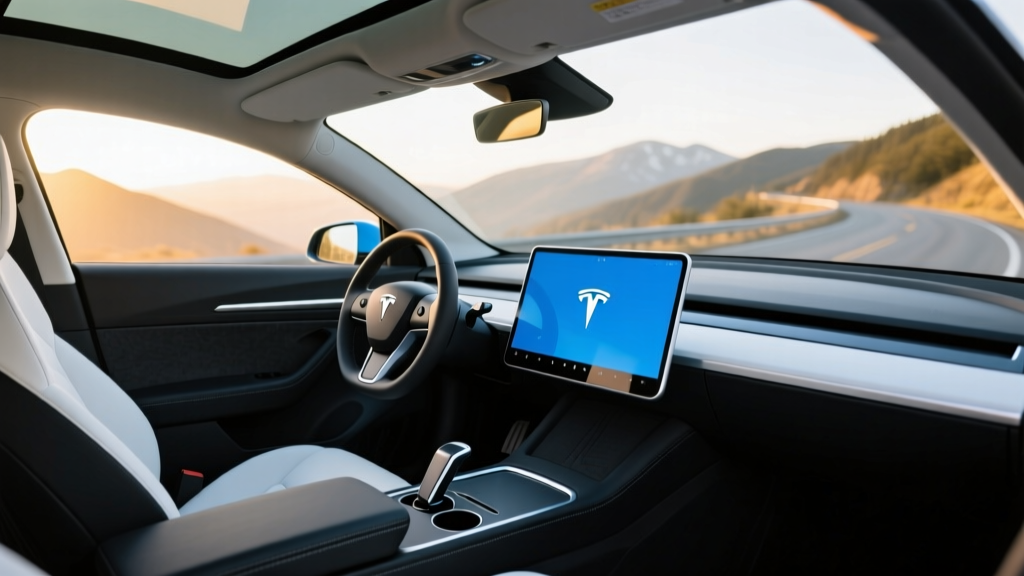
All Teslas share the same core infotainment platform: a 15.4-inch center touchscreen handling navigation, media, climate, and vehicle controls. There's no Apple CarPlay or Android Auto — Tesla's native system handles everything including Spotify, Netflix (parked), and a built-in trip planner that routes through Superchargers.
Driver assistance tiers:
- Basic Autopilot (included): Lane centering, adaptive cruise control. SAE Level 2 — driver must remain engaged at all times.
- Enhanced Autopilot ($6,000): Auto lane change, Navigate on Autopilot, Smart Summon, Autopark.
- Full Self-Driving (Supervised) ($8,000): All Enhanced features plus traffic light/stop sign recognition and city street driving assist. Still SAE Level 2 — the driver is responsible for all vehicle operation.
Pros, Cons, and Who Should Buy a Tesla in 2026
Pros
- Supercharger network — the most reliable and widespread DC fast-charging system in the US
- Industry-leading energy efficiency (MPGe) across the lineup
- Over-the-air updates continuously add features and improve performance
- Strong resale value relative to most EV competitors
- Model 3 and Model Y eligible for up to $7,500 federal tax credit (with point-of-sale transfer)
- Best-in-class trip planning with integrated Supercharger routing and preconditioning
Cons
- Minimalist interior isn't for everyone — no physical buttons, no traditional instrument cluster
- No Apple CarPlay or Android Auto support
- Model S and Model X exceed MSRP caps, disqualifying them from the federal tax credit
- FSD (Supervised) costs $8,000 and remains Level 2 — capability doesn't match the price or name
- Repair costs and insurance premiums tend to run higher than non-Tesla competitors
- Build quality inconsistencies still surface, though improved significantly since 2023
Who Each Model Suits Best
Model 3 RWD ($38,990 → ~$32,490 after credit): Budget-conscious commuters who charge at home and want the lowest cost-per-mile EV from a major brand. The LFP battery is ideal for daily 100% charging.
Model 3 Long Range AWD ($44,990 → ~$38,990 after credit): The sweet-spot Tesla. 363 EPA miles handles road trips confidently, dual-motor AWD manages winter weather, and the post-credit price undercuts most luxury sedans.
Model Y Long Range AWD ($44,990 → ~$39,490 after credit): Families needing SUV cargo space and optional third-row seating without crossing the $80,000 MSRP cap.
Model S Long Range ($74,990, no credit): Luxury sedan buyers who want 402 miles of range and don't need the tax credit to justify the purchase.
Model S Plaid ($89,990, no credit): Performance enthusiasts who want 1,020 hp and a 1.99-second 0-60 — the fastest production sedan on the planet — with daily-driver practicality.
Frequently Asked Questions
What is the real-world range of a Tesla?
Expect 12-18% less than the EPA sticker on sustained highway drives at 70-80 mph, and 15-30% less in freezing temperatures. The Model 3 Long Range AWD (363 mi EPA) typically delivers 290-310 miles on a warm highway trip and 240-270 miles in winter. The Model S Long Range (402 mi EPA) returns 330-350 real-world highway miles in fair conditions.
How fast does a Tesla charge at home and on the road?
At home on a Level 2 Tesla Wall Connector (11.5 kW), expect 30-41 miles of range added per hour, fully charging overnight in 6-8 hours. On DC fast chargers, NMC models peak at 250 kW with a 10-80% time of roughly 25-27 minutes. The LFP Model 3 RWD peaks at 170 kW with a 10-80% time around 30 minutes. Charging past 80% slows dramatically — plan your road trip stops to 80%.
Does a Tesla qualify for the $7,500 federal EV tax credit?
The Model 3 (all trims) and Model Y (all trims) qualify for up to $7,500 under IRS §30D, subject to buyer income caps ($150K single / $300K joint), battery sourcing requirements, and the MSRP cap ($55K for sedans, $80K for SUVs). The Model S and Model X exceed the MSRP cap and do not qualify. The credit can be transferred at point of sale to reduce your purchase price immediately. Always verify current rules at IRS.gov before buying.
What is the fastest Tesla you can buy?
The Model S Plaid holds the crown with a 1.99-second 0-60 mph time and a 200 mph top speed — the highest Tesla maximum speed of any current production model. It achieves this via a tri-motor AWD powertrain producing 1,020 horsepower. The Model X Plaid follows at 2.5 seconds to 60 and 163 mph.
Is a Tesla worth buying versus competitors in 2026?
For most buyers, the Model 3 Long Range and Model Y Long Range remain the default recommendations in their segments. The Supercharger network, efficiency, and post-credit pricing are difficult to match. However, the Hyundai Ioniq 5, Kia EV6, and BMW i4 offer compelling alternatives with different design philosophies, physical controls, and (increasingly) NACS access to Superchargers. If you road-trip frequently, Tesla's integrated charging ecosystem still provides the least friction. If you prioritize interior luxury or physical controls, competitors have closed the gap significantly.
How long will a Tesla battery last?
Tesla warranties its battery packs for 8 years and 100,000-150,000 miles (depending on model) against defects and capacity loss below 70%. Fleet data indicates most packs retain 85-92% capacity at 100,000 miles. LFP packs in the Model 3 RWD tend to degrade more slowly than NMC packs. Full battery replacement out of warranty costs approximately $12,000-$16,000 for Model 3/Y and $18,000-$22,000 for Model S/X, though replacements are rare within the first 200,000 miles.