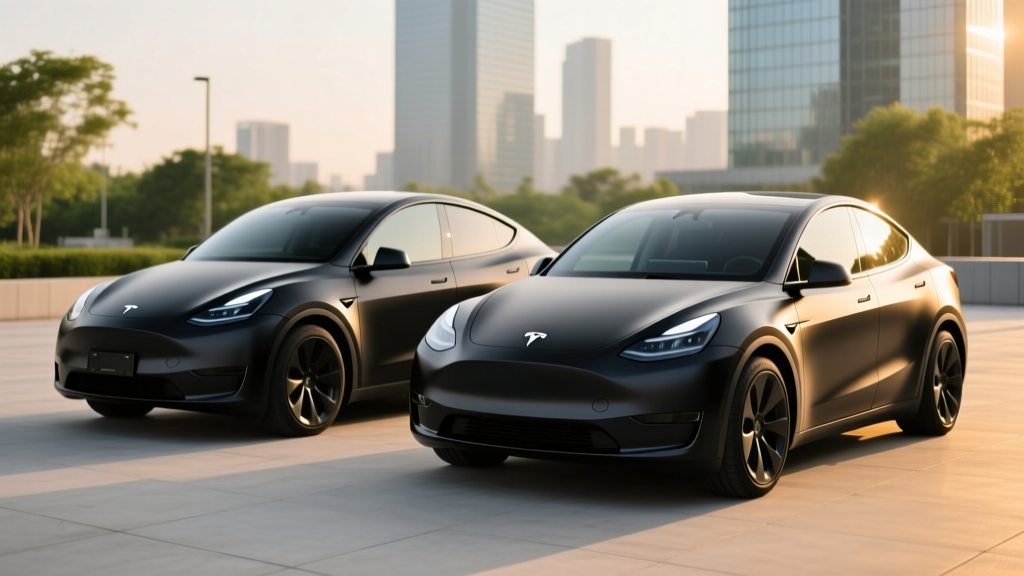
A matte black Tesla is one of the most searched aesthetics in the EV world — and for good reason. The stealth, light-absorbing finish transforms the already-sculpted lines of the Model Y and Model 3 into something far more aggressive and head-turning than any factory paint Tesla offers. But a wrap is a significant investment layered on top of an already expensive vehicle, and buyers searching for a "Tesla matte black" setup need to understand exactly what they're getting underneath the vinyl: real-world range, charging behavior, tax credit eligibility, and total cost.
This guide covers the 2026 Tesla Model Y and Model 3 — the two platforms most commonly wrapped in matte black — with exact specs, ownership economics, and practical advice on pairing a stealth wrap with the right configuration.
2026 Tesla Model Y: Specs, Range, and Real-World Numbers
The refreshed Model Y (internally dubbed "Juniper") carries into the 2026 model year with meaningful efficiency and interior upgrades. Here's what the data shows across the lineup:
| Spec | Long Range AWD | Performance AWD |
|---|---|---|
| EPA Range | 320 miles | 285 miles |
| Battery (usable) | ~75 kWh (NMC) | ~75 kWh (NMC) |
| Drivetrain | Dual Motor AWD | Dual Motor AWD |
| Horsepower | 384 hp | 456 hp |
| 0–60 mph | 4.8 sec | 3.5 sec |
| Peak DC Fast Charge | 250 kW | 250 kW |
| 10–80% DCFC Time | ~25 min | ~25 min |
| Level 2 Home Charge | 11.5 kW (~44 mi/hr) | 11.5 kW (~44 mi/hr) |
| Efficiency (combined) | 119 MPGe / 28 kWh/100mi | 110 MPGe / 30 kWh/100mi |
| Cargo (rear seats up) | 30.2 cu ft | 30.2 cu ft |
| Cargo (rear seats folded) | 72.1 cu ft | 72.1 cu ft |
| Rear Legroom | 38.4 in | 38.4 in |
| Base MSRP | $46,630 | $51,630 |
Sources: fueleconomy.gov, Tesla Model Y configurator.
EPA estimate: 320 miles. Expect ~270–290 miles on sustained highway driving at 70–75 mph. In freezing temperatures (below 32°F), plan for 220–260 miles due to battery preconditioning energy use and cabin heating draw. City/regenerative driving in mild weather can approach or slightly exceed the EPA figure.
2026 Tesla Model 3: The Sedan Alternative for Matte Black Builds
The Highland-refreshed Model 3 continues into 2026 with improved cabin isolation and a slightly larger battery pack. For buyers who want a lower, sportier canvas for a matte black wrap, the Model 3 is the more aerodynamic choice — and that translates directly to range.
| Spec | RWD | Long Range AWD | Performance AWD |
|---|---|---|---|
| EPA Range | 272 mi | 341 mi | 315 mi |
| Battery (usable) | ~57.5 kWh (LFP) | ~75 kWh (NMC) | ~75 kWh (NMC) |
| Drivetrain | Single Motor RWD | Dual Motor AWD | Dual Motor AWD |
| Horsepower | 271 hp | 346 hp | 456 hp |
| 0–60 mph | 5.8 sec | 4.2 sec | 2.9 sec |
| Peak DC Fast Charge | 170 kW | 250 kW | 250 kW |
| 10–80% DCFC Time | ~30 min | ~25 min | ~25 min |
| Level 2 Home Charge | 11.5 kW (~37 mi/hr) | 11.5 kW (~44 mi/hr) | 11.5 kW (~44 mi/hr) |
| Efficiency (combined) | 132 MPGe / 25 kWh/100mi | 125 MPGe / 27 kWh/100mi | 113 MPGe / 30 kWh/100mi |
| Trunk Volume | 23 cu ft | 23 cu ft | 23 cu ft |
| Rear Legroom | 35.2 in | 35.2 in | 35.2 in |
| Base MSRP | $38,990 | $45,630 | $52,630 |
The RWD Model 3 uses an LFP (lithium iron phosphate) battery — a chemistry that sacrifices some energy density for longer cycle life and the ability to charge to 100% daily without degradation concerns. The Long Range and Performance trims use NMC (nickel manganese cobalt) packs, which offer higher energy density but benefit from daily charging limits around 80%.
EPA estimate: 341 miles. Highway cruising at 75 mph yields ~290–310 miles in mild weather. Cold-weather highway range drops to approximately 240–270 miles. The Model 3's lower drag coefficient (0.219 Cd) gives it a real-world edge over the Model Y on long road trips.
Matte Black Wrap Costs and Practical Considerations
Tesla does not offer a factory matte black paint option. Achieving the look requires a professional vinyl wrap or paint protection film (PPF) with a matte finish. Here's what that investment looks like:
- Full matte black vinyl wrap (Model 3): $3,000–$5,000 depending on film brand (3M, Avery Dennison, KPMF) and installer reputation.
- Full matte black vinyl wrap (Model Y): $3,500–$5,500 due to larger surface area.
- Matte PPF (paint protection film + color change): $6,000–$9,000. This combines protection and aesthetics — the clear bra layer is replaced with a tinted matte film that shields against rock chips while delivering the stealth look.
- Matte ceramic coating over wrap: $800–$1,500. Highly recommended — matte finishes show water spots and fingerprints more than gloss, and a matte-specific ceramic coating makes maintenance far easier.
Critical wrap advice for Tesla owners: Choose a white or silver base vehicle if ordering new. Dark factory paint underneath a matte black wrap can telegraph imperfections and makes the wrap look less uniform if it's ever removed. A white base also keeps cabin temperatures lower in summer before the wrap is applied. If you're wrapping a used Tesla, inspect the factory paint condition first — wraps hide minor swirl marks but will conform to and highlight dents, deep scratches, or orange-peel clear coat.
Warranty note: A vinyl wrap does not void Tesla's vehicle warranty. However, if a wrap installer damages a sensor, camera, or trim piece, that damage is the installer's responsibility — not Tesla's. Choose an installer experienced with Tesla's tight panel gaps and camera housings.
Charging Speed and Infrastructure: What Matte Black Tesla Owners Need to Know
| Level | Power | Model Y (mi/hr) | Model 3 LR (mi/hr) | Notes |
|---|---|---|---|---|
| Level 1 (120V) | 1.4–1.9 kW | ~5–7 | ~5–8 | Emergency/trickle only |
| Level 2 (240V, 48A) | 11.5 kW | ~44 | ~44 | Home standard; full charge overnight |
| DC Fast (V3 Supercharger) | Up to 250 kW | ~200 mi in 15 min | ~200 mi in 15 min | Peak rate; tapers above 60% SoC |
| DC Fast (V4 Supercharger) | Up to 350 kW | Vehicle-limited to 250 kW | Vehicle-limited to 250 kW | Future OTA may unlock higher rates |
Understanding the charge curve: Tesla's peak 250 kW rate applies only at a low state of charge (roughly 10–30% SoC) with a preconditioned battery. By 60% SoC, the rate tapers to ~100 kW, and above 80% it drops further to ~40–50 kW. This is why manufacturers quote 10–80% times rather than 0–100%. For daily driving, charging to 80% at home on Level 2 and only using DCFC for road trips is the optimal strategy for NMC battery longevity.
Tesla's Supercharger network remains the most reliable DC fast-charging ecosystem in the US, with over 25,000 stalls nationwide. With the NACS connector standard on all Teslas, you also now have access to select Electrify America and EVgo stations equipped with NACS cables, though adapter-based CCS access has largely been phased out as the industry standardized on NACS.
Pricing, Tax Credits, and Total Cost After a Matte Black Wrap
Here's what a matte black Tesla build actually costs in 2026, factoring in the federal EV tax credit under IRS §30D:
| Item | Model 3 LR AWD | Model Y LR AWD |
|---|---|---|
| Base MSRP | $45,630 | $46,630 |
| Common upgrades (FSD, wheels, color) | +$3,000–$8,000 | +$3,000–$8,000 |
| As-tested estimate | ~$50,000 | ~$51,000 |
| Federal §30D tax credit | Up to $7,500 | Up to $7,500 |
| Estimated price after credit | ~$42,500 | ~$43,500 |
| Matte black wrap (mid-range) | $4,000 | $4,500 |
| Matte ceramic coating | $1,200 | $1,200 |
| Total out-the-door (est.) | ~$47,700 | ~$49,200 |
Federal tax credit eligibility (§30D) — critical caveats:
- MSRP cap: The Model Y qualifies (SUV cap: $80,000). The Model 3 qualifies (sedan cap: $55,000). Adding options that push the sedan above $55,000 disqualifies it.
- Buyer income cap: Modified AGI must not exceed $150,000 (single), $225,000 (head of household), or $300,000 (joint filers).
- Battery sourcing: A percentage of critical minerals and battery components must meet North American sourcing or free-trade-agency requirements. Tesla's US-built vehicles have generally qualified for the full $7,500, but component sourcing rules tighten annually. Verify current eligibility at IRS.gov §30D before purchasing.
- Point-of-sale transfer: As of 2024, the credit can be transferred to the dealer at purchase, reducing your out-of-pocket cost directly rather than waiting for a tax refund. Tesla supports this through their checkout flow.
Warranty, Tech, and Driver Assistance
Battery and drivetrain warranty: Tesla covers the Model 3 and Model Y battery and drive units for 8 years or 120,000 miles (Long Range/Performance) or 8 years/100,000 miles (RWD Model 3), whichever comes first, with a minimum 70% capacity retention threshold. This is competitive with the industry standard but slightly less generous than Hyundai/Kia's 10-year/100,000-mile EV powertrain coverage.
Warranty (bumper-to-bumper): 4 years / 50,000 miles.
Standout tech features:
- 15.4" center touchscreen (Model Y Juniper) with ventilated front seats and ambient lighting — a major interior upgrade from the pre-refresh model.
- Tesla Vision (camera-only) Autopilot included standard. Full Self-Driving (Supervised) available as a $8,000 option or $99/month subscription.
- Over-the-air updates continue to add features post-purchase — range optimizations, UI improvements, and entertainment apps.
- Sentry Mode and Dashcam record 360° footage, valuable for documenting any wrap damage or parking incidents.
- Heat pump standard on all 2026 trims — significantly improves cold-weather range and cabin heating efficiency vs. resistive heaters.
Tesla Autopilot and FSD (Supervised) are SAE Level 2 driver-assistance systems. The driver must remain fully engaged, hands on or near the wheel, and eyes on the road at all times. These systems do NOT make the vehicle self-driving. Only Level 4 robotaxi services like Waymo operate without a human driver in geofenced areas. Treat FSD as an advanced cruise-and-lane-keeping assist — nothing more.
Notable drawbacks:
- No Apple CarPlay or Android Auto — Tesla's proprietary infotainment is the only option.
- Camera-only vision system lacks LiDAR or radar redundancy; performance in heavy rain or direct sun glare can degrade.
- Panel gap inconsistency remains a concern on some build batches — inspect carefully before accepting delivery, especially important since a wrap will conform to and highlight any misalignment.
- Insurance premiums for Teslas run 15–30% higher than comparable non-Tesla EVs in most states, due to repair costs and parts pricing.
Matte Black Tesla: Pros and Cons
Pros
- Unmatched Supercharger network reliability for road trips
- Best-in-class efficiency (kWh/100mi) for both Model 3 and Model Y
- Over-the-air updates add value over time
- Strong resale value relative to other EVs
- Matte wrap is fully reversible — preserves factory paint underneath
- Heat pump standard for cold-weather range preservation
- Point-of-sale tax credit transfer reduces upfront cost
Cons
- No factory matte paint option — wrap adds $3,500–$9,000
- Matte wraps require specialized cleaning products and more frequent maintenance
- No CarPlay/Android Auto integration
- FSD (Supervised) is expensive and remains Level 2 — not autonomous
- Insurance costs 15–30% above segment average
- DCFC rate capped at 250 kW — slower than 800V competitors (Hyundai Ioniq 5 at 350 kW)
- Wrap may complicate body-shop repairs after collision damage
Is a Matte Black Tesla Worth It vs. Competitors?
The matte black Tesla appeal is as much about the ownership ecosystem as the aesthetic. Here's how the value proposition stacks up:
Choose a matte black Tesla Model Y if: you prioritize Supercharger network access for frequent road trips, need crossover cargo space (72 cu ft with seats folded), and want OTA updates that improve the car over time. The Juniper refresh finally fixed the interior quality complaints that plagued earlier Model Y builds.
Choose a matte black Tesla Model 3 if: you want the most efficient sedan in its class (132 MPGe on the RWD trim), prefer a lower, sportier silhouette for the wrap aesthetic, and don't need the cargo height of a crossover. The Model 3 Long Range at 341 miles EPA is one of the longest-range EVs available under $50,000.
Consider a matte-wrapped Hyundai Ioniq 5 N or BMW i4 instead if: you want 800V architecture for faster DC charging peaks (Ioniq 5: 350 kW capable), prefer physical controls alongside a touchscreen, or want a factory dark paint option (BMW offers frozen/matte finishes from the factory, eliminating wrap cost and maintenance).
Matte black Tesla Model Y: Best for families, road-trippers, and buyers who value the Supercharger network and cargo versatility.
Matte black Tesla Model 3: Best for commuters, efficiency-focused buyers, and those who want maximum range per dollar.
Factory matte competitor (BMW i4 M50, Porsche Taycan): Best for buyers who want OEM matte paint, premium interior materials, and don't need the Supercharger ecosystem.
Frequently Asked Questions
What is the real-world range of a matte black Tesla Model Y?
The 2026 Model Y Long Range AWD carries a 320-mile EPA estimate. In real-world highway driving at 70–75 mph, expect 270–290 miles. Cold weather (below freezing) reduces this to 220–260 miles. The matte black wrap itself has negligible impact on range — vinyl adds less than 10 lbs to the vehicle and does not meaningfully affect aerodynamics. However, black wraps absorb more solar heat, which can increase cabin cooling demand in summer by a small margin (~1–2% range impact in extreme heat).
How fast does a Tesla Model 3 charge at home and on the road?
On a 240V Level 2 home charger (48A/11.5 kW), the Model 3 Long Range adds approximately 44 miles of range per hour — a full overnight charge from 20% to 80% takes about 4–5 hours. On a V3 Supercharger, it peaks at 250 kW and reaches 10–80% in roughly 25 minutes with a preconditioned battery. The RWD trim peaks at 170 kW due to its smaller LFP battery, taking ~30 minutes for 10–80%.
How much does a matte black Tesla cost after the federal tax credit?
A 2026 Model Y Long Range AWD at ~$51,000 as-tested, minus a $7,500 federal credit (if eligible), comes to roughly $43,500 before adding a $3,500–$5,500 matte black wrap. Total all-in: approximately $47,000–$49,000. The Model 3 Long Range follows a similar pattern at ~$42,500 after credit, plus wrap costs. Eligibility depends on buyer income caps, MSRP limits, and battery component sourcing — always verify at IRS.gov before committing.
Does wrapping a Tesla void the warranty?
No. A professionally installed vinyl wrap does not void Tesla's battery, drivetrain, or bumper-to-bumper warranty. However, any damage caused during wrap installation (scratched trim, damaged camera housings, pulled wiring) is the installer's liability, not Tesla's. Document the vehicle's condition with photos before and after installation. If you need a body repair under warranty, the wrap section over the repair area will need to be replaced at your expense.
Does a matte black Tesla qualify for the $7,500 federal EV tax credit?
The vehicle itself qualifies — the wrap is an aftermarket modification that doesn't affect credit eligibility. Both the 2026 Model Y and Model 3 are assembled in the US and have historically met §30D battery sourcing requirements for the full $7,500 credit. However, buyer income limits ($150K single / $300K joint) and MSRP caps ($80K SUV / $55K sedan) apply. The credit can be transferred at point of sale to reduce your purchase price directly. Rules evolve annually — confirm current-year eligibility with your tax professional and the IRS clean vehicle credit page.
How do I maintain a matte black wrap on my Tesla?
Matte wraps require pH-neutral, matte-specific car wash soap (never wax-based or gloss-enhancing products). Hand washing is strongly preferred — automatic brush washes will scuff the matte finish. Apply a matte-specific ceramic coating ($800–$1,500) to make cleaning easier and protect against water spots, bird droppings, and UV fading. Expect the wrap to last 5–7 years with proper care before needing replacement. Avoid parking under trees that drip sap, as matte finishes are harder to decontaminate than gloss.