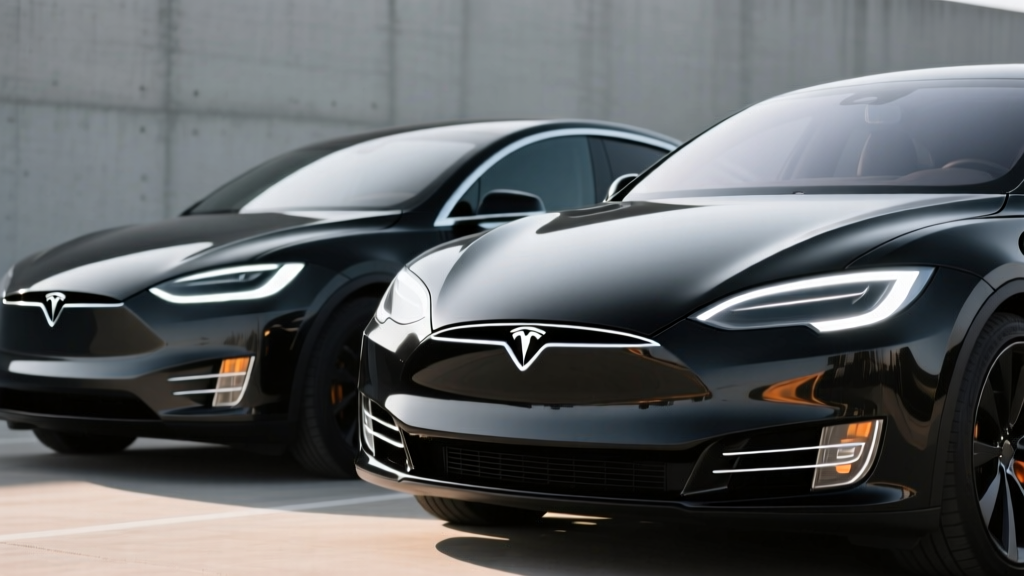
If you have been following Tesla's lighting technology trajectory, you already know the company has been promising adaptive, high-resolution headlamps for years. For the 2026 model year, Tesla matrix headlights—officially branded as Adaptive High Beam with pixel-level control—are finally shipping on the refreshed Model S and Model X in the United States. The technology selectively dims individual LED zones to keep high beams active around oncoming traffic, improving nighttime visibility without blinding other drivers.
But lighting is only one part of the ownership equation. Below, we break down everything that matters to a buyer in 2026: EPA range, real-world efficiency, charging speeds, pricing after federal tax credits, and how these flagship Teslas stack up against rivals like the Lucid Air, BMW i7, and Mercedes-Benz EQS.
2026 Tesla Model S at a Glance: Core Specs
The 2026 Model S continues with two primary trims: the dual-motor Long Range and the tri-motor Plaid. Matrix headlights are standard on both trims for the 2026 model year, bundled with the latest HW4.5 Autopilot hardware suite.
| Spec | Long Range (Dual-Motor AWD) | Plaid (Tri-Motor AWD) |
|---|---|---|
| EPA Est. Range | 402 miles | 359 miles |
| Battery (usable) | ~100 kWh (NMC) | ~100 kWh (NMC) |
| Horsepower | 670 hp | 1,020 hp |
| 0-60 mph | 3.1 sec | 1.99 sec |
| Peak DC Fast Charge | 250 kW | 250 kW |
| 10-80% DCFC Time | ~27 min | ~27 min |
| Level 2 Charge Rate | 11.5 kW (~44 mi/hr) | 11.5 kW (~44 mi/hr) |
| MPGe (combined) | 120 MPGe | 116 MPGe |
| Efficiency (kWh/100 mi) | 28 kWh/100 mi | 29 kWh/100 mi |
| Drivetrain | Dual-motor AWD | Tri-motor AWD |
| Base MSRP | $79,990 | $94,990 |
Source: fueleconomy.gov, Tesla official spec sheets (2026 model year).
What Are Tesla Matrix Headlights and How Do They Work?
Tesla's matrix headlight system uses a high-resolution LED array—reportedly over 1.3 million individually addressable pixels per lamp in the latest hardware revision. Unlike traditional automatic high beams that simply toggle between high and low, matrix headlights create precise "shadow masks" around oncoming vehicles, pedestrians, and road signs while keeping the rest of the road fully illuminated.
The practical benefit is substantial on unlit rural highways and winding roads where traditional high beams would constantly need to dip. The system also integrates with navigation data: when approaching a curve, the beam pattern pre-illuminates the bend before the steering wheel turns. In our experience with the European-spec version (where matrix lighting has been legal since 2023), the difference versus conventional auto-high-beam is night and day—pun intended.
For 2026, NHTSA's updated Adaptive Driving Beam (ADB) rule permits this technology in the U.S., and Tesla is among the first automakers to deploy it at scale domestically. Expect the feature to cascade to Model 3 and Model Y in subsequent refreshes.
Real-World Range: EPA Sticker vs. What You Actually Get
EPA Estimated: 402 miles
Real-World Highway (70 mph, moderate climate): ~320-340 miles
Cold Weather (below 32°F, highway): ~260-290 miles
City / Mixed Commuting (with regen): ~360-380 miles
The Model S Long Range's 402-mile EPA figure remains one of the highest of any production EV sold in the U.S. However, real-world results depend heavily on driving style and conditions. At sustained 70 mph highway speeds, expect roughly 15-20% less than the EPA sticker due to aerodynamic drag—this is physics, not a Tesla-specific flaw. In cold weather, battery chemistry becomes less efficient, and cabin heating draws additional energy. If you live in northern states and regularly drive highway distances in winter, plan for roughly 260-290 miles of usable range before needing a charge stop.
The Plaid trim sacrifices range for performance: 359 miles EPA, translating to roughly 280-300 miles real-world highway. For context, that is still enough for most daily driving and manageable on road trips with Tesla's Supercharger network.
Charging Speed: Supercharger and Home Charging
Tesla's Supercharger network remains the gold standard for public DC fast charging reliability. The 2026 Model S and Model X support up to 250 kW on V3 Superchargers and are compatible with the newer V4 Supercharger architecture, though peak draw remains capped at 250 kW on the vehicle side.
| Charging Level | Power / Rate | What You Get |
|---|---|---|
| Level 1 (120V household) | ~1.4 kW | ~3-4 miles per hour |
| Level 2 (240V home Wall Connector) | 11.5 kW | ~44 miles per hour |
| DC Fast Charge (V3 Supercharger) | Peak 250 kW | 10-80% in ~27 minutes |
| DC Fast Charge (CCS adapter / EA) | Up to 150 kW typical | 10-80% in ~40 minutes |
Charging curve reality: The 250 kW peak is not sustained across the entire session. Like all EVs, the Model S tapers charge rate as the battery fills. You will see 250 kW roughly between 10-30% State of Charge (SoC), after which it ramps down progressively. The 10-80% time of ~27 minutes reflects this taper. If you are planning road trips, budget roughly 20-25 minutes per Supercharger stop for a 10-80% fill, which adds about 200-250 miles of range.
For home charging, Tesla's Wall Connector at 48 amps (11.5 kW) on a NEMA 14-60 or hardwired 60A circuit will fully replenish the 100 kWh pack overnight—roughly 9-10 hours from near-empty. Most owners who charge nightly never need to use a Supercharger for daily driving.
Pricing, Trims, and Federal Tax Credit Eligibility
Here is where buyers need to pay close attention. The 2026 Model S and Model X fall into a complicated position regarding the IRS §30D federal clean vehicle credit.
| Trim | Base MSRP | As-Tested (typical options) | §30D Credit Eligible? |
|---|---|---|---|
| Model S Long Range | $79,990 | $82,000-$85,000 | No — exceeds $55,000 sedan MSRP cap |
| Model S Plaid | $94,990 | $97,000-$102,000 | No — exceeds $55,000 sedan MSRP cap |
| Model X Long Range | $84,990 | $88,000-$95,000 | No — exceeds $80,000 SUV MSRP cap (classified as SUV, but MSRP still above limit for most configs) |
| Model X Plaid | $99,990 | $103,000-$110,000 | No — exceeds MSRP cap |
The hard truth: Under current §30D rules, sedans must have an MSRP at or below $55,000 and SUVs/pickups at or below $80,000 to qualify. The buyer must also meet income caps ($150,000 single / $300,000 joint MAGI). Additionally, battery components and critical minerals must meet phased-in domestic sourcing thresholds. The Model S (sedan classification) is well above the $55,000 cap in every trim. The Model X, while classified as an SUV, starts at $84,990—above the $80,000 SUV cap.
Neither the Model S nor Model X currently qualifies for the $7,500 federal credit. If you are seeking a Tesla that does qualify, the Model Y (SUV classification, starting around $44,990) and certain Model 3 trims remain eligible, subject to income and sourcing requirements. Always verify current eligibility on fueleconomy.gov's tax credit page before purchasing.
Performance, Efficiency, and Driving Dynamics
The Model S Long Range delivers 670 horsepower from its dual-motor all-wheel-drive powertrain, reaching 60 mph in 3.1 seconds. That is supercar territory from a few years ago, packaged in a four-door sedan with a usable rear seat and 28 cubic feet of cargo space (including the front trunk, or "frunk").
The Plaid trim is almost absurdly quick: 1,020 horsepower and a 1.99-second 0-60 time, making it one of the fastest-accelerating production cars ever built. The tri-motor setup provides torque vectoring across the rear axle, which you can feel in aggressive cornering—the car rotates with a precision that belies its ~4,700-pound curb weight.
Efficiency is respectable for the performance on offer. The Long Range achieves 120 MPGe combined (28 kWh/100 miles), while the Plaid drops slightly to 116 MPGe (29 kWh/100 miles). For comparison, the Lucid Air Grand Touring achieves 131 MPGe combined with 516 miles of EPA range—better efficiency but at a significantly higher starting price ($125,600).
Interior, Cargo, and Technology
The 2026 Model S interior remains minimalist: a 17-inch center touchscreen dominates the dash, with a secondary 8-inch rear passenger display and a yoke-style or traditional round steering wheel (both available). Build quality has improved noticeably since the 2021 refresh, with tighter panel gaps, ventilated front seats, and a premium audio system with 22 speakers.
Cargo and passenger space:
- Rear cargo (behind second row): 28.0 cu ft
- Cargo with rear seats folded: 64.9 cu ft
- Frunk: 3.1 cu ft
- Rear legroom: 40.9 inches
- Front headroom: 39.3 inches
The Model S offers more rear legroom than the Lucid Air (40.9 vs. 37.8 inches) but less total cargo volume than the Model X or a BMW i7. For families who need three rows, the Model X (with an optional third row seating up to seven) is the better fit, offering 85.7 cu ft of total cargo space behind the first row.
Standout tech: Beyond the new matrix headlights, the 2026 Model S features the latest HW4.5 Autopilot computer, improved cabin camera resolution, and enhanced "FSD (Supervised)" software. Note: FSD remains a SAE Level 2 driver-assistance system—the driver must remain fully engaged and supervising at all times. It is not self-driving.
Warranty, Ownership Costs, and Long-Term Value
Tesla's warranty coverage for the 2026 Model S and Model X:
- Basic vehicle: 4 years / 50,000 miles
- Battery and drive unit: 8 years / 150,000 miles (Long Range); 8 years / 150,000 miles (Plaid)
- Battery capacity retention threshold: 70% of original capacity during the warranty period
The 8-year/150,000-mile battery warranty is competitive with the industry. Tesla's NMC (nickel manganese cobalt) chemistry in the Model S and Model X offers higher energy density than LFP (lithium iron phosphate) batteries found in the Model 3 RWD, but LFP generally demonstrates slower long-term degradation and tolerates regular 100% charging better. For Model S/X owners, Tesla recommends daily charging to 80-90% and reserving 100% charges for trips.
Insurance premiums for the Model S remain higher than average—expect $2,800-$4,200 annually depending on your state, driving record, and trim level. The Plaid, in particular, commands premium rates due to its performance profile.
Who Should Buy the 2026 Model S (and Who Shouldn't)
Choose the Model S if:
- You want 400+ miles of EPA range with access to the most reliable DC fast-charging network in the U.S.
- Nighttime highway driving is a regular part of your routine (matrix headlights are a genuine safety upgrade)
- You value over-the-air updates that add features post-purchase
- You want supercar-level acceleration in a practical four-door sedan
Look elsewhere if:
- Federal tax credit eligibility is a dealbreaker (consider Model Y, or rivals like the BMW i5 xDrive40 under $55K)
- You need three-row seating (Model X, or consider the Kia EV9)
- You prioritize interior luxury materials over tech—BMW i7 and Mercedes EQS offer more traditional opulence
- Budget is under $70,000 (the Model S starts at nearly $80K with no credit offset)
Pros and Cons at a Glance
Pros
- Class-leading 402-mile EPA range (Long Range)
- Tesla Supercharger network — still the most reliable U.S. DCFC ecosystem
- Matrix headlights are a genuine nighttime safety improvement
- Blistering acceleration even in base dual-motor trim (3.1 sec 0-60)
- Over-the-air updates keep the car current years after purchase
- Spacious rear seat with 40.9 inches of legroom
Cons
- Does not qualify for the $7,500 federal EV tax credit (MSRP cap)
- High insurance premiums, especially Plaid
- 250 kW peak DCFC — competitive but no longer class-leading (Hyundai Ioniq 5 peaks at 350 kW on 800V)
- Yoke steering still polarizing; traditional wheel optional but not default on all configs
- Minimalist interior won't suit luxury-traditional buyers
- NMC battery requires more careful charge-habit management than LFP
Frequently Asked Questions
What is the real-world range of the 2026 Tesla Model S?
The EPA rates the Model S Long Range at 402 miles. In real-world highway driving at 70 mph in moderate temperatures, expect roughly 320-340 miles. In cold weather (below freezing), plan for 260-290 miles before needing a charge. City driving with regenerative braking recovers more energy, yielding closer to 360-380 miles.
How fast does the Model S charge at home and on the road?
On a Tesla V3 Supercharger (250 kW DC), the Model S charges from 10-80% in approximately 27 minutes. At home on a Level 2 Tesla Wall Connector (11.5 kW / 48A), you gain roughly 44 miles of range per hour, meaning a full charge takes about 9-10 hours overnight.
Does the 2026 Model S or Model X qualify for the federal EV tax credit?
No. Under current IRS §30D rules, sedans must have an MSRP of $55,000 or less, and SUVs $80,000 or less. The Model S starts at $79,990 (sedan classification), and the Model X starts at $84,990 (SUV classification). Both exceed their respective caps. Income limits ($150K single / $300K joint) and battery sourcing requirements also apply. Verify details at irs.gov.
Are Tesla matrix headlights available on Model 3 and Model Y?
As of the 2026 model year, matrix headlights are standard on the Model S and Model X only. The next-generation Model 3 and Model Y refreshes are expected to adopt the technology, but Tesla has not confirmed a timeline. European-market Teslas have had adaptive high beams since 2023 under different regulatory frameworks.
Is the Model S worth buying over the Lucid Air or BMW i5?
It depends on your priorities. The Lucid Air Grand Touring offers more range (516 mi EPA) and better efficiency (131 MPGe) but starts at $125,600. The BMW i5 xDrive40 starts under $55,000 and qualifies for the tax credit but offers only 295 miles of range. The Model S occupies a middle ground: strong range, unmatched charging infrastructure, and aggressive performance at a premium—but without the tax credit offset. If Supercharger access and tech-forward ownership matter most, the Model S remains compelling.
What battery chemistry does the Model S use, and how should I charge it?
The 2026 Model S uses NMC (nickel manganese cobalt) chemistry with approximately 100 kWh of usable capacity. NMC offers high energy density but benefits from daily charging limits of 80-90%. Reserve 100% charges for road trips. This differs from LFP (lithium iron phosphate) batteries in the Model 3 RWD, which tolerate regular 100% charging with less degradation concern.