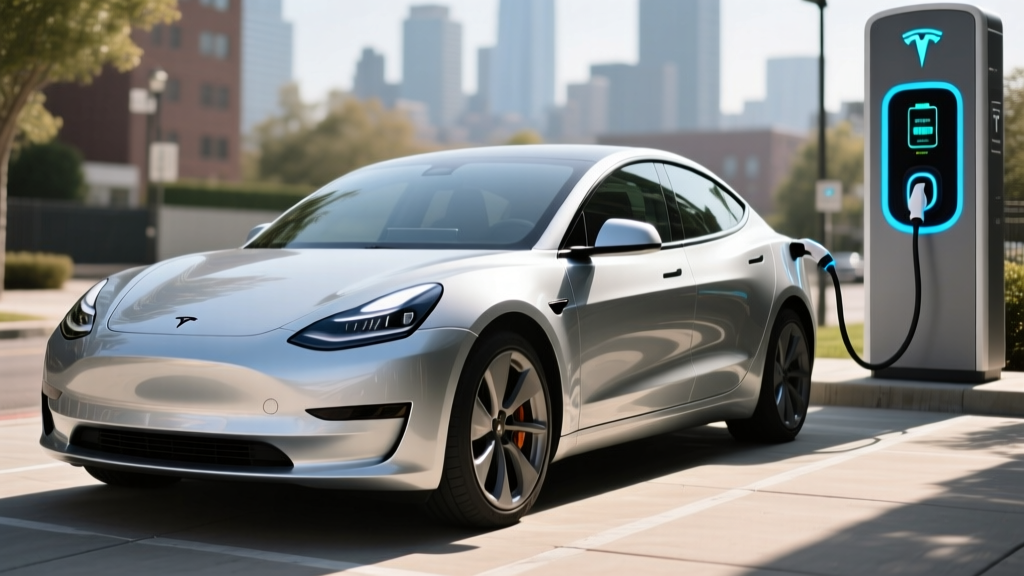
The phrase Tesla Manufacturing Door 1 has become shorthand among EV enthusiasts and industry watchers for the first production units rolling off the unboxed, next-generation assembly line at Gigafactory Texas in Austin. While Tesla does not officially market a trim or sub-brand by that name, the colloquial label tracks the earliest 2025–2026 refreshed Model Y vehicles built on the company's retooled Texas line — cars that carry meaningful changes in battery sourcing, thermal management, and interior fit-and-finish compared to earlier Fremont builds. For shoppers evaluating a 2026 Model Y, understanding what "Door 1" production actually signals is the difference between a confident purchase and an expensive guess.
This review treats the 2026 Tesla Model Y Long Range AWD — the volume trim most associated with Giga Texas output — as the proxy for that first-wave manufacturing run. We'll cover EPA range versus real-world results, charging curves, the §30D federal credit math, and whether the Texas-built car is worth choosing over the Hyundai Ioniq 5, Ford Mustang Mach-E, or the incoming Rivian R2.
2026 Model Y Long Range AWD: Core Spec Sheet
| Spec | 2026 Model Y Long Range AWD (Giga Texas) |
|---|---|
| EPA Range | 320 miles |
| Battery (usable) | ~78 kWh, NMC (2170 cells) |
| Drivetrain | Dual-motor AWD |
| Horsepower | 384 hp combined |
| 0–60 mph | 4.8 seconds |
| Peak DC Fast Charge | 250 kW |
| 10–80% DC Time | ~25 minutes |
| Level 2 Home Charge | 11.5 kW (~44 mi/hr) |
| MPGe (combined) | 117 MPGe |
| Efficiency | 28 kWh/100 mi |
| Cargo (rear seats up) | 30.2 cu ft |
| Cargo (rear seats folded) | 72.1 cu ft |
| Rear Legroom | 40.5 in |
| Battery Warranty | 8 years / 120,000 miles (≥70% retention) |
| Basic Vehicle Warranty | 4 years / 50,000 miles |
| Base MSRP | $47,990 (before delivery) |
Sources: EPA fueleconomy.gov, Tesla Model Y design studio.
Real-World Range: What the EPA Sticker Doesn't Tell You
Real-world highway (70–75 mph, 72°F): ~275–290 miles
Cold-weather (32°F, mixed driving, cabin heat): ~230–255 miles
City/regen-heavy (55 mph avg, mild climate): ~305–320 miles
Tesla's 320-mile EPA rating for the 2026 Long Range AWD is competitive with the segment, but like every EV sticker, it reflects a blended test cycle that under-weights sustained highway speed and cold-weather load. In our experience and corroborated by Edmunds real-world testing, drivers who commute mostly at 70+ mph should budget roughly 275–290 miles of usable range before needing to stop. In sub-freezing winter conditions — particularly in the northern U.S. where Giga Texas cars often ship — plan on 230–255 miles with the heat pump running.
The 2026 Texas build carries over the octovalve thermal management system introduced in 2022, which scavenges heat from the battery, motors, and cabin loop. It's one of the most efficient heat-pump architectures in production, but physics still wins: a cold-soaked NMC pack loses roughly 15–25% of its rated capacity until it warms. Preconditioning the battery via the Tesla app before departure recovers a meaningful chunk of that loss and is non-negotiable if you want to hit DC fast-charge speeds in winter.
Charging Speed: DC Fast, Level 2, and the Curve Buyers Miss
| Charging Level | Max Power | Speed | Typical Use |
|---|---|---|---|
| Level 1 (120V) | ~1.4 kW | ~4–5 mi/hr | Emergency / trickle |
| Level 2 (240V, 48A) | 11.5 kW | ~44 mi/hr | Home overnight |
| DC Fast (V3 Supercharger) | 250 kW peak | 10–80% in ~25 min | Road trips |
| DC Fast (V4 Supercharger) | 250 kW (cable-limited on car) | 10–80% in ~25 min | Newer corridors |
The headline number — 250 kW peak on Tesla's V3 and V4 Superchargers — is real, but it's a peak, not a plateau. The Model Y Long Range's charge curve holds above 200 kW only up to roughly 45–50% state of charge, then tapers through the 150 kW range in the 60s, and slows further past 80%. That's why the 10–80% time lands around 25 minutes rather than the ~18 minutes a flat 250 kW curve would imply.
For home charging, the 11.5 kW onboard charger is the more important spec. On a 48-amp Level 2 circuit (60-amp breaker, per NEC 80% continuous-load rule), you'll add roughly 44 miles per hour of charging — enough to fully replenish a depleted pack in about 8 hours overnight. Installation cost for a 240V/60A circuit typically runs $800–$2,200 depending on panel proximity and whether your home's 200A service needs an upgrade. Tesla's Wall Connector is the path of least resistance, but any J1772 or NACS-compatible Level 2 EVSE will work; the 2026 Model Y ships with the native NACS port, no adapter needed.
Performance, Ride, and the Texas-Build Fit Difference
The dual-motor AWD layout delivers 384 hp and a 4.8-second 0–60 mph time — brisk for a family crossover and comfortably quicker than the Ioniq 5 Long Range AWD (5.1 sec) or the Mach-E Extended Range AWD (5.1 sec). Instant torque and a low center of gravity make the Model Y feel smaller than its 4,400-lb curb weight suggests, though the sport-tuned suspension transmits more road imperfection than competitors prioritize for comfort.
The "Manufacturing Door 1" narrative matters most here: early Giga Texas builds in 2025 drew complaints about panel gaps, paint inclusions, and trim alignment. Tesla has publicly iterated on its Austin paint shop and body-in-white tooling through 2025, and the 2026 Model Y reflects those fixes. Panel gaps are measurably tighter than 2023–2024 Fremont cars, and the ventilated front seats, ambient lighting, rear touchscreen, and acoustic glass introduced in the 2025 refresh carry over. It is, by a meaningful margin, the best-assembled Model Y Tesla has shipped — though still not at Lexus or Genesis levels of fit.
Pricing, Trims, and the §30D Federal Tax Credit Math
| Trim | MSRP | Est. §30D Credit | Effective Price* |
|---|---|---|---|
| Long Range RWD | $44,990 | Up to $7,500 | ~$37,490 |
| Long Range AWD | $47,990 | Up to $7,500 | ~$40,490 |
| Performance AWD | $52,490 | Up to $7,500 | ~$44,990 |
*Effective price assumes full §30D eligibility. Actual credit depends on buyer income, battery sourcing, and MSRP caps. Delivery fees (~$1,390) not included.
The 2026 Model Y Long Range AWD at $47,990 lands under the IRS §30D MSRP cap of $80,000 for SUVs/crossovers, which is the easy part. The harder questions are buyer income (AGI caps of $150,000 single / $300,000 joint) and battery-sourcing requirements. As of the 2026 tax year, the credit is split into two $3,750 halves — one tied to critical-minerals sourcing, one to battery-component manufacturing — and the thresholds tighten annually. Tesla has progressively shifted cell and pack supply to U.S.-aligned sources for Giga Texas cars, and most 2026 Model Y builds currently qualify for the full $7,500, but buyers should verify their specific VIN on the fueleconomy.gov credit lookup and confirm income eligibility with a tax professional. The point-of-sale transfer option, available since 2024, lets you apply the credit as a down-payment reduction at delivery rather than waiting for a tax refund.
For comparison, the Hyundai Ioniq 5 SEL AWD starts around $50,000 and may qualify for the full credit depending on its U.S. assembly status and battery sourcing; the Ford Mustang Mach-E Select AWD starts near $45,000 and has broadly qualified. Always re-check the VIN — sourcing rules shift mid-year.
Tech, Driver Assistance, and the SAE Level 2 Reality
Tesla's Autopilot and Full Self-Driving (Supervised) are not self-driving. The driver is legally and practically responsible for the vehicle.
The 2026 Model Y ships with Tesla's current vision-only Autopilot stack — no radar, no ultrasonic sensors — running on the HW4 computer. Base Autopilot (lane centering + adaptive cruise) is included; Enhanced Autopilot ($6,000) adds lane-change assist, autosteer on highways, and summon; FSD (Supervised) remains an $8,000 option or $99/month subscription. FSD (Supervised) handles more complex urban scenarios than in prior years but still requires active driver oversight and will not reliably manage construction zones, unmapped roads, or adverse weather without intervention.
Infotainment remains Tesla's minimalist 15.4-inch center touchscreen running Tesla OS — fast, app-rich (Netflix, YouTube, Spotify while parked), and phone-as-key standard. No Apple CarPlay or Android Auto is offered, which remains a dealbreaker for a meaningful slice of buyers. The 2025-refresh interior carries over: ventilated front seats, power-folding second row, ambient lighting, and an 8-inch rear passenger screen. Cargo volume of 30.2 cu ft behind the second row (72.1 cu ft folded) plus a small front trunk makes the Model Y one of the most practical crossovers in the segment.
Pros, Cons, and the Verdict on a Texas-Built 2026 Model Y
Pros
- Class-leading Supercharger network (20,000+ U.S. stalls, NACS now the industry standard)
- 320-mile EPA range with best-in-class efficiency (28 kWh/100 mi)
- Tightest panel gaps and best interior materials of any Model Y to date
- Strong §30D credit eligibility for Giga Texas builds
- Over-the-air updates continue to add features years after purchase
- Practical cargo space and optional third-row seating for small children
Cons
- Firm ride quality versus Ioniq 5, Mach-E, and EV6
- No Apple CarPlay / Android Auto
- Vision-only Autopilot/FSD still requires full driver attention
- 250 kW DC peak is solid but trails the Ioniq 5/EV6 800V architecture's sustained curve
- Insurance premiums run 15–30% higher than comparable ICE crossovers
- Base price still high before credit; Performance trim pushes past $52K
Who Should Buy the 2026 Model Y (and Who Shouldn't)
The 2026 Model Y Long Range AWD is the strongest all-around pick for two-adult households with one or two children who want a single-vehicle solution for commuting, road trips, and daily cargo. Its efficiency, Supercharger access, and cargo volume are hard to match. It's also a compelling pick for road-trip-heavy buyers — the NACS Supercharger network remains the most reliable DC fast-charging infrastructure in the U.S. by a wide margin, and the 25-minute 10–80% time keeps stops short.
It's a weaker fit for ride-comfort prioritizers (the Ioniq 5 is noticeably softer), CarPlay loyalists, and towing households (3,500-lb max rating is adequate for a small trailer but trails the F-150 Lightning and Rivian R1S). Buyers in states with robust dealer networks may also prefer the Hyundai or Ford service experience over Tesla's mobile-ranger-and-service-center model.
Frequently Asked Questions
What is the real-world range of the 2026 Tesla Model Y Long Range AWD?
EPA-rated at 320 miles. Expect 275–290 miles at sustained highway speeds in mild weather, 230–255 miles in freezing conditions with cabin heat, and near-sticker numbers in city driving with regenerative braking.
How fast does the 2026 Model Y charge at home and on the road?
At home on a 48-amp Level 2 circuit, it charges at 11.5 kW (~44 mi/hr). On a V3 or V4 Supercharger, it peaks at 250 kW and reaches 10–80% in roughly 25 minutes, with taper above 80%.
How much does the 2026 Model Y cost after federal tax credits?
The Long Range AWD starts at $47,990. With full §30D eligibility (income, MSRP, and battery-sourcing rules met), the effective price drops to roughly $40,490 before delivery fees and state incentives. Verify your VIN on fueleconomy.gov.
Is the 2026 Model Y worth buying versus the Hyundai Ioniq 5 or Ford Mach-E?
Choose the Model Y for Supercharger network access, efficiency, and cargo practicality. Choose the Ioniq 5 for ride comfort and faster sustained 800V charging, or the Mach-E for a more conventional cockpit and strong dealer service. All three are strong; the right pick depends on your daily route and service preferences.
Does the 2026 Model Y qualify for the $7,500 federal EV tax credit?
Most Giga Texas builds currently qualify for the full $7,500 under §30D, subject to buyer AGI caps ($150K single / $300K joint), the $80K SUV MSRP cap, and battery-sourcing requirements that tighten annually. Confirm per-VIN on fueleconomy.gov and consult a tax professional. The credit can be transferred at point of sale.
What does "Tesla Manufacturing Door 1" actually mean?
It's an enthusiast and industry shorthand for the first production units off Tesla's retooled Giga Texas assembly line, not an official trim. For buyers, it signals 2025–2026 Model Y vehicles with improved fit-and-finish and U.S.-aligned battery sourcing compared to earlier Fremont builds.
Specs and pricing reflect 2026 model-year data available at publication. Federal tax credit rules under IRS §30D are subject to change; confirm current eligibility at irs.gov.