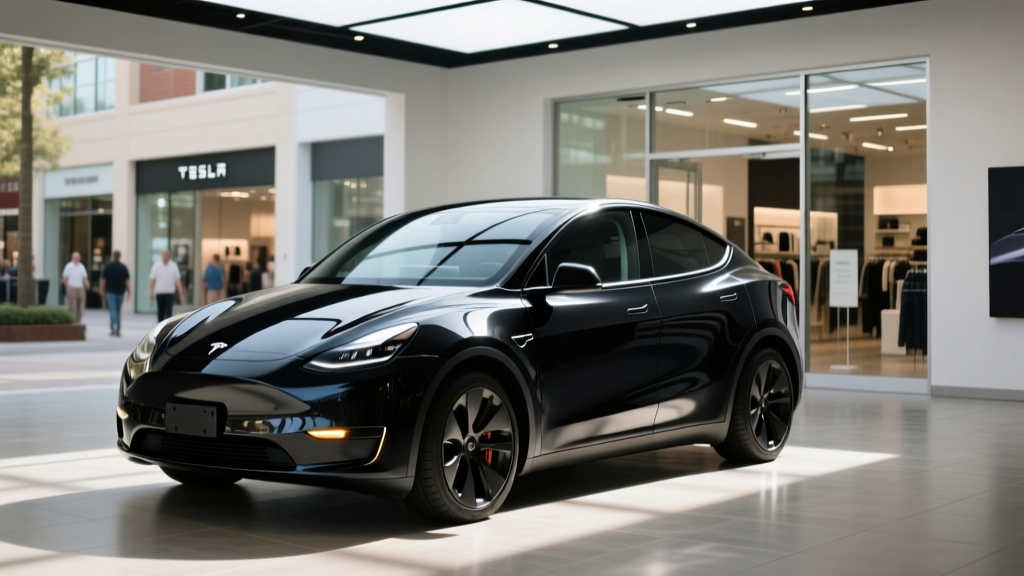
If you've walked past the Tesla pop-up at the Mall of Georgia in Buford, you've likely seen the refreshed Model Y on display — sleek Juniper styling, minimalist interior, and a sales specialist ready to answer questions. But before you put down a deposit, you need the numbers that matter: real-world range, actual charging speeds, total cost after incentives, and how it stacks up against the Hyundai Ioniq 5, Ford Mustang Mach-E, and Chevrolet Equinox EV.
This review breaks down the 2026 Tesla Model Y with the exact specs, pricing, and ownership realities you need to evaluate whether a purchase at the Mall of Georgia location — or any Tesla showroom — makes sense for your driving life.
2026 Tesla Model Y: Core Specifications at a Glance
| Specification | Value |
|---|---|
| EPA Range | 320 miles |
| Battery (usable) | ~78 kWh, NMC chemistry |
| Drivetrain | Dual-motor AWD |
| Horsepower | 384 hp (combined) |
| 0–60 mph | 4.8 seconds |
| Max DC Fast Charge | 250 kW (peak) |
| 10–80% DC Charge Time | ~25 minutes |
| Level 2 Home Charge Rate | 11.5 kW (~37 mi/hr) |
| EPA Efficiency | 117 MPGe combined / 29 kWh/100 mi |
| Cargo Volume | 30.2 cu ft (rear seats up), 72.1 cu ft (folded) |
| Rear Legroom | 41.6 inches |
| Battery Warranty | 8 years / 120,000 miles |
| Base MSRP (Long Range AWD) | $44,990 |
Tesla also offers a base Rear-Wheel Drive (RWD) variant with an LFP (lithium iron phosphate) battery at a lower price point, detailed in the pricing section below. The Long Range AWD remains the volume seller and the model most commonly displayed at pop-up locations like the Mall of Georgia.
Real-World Range: What the EPA Number Doesn't Tell You
EPA Estimate: 320 miles (Long Range AWD)
Real-World Highway (70–80 mph): ~265–285 miles
Cold Weather (below 32°F): ~220–250 miles
Mixed City/Suburban Commute: ~300–315 miles
The EPA's 320-mile figure for the Long Range AWD is achievable in moderate temperatures with a mix of city and suburban driving where regenerative braking recovers energy. On a sustained highway run at 75 mph — the kind of trip you'd take from Atlanta to Savannah — expect to use roughly 28–30 kWh per 100 miles, yielding closer to 270 miles before you'd want to stop.
Georgia winters are mild, so cold-weather degradation is less severe than in northern states. Still, any drive in the 20–35°F range will cost you 20–25% of range due to battery heating demands and cabin climate use. The Model Y's standard heat pump helps significantly compared to older resistance-heater EVs, but physics is physics.
The RWD variant, equipped with an LFP battery, carries a lower EPA rating of approximately 270 miles. LFP chemistry has a lower energy density than NMC, but it compensates with superior cycle life and the ability to charge routinely to 100% without accelerating degradation — a practical advantage for daily commuters.
Charging Speed: DC Fast Charging and Home Level 2
Charging speed is where the Model Y's Tesla Supercharger network advantage becomes tangible. Here's the breakdown by charging level:
| Charging Level | Power | Speed (approx.) | Use Case |
|---|---|---|---|
| Level 1 (120V household) | ~1.4 kW | ~4–5 mi/hr | Emergency / overnight trickle |
| Level 2 (240V home wall connector) | 11.5 kW | ~37 mi/hr | Daily home charging |
| DC Fast Charge (Supercharger V3) | 250 kW peak | 10–80% in ~25 min | Road trips |
| DC Fast Charge (Supercharger V4) | Up to 325 kW (cable) | 10–80% in ~20 min (vehicle-limited) | Newer Supercharger stalls |
Charging curve reality: The 250 kW peak rate only holds between roughly 10% and 35% state of charge. Above 50%, the rate tapers progressively — by 80% SoC, you're pulling roughly 60–70 kW. This is why Tesla (and every other manufacturer) quotes 10–80% times rather than 0–100%. Charging from 80–100% at a DC fast charger is painfully slow and not worth your time; save that for overnight Level 2.
At home on a Tesla Wall Connector (48-amp circuit, 60-amp breaker), the Model Y adds roughly 37 miles of range per hour. A full charge from 10% to 80% takes about 5.5 hours — easily accomplished overnight. If your home has a standard NEMA 14-50 outlet (240V, 40 amps), expect roughly 30 mi/hr using the Mobile Connector.
The Model Y uses Tesla's NACS connector natively. With Tesla now opening Superchargers to non-Tesla EVs (via built-in adapter or Magic Dock), the network is larger than ever — but Model Y owners still enjoy the most seamless plug-and-charge experience in the industry.
Performance and Driving Dynamics
The Long Range AWD's dual-motor setup delivers 384 horsepower and a 4.8-second 0–60 mph time. That's brisk enough to merge confidently onto I-85 and pass without hesitation. The instant torque delivery makes it feel quicker than the number suggests in stoplight-to-stoplight driving.
Ride quality in the Juniper-refreshed Model Y has improved meaningfully over the 2020–2024 generation. Revised suspension tuning and acoustic glass reduce highway drone and absorb expansion joints better than the outgoing car. It's still firm — Tesla prioritizes handling over plushness — but it's no longer harsh.
The RWD variant uses a single rear motor producing approximately 295 hp and hitting 60 mph in about 6.6 seconds. It's adequate for commuting but noticeably less urgent when fully loaded with passengers and cargo.
Pricing, Trims, and Federal Tax Credit Eligibility
| Trim | MSRP | Est. After §30D Credit | Drivetrain |
|---|---|---|---|
| RWD (LFP) | $39,990 | ~$32,490* | Rear-Wheel Drive |
| Long Range AWD | $44,990 | ~$37,490* | Dual-Motor AWD |
| Performance AWD | $49,990 | ~$42,490* | Dual-Motor AWD |
*Estimated after the $7,500 federal tax credit, assuming buyer eligibility. Actual credit amount depends on IRS §30D requirements.
The federal EV tax credit under IRS §30D is not automatic. To qualify for the full $7,500, you must meet several criteria:
- Income caps: Modified AGI must not exceed $150,000 (single), $225,000 (head of household), or $300,000 (married filing jointly).
- MSRP cap: The vehicle's MSRP must be at or below $55,000 for SUVs (the Model Y qualifies as an SUV per IRS classification).
- Battery sourcing: The vehicle must meet critical-mineral and battery-component sourcing requirements that tighten annually. As of 2026, a significant percentage of critical minerals must be sourced from the US or free-trade-agreement partners, and battery components cannot be manufactured by a "foreign entity of concern."
- Point-of-sale transfer: You can elect to transfer the credit to the dealer at purchase, reducing your out-of-pocket cost immediately rather than waiting for tax filing.
Tesla's US-built vehicles have historically met sourcing requirements, but battery component rules tighten each year. Always verify current eligibility on fueleconomy.gov before finalizing a purchase. A tax professional can confirm your personal eligibility.
Interior, Cargo, and Technology
The Juniper refresh brought meaningful updates to the Model Y's interior. A ventilated front-seat upgrade (now standard on Long Range and Performance), ambient lighting, power-folding second-row seats, and a rear-seat touchscreen for climate and entertainment controls address the most common complaints about the pre-2025 model.
Cargo space remains a strong suit: 30.2 cubic feet behind the second row and 72.1 cubic feet with seats folded. The front trunk (frunk) adds useful volume for charging cables or a small bag. Rear legroom at 41.6 inches is competitive with the segment, though the sloping roofline cuts into headroom for taller passengers.
The 15.4-inch center touchscreen handles all vehicle functions — there are no physical buttons for climate, mirrors, or glovebox. This minimalism is polarizing: some owners love it, others find it distracting while driving. The infotainment system supports Netflix, YouTube, and arcade-style games while parked, plus Spotify and Tidal integration.
Autopilot and FSD (Supervised): Every Model Y includes basic Autopilot (traffic-aware cruise control and lane centering). The optional Full Self-Driving (Supervised) package adds automated lane changes, traffic-light recognition, and city-street navigation. This is an SAE Level 2 driver-assistance system — meaning you must remain engaged, hands on the wheel, eyes on the road. It is not autonomous driving.
Ownership Costs, Warranty, and Long-Term Value
Tesla covers the Model Y's battery and drive unit for 8 years or 120,000 miles (whichever comes first), with a guaranteed minimum 70% capacity retention over that period. The limited vehicle warranty is 4 years / 50,000 miles.
Based on national average electricity rates of $0.16/kWh, charging a Model Y at home costs roughly $4.64 per 100 miles of driving. Compare that to a comparable gas SUV at 26 MPG combined and $3.30/gallon fuel: $12.69 per 100 miles. Over 15,000 miles annually, the fuel savings alone approach $1,200/year.
Insurance tends to run higher than comparable non-electric crossovers — typically $1,800–$2,600/year depending on your state, driving record, and coverage level. Get quotes before purchasing; the premium can be a meaningful addition to your monthly budget.
Depreciation for the Model Y has stabilized after the steep price cuts of 2023–2024. Three-year residual values currently sit in the 55–60% range, competitive with mainstream EV crossovers but below the Toyota RAV4 Hybrid's exceptional retention.
Pros, Cons, and the Verdict
- Supercharger network: most reliable DC fast-charging infrastructure in the US
- 320-mile EPA range covers most road trips with a single stop
- Class-leading cargo volume for an EV crossover
- Over-the-air updates continuously add features
- Strong efficiency (117 MPGe) keeps charging costs low
- Improved ride quality post-Juniper refresh
- Touchscreen-only controls can distract while driving
- FSD (Supervised) remains Level 2, not autonomous — despite the name
- Higher insurance premiums than gas counterparts
- Rear headroom limited by coupe-like roofline
- No Apple CarPlay or Android Auto support
- Service center availability varies by region (check your local capacity)
Who Should Buy the Model Y — And Who Should Look Elsewhere?
- You want the lowest-friction road-trip charging experience (Supercharger network)
- Your daily commute is under 80 miles round-trip and you can charge at home
- You value cargo space and efficiency over luxury interior materials
- You're comfortable with touchscreen-centric vehicle controls
- You want Apple CarPlay/Android Auto (Hyundai Ioniq 5, Ford Mach-E)
- You need a smoother ride and more traditional interior (Hyundai Ioniq 5, Kia EV6)
- Lower starting price is paramount (Chevrolet Equinox EV starts ~$33,000)
- You want hands-free highway driving with eyes-off capability (Ford Mach-E with BlueCruise, GM vehicles with Super Cruise)
Frequently Asked Questions
What is the real-world range of the 2026 Tesla Model Y?
The EPA rates the Long Range AWD at 320 miles. In real-world highway driving at 75 mph, expect 265–285 miles. In cold weather below freezing, range drops to approximately 220–250 miles. The RWD variant with LFP battery is rated at about 270 miles EPA.
How fast does the Model Y charge at home and on the road?
At home on a 240V Level 2 Wall Connector (11.5 kW), the Model Y adds about 37 miles of range per hour, fully charging overnight. On a Tesla V3 Supercharger, it peaks at 250 kW and charges from 10–80% in approximately 25 minutes. Charging slows significantly above 80% due to the battery management system protecting cell longevity.
Does the Model Y qualify for the $7,500 federal EV tax credit?
As of 2026, the Model Y generally qualifies for the full $7,500 credit under IRS §30D, provided the buyer meets income caps ($150K single / $300K joint), the vehicle MSRP is under $55,000 (it qualifies as an SUV), and battery-sourcing requirements are met. Verify current eligibility at fueleconomy.gov and consult a tax professional for your specific situation.
Is the Model Y worth buying over the Hyundai Ioniq 5 or Ford Mach-E?
The Model Y wins on charging-network convenience (Superchargers), cargo volume, and efficiency. The Ioniq 5 offers faster 10–80% charging (~18 min on a 350 kW charger), a more comfortable ride, and Apple CarPlay. The Mach-E offers available hands-free BlueCruise driving. Your priorities — network, comfort, or tech — should drive the decision.
What's the biggest downside of owning a Model Y?
The most common owner complaints center on the touchscreen-only interface (no physical buttons for climate or mirrors), higher-than-average insurance costs, and limited service center availability in some regions. The lack of Apple CarPlay and Android Auto is also a dealbreaker for some buyers.
Can I test drive a Model Y at the Mall of Georgia pop-up?
Tesla pop-up locations typically offer vehicle displays and order consultations rather than test drives. For a test drive, Tesla usually directs customers to the nearest service center or showroom — in the Atlanta area, that would be the Tesla Service Center in Duluth or the Buckhead showroom. You can schedule a demo drive through Tesla's website.
Sources: fueleconomy.gov (EPA range and efficiency data), IRS §30D Clean Vehicle Credit, Tesla manufacturer specifications.