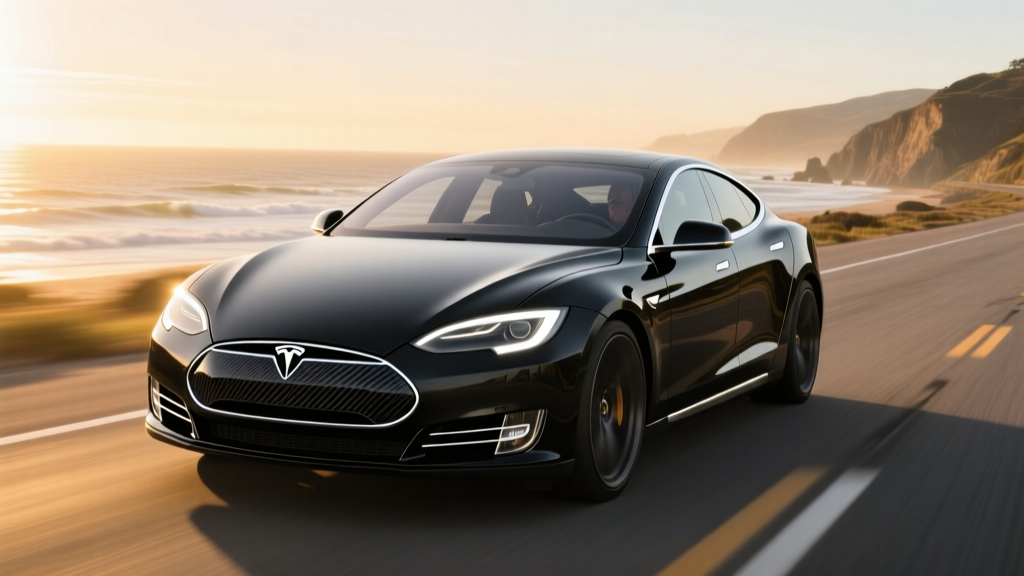
If you've been searching for the Tesla Mad Max, you're likely chasing one of two things: a meme-fueled nickname for Tesla's most unhinged performance modes, or a genuine attempt to decode just how extreme a fully-optioned Model S Plaid or Model X Plaid really is. The name stuck in forums and YouTube thumbnails because it perfectly captures the post-apocalyptic acceleration, the yoke steering, and the sheer absurdity of a 5,000-pound luxury sedan or SUV that hits 60 mph in under two seconds. But strip away the hype, and there's a serious engineering story here — one with real trade-offs in range, charging speed, and daily usability that every prospective buyer needs to understand before writing a six-figure check.
This review breaks down the 2026 Tesla Model S Plaid and Model X Plaid — the vehicles behind the "Mad Max" moniker — with the exact numbers that matter: EPA range versus real-world highway results, the tri-motor powertrain's true output, the 250 kW DC fast-charge ceiling (and why it matters), and the current IRS §30D tax-credit situation for six-figure EVs. Whether you're cross-shopping a Lucid Air Sapphire, a Porsche Taycan Turbo GT, or a Rivian R1T, this is the data-driven teardown you need.
The Powertrain Behind the Mad Max Nickname
The "Mad Max" label isn't an official Tesla trim — it's the community shorthand for what happens when you combine Tesla's tri-motor Plaid powertrain with the company's most aggressive acceleration software setting. In the Model S Plaid, that means three permanent-magnet synchronous reluctance motors (one front, two rear) producing a combined 1,020 horsepower and an estimated 1,050 lb-ft of torque. The Model X Plaid delivers the same output, though it routes that power through a heavier, taller body.
The tri-motor setup uses torque vectoring on the rear axle, actively managing power delivery to each rear wheel independently. This is what allows the Plaid models to put 1,020 hp to the ground without the kind of wheelspin that would make the power useless. Tesla's carbon-sleeved rotors in the rear motors are rated to spin at up to 20,000 RPM — a spec that directly enables the sub-2-second 0-60 claim.
| Spec | Model S Plaid | Model X Plaid |
|---|---|---|
| Drivetrain | AWD (Tri-Motor) | AWD (Tri-Motor) |
| Horsepower | 1,020 hp | 1,020 hp |
| 0-60 mph | 1.99 seconds | 2.5 seconds |
| Quarter Mile | 9.23 sec @ 155 mph | 9.9 sec @ 142 mph |
| Top Speed | 200 mph (w/ hardware) | 163 mph |
| Curb Weight | ~4,766 lbs | ~5,185 lbs |
For context, the 0-60 time of 1.99 seconds in the Model S Plaid makes it one of the quickest production cars ever sold, alongside the Rimac Nevera and the Lucid Air Sapphire (1.89 sec). But unlike those seven-figure hypercars, you can buy a Model S Plaid for under $90,000. That price-to-performance ratio is the core of the Mad Max appeal.
Range and Efficiency: The Real-World Reckoning
Performance this extreme doesn't come free. The Model S Plaid's EPA-estimated range is 396 miles on its 19-inch wheel configuration, dropping to an estimated 359 miles on the optional 21-inch Arachnid wheels. The Model X Plaid carries a heavier body and a larger frontal area, yielding an EPA-estimated 333 miles on 20-inch wheels and roughly 311 miles on 22-inch turbines.
Real-World Range Expectations
Model S Plaid EPA: 396 mi (19" wheels) / 359 mi (21" wheels)
Highway (75 mph, 70°F): Expect ~310–340 mi on 19" wheels; ~275–300 mi on 21"
Cold weather (30°F, highway): Expect ~240–280 mi — LFP isn't used here, but NMC chemistry still loses 20-30% in freezing temps
Model X Plaid EPA: 333 mi (20" wheels)
Highway real-world: Expect ~260–290 mi; cold weather drops this to ~210–240 mi
The battery pack is a 100 kWh (usable ~95 kWh) NMC (nickel manganese cobalt) lithium-ion pack. Tesla does not publish exact chemistry breakdowns per model year, but the Plaid lineup has consistently used NMC cells for their higher energy density — a necessary trade-off versus the LFP chemistry used in base Model 3 and Model Y RWD trims. NMC packs deliver more range per kilogram but are more sensitive to sustained 100% SoC storage and extreme cold.
Efficiency figures from fueleconomy.gov place the Model S Plaid at approximately 120 MPGe combined (roughly 28 kWh/100 mi), while the Model X Plaid sits closer to 105 MPGe combined (about 32 kWh/100 mi). These are reasonable numbers for the performance class but noticeably thirstier than a standard Model S Long Range (124 MPGe) or a Lucid Air Grand Touring (131 MPGe).
Charging Speed: DC Fast, Level 2, and the 250 kW Ceiling
The Plaid models use Tesla's proprietary NACS connector and are fully compatible with the Supercharger network — which, as of 2026, has opened to other brands but remains the most reliable DC fast-charging ecosystem in North America. The maximum DC fast-charge rate is 250 kW at a V3 or V4 Supercharger stall.
| Charging Method | Power (kW) | Speed / Time | Notes |
|---|---|---|---|
| DC Fast (Supercharger V3/V4) | Up to 250 kW | 10–80% in ~27 min | Peak rate sustained to ~50% SoC, then tapers |
| DC Fast (CCS adapter) | Up to 250 kW | 10–80% in ~27–30 min | Requires Tesla CCS adapter; Electrify America compatible |
| Level 2 (Tesla Wall Connector) | 11.5 kW (48A) | ~44 mi/hr of charging | Full charge in ~9 hours from 10% |
| Level 2 (NEMA 14-50 outlet) | ~9.6 kW (40A) | ~36 mi/hr of charging | Common home install; requires $500–$1,500 electrician visit |
| Level 1 (120V standard) | ~1.4 kW | ~5 mi/hr of charging | Emergency/trickle only — not viable for daily use |
Here's the charging-curve reality that spec sheets don't show: the Plaid models hit their 250 kW peak around 10–15% SoC and sustain close to that rate until roughly 50% SoC. After that, the curve tapers significantly — from 50–80%, you're averaging closer to 120–150 kW. This means the 10–80% time of ~27 minutes is accurate, but a 10–95% session will take closer to 50–55 minutes. If you're road-tripping and want to minimize stops, charging to 80% and driving is substantially more time-efficient than topping off to 100%.
At home on a 48-amp Level 2 Wall Connector (which requires a 60-amp circuit), you'll add roughly 44 miles of range per hour. Plugging in overnight from 30% to 80% takes about 5.5 hours — easily achievable during a normal sleep cycle. The onboard charger maxes out at 11.5 kW, so installing a higher-amperage circuit won't speed things up beyond that ceiling.
Interior, Tech, and the Yoke Question
The Plaid interior is where the Mad Max identity gets most polarizing. The centerpiece is a 17-inch horizontal touchscreen running Tesla's latest infotainment software, which in 2026 includes a redesigned navigation stack, improved voice commands, and an integrated gaming system capable of running Cyberpunk 2077 at full fidelity while charging. A secondary 8-inch screen for rear passengers handles climate and entertainment controls.
The yoke steering wheel is now standard on Plaid trims (a conventional round wheel can be requested at no cost, though delivery times may vary). The yoke's advantage is an unobstructed view of the instrument cluster and a race-car aesthetic. The disadvantage is real: multi-point turns, roundabouts, and low-speed maneuvering require hand-over-hand inputs that the yoke doesn't accommodate gracefully. On highway drives and sweeping roads, it works well. In a tight parking garage, you will miss the top half of a steering wheel.
Cargo space in the Model S Plaid is 28 cubic feet behind the rear seats (including the rear trunk and frunk combined), which is competitive with the Porsche Taycan's ~29 cu ft. The Model X Plaid offers substantially more: approximately 88 cubic feet behind the front seats with the second row folded, plus a usable frunk. The Model X's falcon-wing rear doors remain a love-it-or-hate-it feature — they provide excellent access in tight parking spaces but add complexity and have historically been a reliability concern, though Tesla's latest-generation hardware has improved significantly.
Legroom is adequate but not class-leading: the Model S offers 42.7 inches of front legroom and 35.4 inches in the rear, while the Model X provides 41.2 inches front and 41.7 inches in the second row. For adults on longer trips, the Model X is the more comfortable rear-seat experience.
Pricing, Trims, and the Federal Tax Credit Reality
Here's where the Mad Max dream meets financial reality. The 2026 Model S Plaid starts at an MSRP of $89,990 (including destination), and the Model X Plaid starts at $94,990. Common options — including the 21-inch Arachnid wheels ($4,500), Full Self-Driving (Supervised) capability ($8,000), and premium paint colors ($1,500–$2,500) — can push an as-tested Model S Plaid to $102,000–$105,000 and a Model X Plaid to $108,000–$112,000.
| Item | Model S Plaid | Model X Plaid |
|---|---|---|
| Base MSRP (incl. destination) | $89,990 | $94,990 |
| Typical As-Tested Price | $102,000–$105,000 | $108,000–$112,000 |
| Federal §30D Tax Credit | $0 (MSRP cap exceeded) | $0 (MSRP cap exceeded) |
| IRS MSRP Cap (Sedans) | $55,000 | $80,000 (SUVs) |
| Effective Net Price (no credit) | $89,990+ | $94,990+ |
The critical detail: neither Plaid model qualifies for the federal §30D new EV tax credit. Per IRS rules, the credit is capped at vehicles with an MSRP of $55,000 for sedans and $80,000 for SUVs/vans/pickups. The Model S Plaid at $89,990 blows past the sedan cap. The Model X Plaid at $94,990 exceeds the SUV cap. Additionally, buyer income caps apply ($150,000 single / $300,000 joint filers for the new-vehicle credit), though at these price points, most buyers exceed income thresholds regardless.
There is no workaround here — leasing no longer provides a pass-through advantage as of 2025 regulatory changes. If the federal credit is a deciding factor in your EV purchase, the Plaid models are off the table, and you should look at the Model S Long Range or the Model Y lineup instead.
Autopilot and FSD: What "Mad Max" Can't Do
SAE Level 2: Driver Supervision Required
Tesla's Autopilot and Full Self-Driving (Supervised) are SAE Level 2 driver-assistance systems. This means the driver must remain fully engaged — hands on the yoke/wheel, eyes on the road — at all times. FSD (Supervised) can handle highway lane changes, stoplights, and some city navigation, but it is not autonomous driving. The driver is legally responsible for all vehicle actions. Only Level 4 services like Waymo operate without a human driver.
The Plaid models ship with Tesla's latest Hardware 4 (HW4) sensor suite, which includes higher-resolution cameras, improved processing, and better low-light performance. FSD (Supervised) in 2026 has made measurable progress in urban environments, but it still struggles with construction zones, unprotected left turns in heavy traffic, and adverse weather. For highway cruising, it's excellent — reducing fatigue on long drives substantially. For the "Mad Max" acceleration runs, you'll want to disengage all assists and use Tesla's dedicated drag-strip mode, which preconditions the battery and powertrain for maximum power delivery.
Ownership Costs: Warranty, Insurance, and Maintenance
Tesla's warranty coverage for the Plaid models includes:
- Basic Vehicle Limited Warranty: 4 years / 50,000 miles
- Battery & Drive Unit Warranty: 8 years / 150,000 miles, with a minimum 70% battery capacity retention threshold over that period
- Restraint System: 5 years / 60,000 miles
The 8-year/150,000-mile battery warranty is one of the stronger offerings in the luxury EV segment, though Porsche matches it with an 8-year/100,000-mile battery warranty on the Taycan, and Lucid offers 8 years/100,000 miles on the Air. The 70% retention threshold is industry-standard — it means Tesla will replace or repair the pack if it degrades below 70% of original capacity within the warranty window. In practice, NMC packs in Tesla's thermal management system have shown degradation curves that plateau around 90–92% State of Health after 50,000–80,000 miles, with gradual decline thereafter.
Insurance is a real cost factor. Plaid models carry significantly higher premiums than their Long Range siblings. Expect annual insurance costs of $3,500–$5,500 depending on your state, driving record, and coverage level — roughly 40–60% more than a standard Model S. Get quotes before purchasing; this is often the most overlooked line item in performance-EV ownership.
Maintenance is minimal compared to ICE performance sedans: no oil changes, no transmission fluid, no spark plugs. Budget for tire replacement every 20,000–30,000 miles (performance tires on 21-inch wheels run $350–$500 each), cabin air filter replacement ($100–$150 every 2 years), and brake fluid checks. The regenerative braking system means the physical brake pads last well beyond 100,000 miles under normal driving.
Tesla Plaid vs. The Competition
| Spec | Tesla Model S Plaid | Lucid Air Sapphire | Porsche Taycan Turbo GT |
|---|---|---|---|
| Price | $89,990 | $249,000 | $230,000 |
| Horsepower | 1,020 hp | 1,234 hp | 1,019 hp |
| 0-60 mph | 1.99 sec | 1.89 sec | 2.1 sec |
| EPA Range | 396 mi | 427 mi | 275 mi |
| Max DC Charge | 250 kW | 300 kW | 320 kW |
| Fed. Tax Credit | No | No | No |
The Plaid's position is clear: it delivers 95% of the Sapphire's performance for 36% of the price, with better range and access to the Supercharger network. The Porsche trades outright acceleration for superior handling dynamics, build quality, and a more engaging steering feel — but at more than double the cost and with significantly less range. For buyers who want the Mad Max experience without seven-figure spending, the Model S Plaid has no direct equal.
Pros
- Sub-2-second 0-60 at under $90K — unmatched value-to-performance ratio
- 396-mile EPA range (19" wheels) is class-leading for the performance segment
- Supercharger network access remains the gold standard for road-trip charging
- OTA updates continuously improve performance and features post-purchase
- Practical cargo space and usable rear seats — a daily-drivable supercar
Cons
- No federal tax credit eligibility — full MSRP is the real price
- Yoke steering is polarizing and impractical for low-speed maneuvering
- 250 kW DC charge ceiling is slower than Lucid (300 kW) and Porsche (320 kW)
- Insurance premiums 40–60% higher than Long Range trims
- Build quality still trails Porsche and Lucid in panel gaps and material feel
Who Should Buy the Tesla "Mad Max"?
The Model S Plaid is for the buyer who wants hypercar acceleration in a sedan that can still carry four adults and their luggage on a road trip — and who values the Supercharger network's reliability over the Porsche badge or Lucid's luxury materials. It's the ultimate commuter weapon if your commute includes open highway and you can charge at home nightly.
The Model X Plaid is for the family that refuses to compromise on performance — a three-row SUV that runs the quarter-mile in under 10 seconds while carrying kids, cargo, and a week's worth of groceries. It's also the stronger choice for cold-climate buyers who need AWD traction and the higher ride height.
If your priority is luxury and build quality above all else, drive the Lucid Air and the Porsche Taycan before committing. If your priority is the lowest price per horsepower in the EV world, nothing touches the Plaid.
Frequently Asked Questions
What is the real-world range of the Tesla Model S Plaid?
The EPA rates it at 396 miles on 19-inch wheels. In real-world highway driving at 75 mph in mild temperatures, expect 310–340 miles. In cold weather (below 35°F), that drops to approximately 240–280 miles. The 21-inch Arachnid wheels reduce EPA range to 359 miles and real-world highway range to roughly 275–300 miles.
How fast does the Tesla Plaid charge at home and on the road?
On a DC fast charger (Supercharger V3/V4), the Plaid peaks at 250 kW and charges from 10–80% in approximately 27 minutes. At home on a 48-amp Level 2 Wall Connector, it adds about 44 miles of range per hour, with a full charge taking roughly 9 hours.
Does the Tesla Model S Plaid or Model X Plaid qualify for the federal EV tax credit?
No. The IRS §30D credit caps eligible sedans at $55,000 MSRP and SUVs at $80,000 MSRP. The Model S Plaid starts at $89,990 and the Model X Plaid at $94,990, both well above their respective caps. There is currently no workaround via leasing. See IRS.gov for current rules.
Is the Tesla Plaid worth buying over the Lucid Air Sapphire or Porsche Taycan Turbo GT?
If your priority is performance-per-dollar and daily usability, yes — the Plaid delivers near-identical acceleration to both competitors at a fraction of the price, with longer range and superior charging infrastructure. If build quality, handling precision, or luxury materials are paramount, the Porsche and Lucid are stronger choices.
What are the biggest drawbacks of the Tesla Plaid models?
The top concerns are the lack of federal tax credit eligibility, higher insurance premiums ($3,500–$5,500/year), the 250 kW charging ceiling being outpaced by competitors, and the yoke steering wheel's impracticality in low-speed driving. Build quality, while improved, still trails German and Lucid standards.
How long will the Plaid battery last?
Tesla warranties the battery for 8 years or 150,000 miles with a minimum 70% capacity retention. Real-world data from high-mileage Tesla owners suggests NMC packs with Tesla's thermal management typically retain 88–92% capacity at 80,000 miles, with gradual linear degradation thereafter. A battery replacement outside of warranty currently costs approximately $15,000–$22,000 depending on the pack and labor.