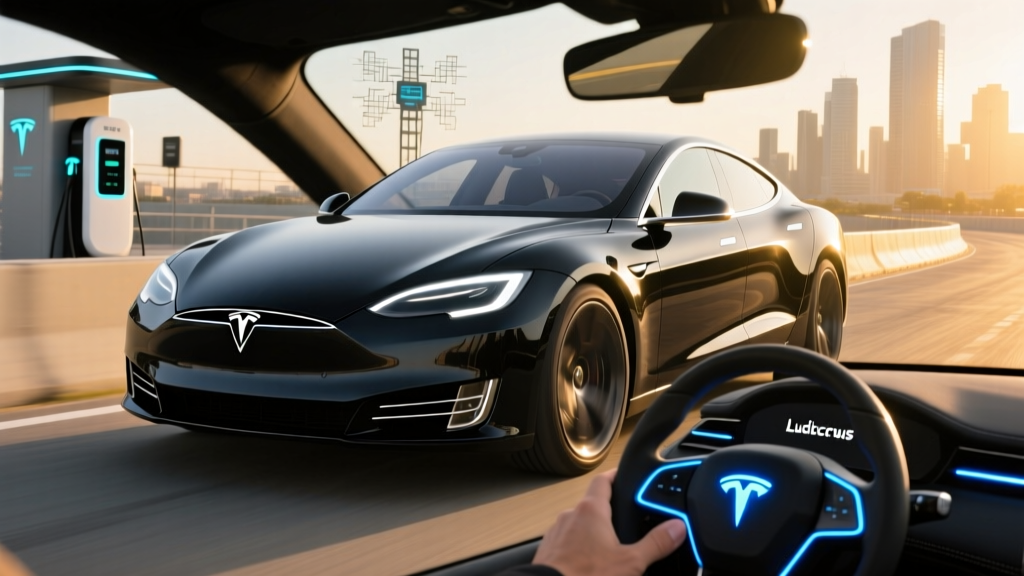
If you searched for the Tesla Ludicrous button, you're probably chasing one of the most iconic acceleration experiences in automotive history. The original Ludicrous Mode — a software-unlocked launch setting that made a family sedan outrun supercars — debuted on the Model S P85D back in 2015. Tesla has since retired that specific button, replacing it with the even more extreme Plaid Mode on the current-generation Model S Plaid. But the DNA of that original feature lives on, and in 2026, the execution is sharper than ever.
This review covers the 2026 Tesla Model S Plaid in full: real-world range, tri-motor performance, DC fast-charging behavior, pricing after federal tax credits, and how it stacks up against the Lucid Air Sapphire, Porsche Taycan Turbo GT, and BMW i7 M70. If you want the spiritual successor to the Ludicrous button experience, this is the car — but it comes with caveats every buyer should understand before signing.
2026 Tesla Model S Plaid: At-a-Glance Specs
| Spec | 2026 Model S Plaid |
|---|---|
| EPA Range | 396 miles |
| Battery (usable) | ~95 kWh, NMC (nickel manganese cobalt) |
| Drivetrain | Tri-motor AWD (1 front, 2 rear) |
| Horsepower | 1,020 hp |
| 0–60 mph | 1.99 seconds (with rollout subtracted) |
| Top Speed | 200 mph |
| Max DC Fast Charge | 250 kW (V3 Supercharger) |
| 10–80% DC Charge | ~28 minutes |
| Level 2 Home Charge | 11.5 kW (~41 mi/hr) |
| MPGe (combined) | 116 MPGe |
| Efficiency | 29 kWh/100 mi |
| Cargo (rear + frunk) | 28.0 cu ft rear + 3.1 cu ft frunk |
| Rear Legroom | 35.4 inches |
| Base MSRP | $89,990 |
| Battery/Drive Unit Warranty | 8 years / 120,000 miles |
What Happened to the Ludicrous Button?
The original Ludicrous Mode was an over-the-air upgrade and a physical toggle buried in the Model S settings menu. It preconditioned the battery and unleashed maximum current from the pack to the motors, cutting 0–60 times from roughly 4.2 seconds down to 2.8 seconds on the P90D. It was a party trick, a marketing masterstroke, and genuinely thrilling.
Tesla phased out the "Ludicrous" name with the 2021 Model S refresh. The new Plaid trim uses a tri-motor architecture with carbon-sleeved rotors capable of spinning past 20,000 RPM. Where Ludicrous Mode was a software toggle on a dual-motor car, Plaid Mode is the car's fundamental hardware identity. You activate it through the touchscreen: press and hold the chevron icon on the drive mode selector, and the car drops into its full 1,020-hp configuration, preconditions the battery for maximum discharge, and primes the thermal system.
The result? A 1.99-second 0–60 mph time (measured with a 1-foot rollout subtracted, per Tesla's standard — real-world roll-in starts are closer to 2.1–2.2 seconds). That's faster than the original Ludicrous Mode by nearly a full second, and it remains one of the quickest production cars on Earth at any price.
Real-World Range: What 396 EPA Miles Actually Means
Real-World Highway (70–75 mph, mild weather): ~320–340 miles
Real-World Highway (cold weather, below 32°F): ~250–280 miles
City/Mixed Commuting: ~350–380 miles
The Model S Plaid carries a roughly 95 kWh usable NMC (nickel manganese cobalt) battery pack. NMC chemistry provides higher energy density than LFP (lithium iron phosphate), which is essential for fitting nearly 400 miles of range into a sedan platform while keeping weight manageable at around 4,766 lbs.
The 396-mile EPA figure is impressive, but tri-motor Plaid models consume more energy than dual-motor Long Range variants. At a sustained 75 mph on flat interstate, expect efficiency around 30–32 kWh/100 mi, yielding roughly 320 miles before you hit a 10% buffer. In cold weather — particularly below freezing — NMC packs lose 20–30% of effective range due to increased internal resistance and cabin heating loads. Tesla's heat pump helps, but physics is physics.
If you drive aggressively — and with 1,020 hp available, you will — consumption spikes above 35 kWh/100 mi. Plan road trips around 250–280 miles between Supercharger stops to maintain a safety buffer. According to fueleconomy.gov, the Model S Plaid achieves 116 MPGe combined, which trails the Long Range AWD variant's 122 MPGe due to the tri-motor weight and rolling-resistance penalty.
Charging Speed: 250 kW Peak, but Mind the Curve
| Charging Level | Power / Rate | Speed |
|---|---|---|
| Level 1 (120V household) | ~1.4 kW | ~3–4 mi/hr |
| Level 2 (240V, 48A Wall Connector) | 11.5 kW | ~41 mi/hr |
| DC Fast (Tesla V3 Supercharger) | 250 kW peak | 10–80% in ~28 min |
| DC Fast (Tesla V4 Supercharger) | Up to 250 kW (current Model S architecture) | Similar to V3 |
The Model S Plaid peaks at 250 kW on V3 and V4 Superchargers. Here's the nuance that spec sheets hide: peak kW is not sustained kW. The Plaid hits 250 kW only between roughly 10–25% state of charge, then tapers progressively. By 50% SoC, you're seeing ~150 kW; by 80%, it drops below 70 kW. The 10–80% time of approximately 28 minutes reflects this average, not the headline number.
For home charging, Tesla's Wall Connector at 48 amps on a 60-amp circuit delivers 11.5 kW — adding about 41 miles of range per hour. An overnight charge from 20% to 80% takes roughly 6–7 hours. Tesla recommends setting daily charge limits to 80% for NMC packs to preserve long-term battery health, saving 100% charges for road trips. This is different from LFP packs (found in some Model 3/Y RWD trims), which tolerate daily 100% charges better.
One important note: the Model S still uses Tesla's proprietary NACS connector natively. With Tesla opening the Supercharger network to other brands via NACS adapters, the reliability advantage of Superchargers remains a genuine ownership perk — Tesla's Supercharger network consistently outperforms CCS networks in uptime metrics.
Performance: Tri-Motor Engineering Beyond the Launch
The 1.99-second 0–60 time dominates headlines, but the Plaid's engineering depth extends well beyond straight-line acceleration. The tri-motor layout — one front motor and two independent rear motors — enables torque vectoring across the rear axle. This means the car can actively send more torque to the outside rear wheel in a corner, rotating the car and reducing understeer. For a 4,766-lb sedan, the handling agility is remarkable.
Tesla's carbon-sleeved rotor technology is the key to sustained performance. Traditional EV motors lose power at high RPM as centrifugal force threatens to separate the rotor magnets. Tesla wraps the rotors in a carbon-fiber sleeve that contains expansion, allowing sustained output past 20,000 RPM. This means the Plaid doesn't just launch hard — it pulls relentlessly to its 200 mph top speed without the power falloff that limits most EVs above 120 mph.
Track use reveals thermal limits. Tesla offers a Track Mode that adjusts cooling, torque distribution, and stability control for circuit driving, but sustained lapping will still heat-soak the battery and trigger power reduction. For the vast majority of owners, the Plaid delivers supercar acceleration daily without degradation concerns — the 8-year/120,000-mile battery and drive unit warranty backs this up.
Pricing, Tax Credits, and Total Cost
| Item | Amount |
|---|---|
| 2026 Model S Plaid Base MSRP | $89,990 |
| Destination Fee | $1,995 |
| FSD (Supervised) Add-On | $8,000 (or $99/mo subscription) |
| Federal §30D Tax Credit | Not eligible (MSRP exceeds $55,000 sedan cap) |
| Estimated Out-the-Door (base) | ~$91,985 + state/local fees |
The 2026 Model S Plaid starts at $89,990 before destination. With FSD (Supervised), Ultra Red paint, and 21-inch Arachnid wheels, an as-tested configuration can reach $100,000+.
Here is the tax-credit reality: under IRS §30D rules, the federal EV tax credit caps sedan eligibility at $55,000 MSRP. The Model S Plaid at $89,990 far exceeds this threshold. It also exceeds the adjusted gross income caps ($300,000 joint / $150,000 single) that many Plaid buyers would surpass. No federal purchase credit applies to this vehicle. Some states offer separate incentives — check your state energy office — but plan your purchase assuming full MSRP.
For total cost of ownership, electricity at the national average of $0.17/kWh yields roughly $0.05 per mile in energy cost. Compare that to a BMW M5 at 16 mpg combined on $3.80/gallon premium: $0.24 per mile. Over 60,000 miles, the Plaid saves approximately $11,400 in fuel alone, partially offsetting its premium purchase price.
Tech, Interior, and the FSD Caveat
The Model S interior centers on a 17-inch horizontally oriented touchscreen running Tesla's latest software. The yoke steering wheel remains standard on Plaid (a round wheel is available at no cost). Build quality on the current-generation refresh is markedly better than pre-2021 cars — panel gaps are tight, materials are premium, and the ventilated front seats plus heated rear seats are standard.
The 22-speaker audio system, wireless phone charging, HEPA air filtration with Bioweapon Defense Mode, and a rear-seat 8-inch touchscreen for climate and entertainment round out the tech. Cargo capacity is generous for a sedan: 28.0 cubic feet behind the rear seats (hatchback design helps) plus a 3.1 cu ft front trunk.
A critical clarification on FSD (Supervised): Tesla's Full Self-Driving capability is an SAE Level 2 driver-assistance system. Despite the name, it requires full driver attention, hands-on or eyes-on supervision, and does not make the car autonomous. You are responsible for every driving action. This is fundamentally different from Level 4 robotaxi services like Waymo, which operate without a driver. FSD is impressive for highway lane management and city navigation, but treat it as an advanced cruise-control system — not a chauffeur.
Model S Plaid vs. the Competition
| Spec | Tesla Model S Plaid | Lucid Air Sapphire | Porsche Taycan Turbo GT |
|---|---|---|---|
| 0–60 mph | 1.99 sec | 1.89 sec | 2.1 sec |
| EPA Range | 396 mi | 427 mi | 269 mi |
| Horsepower | 1,020 hp | 1,234 hp | 1,019 hp |
| Max DC Charge | 250 kW | 300 kW | 320 kW |
| Base Price | $89,990 | $249,000 | $240,000 |
| Federal Tax Credit | No | No | No |
The Model S Plaid occupies a unique value position: it delivers 95% of the Lucid Air Sapphire's performance at roughly one-third the price. The Sapphire is quicker and has more range, but at $249,000, it's a different market segment entirely. The Porsche Taycan Turbo GT offers superior build quality, chassis dynamics, and 800-volt charging architecture (320 kW peak), but sacrifices 127 miles of EPA range and costs nearly three times as much.
Against the BMW i7 M70 ($168,000, 660 hp, 2.9-sec 0–60), the Plaid wins on performance and price while the i7 wins on rear-seat luxury and traditional dealer service infrastructure.
Pros and Cons
✓ Pros
- Sub-2-second 0–60 mph at a sub-$100K price
- 396-mile EPA range — best in the performance-sedan class
- Access to Tesla Supercharger network (highest uptime)
- Tri-motor torque vectoring for real handling capability
- Continuous OTA software improvements
- Generous cargo space with hatchback design
✗ Cons
- No federal tax credit (exceeds MSRP and income caps)
- 250 kW DC peak is now outpaced by 800V rivals (320–350 kW)
- Yoke steering is polarizing; round wheel should be default
- Minimal physical controls — everything routed through touchscreen
- Rear seat comfort trails luxury competitors (i7, Lucid)
- Service center wait times remain an issue in some markets
Who Should Buy the Model S Plaid?
The 2026 Model S Plaid is the right car if you want supercar-rivaling acceleration in a practical daily driver with genuine 300+ mile road-trip range and access to the most reliable DC charging network. It suits tech-forward buyers who value software updates, performance metrics, and the Tesla ecosystem over traditional luxury-brand prestige.
It's the wrong car if you prioritize rear-seat luxury, concierge dealer service, 800-volt ultra-fast charging architecture, or federal tax-credit savings. Buyers who frequently drive in extreme cold should also consider that NMC range loss is real, and the Plaid's high energy consumption amplifies that effect.
Frequently Asked Questions
Is the Tesla Ludicrous button still available in 2026?
The original Ludicrous Mode button was retired after the 2020 model year. Its spiritual successor is Plaid Mode on the Model S Plaid, activated through the touchscreen drive-mode selector. It delivers even more extreme acceleration — 1.99 seconds 0–60 mph versus the original Ludicrous Mode's 2.8 seconds.
What is the real-world range of the Model S Plaid?
The EPA rates it at 396 miles. In real-world highway driving at 70–75 mph in moderate temperatures, expect 320–340 miles. In cold weather below freezing, plan for 250–280 miles. City driving with regenerative braking recovers energy and yields closer to the EPA figure.
Does the Model S Plaid qualify for the federal EV tax credit?
No. Under IRS §30D, sedans must have an MSRP at or below $55,000 to qualify. The Plaid at $89,990 far exceeds this cap. Additionally, many buyers in this price range exceed the income limits ($300K joint / $150K single). Plan your purchase assuming no federal credit.
How fast does the Model S Plaid charge at home and on road trips?
At home on a Level 2 Tesla Wall Connector (11.5 kW), it adds about 41 miles per hour — a full overnight charge covers most daily needs. On V3 Superchargers, it peaks at 250 kW and charges from 10–80% in approximately 28 minutes. The charge curve tapers significantly above 50% SoC.
Is the Model S Plaid worth it versus the Lucid Air Sapphire or Porsche Taycan Turbo GT?
If value is a priority, yes. The Plaid delivers comparable acceleration to both rivals at a fraction of the price, with superior range and Supercharger access. The Sapphire is quicker and more luxurious but costs $249,000. The Taycan Turbo GT charges faster (320 kW) and handles better on track but sacrifices 127 miles of range and costs $240,000.
Sources: fueleconomy.gov, Tesla Model S specifications, IRS §30D Clean Vehicle Credits.