What Is the Tesla Loaner Program and How Does It Work?
If you've searched for "Tesla loaner" online, you likely fall into one of two camps: you're a current Tesla owner wondering what replacement vehicle you'll receive during a service appointment, or you're a prospective buyer trying to understand whether Tesla's service loaner fleet gives you a free extended test drive. Both questions deserve precise answers, because Tesla's loaner program operates differently from traditional dealership courtesy cars.
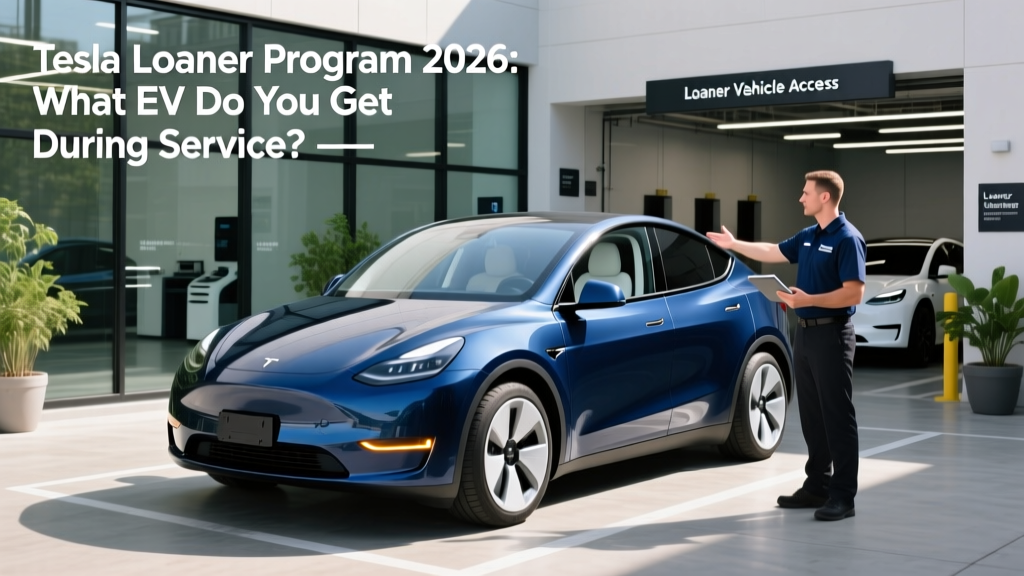
Tesla Service Centers maintain a fleet of loaner vehicles — typically current or recent model-year Teslas — provided to customers whose cars require overnight or multi-day repairs. Loaners are not guaranteed for every visit. Tesla prioritizes them for warranty repairs that keep a vehicle in the shop beyond a single day. Minor recalls, software updates, and same-day fixes generally don't qualify.
The most common loaner models in 2026 include the Tesla Model Y Long Range AWD, the Model 3 Long Range AWD, and occasionally the Model 3 Rear-Wheel Drive (the fleet-volume trim). In some high-traffic service centers, you may encounter a Model S or Model X, but these are rare. This profile focuses on the Model Y Long Range AWD and Model 3 Long Range AWD, the two vehicles you're most likely to receive.
2026 Tesla Model Y Long Range AWD: The Most Common Loaner
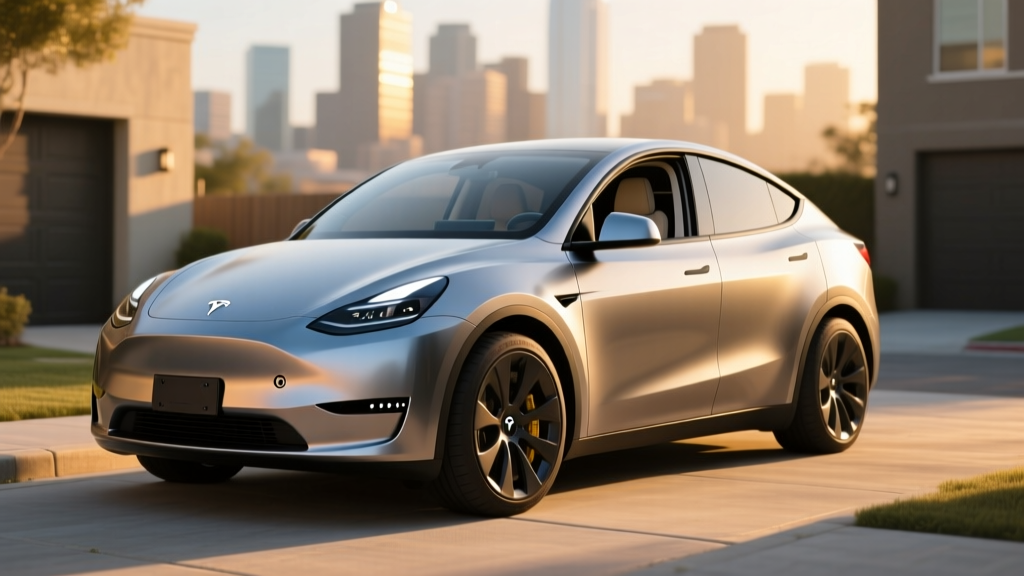
The refreshed Model Y (internally dubbed "Juniper") is the backbone of Tesla's service loaner fleet in 2026. Here are the exact specifications you'll be driving:
| Specification | 2026 Model Y Long Range AWD |
|---|---|
| EPA Range | 320 miles |
| Battery Capacity | 78.1 kWh usable (NMC chemistry) |
| Drivetrain | Dual-Motor AWD |
| Horsepower | 384 hp combined |
| 0–60 mph | 4.8 seconds |
| Max DC Fast Charge | 250 kW peak (V3 Supercharger) |
| 10–80% DC Charge Time | ~25 minutes |
| Level 2 Home Charge Rate | 11.5 kW (~44 miles/hr) |
| Efficiency | 122 MPGe combined / 27 kWh/100mi |
| Cargo Volume | 76.2 cu ft (rear seats folded) |
| Rear Legroom | 41.6 inches |
| Battery Warranty | 8 years / 120,000 miles |
| Base MSRP | $46,630 |
Charging Deep Dive: What to Expect on a Supercharger
Tesla's NACS connector and Supercharger network remain the gold standard for public charging reliability. When you plug a loaner Model Y into a V3 Supercharger (250 kW capable), the charge curve looks like this:
| State of Charge | Sustained Power | Approximate Time in Band |
|---|---|---|
| 10–30% | 220–250 kW | ~6 minutes |
| 30–50% | 180–220 kW | ~6 minutes |
| 50–80% | 100–150 kW | ~13 minutes |
| 80–100% | 30–50 kW | ~25+ minutes (avoid unless necessary) |
The 10–80% charge takes approximately 25 minutes under optimal conditions — meaning the battery is preconditioned via the car's navigation routing to the Supercharger. If you arrive at a Supercharger without preconditioning (e.g., you searched for it manually), expect slower initial speeds, especially in cold weather. This is a nuance many first-time Tesla drivers miss.
At home on a Level 2 Wall Connector (48-amp circuit, 11.5 kW), the Model Y adds roughly 44 miles of range per hour. A full 10–80% charge at home takes about 5.5 hours — easily accomplished overnight on a standard 240V installation.
2026 Tesla Model 3 Long Range AWD: The Sedan Loaner Alternative
Some service centers stock Model 3 sedans, particularly the Long Range AWD with the "Highland" refresh architecture. If you receive one, here's what you're working with:
| Specification | 2026 Model 3 Long Range AWD |
|---|---|
| EPA Range | 341 miles |
| Battery Capacity | 78.1 kWh usable (NMC chemistry) |
| Drivetrain | Dual-Motor AWD |
| Horsepower | 366 hp combined |
| 0–60 mph | 4.2 seconds |
| Max DC Fast Charge | 250 kW peak |
| 10–80% DC Charge Time | ~22 minutes |
| Level 2 Home Charge Rate | 11.5 kW (~48 miles/hr) |
| Efficiency | 131 MPGe combined / 25 kWh/100mi |
| Cargo Volume | 23.1 cu ft (trunk + frunk) |
| Rear Legroom | 35.3 inches |
| Battery Warranty | 8 years / 120,000 miles |
| Base MSRP | $44,130 |
The Model 3 Long Range achieves slightly better range and efficiency than the Model Y due to its lower weight and more aerodynamic profile. The 341-mile EPA rating is among the best in its class. Real-world highway range settles around 285–310 miles in fair weather, and roughly 230–260 miles in deep winter.
One trade-off: rear legroom in the Model 3 is noticeably tighter than the Model Y (35.3 vs. 41.6 inches). If you're hauling family members during a multi-day loaner period, the Model Y is the more comfortable choice.
Tech, Driver Assistance, and the Autopilot Reality Check
Every Tesla loaner comes equipped with the company's latest infotainment system, which in 2026 includes a 15.4-inch center touchscreen (Model Y) or 15.4-inch touchscreen (Model 3), wireless phone charging, HEPA air filtration (Model Y), and over-the-air software updates.
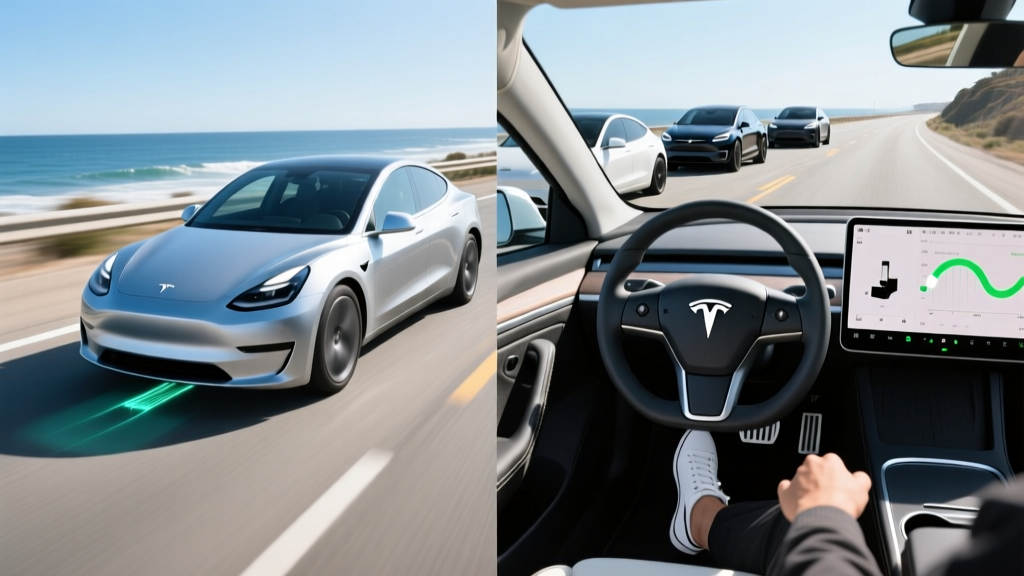
All loaners include Basic Autopilot as standard — this provides Traffic-Aware Cruise Control and Autosteer (lane centering). Some loaners may have Enhanced Autopilot or Full Self-Driving (Supervised) enabled, but this varies by vehicle and is not guaranteed.
- It does not navigate construction zones reliably without driver intervention
- It does not handle unmapped roads or roads with faded lane markings consistently
- FSD (Supervised) does not remove the driver's legal responsibility for the vehicle
- Neither system qualifies as "autonomous" under NHTSA or SAE definitions
Standout tech features include Tesla's native Supercharger routing (the car plans charging stops automatically on long trips), the Tesla app for remote climate control and location tracking, and Sentry Mode for parking surveillance. Notable drawbacks include the absence of Apple CarPlay/Android Auto, a minimalist interior that frustrates some drivers seeking physical buttons, and panel-gap quality that remains inconsistent across production batches.
Pricing, Tax Credits, and What a Loaner Costs You
Tesla loaners are provided at no cost to the customer during qualifying service events. You pay nothing for the vehicle itself, though you are responsible for charging during the loaner period. Tesla does not typically charge mileage fees or daily rates for service loaners, unlike some luxury-brand dealership programs.
However, many readers searching for "Tesla loaner" are actually evaluating whether to purchase a Tesla after experiencing one as a loaner. Here's the current pricing and tax credit picture:
| Model / Trim | Base MSRP | Federal Tax Credit (§30D) | Effective Price (if eligible) |
|---|---|---|---|
| Model 3 RWD | $38,630 | Up to $7,500 | ~$31,130 |
| Model 3 Long Range AWD | $44,130 | Up to $7,500 | ~$36,630 |
| Model Y Long Range AWD | $46,630 | Up to $7,500 | ~$39,130 |
| Model Y Performance | $51,630 | Up to $7,500 | ~$44,130 |
Critical eligibility caveats under IRS §30D rules:
- MSRP Cap: SUVs (Model Y) must have an MSRP at or below $80,000; sedans (Model 3) must be at or below $55,000. All current Tesla trims qualify.
- Income Cap: Modified adjusted gross income must not exceed $150,000 (single), $225,000 (head of household), or $300,000 (joint filing).
- Battery Sourcing: The full $7,500 credit requires meeting both critical-mineral and battery-component sourcing requirements. Tesla's supply chain has adapted significantly, but the exact credit amount (full $7,500 vs. partial $3,750) depends on the specific vehicle's battery provenance at time of delivery. Always verify current eligibility on fueleconomy.gov before purchasing.
- Point-of-Sale Transfer: As of 2024 and continuing in 2026, buyers can transfer the credit to the dealer at point of sale, effectively reducing the purchase price upfront rather than waiting for a tax refund.
Pros and Cons of Driving (and Buying) a Tesla Loaner
Pros
- Access to the Supercharger network — the most reliable and widespread DC fast-charging infrastructure in the US
- Class-leading efficiency: 25–27 kWh/100mi means lower charging costs than most competitors
- Over-the-air updates continuously improve the vehicle after purchase
- Strong real-world range (270+ miles highway) reduces charging stops on road trips
- Minimal maintenance: no oil changes, no transmission fluid, reduced brake wear from regen
- Excellent cargo space in Model Y (76.2 cu ft with seats folded)
Cons
- No Apple CarPlay or Android Auto — everything runs through Tesla's proprietary system
- Service center wait times can stretch to weeks in high-demand metro areas
- Insurance premiums tend to run 15–25% higher than equivalent ICE vehicles
- Panel gaps and paint quality still inconsistent on some production units
- Touchscreen-only controls for climate, mirrors, and glovebox frustrate some drivers
- FSD (Supervised) costs $8,000 extra and remains a Level 2 system — not autonomous
Who Is This EV Best For?
Daily commuters: The Model 3 Long Range's 341-mile EPA range means most commuters can go a full work week without charging, even with a 60-mile round trip. Home Level 2 charging makes this effortless.
Families needing cargo space: The Model Y's 76.2 cu ft of cargo volume and available third-row seat (for small children) make it a strong family hauler. The hatchback design accommodates strollers and groceries more easily than a sedan trunk.
Road-trip enthusiasts: Tesla's integrated Supercharger routing is unmatched for cross-country travel. Plan a route, and the car tells you exactly where to stop, for how long, and at what charge rate. A 10–80% Supercharger stop takes roughly 25 minutes — enough time for a meal or restroom break.
Not ideal for: Buyers who prioritize physical button controls, want Apple CarPlay integration, or live in areas with limited Tesla Service Center access. Rural owners in charging-desert regions should evaluate local infrastructure before committing, as the Supercharger network, while extensive, still has gaps in parts of the Mountain West and rural South.
Frequently Asked Questions
What is the real-world range of a Tesla loaner?
Most loaners are Model Y Long Range AWD (EPA 320 mi) or Model 3 Long Range AWD (EPA 341 mi). In real-world highway driving at 70–75 mph, expect 270–290 miles for the Model Y and 285–310 miles for the Model 3. In freezing temperatures, subtract 20–30% from those figures.
How fast does a Tesla loaner charge?
On a V3 Supercharger, both the Model Y and Model 3 Long Range peak at 250 kW and charge from 10–80% in approximately 22–25 minutes with battery preconditioning. At home on a Level 2 Wall Connector (11.5 kW), expect 44–48 miles of range added per hour, with a full overnight charge taking 5–6 hours.
How much does a Tesla cost after federal tax credits?
The Model 3 RWD starts at $38,630 and can drop to ~$31,130 with the full $7,500 §30D credit. The Model Y Long Range AWD starts at $46,630 and can reach ~$39,130 after the credit. Eligibility depends on your income, the vehicle's MSRP, and battery-sourcing compliance. Verify current status at fueleconomy.gov.
Is a Tesla worth buying vs. competitors like the Hyundai Ioniq 5 or Ford Mustang Mach-E?
Tesla's advantages are the Supercharger network, software ecosystem, and efficiency. The Hyundai Ioniq 5 offers 800V ultra-fast charging (10–80% in ~18 minutes on a 350 kW charger), physical buttons, and Apple CarPlay. The Ford Mustang Mach-E provides a more traditional crossover feel. If charging reliability and road-trip ease are your top priorities, Tesla still leads. If interior ergonomics and CarPlay matter more, cross-shop the Ioniq 5.
Does a Tesla qualify for the federal EV tax credit?
Yes — as of 2026, the Model 3 and Model Y qualify for up to $7,500 under IRS §30D, subject to buyer income limits ($150K single / $300K joint), MSRP caps ($55K sedans / $80K SUVs), and battery critical-mineral/component sourcing requirements. The credit can be applied at point of sale. Always confirm the specific vehicle's eligibility before signing paperwork, as sourcing rules can shift.
Am I guaranteed a Tesla loaner during service?
No. Tesla provides loaners at its discretion, typically for warranty repairs requiring overnight or multi-day service. Same-day appointments, recall work, and cosmetic issues generally do not qualify. Availability also depends on your service center's fleet size. Call ahead to confirm if a loaner is essential for your schedule.
Can I use a Tesla loaner for a road trip?
Technically, yes — there are no mileage restrictions on most Tesla loaners, and you have full access to the Supercharger network. However, loaners are intended as temporary transportation during service, not as vacation vehicles. Extended use beyond the service period is not permitted, and you're responsible for all charging costs during the loaner period.