The Real Question Behind Tesla Lifespan
When shoppers search for "Tesla lifespan," they're usually asking one of two things: how long will the battery last before needing replacement, and how many total miles can the car deliver before major repairs make it uneconomical to keep? Both questions matter because a Tesla's traction battery is its single most expensive component — and its longevity directly determines the vehicle's total cost of ownership over 10 or 15 years.
After tracking fleet data, owner reports, and Tesla's own impact reports, the short answer is encouraging: most Tesla batteries retain 85-90% of their original capacity after 150,000 miles. But the full picture depends heavily on which model you buy, which battery chemistry it uses, and how you charge it. Let's break it all down with hard numbers.
Tesla Battery Degradation: What the Data Shows
Tesla's 2025 Impact Report (the most recent published data) states that Model 3 and Model Y vehicles retain approximately 85% of their original range after 150,000 miles. That's a meaningful data point, but it averages across all driving and charging behaviors. Individual results vary based on three factors:
- Battery chemistry: LFP (lithium iron phosphate) vs. NMC (nickel manganese cobalt)
- Charging habits: Frequent DC fast charging and consistently charging to 100% accelerate degradation in NMC cells
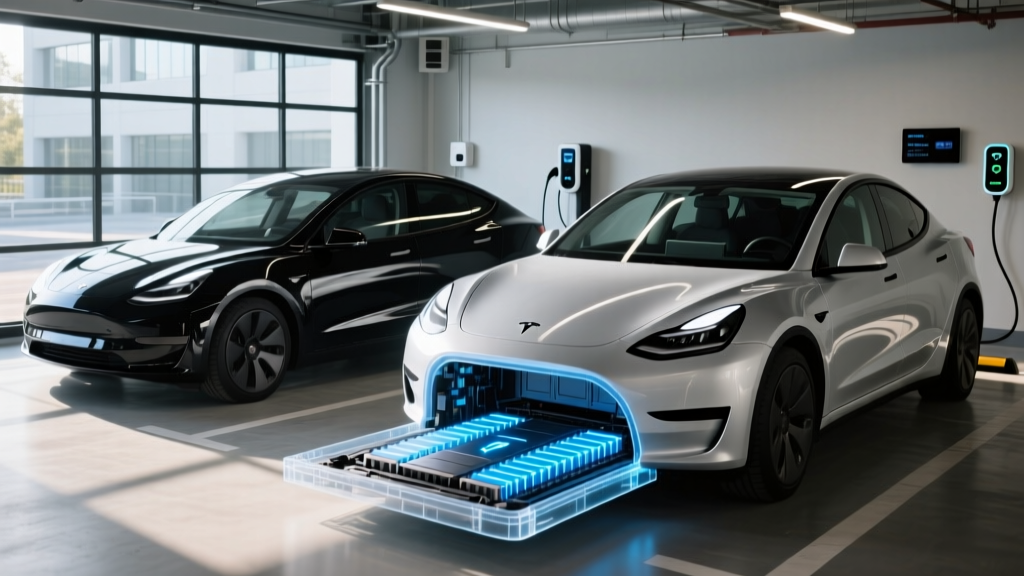
- Thermal management: Tesla's active liquid cooling system is among the best in the industry, which is why Tesla degradation curves tend to flatten out after the initial 10-15% drop in the first 20,000 miles
| Attribute | LFP (Standard Range) | NMC (Long Range / Performance) |
|---|---|---|
| Typical Models | Model 3 RWD, Model Y RWD | Model 3 LR, Model Y LR, Performance trims |
| Cycle Life | 3,000-5,000+ cycles | 1,500-2,500 cycles |
| Recommended Daily Charge | 100% (Tesla recommends periodic full charges) | 80-90% daily; 100% only for trips |
| Energy Density | Lower (heavier pack for same range) | Higher (lighter, more range per kWh) |
| Cold-Weather Performance | More range loss in freezing temps (~30-35%) | Moderate range loss (~20-25%) |
| Expected Degradation at 150k mi | ~8-12% loss | ~12-18% loss |
The key takeaway: if longevity is your top priority, the LFP-equipped Standard Range models offer a longer cycle life and tolerate daily 100% charges. The trade-off is lower energy density, meaning slightly less range in a comparable pack size, and worse cold-weather performance.
Current Tesla Lineup: Range, Battery, and Charging Specs
Here's how the 2025/2026 Tesla lineup stacks up on the metrics that most affect lifespan and daily usability.
| Spec | Model 3 RWD | Model 3 Long Range AWD | Model Y RWD | Model Y Long Range AWD |
|---|---|---|---|---|
| EPA Range | 272 mi | 341 mi | 302 mi | 320 mi |
| Battery (usable) | ~57.5 kWh (LFP) | ~75 kWh (NMC) | ~57.5 kWh (LFP) | ~75 kWh (NMC) |
| Max DC Fast Charge | 170 kW | 250 kW | 170 kW | 250 kW |
| 10-80% DCFC Time | ~25 min | ~18 min | ~25 min | ~18 min |
| Level 2 Home Charge | 11.5 kW (~44 mi/hr) | 11.5 kW (~44 mi/hr) | 11.5 kW (~44 mi/hr) | 11.5 kW (~44 mi/hr) |
| 0-60 mph | 5.8 sec | 4.2 sec | 6.5 sec | 4.8 sec |
| Horsepower | 271 hp | 346 hp | 295 hp | 384 hp |
| Drivetrain | RWD | Dual-Motor AWD | RWD | Dual-Motor AWD |
| Efficiency | 132 MPGe / 25 kWh/100mi | 134 MPGe / 25 kWh/100mi | 119 MPGe / 28 kWh/100mi | 122 MPGe / 27 kWh/100mi |
| Base MSRP | $38,990 | $45,740 | $44,990 | $48,490 |
Real-World Range vs. EPA Sticker
EPA estimates are a starting point, not a guarantee. In mixed real-world driving at 70-75 mph highway speeds, expect:
- Model 3 LR AWD: EPA 341 mi → real-world highway ~280-300 mi; cold weather (below 32°F) ~240-260 mi
- Model 3 RWD (LFP): EPA 272 mi → real-world highway ~225-245 mi; cold weather ~185-210 mi
- Model Y LR AWD: EPA 320 mi → real-world highway ~265-285 mi; cold weather ~220-245 mi
Highway driving at sustained speeds above 70 mph reduces range 15-20% vs. EPA. Freezing temperatures add another 10-15% loss, especially for LFP packs. Preconditioning the battery while plugged in recovers some of this loss.
Charging Speed and Infrastructure: The Tesla Advantage
Tesla's Supercharger network remains a major ownership advantage. With over 6,500 Superchargers in North America and growing, Tesla owners face fewer charging-desert anxieties than drivers of CCS-equipped competitors. The 2025-2026 models all use the NACS connector natively — no adapter needed at Superchargers.
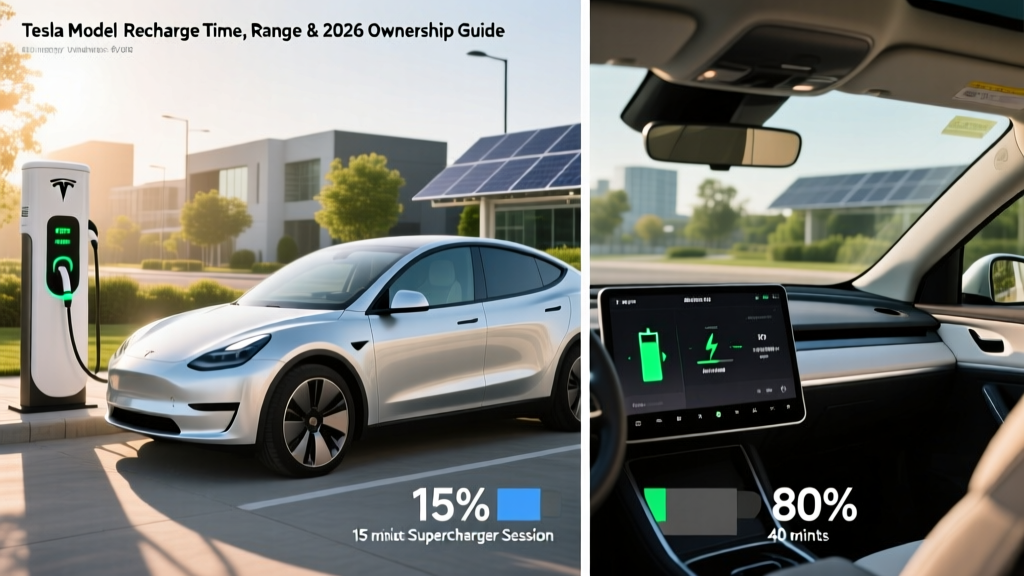
For DC fast charging, the Long Range models peak at 250 kW at V3 Superchargers. However, peak kW is not sustained kW. The charge curve tapers significantly above 50% state of charge. A typical 10-80% session on a V3 Supercharger averages around 100-130 kW sustained, delivering the advertised ~18 minutes for LR models. The LFP Standard Range models, capped at 170 kW peak, take roughly 25 minutes for the same 10-80% window.
At home, Tesla's Wall Connector delivers up to 11.5 kW on a 48-amp circuit (requiring a 60-amp breaker). That adds approximately 44 miles of range per hour of charging — enough to fully replenish any Tesla overnight. Installation costs typically run $500-$2,000 depending on panel proximity and local permit requirements. If your home has a 200-amp electrical panel with spare capacity, expect the lower end; a panel upgrade to 200A can add $1,500-$3,000.
Warranty Coverage: What Tesla Guarantees
Tesla's battery warranty is one of the most important factors in the lifespan conversation. Here's what's covered for 2025/2026 models:
- Model 3 RWD (LFP): 8 years / 100,000 miles, whichever comes first, with 70% minimum capacity retention
- Model 3 Long Range & Performance: 8 years / 120,000 miles, 70% minimum retention
- Model Y (all trims): 8 years / 120,000 miles, 70% minimum retention
- Basic Vehicle Limited Warranty: 4 years / 50,000 miles
- Drive Unit (motor): Same as battery — 8 years / 100k-120k miles depending on trim
The 70% retention threshold matters. If your battery drops below 70% of original capacity within the warranty period, Tesla will replace or refurbish it at no cost. In practice, based on fleet data, very few Teslas hit that threshold within the warranty window. The more common scenario is gradual degradation that levels off — meaning a 10-year-old Tesla with 150,000 miles may still have 80-85% battery health, which is perfectly usable for daily driving.
For buyers concerned about out-of-warranty battery replacement, current costs run $12,000-$16,000 for a Model 3/Y battery pack replacement at a Tesla service center. However, third-party refurbishment options are emerging at $7,000-$10,000, and prices continue to trend downward as battery manufacturing scales.
Pricing, Tax Credits, and Total Cost of Ownership
Tesla's pricing has stabilized after several rounds of cuts in 2023-2024. Here's the current landscape for 2025-2026 models, including federal tax credit eligibility under IRS §30D:
| Model / Trim | Base MSRP | Federal Credit (§30D) | Effective Price |
|---|---|---|---|
| Model 3 RWD | $38,990 | Up to $7,500* | ~$31,490 |
| Model 3 Long Range AWD | $45,740 | Up to $7,500* | ~$38,240 |
| Model 3 Performance | $52,990 | Up to $7,500* | ~$45,490 |
| Model Y RWD | $44,990 | Up to $7,500* | ~$37,490 |
| Model Y Long Range AWD | $48,490 | Up to $7,500* | ~$40,990 |
| Model Y Performance | $52,490 | Up to $7,500* | ~$44,990 |
*Critical eligibility requirements under §30D (verify on IRS.gov before purchasing):
- MSRP cap: Sedans (Model 3) must be under $55,000; SUVs/trucks (Model Y) under $80,000 — all current trims qualify
- Income cap: Modified AGI must not exceed $150,000 (single), $225,000 (head of household), or $300,000 (joint filing)
- Battery sourcing: Critical minerals and battery components must meet phased percentages from US or FTA-partner countries — Tesla's US-built LFP and NMC packs have increasingly met these thresholds, but eligibility can change by model year and production batch
- Point-of-sale transfer: You can transfer the credit to the dealer at purchase, reducing your out-of-pocket cost immediately rather than waiting for tax filing
Always confirm eligibility for your specific vehicle VIN on the IRS clean vehicle portal before finalizing a purchase. Rules have shifted multiple times since 2023, and battery sourcing compliance is model-year-specific.
Who Should Buy a Tesla (and Who Shouldn't)
Best for:
- Daily commuters with home charging access — Teslas excel at stop-and-go efficiency with strong regenerative braking and low per-mile energy costs (~$0.04-$0.06/mi on residential electricity)
- Road trippers who value the Supercharger network — still the most reliable and widespread DC fast-charging network in the US
- Tech-forward buyers who want over-the-air updates, app-based climate preconditioning, and available FSD (Supervised) for highway driving assistance
- Long-term owners planning to keep the car 8+ years — the battery degradation data supports strong longevity
Think twice if:
- You lack home charging access. Public charging costs 2-4x more per mile than home charging, eroding the fuel-cost advantage significantly
- You need a traditional dealership service experience. Tesla's service model is mobile-ranger and service-center based; wait times for body repair can stretch weeks in some markets
- You want the most luxurious interior at this price point. Tesla's minimalist cabin is polarizing — competitors like the Hyundai Ioniq 5 and BMW i4 offer more traditional luxury touches
- You frequently tow. The Model Y can tow up to 3,500 lbs, but towing cuts range by 30-50%. For serious towing, an F-150 Lightning or Rivian R1T is more purpose-built
Pros
- Best-in-class battery degradation data (85% at 150k miles)
- Supercharger network — 6,500+ stations, high uptime
- Industry-leading efficiency (25-28 kWh/100mi)
- Strong OTA update cadence adds features post-purchase
- LFP option for maximum cycle life on Standard Range trims
- Competitive pricing after tax credit (~$31k-$45k effective)
Cons
- Minimalist interior not for everyone; no physical buttons or instrument cluster
- Service center capacity still lags behind sales volume in some regions
- FSD (Supervised) is SAE Level 2 — driver must remain fully engaged at all times
- LFP models suffer greater cold-weather range loss
- Ride quality on Model 3 is firm; road noise noticeable on rough pavement
- Insurance premiums often 15-25% higher than comparable gas sedans
Tesla Driver Assistance: What Autopilot and FSD Actually Do
SAE Automation Level: Level 2
Both Tesla Autopilot and Full Self-Driving (Supervised) are SAE Level 2 driver-assistance systems. They do not make the vehicle self-driving. The driver must keep hands on the wheel (or demonstrate attention via the cabin camera), monitor the road at all times, and be prepared to take over immediately. No Tesla vehicle currently sold is capable of SAE Level 3 or higher autonomous operation on public roads.
Tesla's Autopilot (standard) includes adaptive cruise control and lane-centering on highways. FSD (Supervised), available as a $8,000 add-on or $99/month subscription, adds automated lane changes, navigation-based on/off-ramp handling, traffic light and stop sign recognition, and city-street steering assistance. In practice, FSD performs well on well-marked highways but requires frequent interventions on complex urban streets, construction zones, and adverse weather. Think of it as an advanced cruise control, not a chauffeur.
Cargo, Space, and Practicality
The Model 3 is a compact sedan with 23 cu ft of trunk space (including the rear sub-trunk) plus a small front trunk (frunk). Rear legroom is 35.3 inches — adequate for adults on shorter trips but tight for tall passengers on long rides.
The Model Y is a compact crossover with 30 cu ft behind the second row (76 cu ft with seats folded) and an available third row that's best suited for children. Rear legroom is 41.6 inches, significantly more generous than the Model 3. The Model Y's hatchback design makes loading bulky items far easier than the Model 3's sedan trunk.
Both vehicles include Tesla's 15.4-inch center touchscreen running the latest software, wireless phone charging, HEPA air filtration (Model Y), and a glass roof. Neither offers Apple CarPlay or Android Auto — Tesla's native infotainment handles navigation, media (Spotify, Apple Music, Tidal), and gaming.
Frequently Asked Questions
What is the real-world range of a Tesla Model 3 or Model Y?
The EPA rates the Model 3 Long Range at 341 miles and the Model Y Long Range at 320 miles. In real-world highway driving at 70-75 mph, expect 280-300 miles from the Model 3 LR and 265-285 from the Model Y LR. In freezing weather, subtract another 15-25% depending on chemistry — LFP packs lose more range in the cold than NMC.
How fast does a Tesla charge at home and on the road?
At home on a Level 2 Tesla Wall Connector (11.5 kW / 48A), all current Teslas add about 44 miles of range per hour — a full charge takes 6-8 hours overnight. On DC fast chargers, Long Range models peak at 250 kW and charge 10-80% in roughly 18 minutes at a V3 Supercharger. Standard Range (LFP) models peak at 170 kW, taking about 25 minutes for 10-80%.
How much does a Tesla cost after the federal tax credit?
The Model 3 RWD starts at $38,990 and can drop to ~$31,490 with the full $7,500 federal credit. The Model Y Long Range AWD starts at $48,490 and can reach ~$40,990 after credit. Eligibility depends on your income (under $150k/$300k depending on filing status), the vehicle's battery sourcing compliance, and MSRP caps. Always verify on IRS.gov before purchasing.
Is a Tesla worth buying vs. competitors like the Hyundai Ioniq 5 or Ford Mustang Mach-E?
Tesla's advantages are the Supercharger network, proven battery longevity data, and class-leading efficiency. Competitors like the Ioniq 5 offer faster 800V charging architecture (10-80% in ~18 min at 350 kW chargers), more distinctive interior design, and Apple CarPlay. The Mach-E offers a more traditional crossover feel. If charging infrastructure and long-term battery data are your top priorities, Tesla still leads. If interior quality and design matter more, test-drive the competition.
How long will a Tesla battery last before it needs replacing?
Based on Tesla's fleet data, most Model 3/Y batteries retain ~85% capacity at 150,000 miles. LFP-equipped Standard Range models may retain even more due to superior cycle life. Battery replacement is rarely needed within the first 10-12 years of normal use. When it is needed, current costs run $12,000-$16,000 at a Tesla service center, though third-party options are emerging at lower prices.
Does Tesla's warranty cover battery degradation?
Yes. Tesla guarantees 70% minimum battery capacity retention for 8 years / 100,000 miles (Model 3 RWD) or 8 years / 120,000 miles (all other Model 3/Y trims). If capacity drops below 70% within that window, Tesla will repair or replace the battery at no cost. According to fueleconomy.gov, Tesla's warranty terms are competitive with Hyundai's 10-year/100,000-mile battery warranty and ahead of most European competitors.
Sources: Tesla 2025 Impact Report, fueleconomy.gov (EPA range and efficiency data), IRS.gov (§30D clean vehicle credit rules), Tesla.com official specifications. Pricing and credit eligibility current as of early 2026; verify before purchase.